Gimkit Free: Can You Teach Effectively Without Pro?
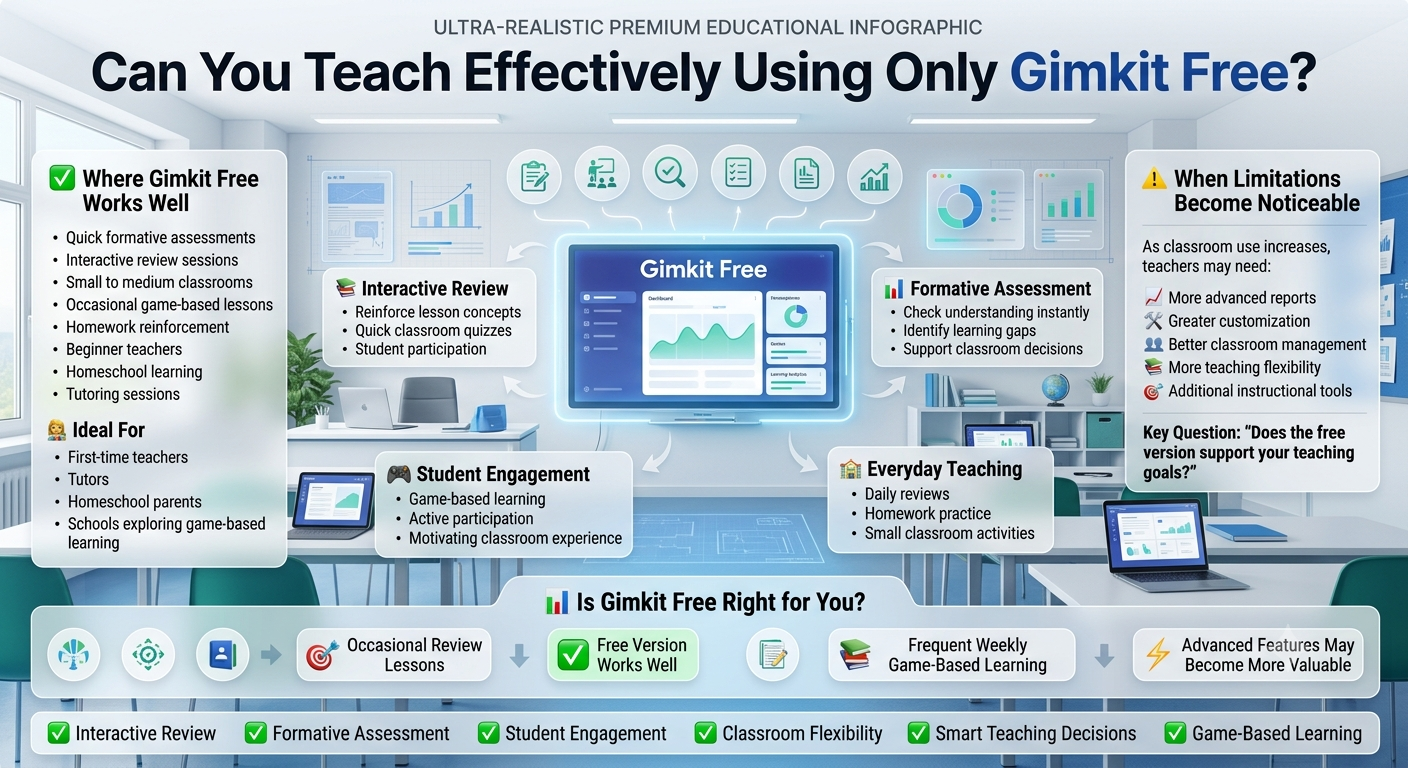
Yes. Gimkit Free, officially called Gimkit Basic, can support meaningful classroom teaching through ordinary Kits, rotating Featured live-game modes, Classes, game reports and simple Practice links. Effective results depend on how those resources are used, not merely on whether the account has a paid subscription.
This updated guide explains the real capabilities and limitations of free Gimkit, practical teaching strategies, formative checks, independent retrieval practice, purposeful classroom feedback and methods for improving instruction without relying on Pro-only Assignments.
Use the interactive Free Teaching Cycle & Learning Evidence Studio to build a focused instructional sequence and record anonymous evidence of student understanding before and after review.
No Pro subscription required for core workflowFeatured live gamesPractice linksTeacher-led feedbackAnonymous learning checks
Free teaching is a learning cycle
Original instructional model, not an official Gimkit interface.
01
Define one measurable objective
Identify what learners should demonstrate.
02
Explain and check prior knowledge
Find initial misunderstanding before practice.
03
Use a free-compatible Gimkit activity
Featured live mode or ordinary Practice link.
04
Discuss errors and supply feedback
Target the concept rather than only the score.
05
Recheck understanding
Observe evidence and choose the next teaching step.
Clear Answer for Educators
Can You Really Teach Effectively with Gimkit Free?
Yes—when used as a purposeful part of teaching. The free Gimkit Basic plan offers enough functionality for many ordinary review lessons, formative checks and repeated practice experiences. It does not need to replace direct instruction, discussion or other assessment methods.
Gimkit's official Pro FAQ identifies the free plan as Gimkit Basic. It confirms that educators can use Featured modes, set up Classes and collect reports without Pro. The Featured mode selection rotates, and paid-only features remain restricted. This is more precise than older descriptions that imply Basic cannot support reporting or classroom management.
The most useful question is not whether free software is inherently effective. Teaching quality depends on the alignment among curriculum objectives, question quality, instruction, feedback, participation and the opportunity to revisit misunderstandings. A free game may provide repeated exposure to content, but it does not independently determine whether students can explain or apply what they have learned.
A purposeful free-only workflow can begin with a short diagnostic check, continue through teacher explanation, incorporate a relevant Featured live mode or a simple Kit Practice link, and conclude with feedback and a comparable recheck. This is a teacher-designed instructional sequence, not an official Gimkit automated teaching plan.
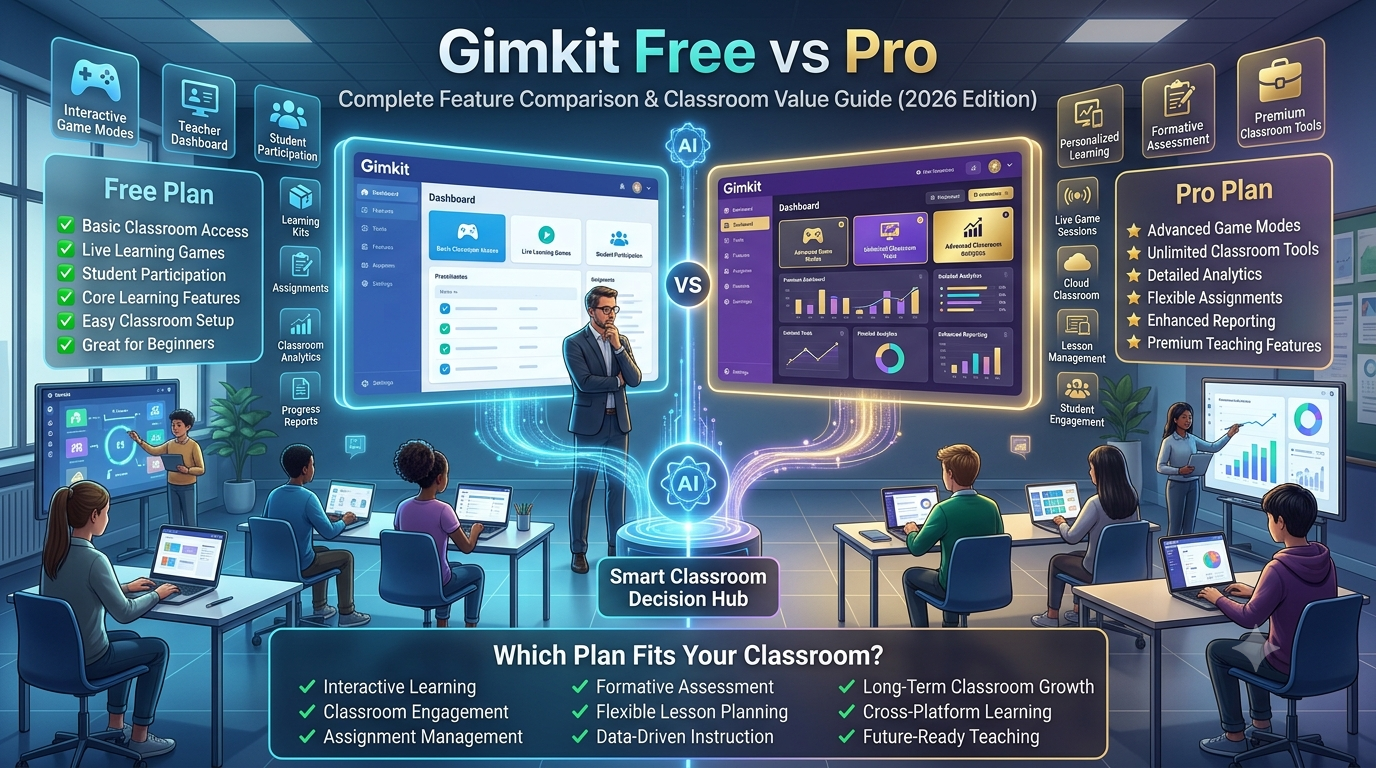
The free plan has genuine boundaries. Gimkit Assignments are documented as Pro-only, and Pro also includes image uploads, audio questions and broader access to exclusive game modes. A teacher should not describe a Practice link as though it carries assignment due dates, completion tracking or the full game mechanics of an Assignment.
The independent application below brings these principles into one focused environment. It lets an educator describe a learning objective, assign a reasonable time budget, document anonymized concept checks and see which concepts merit renewed instruction. The metrics come from numbers entered by the teacher, not from an authenticated Gimkit report.
Official terminology: Gimkit Free is generally called Gimkit Basic in Gimkit's own Help Center. This article uses both phrases to help readers recognise the same free educator offering.
01 / FREE FEATURES
Work with what Basic supports
Use Kits, rotating Featured modes, Classes, reports and Practice links without assuming that every advanced feature is available.
02 / LEARNING QUALITY
Make every review intentional
Connect questions to clear objectives and build feedback into the lesson rather than treating a game score as the only outcome.
03 / EVIDENCE
Measure what students can show
Record anonymous before-and-after concept checks, interpret the limitations and identify specific next teaching actions.
Part One — Gimkit Basic Capabilities
What the free version of Gimkit really includes
1. Gimkit Basic is an ongoing free educator plan
The official Gimkit Pro FAQ describes Basic as a robust free offering rather than a limited account that becomes unusable after a fixed promotional window. An eligible educator can continue to use supported free capabilities for as long as the offering remains available under Gimkit's current terms.
This matters because new educators may first encounter Gimkit through an introductory Pro trial. That experience can expose them to features they will not retain under Basic. The trial and the permanent free offering are therefore different entitlement states, even when they appear within the same educator account.
Effective instruction on Basic begins by understanding the specific free resources. A teacher who prepares ordinary questions, launches currently Featured live modes and uses classroom discussion can build useful review activities without requiring access to every paid feature.
The quality of those activities depends on the instruction surrounding them. A poorly worded question does not become a strong assessment item because it appears inside an entertaining game. Similarly, a carefully designed misconception check may be useful without elaborate premium media.
2. Teachers can create and reuse ordinary Kits
Gimkit's official documentation allows educators to create Kits containing questions for later gameplay and practice. A Kit serves as a reusable content resource. An educator can develop a set for an individual unit, return to it during revision and use it again when that material needs additional retrieval.
Reusability is particularly helpful under a free-only teaching approach because the instructional value of a Kit can increase through thoughtful revision. A teacher may notice that one concept consistently causes confusion and improve the wording of the relevant items before the next class. That change strengthens the material without requiring a new subscription.
Teachers should avoid treating the total number of questions as the main measure of Kit quality. A large set of repetitive or ambiguous items can produce less useful evidence than a smaller, deliberate selection representing the learning objectives. Question clarity, appropriate distractors and coverage of prerequisite knowledge deserve attention.
This page does not reproduce the Kit editor. It focuses on how an already prepared Kit can contribute to effective instruction under Basic. Detailed content creation belongs to the site's separate Gimkit Create and Questions resources.
3. Featured live modes are available without Pro
The official Pro FAQ explains that Basic educators can play Gimkit's Featured game modes. These modes rotate, so an individual mode should not be assumed to remain Featured indefinitely. A practical teacher should check the current Mode Picker before committing to a particular activity.
For a free-only teaching strategy, it is often more useful to define the learning objective before considering the specific game mode. If the goal is accurate recall of important vocabulary, several possible formats may serve that purpose. The lesson should not fail simply because a previously Featured mode has rotated out of free availability.
The teacher can keep the educational content stable while choosing an appropriate currently available format. This preserves the purpose of the review instead of tying it to a particular game's temporary Featured status.
There are also documented participation limits. Gimkit publishes a general hard limit of five hundred live participants and a separate hard limit of sixty for 2D modes. These are technical constraints even when the chosen mode is Featured. The studio flags those limits without guessing current mode availability.
4. Free access to Classes supports organisation
Gimkit identifies Classes and rostering as part of Basic's available educator functionality. Classes can provide a way to group learners and connect supported classroom experiences to the relevant teaching context.
The existence of free Class functionality is important because older third-party comparison articles sometimes describe almost every classroom-management function as paid. That is not consistent with Gimkit's current Pro FAQ. The relevant paid distinction concerns particular features, such as Assignments, not the mere ability to organise Classes.
Class organisation can assist with regular teaching, but membership alone does not guarantee that students understand the instructional content. A clean roster or consistent name format is operationally useful rather than direct evidence of learning.
This article deliberately leaves the detailed Class setup, member permissions and year-long roster architecture to the dedicated Classroom page. The current topic is what effective instruction can accomplish with the free capabilities that exist.
5. Game reports remain available on Basic
Gimkit's official Pro FAQ explicitly includes collecting game reports among Basic capabilities. This corrects a common misconception that all meaningful reporting requires Pro. A teacher using supported live gameplay can still have a basis for reviewing performance information after an activity.
A report is useful when the educator knows what question the evidence should answer. If the objective was identifying fractions equivalent to one-half, the teacher needs information related to that understanding, not merely which participant finished first.
Reports can help identify questions that caused difficulty, but interpreting them requires caution. Repeated responses to one item are not necessarily equivalent to independent demonstrations of mastery by every learner. The teacher should distinguish question-level patterns from assumptions about individual understanding.
Our local studio does not recreate Gimkit Reports. It accepts anonymous teacher-entered counts from separate concept checks and calculates simple response proportions. This supports planning without implying direct integration into the official report system.
6. Practice links offer a free-compatible independent route
Gimkit's official Practice Mode documentation describes a simple form of Kit practice that can be accessed through a shareable Practice link. Students can work through questions and answers without the full game mechanics of a live session.
This is particularly relevant for teachers who do not have Pro Assignments. A Practice link can provide an opportunity to revisit content independently, but the teacher should not represent it as a full Assignment with due dates, mode-specific goals and automatic assignment reporting.
The distinction changes how learning evidence is collected. If the teacher wants to know whether students completed independent Practice, a shared link alone does not provide the full completion-management framework of the paid Assignment feature. An optional follow-up question, classroom explanation or separate short check may be needed.
The studio supports Practice Link as one of its free-compatible delivery routes. It explains the limitations and includes teacher-led rechecking rather than pretending it can generate an official Assignment.
7. Free participation does not remove the need for preparation
A live Gimkit activity still benefits from thoughtful preparation. Students need access to a suitable device or browser, the educator needs a relevant Kit, and the selected mode should be appropriate for the objective and group. Technical access and instructional quality are related but distinct concerns.
A teacher should ensure that students understand how they will participate and what they should learn from the activity. Without that framing, the game may be experienced primarily as entertainment or competition. Competition can be engaging, but it is not a substitute for clarity about the subject material.
A useful preparation habit is to identify the most important concepts before opening the lobby. The teacher can then direct attention toward questions connected to those concepts during the debrief, even if the game itself contains additional items.
The independent studio begins with one learning objective and several concept checks for this reason. It does not ask the teacher to select an elaborate dashboard configuration, and it does not launch real games.
8. Basic does not mean every game mode is freely unrestricted
Featured access should not be confused with unrestricted Pro-exclusive access. Gimkit's Player Maximums article explains that Pro-exclusive modes are limited to five players for Basic members. The Featured and Pro-exclusive designation can rotate over time.
That restriction matters when teachers remember a mode from a previous term. A game may have been Featured earlier but may not be in the same access category when the new lesson occurs. A lesson relying on a specific historical mode therefore carries unnecessary access uncertainty.
A free-only strategy should remain flexible about the presentation method while maintaining a stable instructional objective. When the teacher needs a mode-dependent interaction, the current official Mode Picker remains the appropriate place to check access and availability.
The studio does not select named modes or compare their tags. It asks only whether the educator intends to use a confirmed currently Featured non-2D mode, a confirmed Featured 2D mode or the documented Practice route. Detailed mode eligibility belongs to the site's separate Game Modes article.
Part Two — Accurate Free Plan Boundaries
What Gimkit Free does not provide
9. Independent Gimkit Assignments require Pro
Gimkit's official Assignments Explained article identifies Assignments as a paid Pro feature. This should be stated directly rather than softened into an uncertain possibility. A teacher using Basic cannot assume that the full Assignment workflow is included simply because ordinary live games and Practice links are available.
An Assignment includes product-managed conditions and reporting that are different from a basic independent Practice link. The presence of a link to questions does not establish that the student is working through an official assignment with tracked completion.
Teachers working without Pro can still provide independent learning opportunities, but they should describe those opportunities accurately. A learner might receive a Kit Practice link and later complete a separate class discussion or concept check. That is a teacher-designed independent practice workflow, not an official Gimkit Assignment.
The studio offers this alternative in its free delivery options while keeping assignment-specific functionality outside its scope. This avoids turning a free instructional planning tool into a misleading simulated homework manager.
10. Audio-question authoring is a paid capability
Gimkit's Account FAQ identifies audio questions as a Pro feature. This matters for educators who depend on audio-based prompts, such as spoken-language practice or listening comprehension.
An educator can still teach those subjects without using a paid audio feature inside Gimkit. For example, the teacher may play approved audio through an existing instructional resource and then use ordinary text-based questions to check understanding. Such an arrangement is an independent teaching strategy rather than an equivalent built-in Gimkit audio-question tool.
The correct comparison is between the learning objective and the available delivery methods. If the objective specifically requires embedded audio in the Gimkit question, the official paid feature matters. If the objective can be supported by separate explanation and text-based retrieval, the free workflow may still be practical.
This article does not create audio uploads or claim that external audio is automatically attached to a Kit. It explains how teaching can remain purposeful without inventing functionality that Basic does not provide.
11. Image uploads into questions are Pro-dependent
Gimkit's official guidance states that image uploads into questions are available to paying subscribers. The distinction concerns a particular media-upload capability rather than the universal ability to write a question.
Visual subjects create genuine instructional challenges under this restriction. A biology teacher may need diagrams; a geography teacher may use maps; a mathematics lesson may depend on interpreting graphs. The appropriate teaching response should preserve the objective rather than automatically remove every visual component.
An educator can use an existing authorised visual reference during instruction and then check understanding with ordinary questions where suitable. However, this should not be described as uploading an image into Gimkit Basic. That would misrepresent the technical capability.
The decision depends on whether a visual must be embedded within the question itself. If embedded media is central to the activity, the paid feature distinction becomes significant. If the visual can be shown separately without changing what is being assessed, a free-supported teaching arrangement may remain viable.
12. Basic access has a rotating mode selection
The official Pro FAQ explains that Gimkit rotates its Featured modes. This means a free educator should avoid treating any fixed list of named modes as permanently available without a current Mode Picker check.
One practical consequence is that a teacher should design a learning objective that is portable across suitable presentation formats. A vocabulary review, for example, can remain useful even if the preferred Featured game changes.
This does not mean all game modes are educationally identical. Their actual mechanics can change how learners interact with the material, and some may be more suitable for a given context than others. A flexible free plan preserves the learning goal while adapting the delivery.
The studio asks the teacher to confirm that a live format is currently Featured before treating it as a free-compatible route. It does not promise that a mode observed today will remain available months later.
13. Basic reporting should not be called nonexistent
The older version of this article broadly suggested that advanced reporting limitations make Gimkit Free unsuitable for more demanding teaching. That wording risks implying that meaningful reports are unavailable on Basic. Gimkit's own Pro FAQ states that Basic educators can collect reports.
The accurate distinction is between having access to reports and knowing how to use them. A report can show activity information, but the teacher must connect it to objectives and decide what the responses imply about learning.
Not every teaching question can be answered by a game report alone. A student may have answered a familiar question repeatedly without being able to explain the concept in a new context. A short transfer question or discussion can provide additional evidence.
The studio's anonymous concept-check fields are designed to complement this instructional reasoning. They are not an official report and should not be treated as an automatic measure of mastery.
14. A free plan can support instruction without replacing instruction
One of the most important limitations is educational rather than commercial. A game can facilitate practice and feedback, but it does not automatically provide full explanations of complex material. Teachers still need to introduce concepts, support reasoning and respond to difficulties.
This is especially relevant when questions are simple recognition tasks but the curriculum expects deeper application. Correctly identifying a term may be useful evidence of recall while providing little information about the ability to apply that term in a novel situation.
A stronger lesson can pair gameplay with explicit explanation, a different example, student discussion and a short recheck. These teaching methods do not require Gimkit Pro, although they do require planning and teacher judgment.
The studio deliberately includes explanation and feedback stages rather than allocating the entire available time to gameplay. The goal is to make free Gimkit a productive part of the lesson instead of the only component.
15. Free access is not the same as unrestricted participation
The official Player Maximums article identifies technical participation limits. General live games have a documented hard limit of five hundred students, while 2D modes have a separate sixty-student hard limit.
These limits remain relevant to a free educator who uses currently Featured modes. The phrase unlimited access in an account-feature comparison should not be interpreted as the ability to exceed technical caps.
Device and network conditions also affect practical participation. A mode may be technically available while a classroom's browser environment causes problems. The educator should consider the real devices and current network rather than assuming that a compliant participant count guarantees a perfect session.
The studio checks the user-declared group size against the relevant published hard cap for live delivery. It does not test network reliability, identify specific named modes or contact Gimkit to confirm availability.
Part Three — Effective Free-Only Teaching
How to make Gimkit Basic educationally effective
16. Begin with one observable learning objective
A useful objective describes what learners should be able to demonstrate after instruction. “Understand fractions” is broad; “identify three equivalent fractions and explain why they represent the same quantity” gives the teacher a clearer basis for choosing examples and checking responses.
Gimkit works with question-based activities, so the objective should connect to evidence a question can reveal. If the objective is too complex for a multiple-choice item to assess fairly, the teacher may need additional demonstration, explanation or a written task outside the game.
Before choosing a Featured mode, identify the concept, the initial misconception to investigate and what a successful response would look like. This makes it easier to use gameplay as a means of practice rather than as the purpose of the lesson.
The studio includes a specific objective field and up to six learning-concept records. It does not generate the questions automatically. The teacher remains responsible for creating valid, relevant assessment prompts in the official Kit editor or another legitimate instructional format.
17. Use a short initial check to expose prior understanding
Students arrive with different prior knowledge. Some may remember a prerequisite concept, while others have an incomplete explanation or a common misconception. A short initial check can help the teacher decide which ideas need attention before the main review activity.
For meaningful comparison, the initial check should represent the same objective as the later recheck. A question about naming a scientific process should not be compared directly with a much more demanding question about designing an experiment unless the teacher is deliberately examining different skills.
The check can be conducted through a quick classroom question, a brief written response or another suitable low-stakes method. The teacher can record how many learners answered correctly without collecting names in this application.
The studio calculates the proportion of correct responses from that teacher-entered count and the declared group size. This provides a simple baseline observation, not a comprehensive diagnosis of each learner's understanding.
18. Teach or clarify before expecting meaningful retrieval
Repeated recall can be valuable, but students need access to accurate explanations and opportunities to correct misunderstandings. If learners repeatedly answer a confusing question without understanding the concept, additional repetitions alone may not resolve the underlying problem.
High-quality instruction can include worked examples, comparison of similar concepts, explanations of common errors and opportunities for students to explain their own reasoning. These methods can be used with or without Gimkit.
The Education Endowment Foundation's feedback guidance emphasises the relationship between initial instruction, formative assessment and feedback. This supports a teaching model in which observations lead to useful instructional action rather than only a record of right and wrong answers.
The free teaching cycle therefore begins with explanation and allows a separate feedback period after gameplay. The time allocation is adjustable. A class encountering unfamiliar material may need more explanation; a revision class may devote more time to retrieval.
19. Match the live game to the learning task
A Featured mode may motivate participation, but the teacher should still evaluate whether its interaction fits the lesson. Some activities involve faster decision-making, while others may include spatial navigation or extended gameplay mechanics.
A short vocabulary check may work well with a simple accessible live format. A lesson requiring careful interpretation of complex diagrams may need more explanation outside the game. The objective should guide the teaching arrangement rather than assume that any available mode is equally appropriate.
Because Featured mode availability rotates, the teacher should inspect the official Mode Picker on the intended teaching day. The studio does not recommend named modes or invent which one is currently free.
The tool asks the educator to declare whether the proposed format is currently Featured and whether it is 2D. That declaration determines the relevant capacity advisory. Choosing the actual mode and adjusting its settings remain official Gimkit actions.
20. Preserve enough time for discussion after gameplay
A lesson can become less informative when the activity ends at the final game screen. Students may leave with a score but no explanation of the concepts they found difficult. The teacher may also lose the opportunity to correct misconceptions before they become reinforced.
A short debrief can address two or three important errors, invite students to explain why an answer was incorrect and revisit an example in a different form. The conversation need not be long to be useful, but it should be planned.
The free teaching studio has a dedicated feedback phase separate from the live or Practice activity. If the teacher allocates all available minutes to gameplay, the tool flags that no time remains for the other intended activities.
This is a planning safeguard, not a platform limit. The suggested stages represent an independent instructional approach and can be adjusted according to the teacher's subject, learners and lesson circumstances.
21. Recheck learning after clarification
A recheck asks learners to demonstrate the targeted concept again after explanation and practice. Its value lies in providing evidence about what students can currently show, not in assigning a more impressive number to the same earlier game score.
A useful recheck may ask for an explanation, a parallel question with different surface details or a short application task. The response should represent the same learning goal as the initial check so the teacher can make a cautious comparison.
The studio accepts the number of correct responses to the recheck and compares it with the earlier count. When both checks involve the same declared group size, it displays the change in percentage points and the current proportion meeting the criterion.
A positive difference is evidence of a higher correct-response proportion, not proof that Gimkit caused the improvement. Explanation, discussion, familiarity, question difficulty and many other factors could have influenced the observed result.
22. Use a different question when checking transfer
A learner may remember the answer to one frequently repeated item without fully understanding the concept. A changed question can reveal whether the knowledge transfers beyond the original wording.
For example, an initial fractions question might ask which picture represents one-half. A later recheck could ask the student to select an equivalent symbolic fraction or explain why two shapes represent the same proportion. The teacher must decide whether those tasks fairly represent the intended objective.
Transfer questions should not be arbitrarily more difficult if the aim is to compare response proportions directly. When the demands differ substantially, the results should be interpreted as different forms of evidence rather than identical measurements.
The studio includes space for a likely misconception and a planned next teaching action. It does not generate question equivalence or certify assessment validity automatically.
23. Discuss why wrong answers are attractive
A useful multiple-choice distractor can reveal a misconception when students select it for a meaningful reason. A random incorrect option may be much less informative. Teachers should consider what misunderstanding each distractor is designed to expose.
For instance, a mathematics question may include an answer representing a common procedural error. A science question may include a term students routinely confuse with the correct process. When a repeated error appears, a clear explanation can address the underlying thinking.
The educational value comes from the relationship between the observed answer and the response that follows. Merely knowing the overall proportion correct may not reveal the misconception. A teacher may need to ask students how they reached their answers.
The studio lets educators record a concise anonymous misconception note for each concept. That note informs a suggested next-step explanation. It should not include student names or confidential classroom details.
24. Make progress visible without turning scores into labels
Students benefit from constructive information about their work, but the teacher should avoid treating a single game score as a permanent statement about ability. An incorrect response may reflect a knowledge gap, misunderstanding of language, inattention or the way the question was asked.
The purpose of formative evidence is to support the next instructional decision. If a concept remains difficult for many learners, the teacher may revisit it with another explanation. If most can demonstrate understanding, the lesson may progress while a small number receive additional support.
The studio applies a teacher-selected recheck criterion to each concept and reports whether the recorded proportion meets it. That is a local instructional threshold, not a clinical diagnosis, official grading standard or validated mastery classification.
The calculation can inform discussion, but it should be interpreted alongside actual student explanations and other forms of evidence.
25. Use free Practice links for additional retrieval
Practice Mode provides a simple way to revisit Kit questions through a shareable link. Gimkit's official documentation distinguishes this from a complete game or Assignment: Practice does not include the full game mechanics, due dates or assignment reporting.
That limitation does not eliminate its instructional value. A learner may benefit from encountering the material again after receiving feedback, particularly when the teacher identifies a small group of important concepts to revisit.
The teacher should explain what students are expected to do with Practice and how the learning will be checked. A follow-up discussion, independently written explanation or later classroom question can provide evidence that simple access to a link cannot.
The studio presents Practice as a free-compatible delivery option and provides a recheck stage. It deliberately does not offer a simulated assignment-completion dashboard or claim to track who used the actual Practice link.
26. Keep instruction balanced when using competition
Competition can increase interest and energy, but a leaderboard does not measure every aspect of understanding. Students can differ in speed, familiarity with the mode and confidence even when they possess similar academic knowledge.
A free Gimkit session should therefore provide opportunities to explain, think and correct errors rather than celebrating only the highest visible score. The educator can direct attention to questions, examples and improvements observed during the lesson.
In some classes a shorter review period may maintain focus better than a long continuous session. In other classes additional practice may be helpful. These are instructional choices rather than universal Gimkit timing rules.
The studio lets the teacher determine the minutes assigned to each phase and warns when the total exceeds the declared lesson duration. It does not dictate one fixed ideal length for every age, subject or game mode.
27. Address accessibility through more than one response format
Different learners may need varying amounts of time, alternative explanations or opportunities to demonstrate understanding without rapid interaction. Using only one fast-paced game outcome can miss some of that variation.
Where appropriate, teachers can supplement Gimkit with verbal explanation, written response, supported examples or a short independent recheck. The chosen method should align with school accessibility requirements and the particular objective being assessed.
A free activity can still be inclusive when the educator pays attention to the instructions, question clarity and follow-up methods. Paid features are not a substitute for deliberate accessible teaching design.
The studio treats recorded class proportions as one form of evidence, not as a complete representation of every student's needs. It does not collect disability information, identify individual students or prescribe interventions based on protected personal characteristics.
28. Plan an alternative when the live activity is interrupted
A classroom may experience a connectivity problem, an unavailable device or a mismatch between expected and actual Featured modes. An effective lesson should not lose its educational purpose merely because the planned game cannot proceed.
The simplest contingency is often to retain the original questions and use another permissible way for students to respond: small-group explanation, a brief written check or direct questioning. This preserves the learning objective even when the game presentation changes.
The contingency should not be misrepresented as a Gimkit feature. A teacher-led offline review is a separate instructional activity built around the same concept. It may provide useful evidence but not automatic Gimkit reporting.
The studio's generated teaching brief includes a free-compatible fallback appropriate to the selected route. This adds practical value without imitating a mode-selection engine or an automated backup hosting service.
29. Avoid turning every lesson into a game
Gimkit can support retrieval practice and review, but some objectives need direct explanation, extended reading, written reasoning, laboratory work or discussion that cannot be fully represented by short interactive questions.
A teacher should decide which part of the objective benefits from a game and which part needs another instructional method. Students may recall definitions through rapid questions while still requiring more time to apply those definitions in a meaningful problem.
A free-only teaching strategy can be effective without requiring Gimkit to occupy the majority of every lesson. It may be a short formative component within a broader instructional sequence.
The studio presents explanation, retrieval, feedback and rechecking as separate allocations. It does not automatically reward the user for increasing game time. The intended learning process matters more than the amount of software usage.
30. Interpret a change in correct responses carefully
If more learners answer a recheck correctly than answered the initial question, the teacher has observed a higher correct-response proportion. That is useful information, but it does not establish why the change occurred.
Differences in question difficulty, familiarity, missing participants, guessing and other instruction all affect interpretation. A fair before-and-after comparison requires sufficiently similar checks and a consistent respondent group.
The studio assumes the same declared group size for each concept check. If fewer students responded, the teacher should adjust the input group size for the comparison or refrain from interpreting the change as a like-for-like measure. No student identities are stored.
The report explicitly says the calculated difference is descriptive, not causal. An educator should use it to decide whether further explanation or assessment is warranted rather than treating it as proof of a platform's effectiveness.
Exclusive Gimkit Free Teaching Application
Free Teaching Cycle & Learning Evidence Studio
Build an instructional sequence that works with Gimkit Basic. Record anonymous concept-check responses before and after practice, inspect misconceptions, and produce a feedback and recheck brief without using paid Gimkit Assignments.
FREE-ONLY INSTRUCTIONAL EVIDENCE WORKSPACE
From a free game to an informed teaching decision.
The studio designs a local lesson cycle and analyses manually entered evidence. It cannot import student responses, read Gimkit reports or operate a real live session.
1. Set the learning context
Describe what students should demonstrate, not simply the topic name.
Use one consistent anonymous group for each comparison.
Live Featured status must be checked in the official Mode Picker.
Your own instructional decision threshold, not an official Gimkit mastery standard.
Only use a live route if that mode is currently Featured. This studio does not verify mode availability.
2. Allocate time to the free teaching cycle
Adjust the five phases. The total is calculated from your inputs, and the application warns when the activities exceed the lesson duration.
Explain8m
Initial instruction
Initial Check5m
Baseline responses
Practice14m
Free-compatible activity
Feedback8m
Explain errors
Recheck5m
Fresh evidence
40Allocated minutes
0Unallocated minutes
0Concept checks
0Needs further teaching
The selected phases fit the declared lesson duration.
3. Record anonymous concept-level checks
For each concept, enter the number of learners who answered a comparable initial check and recheck correctly. Leave an unanswered check blank. Do not enter student names.
Maximum six concept checks. All values are anonymous manual observations, not official Gimkit analytics.
4. Learning evidence and next-step suggestions
Interpretation rule: A percentage-point difference describes a change in the entered correct-response proportions. It does not prove that Gimkit caused the change or establish permanent mastery.
5. Export the free teaching brief
This tool attempts local browser autosave. Exports contain only the lesson plan and anonymous manually entered data. No account connection, actual Gimkit score import or paid Assignment is created.
How to interpret the studio correctly
The studio uses the declared group size as the denominator for each concept. If twenty of twenty-five learners answer an initial check correctly, it records eighty percent. If twenty-two of the same twenty-five learners answer a comparable recheck correctly, the recorded proportion rises to eighty-eight percent, a difference of eight percentage points.
Those calculations are straightforward and useful for descriptive classroom reflection, but they cannot establish individual learning gains when identities are not linked. They also cannot tell whether the recheck was easier, whether a different set of learners participated or whether the higher result would persist over time.
The tool's instructional decision threshold is supplied by the teacher. Reaching eighty percent can be treated as a local signal that the group is ready for a new challenge or additional evidence. It is not an official Gimkit performance grade or a research-validated mastery threshold.
For concepts below that threshold, the studio recommends discussing the recorded misconception and offering an additional example or targeted check. These suggestions are deliberately conservative. They do not diagnose individual students or claim that one intervention is guaranteed to work.
The selected delivery route determines the free-compatible activity note in the brief. A Featured live route requires confirmation in the current Mode Picker. A Practice route is independent question review without official Assignment due dates or tracking. The offline route is a teacher-led contingency, not a Gimkit gameplay mode.
Part Four — Reading Free Teaching Evidence
What the results can and cannot tell a teacher
31. Percentage correct is a descriptive observation
The proportion of correct responses describes how often the selected response was observed in a defined set of checks. It is useful because it provides a transparent comparison that can be reproduced from the entered counts.
However, correct-response percentages are not a complete description of learning. They do not automatically reveal the reasoning used to produce an answer, the difficulty of the question or the circumstances under which students responded.
The studio therefore displays the raw count alongside the percentage. An educator can see the numerical basis rather than only an impressive-looking summary. This avoids hiding small samples or incomplete evidence behind an abstract score.
When the group size or response conditions differ, a like-for-like interpretation should not be assumed. The teacher needs to verify comparability before drawing conclusions from the resulting difference.
32. Percentage points differ from percent improvement
Suppose an initial check shows sixty percent correct and a recheck shows eighty percent correct. The difference is twenty percentage points. Describing that as a twenty percent relative increase would be mathematically different.
The studio reports percentage-point change to keep the calculation clear. It subtracts the initial correct-response proportion from the recheck proportion and preserves the sign.
An increase from sixty to eighty percent may support the conclusion that the later check had a higher proportion of correct responses. It does not, by itself, establish a causal relationship with a particular activity.
The distinction is particularly important when educators communicate results to colleagues. Clear numerical terminology makes the record easier to interpret and reduces the risk of exaggerating the measured change.
33. A missing recheck is not a zero score
A teacher may have completed an initial check but not yet collected comparable follow-up responses. In that case, there is no observed later proportion to calculate. Entering zero would imply that the entire group answered incorrectly, which is a materially different statement.
The studio accepts blank inputs for either check and reports the evidence as incomplete. It does not automatically interpret a missing value as failure.
This matters when a lesson is still in progress. A teacher can prepare the plan, record initial observations and return later to add the recheck.
The application preserves that state locally where the browser allows storage, making incomplete evidence visible rather than silently converting it into an artificial result.
34. Meeting a threshold is not proof of durable understanding
An educator may define eighty percent correct as a practical point for deciding whether to progress. This can help create a consistent classroom routine, but it should not be confused with a universal standard of mastery.
A single successful recheck may reflect short-term recall after recent explanation. Durable understanding may require another check after a delay or application of the concept in a different context.
The studio marks a concept as meeting the teacher's criterion when the entered response proportion reaches the chosen threshold. The wording is deliberately local and descriptive.
Teachers can use that information to select a next step while recognising that more evidence may be necessary before concluding that the learning is secure.
35. Low response accuracy can have several explanations
A difficult question may reveal a misconception, but it may also have confusing wording, unfamiliar vocabulary or a mismatch between what was taught and what was asked. A low correct-response proportion should therefore trigger investigation rather than immediate attribution to a student's ability.
A useful response might include reading the question aloud, asking students to explain their interpretation or checking whether the distractors reflect common errors.
If the assessment item was poorly constructed, rewriting it may be more appropriate than repeating the same explanation. If the item is sound and learners demonstrate a consistent conceptual gap, further instruction may be justified.
The studio's misconception note gives the educator a place to document this professional judgment without claiming that the tool automatically knows why students responded incorrectly.
36. Evidence becomes useful when it changes the next action
The central purpose of formative assessment is not simply to produce a record. It is to make a better instructional decision while learning can still be influenced.
The Education Endowment Foundation's guidance on feedback emphasises high-quality instruction, clear learning intentions and formative assessment that identifies gaps. These principles support a cycle in which evidence leads to explanation, further practice or extension.
A teacher may discover that most students understand one concept but struggle with another. Repeating the entire lesson may be inefficient. A short focused explanation of the difficult idea could make better use of limited time.
The studio sorts no students into fixed ability groups and makes no clinical or personal diagnoses. It produces concept-level suggestions intended to help the educator choose the next instructional action.
37. Anonymous counts protect against unnecessary data collection
A free instructional reflection tool does not need the names or identities of individual learners to calculate a class-level response proportion. The studio therefore uses anonymous correct-response counts and teacher-written concept descriptions.
This design reduces the risk of collecting private student information through an unrelated website. Teachers should not enter names, identification numbers, medical information or confidential observations into the concept notes.
The tool also avoids a fake login or Gimkit account-connection interface. Its JavaScript operates locally and attempts to save the plan within the current browser. No authenticated report is requested.
When exporting the data, educators should still exercise ordinary care with instructional records. Even anonymous classroom context may deserve appropriate handling under local school policies.
38. Results from a game and results from a separate recheck differ
A live-game report may contain responses collected under a particular set of gameplay rules. A separate teacher-led recheck may use different questions, timing or response conditions. These are not automatically interchangeable data sources.
The studio's before-and-after calculations are intended for teacher-entered concept checks that are sufficiently comparable. It does not extract game scores, convert virtual cash into academic accuracy or assume every repeated in-game response represents a distinct learner.
This is important because some Gimkit modes use gameplay resources that do not directly describe academic understanding. A player's game outcome can depend on mechanics beyond the accuracy of a specific concept check.
The teacher should keep the instructional evidence appropriately separate from the game experience, using the latter as one opportunity for practice rather than a universal measure of achievement.
Part Five — Free-Only Classroom Scenarios
Practical examples of teaching with Gimkit Basic
39. Science: diagnosing a photosynthesis misconception
A science teacher is preparing a lesson about photosynthesis. The initial check asks students to identify the role of light and the raw materials required by plants. Several learners confuse sunlight with a material consumed in the reaction.
The teacher explains the distinction, uses a suitable current Featured review mode and then asks a parallel question in a different context. The recheck shows a higher proportion of correct responses, but the teacher also asks students to explain their reasoning.
In the studio, the educator can record a separate concept for light, carbon dioxide and plant energy. The misconception note identifies the specific confusion, while the recheck count provides a numerical observation for each concept.
This gives the teacher a more actionable result than simply concluding that the class enjoyed the game. It also avoids relying on paid assignments or media uploads.
40. Mathematics: distinguishing recall from application
A mathematics educator uses Basic to review fractions. Some students can identify equivalent fractions from familiar examples but struggle when the same idea appears in a word problem.
The teacher may use a short Featured live review to reinforce the foundational relationship, then conduct a separate application check. The results should not be collapsed into one undifferentiated success rate if the questions represent different demands.
The studio can record equivalent-fraction recognition and application as separate concepts. Each receives its own initial and recheck counts, misconception note and next-step suggestion.
The teacher may discover that the recognition criterion has been met while application still needs explanation. That pattern can guide the next lesson more effectively than repeating the entire Kit without examining which skill remains difficult.
41. English: vocabulary retrieval followed by sentence use
An English teacher wants students to recall the meaning of unfamiliar vocabulary and use each word accurately in a sentence. A Gimkit Basic review can support the first part through repeated recognition and recall questions.
However, selecting the correct definition does not prove that students can use the word naturally. The teacher can follow the game with a short sentence-writing task or a spoken explanation.
The studio may record vocabulary recognition and contextual usage as separate learning checks. This avoids describing one successful game score as proof of complete vocabulary mastery.
A teacher who notices weak contextual usage can provide additional examples and another short task without requiring a paid Gimkit feature. The value comes from connecting the game activity to the actual language objective.
42. History: from factual recall to causal explanation
A history teacher uses a Kit to review names, events and chronology. A Featured live mode may offer useful retrieval practice for those facts. The broader objective, however, may involve explaining why an event occurred.
An effective free-only lesson can separate those requirements. The initial question checks a prerequisite fact; the teacher then introduces the causal relationship, uses the game for retrieval and asks students to explain that relationship through a short response.
The studio can maintain different concept records for chronology and causal reasoning. This makes it easier to identify whether students know the sequence but struggle to explain its significance.
The approach avoids treating every correct factual answer as equivalent to historical interpretation while still making constructive use of the free Gimkit experience.
43. Foreign languages: practice without embedded audio
A language teacher working on Basic does not have the same paid audio-question authoring capability as a Pro educator. That restriction matters if the activity requires audio embedded inside the questions.
For another lesson objective, the teacher may provide pronunciation or listening input through an approved separate resource and then use ordinary questions to review vocabulary or grammar. The teaching arrangement should clearly distinguish the external audio from what Gimkit itself supplies.
The studio can record correct responses to vocabulary or grammatical concept checks before and after practice. It does not pretend to upload recordings, transcribe speech or verify pronunciation automatically.
The example demonstrates that a paid-feature restriction can change the delivery method without necessarily removing every possible free-supported learning opportunity.
44. Homework alternative: share a Practice link accurately
An educator without Pro wants learners to revisit a Kit outside a live class. Gimkit's official Practice Mode documentation describes a shareable Practice link that allows simple question practice.
The teacher can share that link with appropriate instructions, such as reviewing important questions before the next session. The teacher should also identify how understanding will be checked later, because the Practice link is not the paid Assignment system.
The studio's Practice delivery route produces a brief reflecting that distinction. It explicitly avoids promises of due-date enforcement, automatic completion tracking or assignment reporting.
A later classroom concept check can provide additional evidence of what learners retained. The teacher can record that evidence anonymously in the studio if the same defined respondent group and comparable questions are used.
45. Large-group live review: respect format limits
A teacher plans a free live review for seventy learners. A currently Featured non-2D mode may be considered under the general live-game limit, subject to real network and platform conditions.
A confirmed Featured 2D mode is different because Gimkit publishes a sixty-player hard limit for 2D sessions. It would be inaccurate to ignore that restriction simply because the educator uses Basic.
The studio warns when a declared 2D live group exceeds sixty. It does not invent a method for bypassing the limit or promise that every non-2D session will work perfectly.
If the selected activity is unsuitable, the educator should reconsider the practical delivery method while preserving the learning objective. The mode-selection decision remains with the official Mode Picker and related documentation.
46. A short revision session with limited lesson time
A teacher has twenty-five minutes for review before the next topic. Allocating twenty minutes to gameplay would leave little room for diagnosing prior understanding, discussing mistakes or checking what changed.
The free teaching cycle can help make the time allocation visible. The teacher might assign a few minutes for objective clarification, a short initial check, focused review, brief explanation and a final recheck.
There is no official Gimkit rule requiring those exact minute values. The allocation is an instructional planning choice. Different subjects and age groups may need different proportions.
The studio calculates the total and flags an overrun. It also warns when critical feedback or recheck phases have been assigned no time. The goal is to prevent the interactive part from consuming the entire opportunity to learn.
47. A class that shows no improvement on the recheck
A teacher records fifteen correct initial responses and fifteen correct recheck responses from the same group of twenty-five learners. The entered correct-response proportion has not changed.
That observation does not establish that the game was useless. It may reflect ceiling effects, question difficulty, misconceptions not adequately addressed or an insufficiently sensitive check. The teacher needs more information about the response patterns.
The studio reports a zero percentage-point difference and examines whether the recheck proportion meets the selected criterion. If it remains below the threshold, the suggested next step involves reviewing the stated misconception and using another explanation or check.
The teacher should interpret this cautiously. A descriptive result can guide investigation but cannot identify a single causal explanation automatically.
48. An objective is met but further evidence is still useful
A class begins with a relatively high correct-response proportion and finishes above the teacher's selected criterion. The studio reports the recheck as meeting the local target.
The teacher might choose an extension question or a delayed retrieval check rather than repeating the same simple items indefinitely. A higher-level application task may reveal whether students can transfer the understanding beyond familiar examples.
Meeting the threshold should not turn the result into a permanent label attached to the learners. The observation describes one defined check at one point in the learning process.
The studio recommends additional evidence or extension where appropriate, keeping the decision aligned with the teacher's actual objective rather than only the numerical percentage.
49. A technology interruption during the lesson
The educator begins a Featured live review but the internet connection becomes unreliable. Restarting the same session repeatedly may use time without improving the intended learning experience.
A contingency can preserve the questions and objective through teacher-led discussion or written retrieval. The educator can still check understanding, although the alternative activity will not generate the same official game report.
The studio supports an Offline Teacher-Led Review route so the exported plan can distinguish the revised activity from a normal Gimkit session. This is an independent teaching method, not a hidden Gimkit offline gameplay capability.
The teacher can continue collecting anonymous concept-check information where appropriate, while documenting that the delivery changed. That context is important when comparing outcomes from different sessions.
50. A full unit review across several concepts
A science teacher prepares several concepts from the same unit and wants to know which need additional attention. A single total game score may hide substantial differences among concepts.
The studio supports up to six separately named learning checks. Each can have its own initial and recheck response counts, a misconception note and an instructional next-step recommendation.
A teacher can identify that two concepts meet the chosen criterion while another remains below it. Instead of repeating all material equally, the educator may provide targeted explanation for the remaining difficulty.
The tool does not generate a validated curriculum map or automatically infer relationships among concepts. The teacher supplies the names and evidence. Its value lies in making the teaching response specific and keeping the process free-compatible.
Contextual Learning Resources
Free teaching, daily instruction and report interpretation are different questions
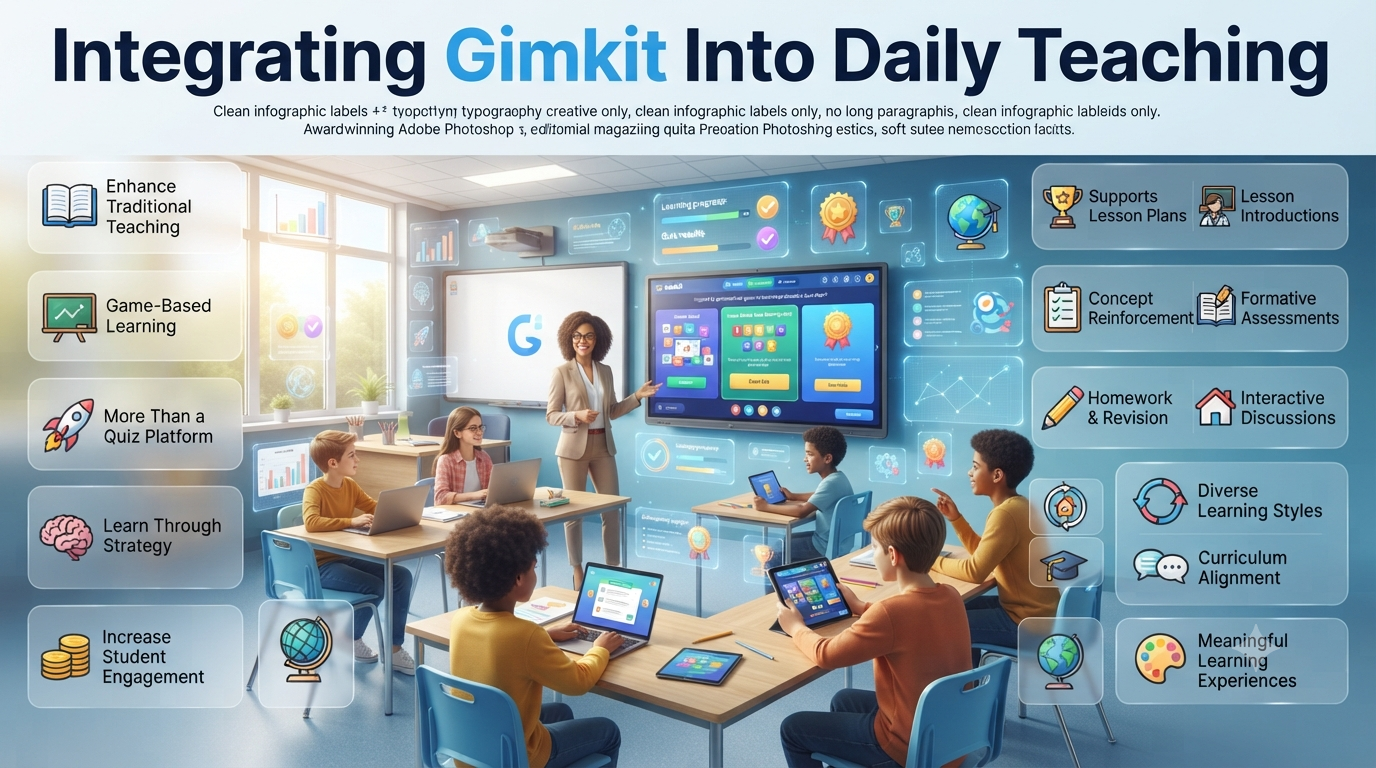
This Gimkit Free guide focuses on whether meaningful instruction can be delivered within Basic's actual feature boundaries. Educators interested in a wider teaching schedule can read the site's guide to integrating Gimkit into daily teaching. That topic concerns regular lesson routines across the school day rather than the distinctive constraints of teaching entirely on Basic.
For more detailed discussion of interpreting educational measurements, the site's assessment reports reference addresses report types and general assessment metrics. The local studio on this page does not replace that broader analysis; it records anonymous manual concept checks for a specific free-only lesson.
These links are distinct contextual reading destinations. Neither is presented as an official Gimkit service.
Frequently Asked Questions
Gimkit Free questions answered
Is Gimkit Free the same as Gimkit Basic?
Yes. Gimkit's own Help Center calls its continuing free educator offering Gimkit Basic. “Gimkit Free” is a common descriptive search phrase for that offering.
Can you teach effectively using only Gimkit Free?
Yes, when Gimkit is used as a deliberate part of instruction, retrieval, feedback and rechecking. It should not be treated as a complete replacement for the teacher or every other instructional method.
Is Gimkit Basic free forever?
Gimkit officially describes Basic as an ongoing free plan. Current terms and features remain controlled by Gimkit.
Can teachers create Kits without Pro?
Yes. Ordinary Kit creation is available through a free Educator account. Certain enhanced media features require paid access.
Can teachers host live games on Basic?
Yes. Basic provides access to currently Featured modes. Featured selections rotate, and published player limits still apply.
How many Featured modes does Basic include?
The official Pro FAQ says there are generally about three Featured modes at a time, with selections rotating. The actual current list should be checked in the official Mode Picker.
Can Basic teachers use Pro-exclusive modes?
Gimkit documents a five-player restriction for Pro-exclusive modes used by Basic members. This is different from unrestricted Pro mode access.
Does every free game have a five-player limit?
No. The five-player Basic restriction concerns Pro-exclusive modes. Featured modes are subject to their applicable published hard caps, including the separate 2D limit.
What is the Gimkit live-game player limit?
Gimkit documents a general hard maximum of 500 students for live games, with a separate limit of 60 for 2D modes. Network reliability and other conditions still matter.
Can Basic teachers create Classes?
Yes. Gimkit lists Class rostering as a Basic capability.
Are game reports available on Gimkit Basic?
Yes. Official Gimkit documentation says Basic educators can collect reports. The instructional value depends on how the teacher interprets and uses that evidence.
Are Gimkit Assignments free?
No. The official Assignments Explained guide identifies Assignments as a paid Pro feature.
Can I share a Practice link without creating an Assignment?
Gimkit documents a Practice link available through a Kit. It allows simple question practice but does not supply the same due-date, game-mode or assignment-reporting functions as a paid Assignment.
Is Practice Mode identical to a live game?
No. Gimkit's official Practice Mode documentation explains that it has no normal game mechanics, modes or due dates. It focuses on questions and correct or incorrect answers.
Can I use Gimkit Free for homework?
A teacher can share a suitable Practice link for independent revision. That is not the same as creating an official Pro Assignment with its corresponding management and results features.
Are audio questions included in Basic?
Gimkit identifies audio-question authoring as a paid capability. Teachers can use other legitimate instructional formats to support listening objectives, but those methods are not built-in Basic audio-question uploads.
Can I upload images into questions using Basic?
Gimkit's official image-upload documentation identifies uploaded images as a paying-subscriber feature. Ordinary text-based question creation is a different capability.
Can I use Gimkit Free every day?
Basic does not expire after a limited number of ordinary uses, but daily instructional suitability depends on objectives, question quality, time, student needs and current product conditions.
Should every lesson include a Gimkit game?
No. Some objectives require extended explanation, writing, investigation or discussion. Gimkit can support retrieval and review without occupying every part of the lesson.
How long should a free Gimkit review last?
There is no one ideal duration for every lesson. Allocate enough time for initial checks, meaningful practice, feedback and a recheck. The studio lets educators test their own time allocation.
What is the Free Teaching Cycle Studio?
It is an independent browser-based lesson and evidence planner. It supports free-compatible activity selection, time allocation, anonymous concept checks, feedback suggestions and local exports.
Does the studio connect to my Gimkit account?
No. It does not request credentials, inspect private Kits or import official game reports. All response counts are entered by the user.
Does it automatically create a Gimkit Kit?
No. Actual Kit creation takes place through Gimkit's authenticated editor. This tool models the free lesson surrounding the activity.
Does it automatically host a free game?
No. The selected route is an instructional declaration. The actual mode choice, game setup and live session remain on Gimkit.
Does the studio check current Featured mode availability?
No. Featured mode availability changes and must be confirmed in Gimkit's official Mode Picker.
What is a learning objective in this tool?
It is a teacher-written description of what learners should be able to demonstrate. It guides the concepts and response checks recorded in the studio.
Why does the tool ask for group size?
It uses the declared group size to calculate correct-response proportions from anonymous counts. The comparison assumes that the checks involve a consistent respondent group.
Does a higher recheck percentage prove Gimkit worked?
No. It describes a higher observed proportion of correct responses. It does not establish causation or eliminate alternative explanations.
What are percentage points?
They describe the arithmetic difference between two percentages. Moving from 60% correct to 80% correct is an increase of 20 percentage points.
What if I have not collected the recheck yet?
Leave the field blank. The application treats the evidence as incomplete rather than converting a missing result into zero correct responses.
What does the recheck target mean?
It is the teacher's own local decision threshold. The tool does not present it as an official Gimkit passing score or a validated measure of long-term mastery.
Can the studio identify individual student learning needs?
No. It uses anonymous concept-level counts. It neither stores individual identities nor diagnoses students.
Why does the tool request a misconception note?
The note helps connect an observed difficulty to a possible next teaching action. The teacher supplies the interpretation; the application does not automatically infer why students answered incorrectly.
Does local save mean my plan is stored in Gimkit?
No. The application attempts to store the plan in the current browser. It is not an official Gimkit cloud record or account synchronization service.
Can I export a teaching plan?
Yes. The studio provides copy, TXT, CSV and JSON actions. JSON can also be imported back into the same independent application.
Will its JSON upload into Gimkit?
No. The exported format belongs to this educational studio and is not an official Gimkit Kit, Assignment or reporting format.
Is Gimkit Free enough for every teacher?
Not necessarily. Educators who require Pro-only Assignments, embedded audio questions, image uploads or unrestricted Pro-exclusive modes have requirements beyond the ordinary Basic entitlement.
What is the most valuable free-only teaching habit?
Use a clear objective, collect meaningful responses, discuss misconceptions and recheck understanding. The game becomes educationally useful when its activity leads to informed teaching rather than ending with a leaderboard alone.
Official and Educational References
Sources used to verify the Gimkit Free guide
Official Gimkit Help Center documents support the product-specific claims about Basic, Featured modes, reports, participant limits, Practice links and paid Assignments. Education Endowment Foundation guidance supports the general instructional emphasis on initial teaching, formative evidence and useful feedback.
Product accuracy: Gimkit Basic includes Classes and game reports. Pro-only Assignments and other premium features should not be confused with these continuing free capabilities. Current Featured availability is controlled by Gimkit.
Independent website: GimkitApp.com is not operated, authorised or endorsed by Gimkit. The local tool does not connect to Gimkit servers, access private classroom information, start official games or create official Assignments.
Teach with purpose—not just with a paid feature list.
Gimkit Basic can support effective review and formative learning when ordinary Kits, Featured modes, simple Practice links, clear explanation and meaningful feedback are combined carefully. The teacher's instructional decisions remain central.





It is remarkable, rather useful idea