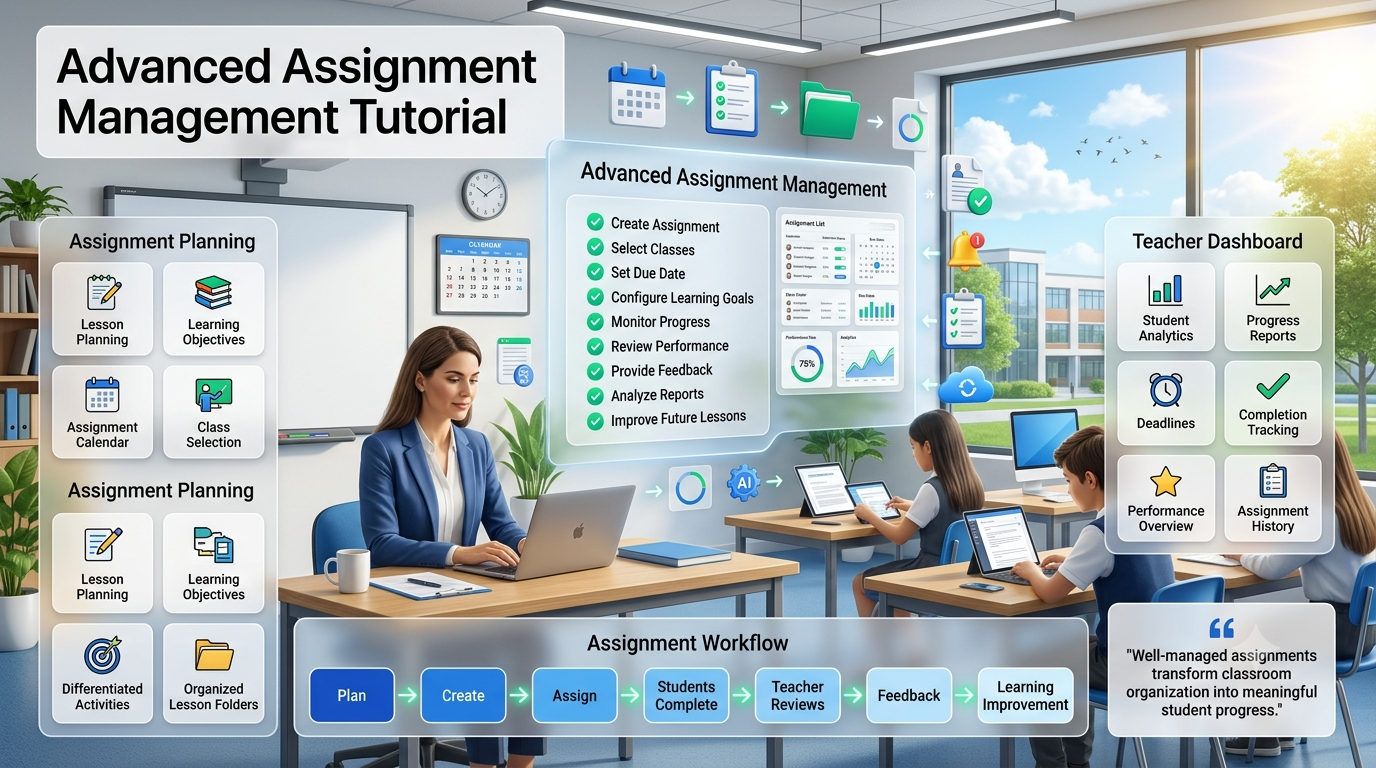
Advanced Assignment Management Tutorial-Managing assignments in Gimkit goes far beyond creating a simple homework game. As teachers become more comfortable with the platform, assignment management evolves into a complete instructional workflow that includes lesson planning, differentiated learning, progress monitoring, deadline management, and performance analysis.
Whether you’re assigning practice for independent study, preparing review sessions before exams, or creating self-paced learning experiences, understanding advanced assignment management helps you save time while improving student outcomes. Instead of manually tracking participation and completion, you can use Gimkit’s assignment features strategically to automate much of the process without sacrificing instructional quality.
This tutorial walks through the complete assignment management workflow—from planning and creating assignments to monitoring student progress, troubleshooting common issues, and implementing advanced classroom strategies used by experienced educators.
Understanding Advanced Assignment Management
Advanced assignment management is the process of organizing, scheduling, monitoring, evaluating, and improving digital assignments throughout the learning cycle rather than simply assigning a game and waiting for results.
Effective teachers view each assignment as part of a broader instructional sequence. A homework activity may introduce new vocabulary, a review assignment may reinforce prior learning, and a follow-up assessment may measure mastery. When these assignments are connected intentionally, students experience continuous learning instead of isolated activities.
Each serves a different instructional purpose, so selecting the right format is the first step toward effective assignment management.
Planning Before Creating Assignments
Successful assignments begin with instructional planning rather than platform settings.
Ask yourself:
What should students know after completing this assignment?
Is this practice, review, assessment, or enrichment?
Should students work independently or collaboratively?
How much time is appropriate?
What evidence will demonstrate mastery?
Planning these elements first helps ensure that every assignment supports meaningful learning rather than simply increasing screen time.
Professional Planning Checklist
Planning Question
Why It Matters
Learning objective defined
Keeps assignment focused
Appropriate question set selected
Prevents content mismatch
Completion deadline established
Improves accountability
Difficulty level reviewed
Matches student ability
Follow-up lesson prepared
Reinforces learning
Creating Advanced Assignments
Creating an assignment involves much more than selecting a question set.
Step 1: Select the Appropriate Kit
Choose a Kit that aligns precisely with your learning objectives. Review every question for accuracy, clarity, and curriculum alignment before assigning it to students.
Step 2: Configure Assignment Settings
Adjust settings based on instructional goals rather than using default options.
Important configuration areas include:
Assignment title
Class selection
Due date
Start availability
Question order
Gameplay settings
Student participation rules
Well-configured settings reduce confusion and minimize support requests from students.
Step 3: Optimize Difficulty
Avoid assignments that are either too easy or overwhelmingly difficult.
Professional educators typically:
Mix foundational and higher-order questions.
Include opportunities for review.
Balance challenge with achievable success.
Consider the prior knowledge of the class.
Managing Multiple Classes Efficiently
Teachers handling several classes benefit from consistent organizational systems.
Recommended practices include:
Strategy
Benefit
Standard naming conventions
Faster assignment identification
Separate Kits by subject
Easier content management
Weekly assignment folders
Better organization
Archived completed work
Cleaner dashboard
Reusable templates
Saves preparation time
Maintaining a structured workflow reduces administrative overhead throughout the school year.
Scheduling Assignments Strategically
Assignment timing influences both participation and completion rates.
Rather than releasing every assignment immediately, schedule them to align with classroom instruction.
Effective scheduling examples include:
Release after introducing new concepts.
Open review assignments several days before assessments.
Avoid overlapping deadlines across multiple subjects when possible.
Provide sufficient completion windows for student flexibility.
Thoughtful scheduling encourages steady participation instead of last-minute submissions.
Editing Existing Assignments
Assignments occasionally require updates due to curriculum adjustments or discovered errors.
Common edits include:
Correcting question wording.
Extending due dates.
Updating instructions.
Clarifying expectations.
Revising assignment titles.
Whenever changes affect active student work, communicate those updates clearly to prevent confusion.
Monitoring Student Progress
Monitoring assignments continuously allows teachers to identify struggling learners before small misunderstandings become larger learning gaps.
Indicators worth reviewing include:
Completion status
Participation rate
Accuracy trends
Time spent
Frequently missed questions
Student consistency
These metrics help teachers intervene proactively rather than waiting until formal assessments reveal difficulties.
Progress Monitoring Workflow
Assignment Published
        │
        ▼
Students Begin Work
        │
        ▼
Monitor Participation
        │
        ▼
Review Performance Data
        │
        ▼
Identify Learning Gaps
        │
        ▼
Provide Intervention
        │
        ▼
Assign Targeted Practice
Reviewing Performance Reports
Assignment reports provide actionable insights beyond simple completion percentages.
Look for patterns such as:
Questions most frequently answered incorrectly.
Concepts requiring reteaching.
Students who finish unusually quickly.
Learners who consistently need additional time.
Overall class mastery.
Instead of focusing solely on grades, use reports to improve future instruction.
Differentiated Assignment Strategies
Not every student benefits from identical assignments.
Differentiated instruction may include:
Student Need
Assignment Strategy
Advanced learners
Extension activities
Students needing support
Additional guided practice
English language learners
Simplified question sets
Mixed-ability classrooms
Tiered assignments
Exam preparation
Focused review Kits
Differentiation improves engagement while respecting individual learning needs.
Classroom Management Best Practices
Experienced educators often follow repeatable assignment routines.
Recommended Workflow
Define instructional objective.
Select or build the appropriate Kit.
Review every question.
Configure assignment settings.
Schedule publication.
Explain expectations to students.
Monitor progress regularly.
Analyze reports.
Address learning gaps.
Archive completed assignments.
Following the same process consistently reduces errors and improves classroom efficiency.
Common Assignment Problems
Students Cannot Access the Assignment
Possible causes include:
Incorrect class enrollment
Assignment not yet published
Expired deadline
Login issues
School network restrictions
Verify settings before asking students to troubleshoot their own devices.
Students Finish Too Quickly
This may indicate:
Questions are too easy.
Students are guessing.
Assignment length is insufficient.
Consider increasing question complexity or adding application-based questions.
Low Completion Rates
Review whether:
Instructions were clear.
Deadline was realistic.
Students understood expectations.
Technical issues affected participation.
Assignment workload was appropriate.
Improving communication often increases completion more effectively than simply extending deadlines.
Professional Assignment Workflow
Experienced teachers rarely create assignments at the last minute.
This structured cycle supports continuous instructional improvement.
Assignment Management Checklist
Before publishing an assignment, confirm the following:
Checklist Item
Status
Learning objective defined
☐
Correct Kit selected
☐
Questions reviewed
☐
Instructions written clearly
☐
Due date verified
☐
Class selected correctly
☐
Settings configured
☐
Assignment tested
☐
Student expectations communicated
☐
Follow-up lesson planned
☐
Completing this checklist minimizes avoidable classroom disruptions.
Expert Recommendations
Teachers who consistently achieve high student participation often follow these practices:
Do
Keep assignment instructions concise.
Review reports after every assignment.
Use assignments as formative assessments.
Organize Kits by curriculum unit.
Schedule assignments in advance.
Avoid
Publishing without reviewing questions.
Overloading students with simultaneous assignments.
Ignoring performance analytics.
Using identical assignments repeatedly.
Waiting until grades are due before reviewing progress.
Summary
Advanced assignment management transforms Gimkit from a simple game platform into a comprehensive instructional tool. By carefully planning assignments, organizing classes, scheduling activities strategically, monitoring progress continuously, and using performance data to guide instruction, teachers create a more effective and engaging learning experience.
The most successful educators treat assignments as part of an ongoing instructional cycle rather than isolated activities. Consistent planning, thoughtful configuration, and regular analysis lead to higher student participation, stronger learning outcomes, and a more efficient classroom workflow.
50+ Advance Level reviews for your outstanding Guidance
Advanced Assignment Management Tutorial begins with establishing clear learning objectives before creating any assignment. Well-defined goals help students understand expectations and allow teachers to measure meaningful academic progress.
Advanced Assignment Management Tutorial recommends organizing assignments according to curriculum units rather than creating isolated activities. A structured workflow makes classroom management more efficient throughout the academic year.
Advanced Assignment Management Tutorial encourages teachers to use descriptive assignment titles that clearly identify the subject, topic, and learning objective for easier organization.
Advanced Assignment Management Tutorial encourages teachers to establish a consistent naming convention for assignments, making it easier to locate, update, and reuse materials across multiple classes.
Advanced Assignment Management Tutorial demonstrates that scheduling assignments according to the pace of classroom instruction prevents students from becoming overloaded while maintaining steady academic progress.
Advanced Assignment Management Tutorial highlights the importance of periodically reviewing assignment completion rates to identify participation trends and provide timely support for students who may be falling behind.
Advanced Assignment Management Tutorial recommends aligning every assignment with specific learning outcomes so each activity contributes directly to curriculum objectives and measurable student achievement.
Advanced Assignment Management Tutorial encourages educators to revise assignment instructions whenever student questions reveal areas that may be unclear or easily misunderstood.
Advanced Assignment Management Tutorial demonstrates that maintaining an organized digital library of assignments saves preparation time and supports consistent instructional quality throughout future semesters.
Advanced Assignment Management Tutorial highlights that combining formative assessments with regular assignments gives teachers a more complete picture of student understanding and learning progress.
Advanced Assignment Management Tutorial recommends analyzing assignment performance across multiple classes to identify successful instructional practices that can be applied more broadly.
Advanced Assignment Management Tutorial encourages teachers to communicate assignment expectations clearly, including objectives, deadlines, grading criteria, and available learning resources before students begin working.
Advanced Assignment Management Tutorial ultimately proves that advanced assignment management is built on organization, consistency, thoughtful planning, continuous assessment, and meaningful feedback.
Advanced Assignment Management Tutorial highlights the importance of setting realistic deadlines that provide students with enough time to complete assignments without unnecessary pressure.
Advanced Assignment Management Tutorial demonstrates that assigning activities in a consistent weekly schedule helps students develop better study habits and time management skills.
Advanced Assignment Management Tutorial recommends reviewing assignment settings carefully before publishing to ensure instructions, question sets, and deadlines are accurate.
Advanced Assignment Management Tutorial encourages teachers to group similar assignments into organized collections, making future lesson planning faster and more consistent.
Advanced Assignment Management Tutorial highlights that reusable assignment templates reduce preparation time while maintaining instructional quality across multiple classes.
Advanced Assignment Management Tutorial demonstrates that assigning activities according to student readiness supports differentiated instruction and improves learning outcomes.
Advanced Assignment Management Tutorial recommends providing clear written instructions that explain assignment objectives, completion requirements, and expected learning outcomes.
Advanced Assignment Management Tutorial encourages educators to monitor assignment progress regularly so students who require additional support can be identified early.
Advanced Assignment Management Tutorial highlights the value of formative assessment by using assignment results to identify misconceptions before introducing new concepts.
Advanced Assignment Management Tutorial recommends balancing independent assignments with collaborative classroom activities to support different learning preferences.
Advanced Assignment Management Tutorial demonstrates that organizing assignments by subject and grading period simplifies long-term classroom management.
Advanced Assignment Management Tutorial encourages teachers to review completed assignments before reusing them, ensuring all content remains current and curriculum aligned.
Advanced Assignment Management Tutorial highlights that meaningful feedback should accompany assignment results, helping students understand both strengths and improvement opportunities.
Advanced Assignment Management Tutorial recommends analyzing assignment performance trends instead of focusing only on individual scores when planning future instruction.
Advanced Assignment Management Tutorial demonstrates that flexible assignment scheduling allows educators to adapt instructional plans according to classroom progress.
Advanced Assignment Management Tutorial encourages teachers to archive completed assignments systematically, creating a searchable resource library for future academic years.
Advanced Assignment Management Tutorial highlights that assignment quality is more important than assignment quantity, promoting deeper understanding instead of repetitive practice.
Advanced Assignment Management Tutorial recommends coordinating assignment difficulty with current classroom instruction to maintain appropriate academic challenge.
Advanced Assignment Management Tutorial demonstrates that regular assignment review sessions reinforce learning while providing opportunities to address common misunderstandings.
Advanced Assignment Management Tutorial encourages educators to use classroom analytics to evaluate assignment effectiveness and improve future instructional planning.
Advanced Assignment Management Tutorial highlights that efficient assignment management combines thoughtful organization, consistent communication, and continuous assessment throughout the learning process.
Advanced Assignment Management Tutorial ultimately demonstrates that successful assignment management depends on careful planning, organized workflows, curriculum alignment, meaningful feedback, ongoing formative assessment, and continuous instructional improvement.
Frequently Asked Questions
How many assignments should students receive each week?
There is no universal number of Gimkit assignments that works for every classroom because the ideal workload depends on several educational factors, including the students’ age, subject complexity, curriculum pace, and overall homework expectations. Instead of focusing on assigning more activities, experienced educators prioritize creating purposeful assignments that reinforce learning objectives without causing cognitive overload. A well-designed assignment should extend classroom instruction, encourage retrieval practice, and provide meaningful opportunities for students to apply what they have learned rather than simply repeating questions.
For elementary students, one to three short assignments per week are often enough to reinforce key concepts while maintaining engagement. Middle school classes may benefit from two to four focused assignments, whereas high school courses can include three to five assignments when aligned with larger projects, exam preparation, or ongoing coursework. However, these numbers should remain flexible based on instructional goals rather than fixed schedules.
To determine the right frequency, teachers should consider:
The complexity of the lesson being reinforced.
The average completion time for students.
Overall homework from other subjects.
Student attention span and grade level.
Whether the assignment is for practice, review, or assessment.
Professional Recommendation: Rather than assigning multiple similar activities, create one high-quality assignment with carefully selected questions, clear objectives, and meaningful feedback. Monitoring completion rates and student performance over several weeks will help you identify the optimal workload for your specific classroom.
Can assignments be edited after students begin working?
Yes, certain assignment details can often be modified after students have started working, but teachers should approach edits carefully because changes can affect student progress, expectations, and overall classroom consistency. Minor updates such as correcting spelling mistakes, clarifying instructions, or extending due dates are generally low-risk and can improve the student experience. However, making significant changes—such as replacing questions, changing learning objectives, or modifying grading expectations—may create confusion for students who have already completed part of the assignment.
Before editing an active assignment, consider how the changes will impact learners at different stages of completion. If substantial modifications are necessary, it may be more appropriate to create a new assignment rather than altering one that students are actively using.
Follow these best practices before making changes:
Review whether students have already started or completed the assignment.
Make only essential corrections after publication.
Notify students immediately about any important updates.
Extend deadlines if major instructional changes are introduced.
Test revised settings before asking students to continue.
Professional Recommendation: Treat published assignments as instructional records. Complete a thorough review before publishing to minimize the need for edits, and reserve post-publication changes for genuine improvements or necessary corrections rather than routine adjustments.
What is the best way to organize assignments for multiple classes?
Managing assignments across multiple classes becomes significantly easier when teachers establish a consistent organizational system from the beginning of the school year. Without a structured workflow, assignments, Kits, reports, and class materials can quickly become difficult to locate, leading to unnecessary administrative work and increased chances of assigning the wrong content to the wrong class.
A professional organization strategy includes standardized naming conventions, logical folder structures, reusable assignment templates, and regular cleanup of completed activities. Instead of creating assignments from scratch every time, experienced educators build reusable instructional resources that can be updated each semester while maintaining consistency across multiple classrooms.
A highly effective organizational workflow includes:
Organizational Practice
Benefit
Name assignments using unit and lesson numbers
Makes searching and sorting faster
Group Kits by subject or curriculum unit
Simplifies lesson planning
Archive completed assignments regularly
Keeps dashboards clean and organized
Create reusable assignment templates
Saves preparation time
Maintain consistent due-date schedules
Helps students build predictable routines
Professional Recommendation: Develop a standardized naming format such as Biology – Unit 3 – Cell Structure Review or Math Grade 7 – Fractions Homework – Week 5. Consistency makes it easier to manage dozens of assignments across multiple classes throughout the academic year.
How should teachers use assignment reports?
Assignment reports should be viewed as instructional decision-making tools rather than simple grading records. While completion rates and scores provide useful information, the greatest value lies in identifying learning patterns that can improve future teaching. A detailed analysis of assignment reports allows teachers to discover which concepts students understand, which questions consistently cause difficulty, and which learners may require additional support before misconceptions become long-term learning gaps.
Instead of focusing only on final scores, examine trends across the entire class. For example, if a large percentage of students miss the same question, the issue may indicate a need to revisit that concept during the next lesson rather than assuming individual student errors. Likewise, students who complete assignments unusually quickly with low accuracy may require additional guidance on reading questions carefully rather than simply practicing more.
When reviewing assignment reports, analyze:
Overall class accuracy.
Frequently missed questions.
Individual student performance trends.
Completion rates and participation levels.
Time spent completing assignments.
Concepts requiring reteaching or enrichment.
Professional Recommendation: Schedule a brief report review after every assignment. Spending just a few minutes analyzing performance data can help you adjust lesson plans, form small intervention groups, differentiate instruction, and provide targeted support that improves future learning outcomes.
What makes an assignment more engaging?
An engaging assignment is not simply one that students enjoy—it is one that successfully captures attention while promoting meaningful learning. Effective assignments balance educational rigor with interactive experiences by presenting achievable challenges, relevant content, and clear objectives that connect directly to classroom instruction. Students are more likely to remain motivated when they understand why an assignment matters and can see measurable progress as they complete it.
Engagement also depends on instructional design. Assignments that include a variety of question types, real-world examples, appropriate difficulty levels, and opportunities for independent success tend to sustain attention longer than repetitive drills. Additionally, keeping assignments concise and focused often produces better participation than assigning lengthy activities with unnecessary repetition.
Characteristics of highly engaging assignments include:
Clear learning objectives.
Appropriate difficulty for the class.
Varied and meaningful question types.
Direct alignment with current lessons.
Manageable completion times.
Opportunities for immediate feedback and reflection.
Content that encourages critical thinking rather than memorization alone.
Professional Recommendation: Design assignments around learning outcomes instead of question quantity. A concise, well-structured assignment that challenges students to apply knowledge, solve problems, and think critically will generally produce higher engagement and stronger learning outcomes than a longer assignment focused primarily on repetition.