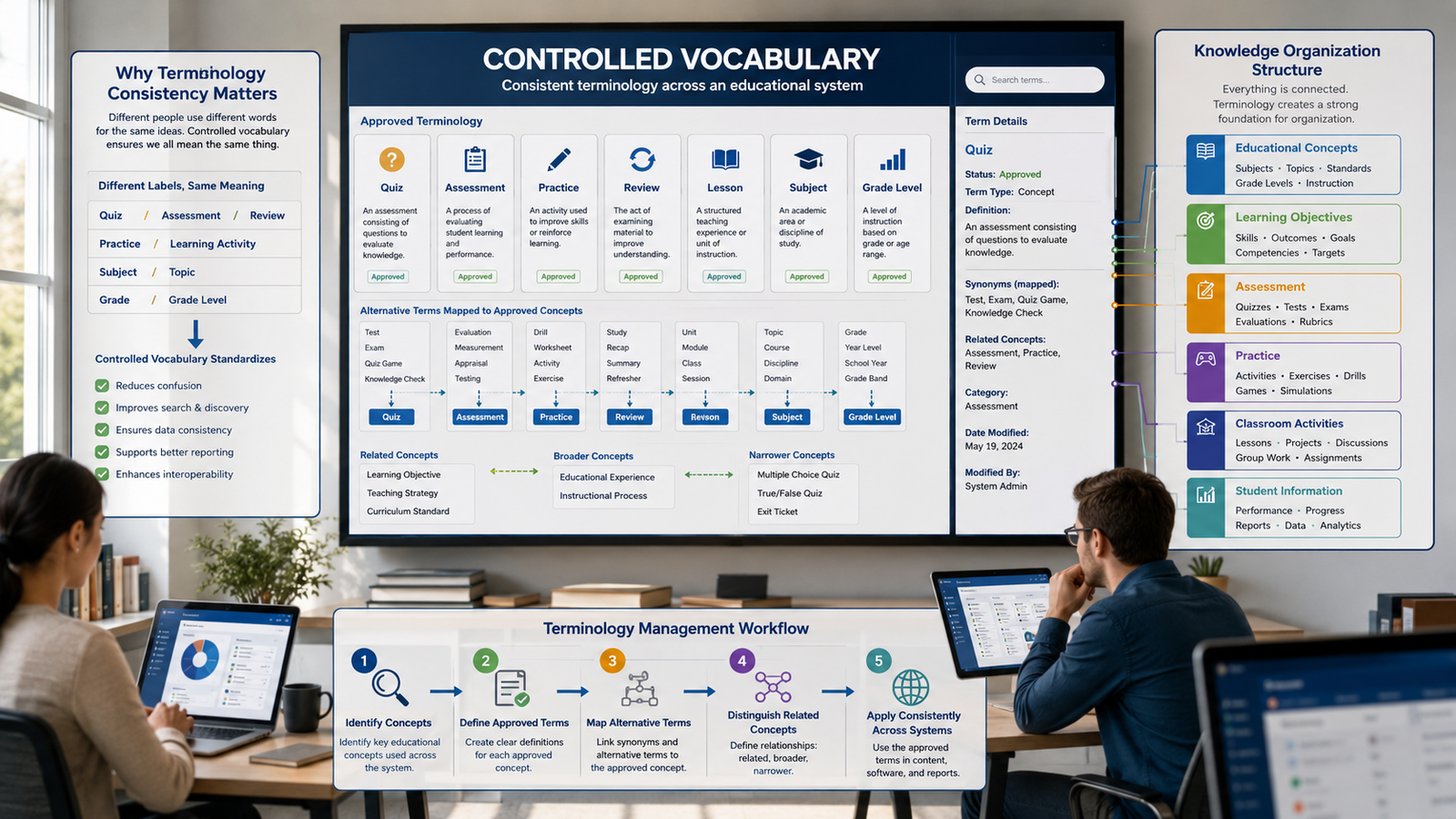
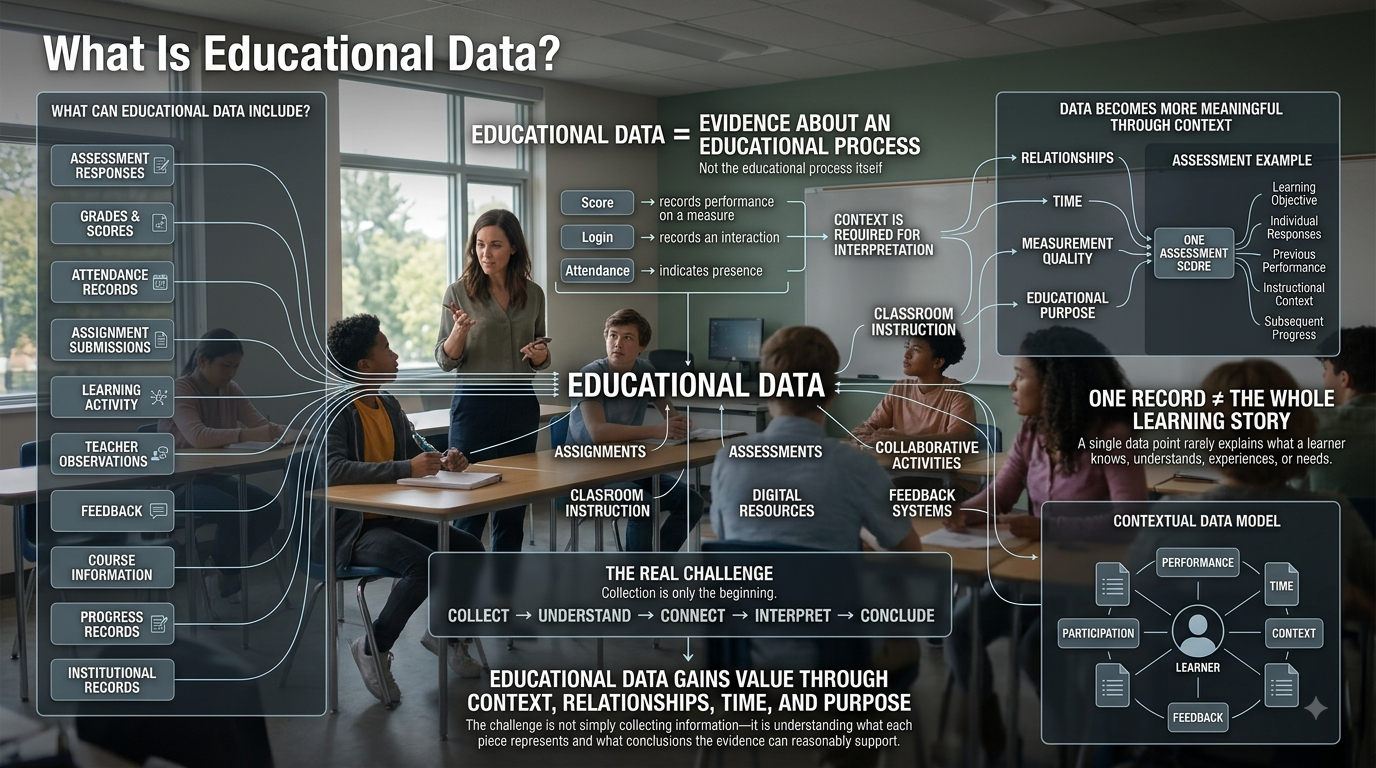
What Is a Controlled Vocabulary? A controlled vocabulary is a deliberately maintained set of approved terms used to describe information consistently. Instead of allowing every contributor, database, or software component to invent its own wording, a controlled vocabulary establishes which terms should be used, which alternatives should point to them, and—when needed—how related terms should be distinguished.
In educational technology, that consistency matters because the same idea can be described in many different ways. A platform may need to distinguish between terms such as quiz, assessment, practice, review, lesson, subject, or grade level without letting inconsistent labels gradually fragment the information.
The key idea is simple:
A controlled vocabulary controls terminology so that the same meaning can be represented consistently across a system.
W3C’s SKOS standard describes controlled vocabularies as knowledge-organization systems that can include thesauri, classification schemes, subject-heading systems, taxonomies, and related concept schemes.
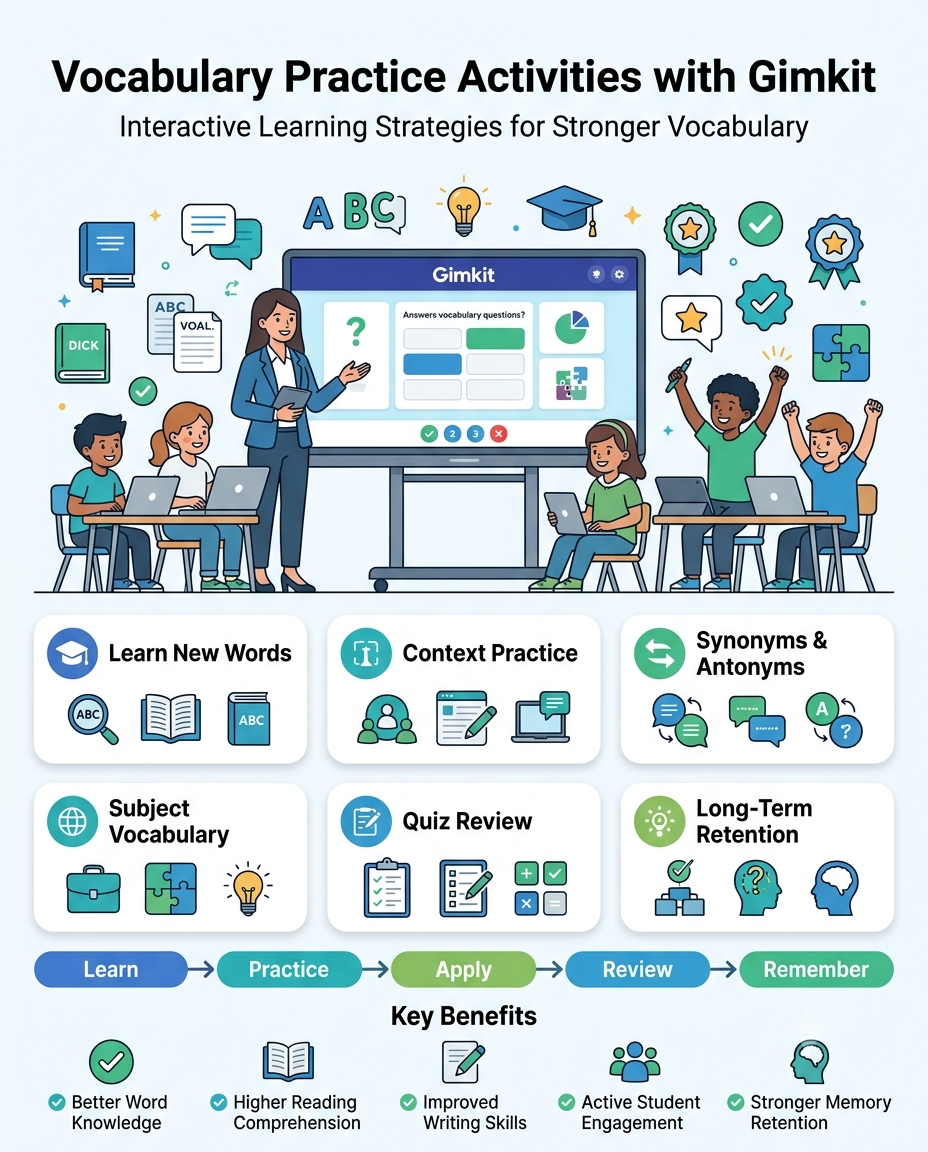
Learn more about interactive classroom learning, educational games, and modern teaching resources through Gimkit Live Learning & Earning Show.
Why the Word “Controlled” Matters
The word controlled does not mean that a system restricts what people are allowed to say in ordinary conversation.
It means the terminology used for a particular information-management purpose is governed by defined rules.
Imagine an educational resource collection where contributors independently enter:
Person
Entered term
Contributor A
Mathematics
Contributor B
Math
Contributor C
Maths
Contributor D
Mathematics subject
Contributor E
Math subject
To a human reader, these may appear close enough.
To a retrieval or cataloging system, however, they can become five different strings.
A controlled vocabulary can establish a preferred representation such as:
Mathematics
while treating the other forms as alternative or non-preferred terms where appropriate.
This is one of the fundamental purposes of vocabulary control: reduce variation where variation would interfere with consistent organization or retrieval. Research-data guidance from KU Leuven similarly describes controlled vocabularies as a way to control synonyms and variant terms while organizing related concepts logically.
Controlled Vocabulary Is About Meaning, Not Just Spelling
It is tempting to think of a controlled vocabulary as simply a list of approved words.
That is the simplest form, but the idea can be much richer.
A vocabulary can establish:
preferred terms;
alternative labels;
definitions;
broader terms;
narrower terms;
related terms;
identifiers;
notes about appropriate usage;
mappings to equivalent or related concepts in another vocabulary.
W3C’s SKOS model, for example, supports labels, identifiers, notes, hierarchical relationships, associative relationships, collections, and mappings between concept schemes.
So there is an important progression:
Approved words
      ↓
Defined terminology
      ↓
Relationships between terms
      ↓
Structured vocabulary
The vocabulary becomes increasingly useful as the system needs more than simple spelling consistency.
Controlled Vocabulary vs Ordinary Keyword List
These two ideas are often confused.
An ordinary keyword list might simply contain:
math, maths, mathematics, algebra, geometry
There is no guarantee that anyone knows why those terms are present or how they relate.
A controlled vocabulary can provide additional rules and meaning.
Ordinary keyword list
Controlled vocabulary
Mainly stores strings
Organizes defined terminology
May contain duplicates
Can manage preferred and alternative terms
Relationships may be absent
Relationships can be explicitly represented
Meaning may depend on context
Terms can have documented definitions
Usually easy to create
Requires governance and maintenance
Useful for loose tagging
Useful for consistent classification and retrieval
That distinction becomes especially important when an educational platform grows large enough that terminology is being reused across many parts of its information environment.
The Smallest Useful Controlled Vocabulary Can Be Very Simple
A controlled vocabulary does not have to be an enormous taxonomy.
It can begin as a simple controlled list.
For example:
Approved value
Meaning
Beginner
Intended for introductory material
Intermediate
Intended for developing knowledge
Advanced
Intended for more demanding material
The important property is not the number of terms.
It is that the system has defined values instead of unrestricted terminology.
KU Leuven distinguishes a controlled list from richer structures such as synonym rings, taxonomies, thesauri, and ontologies. A controlled list can therefore be the simplest member of a much broader family of vocabulary-management approaches.
Why Educational Platforms Need Terminology Discipline
Educational systems contain a particularly wide range of descriptive information.
A learning resource can have attributes relating to:
subject;
educational level;
language;
difficulty;
resource type;
instructional purpose;
topic;
curriculum area;
skill;
audience;
accessibility;
format.
If each system or contributor describes these attributes differently, consistency becomes difficult.
The 1EdTech metadata guidance specifically treats taxonomies and vocabularies as structured collections of terms that can provide values for learning-resource metadata, emphasizing that terminology should be precise, recognizable, and usable across communities.
This gives controlled vocabulary a very practical role:
It provides a stable terminology layer between educational information and the systems that need to organize, exchange, search, or interpret that information.
A Controlled Vocabulary Can Prevent False Differences
Consider these labels:
Grade 5
Fifth Grade
Year 5
Grade Five
Depending on the educational system, some of these may represent the same level while others may genuinely represent different structures.
A vocabulary cannot automatically decide that every similar-looking phrase means the same thing.
That decision requires domain governance.
Once the meaning has been established, however, the vocabulary can define how the concept should be represented.
This is a crucial principle:
Vocabulary control does not eliminate ambiguity by magic; it gives a system a formal place to resolve and document ambiguity.
That makes controlled vocabularies especially valuable in educational environments where terminology can vary by country, institution, curriculum, or discipline.
Preferred Terms and Alternative Terms
One of the most useful mechanisms is separating the term that should normally be displayed or indexed from other expressions that users may encounter.
For example:
Role
Example
Preferred term
Mathematics
Alternative label
Math
Alternative label
Maths
Definition
Academic discipline concerned with mathematical concepts and methods
This does not necessarily mean that every alternative term is incorrect.
It means the system has decided that one representation should serve as the canonical term for a particular purpose.
This distinction is supported by knowledge-organization models such as SKOS, which allow concepts to have labels and relationships rather than treating every textual expression as an unrelated item.
Controlled Vocabulary Can Also Distinguish Similar Terms
Synonyms are only one problem.
Sometimes the harder problem is near-synonyms that should not be merged.
For example:
Term
Potential distinction
Assessment
Broad evaluation activity
Quiz
A particular type of assessment
Practice
Rehearsal rather than formal evaluation
Review
Revisiting previously introduced material
Whether these distinctions are appropriate depends on the vocabulary’s intended domain and governance rules.
A good controlled vocabulary therefore does not simply ask:
“Which words mean the same thing?”
It also asks:
“Which terms need to remain distinct because their meanings or uses differ?”
That is where vocabulary design becomes substantially more valuable than ordinary keyword cleanup.
Taxonomy Is Related to Controlled Vocabulary—but Not Identical
A taxonomy is generally a structured classification system in which terms are organized hierarchically.
The hierarchy provides relationships such as broader and narrower.
A controlled vocabulary can be much simpler and does not necessarily require such a hierarchy.
KU Leuven describes a taxonomy as a classification system that organizes terms hierarchically, while describing controlled lists, synonym rings, taxonomies, thesauri, and ontologies as progressively different forms of vocabulary organization.
So:
Every taxonomy can participate in vocabulary control, but not every controlled vocabulary is a taxonomy.
That distinction prevents a common documentation mistake: using controlled vocabulary, taxonomy, and ontology as if they were interchangeable terms.
Controlled Vocabulary vs Thesaurus
A thesaurus introduces richer relationships between terms.
It can contain:
preferred terms;
non-preferred terms;
broader terms;
narrower terms;
related terms.
That makes it more expressive than a simple approved-term list.
For example:
Preferred term
      │
      ├── Alternative term
      │
      ├── Broader term
      │
      ├── Narrower term
      │
      └── Related term
W3C’s SKOS model is specifically designed to represent these kinds of knowledge-organization structures in a machine-readable form.
Controlled Vocabulary vs Ontology
An ontology goes further.
A controlled vocabulary primarily helps establish which concepts and terms are recognized.
An ontology can formally describe what those concepts are and how entities and relationships behave.
A useful simplification is:
Structure
Main concern
Controlled list
Which values are allowed?
Taxonomy
How are terms hierarchically classified?
Thesaurus
How are terms semantically related?
Ontology
What entities, properties, relationships, and constraints exist?
This is a conceptual distinction rather than a universal boundary; terminology varies across disciplines.
KU Leuven similarly describes ontologies as structures that use controlled vocabularies while adding formal relationships, rules, constraints, and machine-readable semantics.
Why Consistent Terms Improve Educational Information Systems
The value of controlled vocabulary becomes clearer when multiple systems need to work with the same information.
Suppose an educational resource is described using a standardized value for a particular field.
Another system can recognize that value without having to interpret dozens of independently invented labels.
This supports several practical goals:
Goal
How vocabulary control helps
Consistency
Same concept can receive a stable representation
Retrieval
Equivalent terminology can be connected
Classification
Resources can be grouped using defined values
Interoperability
Different systems have a shared terminology layer
Reuse
Existing terms can be applied repeatedly
Maintenance
Terminology can be governed centrally
Machine processing
Structured terms can be represented consistently
Research-data guidance identifies consistency, interoperability, and reusability among the major benefits of controlled vocabularies.
Controlled Vocabulary Is a Governance Problem as Much as a Technical Problem
Software can store a vocabulary.
Software cannot independently decide what every educational term should mean.
That requires human governance.
A useful vocabulary-management process therefore includes:
This is why vocabulary design is not simply a developer task.
It can involve:
subject specialists;
educators;
librarians;
curriculum specialists;
information architects;
metadata specialists;
product teams;
engineers.
1EdTech’s guidance similarly emphasizes that vocabulary choices should consider the communities that create, manage, and consume learning resources rather than assuming that one vocabulary will suit every community.
The Hardest Part Is Often Choosing What Not to Combine
A poorly designed vocabulary can be too loose.
But it can also be too aggressive.
Suppose a system combines every term that appears similar:
Quiz
Assessment
Test
Practice
Review
into a single category called:
Assessment
The terminology may look cleaner, but useful distinctions could disappear.
This creates an important design rule:
Vocabulary control should reduce meaningless variation without destroying meaningful differences.
That balance is one of the central challenges in designing terminology for educational information systems.
A Term Should Represent a Concept, Not Merely a String
One of the most important distinctions in vocabulary design is between a label and the concept represented by that label.
Consider:
“Math”
and
“Mathematics”
They are different strings.
They may, however, be labels used for the same underlying concept.
This approach prevents systems from treating every spelling or wording variation as a separate concept.
SKOS explicitly models concepts separately from their lexical labels, allowing a concept to have preferred, alternative, and hidden labels.
That distinction becomes particularly valuable when terminology is used across search, metadata, filtering, classification, or data exchange.
Every Important Concept Benefits From a Stable Identifier
Human-readable terminology can change.
An identifier provides a more stable reference.
For example, a hypothetical vocabulary might represent a concept like this:
Property
Example
Concept ID
EDU-0472
Preferred label
Mathematics
Alternative label
Math
Definition
Subject area covering mathematical knowledge and practices
Status
Active
The identifier is not intended to replace the human-readable label.
It provides a stable handle that software can use even when the preferred wording changes.
This is one reason SKOS gives concepts identifiers through URIs while treating labels as separate properties.
Why this matters
Suppose a platform changes:
“Mathematics” → “Mathematical Studies”
If systems depend entirely on the displayed text, the terminology change can look like the creation of an entirely new concept.
If both labels are associated with the same stable concept identifier, the semantic identity can remain intact.
Preferred Terms Are Governance Decisions
Choosing a preferred term is not simply a matter of picking whichever word sounds nicest.
The choice should consider:
audience familiarity;
disciplinary correctness;
curriculum terminology;
regional usage;
institutional conventions;
search behavior;
interoperability requirements;
ambiguity;
long-term stability.
A vocabulary might therefore decide that:
Preferred: Mathematics Alternative: Math
But another educational environment could legitimately make a different decision.
The important principle is:
A controlled vocabulary should document its terminology decisions instead of leaving them implicit.
That makes the vocabulary reproducible and easier for future maintainers to understand.
Alternative Labels Preserve Real-World Language
Users do not always use the preferred terminology.
That does not mean their terminology should be discarded.
A vocabulary can preserve common alternatives while still maintaining one canonical representation.
For example:
Concept
Preferred label
Alternative labels
Mathematics
Mathematics
Math, Maths
Physical Education
Physical Education
PE
Computer Science
Computer Science
CS
The exact relationships must be governed by the vocabulary owner.
The important architecture is:
User terminology
      ↓
Alternative label
      ↓
Underlying concept
      ↓
Preferred terminology
This allows the system to accommodate natural language without sacrificing consistency.
SKOS provides altLabel specifically for alternative lexical labels that are not the preferred label for a concept.
For the latest gaming news, expert reviews, and walkthroughs, readers can also visit IGN, one of the world’s leading gaming websites.
Definitions Prevent Terms From Becoming Ambiguous
A label alone can be insufficient.
Consider:
“Level”
What does it mean?
It could refer to:
educational grade;
difficulty;
game progression;
course level;
proficiency;
organizational level.
A controlled vocabulary should define the intended concept rather than assuming the label is self-explanatory.
A useful concept record therefore looks more like:
Field
Purpose
Preferred label
Human-readable name
Definition
What the concept means
Scope note
How the term should or should not be used
Identifier
Stable machine reference
Related concepts
Semantic context
Status
Current lifecycle state
SKOS supports documentation properties such as definitions, scope notes, editorial notes, and history notes for precisely this kind of contextual information.
Scope Notes Can Be More Valuable Than Long Definitions
Sometimes the problem is not explaining what a term means.
The problem is explaining where it should be used.
Imagine a vocabulary contains:
Assessment
and
Practice
A scope note could clarify that “Assessment” is intended for activities used to evaluate learner performance, while “Practice” is intended for activities primarily designed for rehearsal or skill development.
The distinction protects the vocabulary from inconsistent tagging.
The crucial point is that translation should represent the same concept, not simply provide unrelated strings.
SKOS supports language-tagged lexical labels, allowing multilingual labels to be associated with concepts.
This provides an important architectural separation:
Language variation belongs at the label layer when the underlying concept remains the same.
Translation Is Not Always the Same as Equivalence
This is a subtle but important issue.
Two terms in different languages may appear to be translations while carrying different educational meanings because curricula and institutional terminology differ.
Therefore, a multilingual vocabulary should validate:
linguistic accuracy;
domain meaning;
regional usage;
educational context.
Simply running labels through machine translation does not guarantee semantic equivalence.
For high-value educational metadata, terminology should be reviewed in context.
Vocabulary Mapping Connects Different Systems
Sometimes two organizations have separate vocabularies.
One system may use:
Mathematics
while another uses:
Mathematical Sciences
Instead of forcing both systems to abandon their terminology, a mapping can describe how their concepts correspond.
SKOS provides mapping properties such as exact match, close match, broader match, narrower match, and related match for connecting concepts across schemes.
Conceptually:
Vocabulary A
     │
     │ mapping
     ▼
Vocabulary B
This is especially valuable when educational information crosses institutional or software boundaries.
Exact Match and Close Match Should Not Be Treated as Identical
Consider two concepts that are very similar.
That does not automatically mean they are interchangeable.
A mapping system can distinguish between:
Exact match
and
Close match
This prevents interoperability from becoming semantic oversimplification.
The practical principle is:
Map concepts according to meaning, not merely similar wording.
That becomes increasingly important when information is exchanged between different educational organizations.
Controlled Vocabulary Can Improve Search Without Becoming a Keyword-Stuffing Device
A vocabulary can help search systems connect user language with standardized concepts.
For example:
User query
   ↓
Alternative label
   ↓
Controlled concept
   ↓
Preferred terminology
   ↓
Relevant resources
A user may search using an informal term while the underlying resource metadata uses a standardized term.
The vocabulary provides the bridge.
But that does not mean every possible synonym should be inserted into page content.
Vocabulary control is an information-organization mechanism, not an excuse for keyword stuffing.
Search and Navigation Benefit in Different Ways
Search primarily needs to find relevant information.
Navigation needs to organize information so people can explore it.
A controlled vocabulary can support both.
Function
Vocabulary contribution
Search
Connects alternative language to concepts
Filtering
Provides consistent values
Navigation
Organizes concepts into meaningful structures
Metadata
Standardizes descriptive fields
Data exchange
Provides shared terminology
Analytics
Reduces uncontrolled naming variation
This is one reason vocabulary architecture can influence the user experience even when users never see the vocabulary itself.
What This Means for an Educational Platform
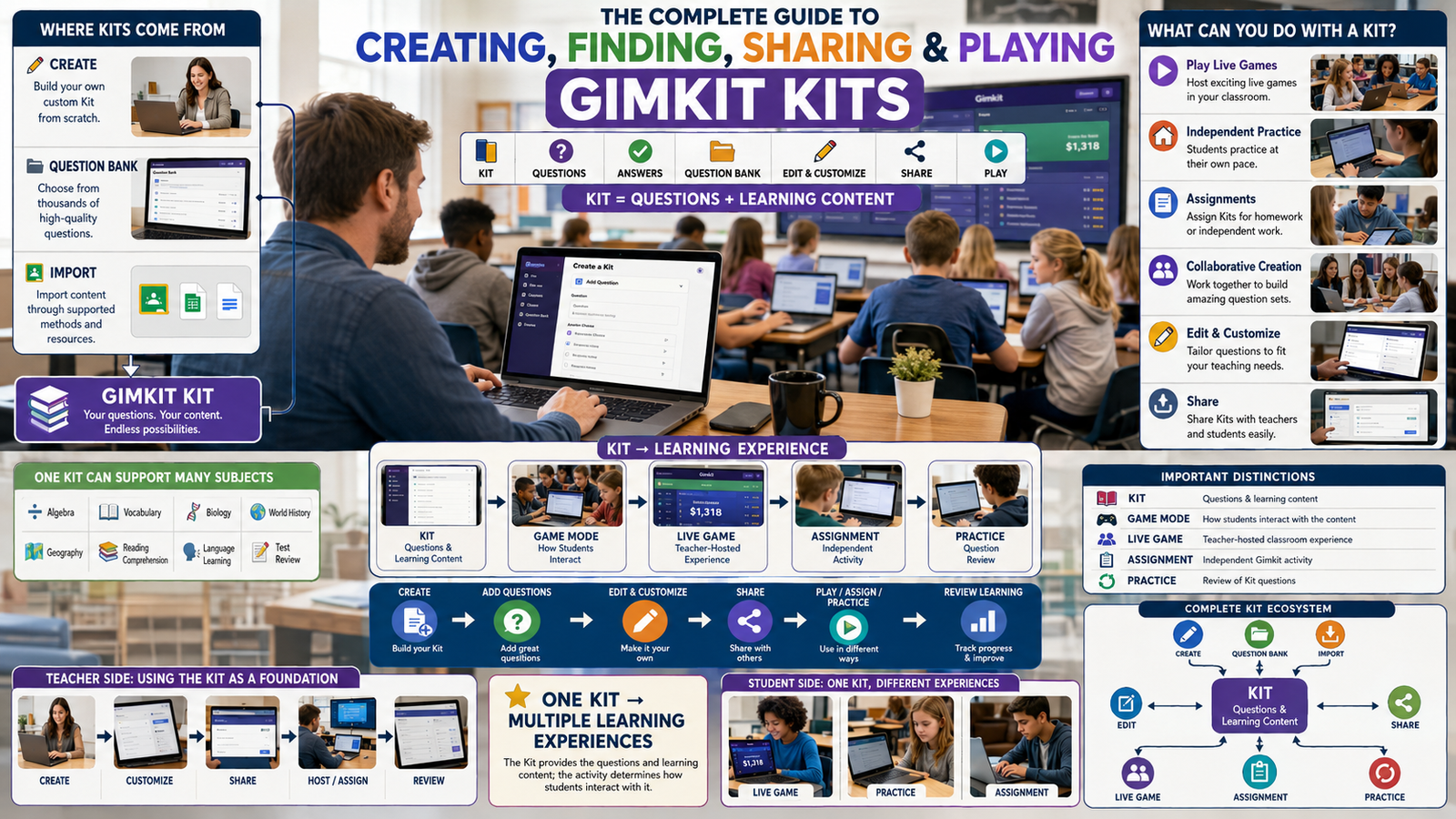
For a platform such as Gimkit, a controlled vocabulary would conceptually sit below the visible interface and alongside its information architecture.
It could provide standardized terminology for a defined information domain without requiring the user to understand how the terminology is managed internally.
This is a conceptual architecture, not a claim that Gimkit publicly documents a particular internal controlled-vocabulary implementation.
That distinction matters.
The Most Important Design Principle
A strong controlled vocabulary should make terminology more predictable without making the educational domain artificially rigid.
The goal is not:
“Everyone must use exactly the same words everywhere.”
The goal is:
“When different words, systems, or people refer to the same concept, the information environment should have a reliable way to recognize, organize, and distinguish those meanings.”
That is the point at which controlled vocabulary becomes valuable to educational technology: it creates a terminology layer capable of supporting consistent metadata, better discovery, cleaner classification, interoperability, multilingual representation, and long-term information maintenance.
Start With the Metadata Question, Not the Word List
A common mistake is to begin with:
“What terms should we add?”
A stronger approach begins with:
“What information are we trying to describe?”
For example, an educational platform may need terminology for:
Metadata question
Possible vocabulary purpose
What subject does this resource concern?
Subject vocabulary
What kind of resource is it?
Resource-type vocabulary
Who is it intended for?
Audience vocabulary
What educational level applies?
Education-level vocabulary
How difficult is it?
Difficulty vocabulary
What language does it use?
Language vocabulary
What learning objective does it address?
Objective vocabulary
1EdTech’s learning-resource metadata work provides examples of precisely these kinds of vocabulary-backed metadata fields, including language, discipline, learning-resource type, interactivity, intended user role, difficulty, and learning time.
The lesson is straightforward:
Define the information requirement first. Choose terminology second.
Do Not Build One Giant Vocabulary
A platform can be tempted to create one enormous terminology system containing every educational concept it might ever need.
That usually creates unnecessary complexity.
A better architecture separates domains:
Educational Metadata
       │
 ┌─────┼───────────┬───────────┐
 ▼     ▼           ▼           ▼
Subject Resource   Level     Language
       Type
Each vocabulary has a defined responsibility.
This makes governance easier because a change to a resource-type vocabulary does not automatically require restructuring the subject vocabulary.
It also allows different communities to use the terminology most appropriate to their domain.
1EdTech explicitly cautions against assuming that one vocabulary can serve every community or every metadata purpose.
Define the Vocabulary’s Scope Before Adding Concepts
Every vocabulary should have a boundary.
A scope statement might say:
“This vocabulary describes the educational subject areas used to classify learning resources.”
That immediately excludes unrelated concepts.
Without such a boundary, vocabulary growth becomes unpredictable.
A useful scope definition should answer:
What domain does the vocabulary describe?
Who will use it?
Where will it be applied?
What information is outside its responsibility?
Is it intended for people, software, or both?
Is it local, institutional, national, or intended for wider interoperability?
A controlled vocabulary with a clear scope is much easier to maintain than one that grows whenever a new terminology question appears.
Give Every Concept a Record
A practical concept record can be designed around a small number of fields.
Field
Purpose
Identifier
Stable machine reference
Preferred label
Main human-readable term
Alternative labels
Other accepted expressions
Definition
Meaning of the concept
Scope note
Appropriate usage
Broader concept
Hierarchical context
Narrower concepts
More specific concepts
Related concepts
Associative context
Status
Active, deprecated, etc.
Version
Vocabulary lifecycle
Editorial note
Internal maintenance information
Not every vocabulary needs every field.
The correct schema depends on the vocabulary’s purpose.
The principle is to capture only the information needed to make the terminology reliable.
Keep Human Labels Separate From Machine Identifiers
A strong implementation should avoid making the displayed label the only identity of a concept.
If the label changes later, the identifier can remain stable.
This separation is particularly useful when vocabulary values are exchanged between systems. Older learning-resource metadata specifications illustrate this principle by representing vocabulary values as resources rather than treating their textual labels as the entire identity of the value.
Decide Whether a New Entry Is a Concept or Just Another Label
This is one of the most important quality checks.
Suppose someone proposes:
“Math”
The vocabulary already contains:
“Mathematics”
The first question should be:
Is “Math” a new concept?
If not, adding a second concept creates unnecessary fragmentation.
The better solution may be:
Mathematics
   │
   └── Alternative label: Math
But if a proposed term actually represents a distinct concept, merging it simply because the wording looks similar would be equally harmful.
So every addition should pass a semantic test:
New concept, existing concept, or alternative label?
Use Validation Rules Before Publication
A controlled vocabulary should be checked before new terminology becomes part of production data.
A useful validation process might include:
Terminology check
Is the label clear and appropriate?
Duplicate check
Does an equivalent concept already exist?
Definition check
Can another person understand exactly what the concept means?
Relationship check
Are broader, narrower, and related relationships logically correct?
Identifier check
Is the identifier unique and stable?
Scope check
Does the concept actually belong in this vocabulary?
Interoperability check
Could another system understand or map the concept?
Governance check
Was the proposed term reviewed by the appropriate authority?
Only after these checks should a new concept become part of the published vocabulary.
Do Not Let the Vocabulary Become Too Large
More terms do not automatically mean better coverage.
A vocabulary with thousands of highly granular concepts can become difficult for users to apply consistently.
This is the same reason metadata systems need restraint.
1EdTech’s guidance warns against “metadata creep”: adding so many descriptive requirements that users are effectively forced into the role of specialist catalogers.
The equivalent vocabulary principle is:
Add enough terminology to produce useful distinctions, but not so much that consistent application becomes unrealistic.
Balance Precision With Usability
There is always a trade-off.
A very small vocabulary is easy to use but may be too vague.
A highly detailed vocabulary can be precise but difficult to apply.
Vocabulary design
Strength
Risk
Very broad
Easy adoption
Low precision
Moderately granular
Good balance
Requires governance
Extremely granular
High specificity
Harder to maintain
Uncontrolled
Flexible
Inconsistent data
The best level of granularity depends on the purpose.
A vocabulary used for broad navigation may need fewer distinctions than one used for specialist curriculum metadata.
Make the Vocabulary Machine-Readable When Machines Need It
A vocabulary intended only for editorial reference can exist as documentation.
A vocabulary intended to drive software should be represented in a structured format.
Possible representations include:
JSON;
XML;
RDF;
SKOS;
database tables;
APIs;
other structured interchange formats.
The correct choice depends on the implementation environment.
For web-based semantic vocabularies, W3C’s SKOS provides a standardized RDF-based model for concepts, labels, notes, relationships, collections, and mappings.
The key principle is:
The representation should match the systems that need to consume the vocabulary.
Separate the Vocabulary From the Application Interface
The vocabulary should ideally be reusable independently of one particular screen.
For educational platforms, that infrastructure can provide a dependable terminology layer for metadata, discovery, classification, filtering, interoperability, and long-term information management. Established learning-resource metadata guidance has treated vocabularies as an important part of describing educational resources, while also emphasizing that terminology should be appropriate to its community rather than forcing every educational environment into one universal scheme.
The most important principle is therefore not “control every word.”
It is:
Control the concepts that need consistency, preserve meaningful differences, and give every important term enough structure that both people and systems can understand what it represents.
That is what turns terminology from a collection of labels into a reliable information system.
Frequently Asked Questions
1. What is the main purpose of a controlled vocabulary in an educational platform?
A controlled vocabulary creates a consistent way to name and organize concepts across an educational information system. Instead of allowing different teams, resources, or databases to describe the same idea in unrelated ways, it establishes preferred terminology and, where necessary, alternative labels, definitions, identifiers, and relationships. This can make metadata more consistent and information easier to classify, filter, search, exchange, and maintain over time.
2. Is a controlled vocabulary the same as a taxonomy?
No. The two are related, but they are not identical.
A controlled vocabulary establishes and manages approved terminology. A taxonomy primarily organizes concepts into a structured classification, often through hierarchical relationships.
For example:
System
Primary purpose
Controlled vocabulary
Standardize terminology
Taxonomy
Organize concepts into categories
Thesaurus
Represent richer semantic relationships
Ontology
Model concepts and relationships more formally
A controlled vocabulary can contain hierarchical relationships, but simply having categories does not automatically make every terminology system a full taxonomy or ontology.
3. Why are identifiers important if users can already see the term?
Because a displayed label can change while the underlying concept may remain the same.
For example, a platform could change a preferred label from “Mathematics” to another approved wording. If software uses only the visible text as the identity of the concept, that change can look like a completely new value. A stable identifier separates concept identity from presentation.
This is particularly useful for historical records, databases, APIs, metadata exchange, and vocabulary versioning.
4. Can a controlled vocabulary contain synonyms?
Yes, but they should be handled deliberately.
A vocabulary can associate alternative labels with an established concept rather than creating a separate concept for every variation.
For example:
Preferred label: Mathematics Alternative label: Math
The important distinction is between a different expression of an existing concept and a genuinely different concept. Treating every synonym as a separate concept can fragment data and make classification less consistent.
5. How often should a controlled vocabulary be updated?
There is no universal update schedule. It should be reviewed according to how quickly the terminology and information requirements of its domain change.
Minor terminology corrections may be handled in smaller releases, while substantial structural changes may justify a major version. Deprecated concepts should also be handled carefully so historical data does not suddenly lose its meaning.
The important thing is not updating frequently for its own sake; it is ensuring that the vocabulary remains accurate, understandable, governed, and useful for the systems and people that depend on it.