Discover Gimkit Diamond Rush, the 2D
player-versus-player mode where Chance Blocks
can reward you, punish you or change your
next move. Explore how diamond collection,
knockout transfers and random outcomes
influence the final leaderboard.
Independent educational website; not affiliated
with or endorsed by Gimkit. Interactive
probabilities are fictional and customizable.
EVERY BLOCK IS A SURPRISE
❔CHANCE
💎DIAMONDS
⚡ENERGY
🎭RANDOM EFFECTS
🔫GADGET
🏆FINAL RANK
Chance determines outcomes. Strategy determines
how you respond to them.
01 / Historical Mode Identity
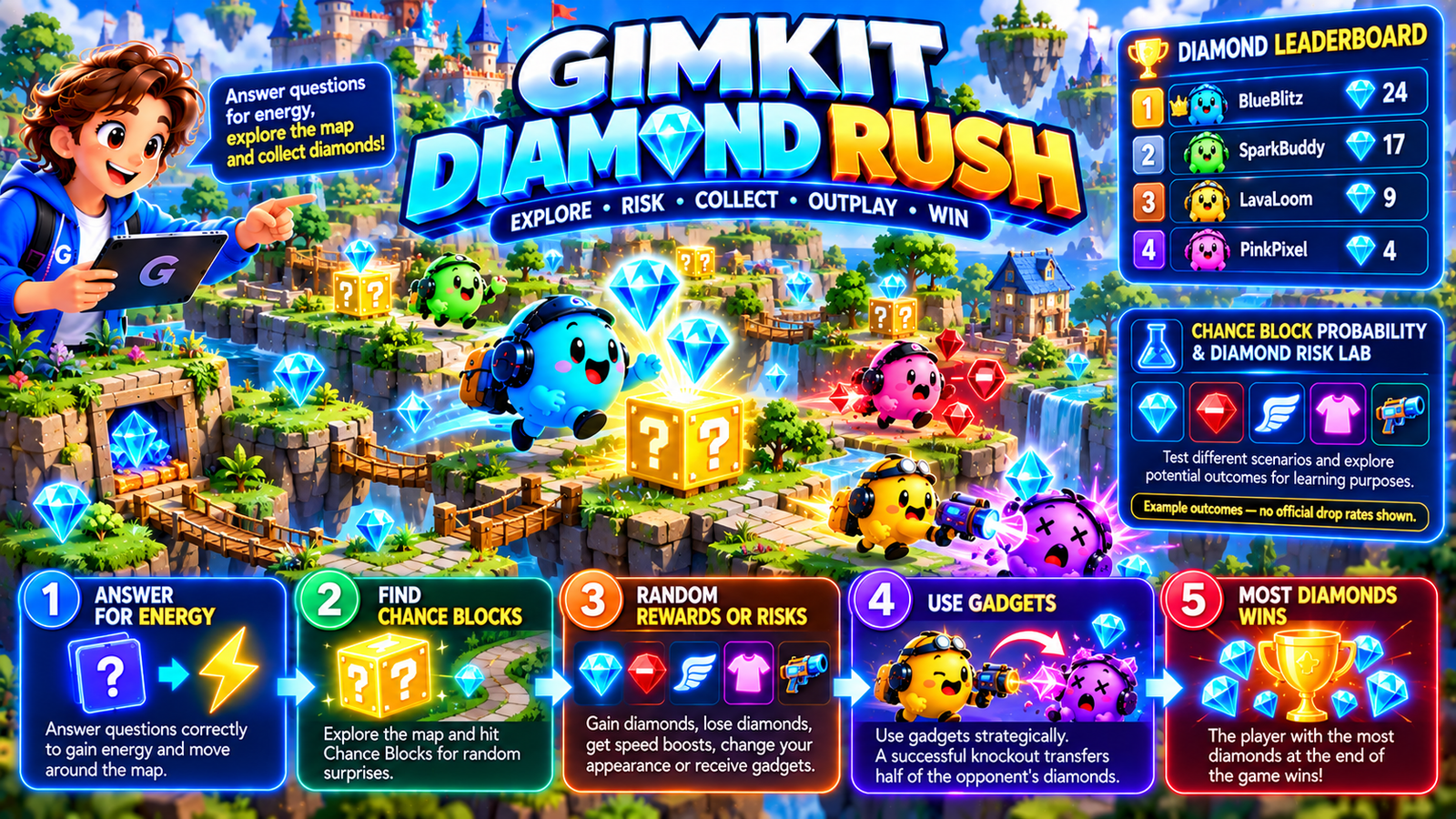
What is Gimkit Diamond Rush?
Diamond Rush is a chance-based, two-dimensional
Gimkit player-versus-player mode first released
on April 28, 2025. Its central objective is
to collect more diamonds than the other players
by the end of the game.
Players explore a map containing Chance Blocks.
Interacting with one activates a random outcome.
An outcome might grant diamonds, remove diamonds,
change the player's appearance, apply a temporary
effect or award a usable gadget.
Some gadgets allow players to knock out an opponent.
Historical descriptions explain that a successful
knockout transfers half of the defeated player's
diamonds to the attacker. That makes direct
player interaction another potential route
to building a leading total.
Verified game concept:
The community Gimkit Wiki records the original
April 2025 launch and reproduces the mode
announcement. Official Gimkit Help documents
the Mode Picker and general 2D balancing options.
The exact chance percentages are not verified
here, so they are never presented as fixed
official drop rates.
MECHANIC 01
❔ Chance Blocks
The primary source of unpredictable events.
A block can produce a beneficial outcome,
a disadvantage or an effect unrelated
to the player's immediate diamond total.
MECHANIC 02
💎 Diamonds
Diamonds are the central scoring resource.
The winner is determined by the highest
diamond total at the end of the game.
MECHANIC 03
🎲 Random Outcomes
Chance Blocks introduce uncertainty.
Players cannot assume every block provides
a positive reward or the same reward.
MECHANIC 04
🔫 Gadget Drops
Certain outcomes may award a gadget.
A gadget can create opportunities
for interactions with other players
that affect the diamond standings.
MECHANIC 05
🏃 Energy and Movement
Historical documentation describes
energy gained through answering questions
and spent while moving around the map.
MECHANIC 06
🏆 Time-Limited Rankings
The final ranking depends on diamonds
retained when the session ends,
not necessarily the number of
blocks activated along the way.
02 / The Chance Block System
Why Chance Blocks create a different kind of Gimkit game
Most predictable resource-collection systems
let players associate an action with a
reasonably stable reward. If the same action
always provides the same resource,
progression can be planned using a
fixed mathematical relationship.
Diamond Rush changes that relationship.
Activating a Chance Block does not
guarantee diamonds. The outcome
can depend on an event selected
from a range of possible effects.
Positive outcomes
A positive Chance Block may increase
a player's diamond total or provide
an effect that improves subsequent
opportunities to move and compete.
Diamonds are an immediate measurable
reward, while temporary speed
or gadget effects may create
indirect future advantages.
Negative outcomes
Historical descriptions explicitly
mention losing diamonds after
interacting with some Chance Blocks.
That makes repeated activation
different from a guaranteed
accumulation system.
A player with a large diamond balance
can still experience a negative event.
The final total therefore depends
on both earlier earnings
and subsequent losses.
Non-diamond outcomes
Some events affect the gameplay
experience without immediately
increasing or decreasing diamonds.
Examples described historically
include speed effects, gadgets
and changes in Gim appearance.
These outcomes should not be
counted automatically as equivalent
diamond rewards because their
value depends on context.
Why a lucky streak is not guaranteed
A player may activate several
Chance Blocks in succession
and receive positive outcomes.
That does not establish
that the next block
is more likely to reward them.
If selections are independent
in a hypothetical probability model,
earlier results do not
change the distribution
for the next event.
Why actual drop rates matter
The probability of each outcome
is essential for calculating a
mathematically expected diamond return.
Without those probabilities,
a precise prediction would
be unsupported.
The independent simulator below
allows users to enter hypothetical
event weights and see
the results under
those declared assumptions.
03 / Exclusive Interactive Application
Chance Block Probability & Diamond Risk Arena
Build a fictional Diamond Rush session.
Activate randomized Chance Blocks, manage
your diamond balance, earn energy, collect
gadgets, attempt knockout transfers and
compare outcomes across repeated mathematical
experiments. Change the probability
model to see how risk shifts.
Simulation disclosure:
All probability weights, block reward amounts,
energy costs and gadget knockout outcomes
in this lab are original illustrative rules.
They are not extracted from Gimkit's server,
not official Chance Block drop rates
and not predictions of your next real block.
The historical game concept of transferring
half the opponent's diamonds after a knockout
is modeled separately from fictional
gadget success probabilities.
💎 Diamond Rush Chance Laboratory
A fully local probability and
diamond-risk experiment with
repeatable actions and transparent
user-selected assumptions.
💎 Your Diamonds
0
🔋 Your Energy
100
❔ Blocks Opened
0
🔫 Gadgets
0
🏆 Your Rank
3 / 4
1. Define the Fictional Session
The model begins with 100 energy,
zero diamonds and three fictional
rivals. Question rewards and
block costs are independent
simulation values.
2. Open Chance Blocks
Select any unopened block. Each block
draws one event from the currently
configured probability distribution.
A new board may be generated after
all available blocks have been used.
Chance Block laboratory ready.
3. Customize the Chance Model
Enter nonnegative relative weights.
They do not need to add up to 100.
The simulator divides each weight
by the total to obtain a probability.
Every outcome is selected
independently on each block opening.
Fictional probability model ready.
4. Diamond Leaderboard
Three rivals have fictional starting
balances. Their totals change when
you simulate knockout transfers
or choose a rival update.
No real students are represented.
5. Gadget & Knockout Transfer
A gadget is consumed with each attempt.
If successful, the model transfers
floor(target diamonds / 2) to you.
Rounding down is a declared
modeling convention, not a
verified current official rule.
Collect a gadget to experiment
with knockout transfers.
6. Mathematical Risk Summary
Expected Diamond Change / Block
+57.50
Negative Event Probability
20%
Gadget Event Probability
15%
Observed Diamond Change
0
Expected direct diamond change uses
the declared reward and penalty amounts,
before balance floors, energy effects,
gadget interactions and later decisions.
7. Run a Monte Carlo Experiment
Experiment has not been run yet.
Experiment trials start from zero
diamonds, use only the positive
and negative diamond event rules,
apply the zero-balance floor
and ignore gadgets and energy.
Results therefore differ from
the complete interactive arena.
8. Activity History
No activity recorded.
04 / Random Outcomes
What can happen when a player opens a Chance Block?
The outcome of a Chance Block is
not necessarily a simple increase
to the diamond counter.
Historical mode descriptions identify
several categories of effects
that can produce different
immediate and future consequences.
Receiving diamonds
A direct diamond reward increases
the resource that determines
a player's competitive ranking.
If everything else remains equal,
gaining more diamonds moves
a player closer to the
highest final total.
Losing diamonds
A negative diamond event
reduces the amount held.
In a simplified system
with no negative balances,
the effective loss
depends on how many
diamonds the player
currently possesses.
A player holding
only forty diamonds
cannot lose one
hundred and fifty
under the simulator's
zero-floor assumption.
The actual reduction
is limited to forty.
Receiving a speed effect
Historical descriptions
include temporary speed
changes among the
possible outcomes.
A speed effect
changes the player's
opportunities to travel
around the map
but does not necessarily
award diamonds directly.
The lab represents
that category
through an illustrative
energy bonus.
This is a simplified
representation and
not an assertion
that official speed
boosts are energy rewards.
Receiving a gadget
Some Chance Blocks
may provide gadgets
that enable interaction
with other players.
This creates a possible
indirect method of
obtaining diamonds.
The historical mode
specifically describes
receiving half an
opponent's diamonds
after knocking
that opponent out.
Changing a Gim's appearance
Random events can
also change a
player's Gim appearance.
This produces a
visual effect
without automatically
increasing the
final diamond total.
The simulator treats
this as a
cosmetic-only event
with zero direct
diamond impact.
Why outcome categories matter
If all outcomes
were simplified
to a positive
diamond reward,
the central uncertainty
of Diamond Rush
would disappear.
Separating benefits,
penalties, temporary
effects and gadgets
is essential for
understanding the
mode's distinctive
risk structure.
05 / Knockout Transfers
Why an opponent's diamond balance changes the risk
Diamond Rush does not limit
diamond accumulation to Chance Blocks.
Historical gameplay descriptions
also identify a transfer mechanic
connected with gadget knockouts.
When a player knocks out another
player, the attacker receives
half of the opponent's diamonds.
This can change the relative
standings of two players at once.
A transfer affects both balances
Imagine a fictional player
holding one thousand diamonds
and an opponent holding
eight hundred.
If the first player
successfully knocks out
the second under
a half-transfer rule,
four hundred diamonds
move from the opponent
to the attacker.
The resulting balances
become one thousand
four hundred and
four hundred.
No new diamonds
were created by
the transfer itself.
Why a wealthy target can be attractive
A knockout involving
a player with a
very large balance
can produce a
larger transfer
than one involving
a player with
few diamonds.
That does not
mean pursuing
the wealthiest
opponent is always
the best action.
Position, available
gadgets and
other gameplay
conditions may
influence whether
a knockout is possible.
Why a knockout creates relative movement
A transfer of
four hundred diamonds
improves the attacker's
position by four hundred
while reducing the
target's position
by four hundred.
The difference between
the two balances
therefore changes
by eight hundred.
This is an
important arithmetic
distinction between
transferring a resource
and merely gaining
a new reward
from the environment.
Knockout success is not guaranteed
A player can
possess a gadget
but fail to
eliminate the
intended opponent.
Gadget availability
does not guarantee
a successful transfer.
The simulator
allows users
to set a
hypothetical success
percentage for
the attempted knockout.
That percentage
is not
an officially
published combat
success rate.
Why the transfer is capped by the target's balance
The simulator
calculates its
transfer using
the opponent's
present diamond count.
It does not
let the target
lose more
than the amount
they hold.
The transfer
therefore remains
a feasible
bookkeeping event
with nonnegative
player balances.
06 / Probability and Risk
How to reason about Chance Block uncertainty
Probability provides a
way to describe
uncertainty across a
set of possible outcomes.
It does not tell
a player exactly
which outcome will
appear on the
next block.
Relative weights
The laboratory
accepts an independent
weight for each
of five possible
event categories.
If the weights
are thirty-five,
twenty, twenty,
fifteen and ten,
the total is
one hundred.
Under those
hypothetical settings,
the first category
has a probability
of thirty-five percent.
If the weights
are changed
to seven, four,
four, three and two,
their relative
proportions remain
the same even
though the total
is now twenty.
Expected direct diamond change
Suppose a
fictional positive
event awards
250 diamonds
with probability
35 percent.
Suppose a
negative event
subtracts 150
diamonds with
probability
20 percent.
If the other
event categories
have zero
immediate diamond
value, the
theoretical expected
direct change is:
0.35 × 250
minus 0.20 × 150,
resulting in
57.5 diamonds
per block.
This value
is a calculation
for the
fictional assumptions,
not an estimate
derived from
Gimkit's actual
Chance Block odds.
Why expectation is not a guaranteed reward
An expected value
is a mathematical
average across
a hypothetical
large number
of repetitions.
It does not
mean every
block will
award 57.5
diamonds.
Each individual
result still
comes from
a discrete
event category.
Why the zero-diamond floor matters
The expected
value formula
above treats
a negative
event as
a full
fixed loss.
In the
interactive model,
a player
cannot hold
a negative
diamond balance.
If an event
requests a
loss greater
than the
current balance,
the actual
loss is
smaller.
This makes
the observed
results of
the full
simulation different
from a
simple unbounded
expected-value calculation.
Why longer runs can still differ
Repeated independent
random selections
tend to produce
aggregate frequencies
that approach
their underlying
probabilities
as the number
of trials increases.
However, even
thousands of
repetitions will
not usually
produce exactly
the expected
number of
each outcome.
Why the Monte Carlo tool is separate
The laboratory's
Monte Carlo experiment
performs many
independent simulated
Chance Block sequences.
It deliberately
excludes knockout
transfers and
most gameplay
effects so
that the
relationship between
direct diamond
rewards and
random outcomes
remains understandable.
07 / Strategy Experiments
Six ways to explore Diamond Rush decisions
Experiment 1: Open a single block
Begin with
the default
fictional probability
distribution.
Activate one
unopened block
and observe
the event.
Compare the
result with
the categories
available in
the settings.
A single
event gives
very limited
evidence about
the underlying
distribution.
Experiment 2: Compare five-block sequences
Reset the
simulation and
open five
blocks in
succession.
Repeat the
experiment after
another reset.
Notice that
the sequences
can produce
different outcomes
even when
the settings
are unchanged.
Experiment 3: Increase negative-outcome weight
Change the
fictional weight
assigned to
negative events,
then apply
the new
probability model.
The displayed
theoretical direct
diamond expectation
should decrease
when all
other settings
remain fixed
and the
effective chance
of loss increases.
Experiment 4: Test the influence of balance size
Start with
zero diamonds
and open
several blocks.
Some hypothetical
negative events
may cause
no actual
loss because
the balance
is already
at zero.
After acquiring
a positive
balance, a
similar negative
event can
have a
larger numerical
effect.
Experiment 5: Attempt a knockout transfer
Collect a
gadget through
the simulated
Chance Block system.
Select a
rival with
a significant
diamond balance.
Attempt a
fictional knockout.
A success
transfers half
the target's
diamonds under
the declared
model rule.
A failure
consumes the
gadget without
awarding diamonds.
Experiment 6: Run independent probability trials
Choose a
trial count
and blocks
per trial
in the
Monte Carlo panel.
Compare the
mean final
balance and
the proportion
of trials
finishing at
zero.
Increase the
number of
trials to
observe how
estimates can
become more
stable.
08 / Practical Play Concepts
Diamond rankings, movement and opportunity costs
A Diamond Rush
leaderboard reflects
diamonds held,
not merely
the number
of positive
Chance Blocks
activated.
Why retained diamonds matter
A player
who earned
many diamonds
early can
still fall
behind after
negative events
or knockouts.
The final
ranking therefore
reflects the
balance remaining
when the
game ends.
Why energy affects exploration
Historical documentation
describes players
receiving energy
by answering
questions and
spending energy
while moving
around the
map.
A player
with limited
available energy
may have
fewer immediate
opportunities to
reach additional
Chance Blocks.
Why randomness does not eliminate decision-making
Chance determines
what a block
produces, but
players still
decide where
to move,
whether to
continue exploring
and how
to use
available gadgets.
Randomness and
decisions can
therefore interact
within the
same game.
Risk near the end of a match
A player
who already
holds a
leading total
may evaluate
further random
events differently
from a
player who
is far
behind.
One player
has a
balance to
protect,
while another
may need
a large
positive outcome
to catch up.
This does
not prove
that either
should adopt
a particular
universal strategy.
Exact advice
would require
genuine outcome
probabilities,
time remaining
and information
about the
game state.
What a random event does not prove
Receiving a
negative result
after several
positive ones
does not
establish that
the system
is correcting
earlier luck.
Similarly,
one exceptionally
valuable reward
does not
reveal the
probability of
that reward
occurring again.
09 / Distinct Gameplay Concepts
How Diamond Rush differs from other Gimkit modes
Mode
Main Mechanic
Distinct Objective
Diamond Rush
Random Chance Blocks and diamond transfers
Finish with the most diamonds
Knockback
Fragility and positional projectile combat
Knock opponents off platforms
Color Clash
Repainting map territory
Control more colored tiles at time expiration
Dig It Up
Mining, permits and vertical construction
Reach Mayor Cole's balloon
Infinity Mode
Purchasing six unique stones
Complete the collection and trigger the Snap
Classic Mode
Cash earnings and upgrades
Compete through the classic cash economy
These comparisons describe primary mechanics,
not a complete list of current features
or account-specific mode availability.
10 / Classroom and Probability Learning
Using chance-based gameplay for critical reasoning
Diamond Rush provides
an interesting context
for discussing uncertainty,
probability and
how people interpret
random events.
Distinguish observed outcomes from probabilities
A student
may open
ten blocks
and observe
four positive
diamond rewards.
The observed
proportion of
forty percent
does not
automatically equal
the underlying
probability of
a reward.
A limited
sequence can
differ from
the long-run
distribution.
Understand why losses matter
A game
that contains
both rewards
and penalties
offers a
simple context
for discussing
changes to
a numerical
balance.
Learners can
distinguish
gross gains
from the
net amount
retained after
losses and
transfers.
Investigate expected value
Users can
experiment with
invented probability
weights and
diamond amounts.
They can
compare the
calculated expected
direct change
with the
outcomes of
a finite
series of
simulations.
Understand resource transfers
A knockout
transfer changes
the balances
of two
players without
necessarily creating
new diamonds.
This illustrates
the mathematical
difference between
adding a
new resource
and redistributing
an existing
resource.
Consider emotional reactions to randomness
Chance-based outcomes
can generate
excitement,
disappointment and
unexpected reversals.
In classrooms,
educators should
avoid interpreting
game luck as
proof of
student ability.
A learner
who finishes
with fewer
diamonds may
still understand
the academic
content well.
Keep the instructional objective visible
The questions
used in
the activity
remain important
to the
learning purpose.
A high
diamond ranking
is not
a stand-alone
measure of
subject mastery.
Teachers can
collect independent
learning evidence
through explanations,
written responses
or focused
follow-up tasks.
11 / Frequently Asked Questions
Gimkit Diamond Rush FAQs
What is Gimkit Diamond Rush?
A chance-based 2D PvP mode where
players interact with Chance Blocks
and try to finish with
the highest diamond total.
When was Diamond Rush released?
The community Gimkit Wiki records
April 28, 2025 as its
initial release date.
What do Chance Blocks do?
They trigger random events that may
grant diamonds, remove diamonds
or produce other gameplay effects.
Can a Chance Block make you lose diamonds?
Yes. Negative diamond outcomes
are included in the historical
game description.
Can Chance Blocks give gadgets?
Yes. Some historical Chance Block
outcomes include usable gadgets.
What determines the winner?
The player with the most diamonds
at the end of the match wins.
Can players steal diamonds through knockouts?
The historical mode description
says a successful knockout
transfers half the defeated
player's diamonds.
Does the mode use energy?
Historical documentation describes
question-answering energy that
supports movement in the 2D map.
Are official Chance Block odds known?
The official drop percentages
have not been verified
from the consulted sources.
The lab's probabilities
are independent assumptions.
What is a Monte Carlo simulation?
A method of estimating possible
outcomes by repeatedly sampling
from a specified probability model.
Does a positive expected value guarantee success?
No. It describes a theoretical
average under selected assumptions,
not the result of an
individual random event.
Can a player finish with zero diamonds?
The fictional simulator allows
the balance to reach zero and
prevents it from becoming negative.
Exact current official balance
handling should be verified separately.
Does the simulator reproduce the official game?
No. It models random outcomes
and resource transfers locally,
without real maps, accounts,
player movement or official odds.
Is Diamond Rush the same as Knockback?
No. Knockback centers on
fragility and platform elimination.
Diamond Rush centers on random
diamond outcomes and rankings.
Is Diamond Rush currently available?
Consult Gimkit's current Mode Picker
to verify availability and
account-specific game options.
12 / Documentation and References
Historical evidence and official information
Gimkit Community Wiki — Diamond Rush
.
Unofficial historical reference for the
April 2025 release, Chance Blocks,
diamond rankings and knockout transfers.
Official Gimkit Platform
.
Use the platform directly
for official gameplay,
available modes and current rules.
Related mode comparisons
For a separate
fragility-based arena
experience, explore
Gimkit Knockback
.
For a mode where
the central challenge
is controlling territory
rather than random
diamonds, see
Gimkit Color Clash
.
This page's subject is the
chance-driven diamond economy.
It does not attempt to duplicate
general Gimkit mode selection,
gadget combat physics or
cosmetic inventory tutorials.
FINAL PERSPECTIVE
In Diamond Rush, uncertainty is part of every decision.
Gimkit Diamond Rush combines random Chance Blocks,
diamond gains and losses, movement, gadgets
and knockout transfers into a distinctive
competitive system. Its defining feature
is not a guaranteed progression path,
but a series of uncertain events
that can change the leaderboard.
Use the independent Chance Block lab
to understand probability and risk,
and consult official Gimkit resources
for contemporary gameplay details.