Gimkit Color Clash: Paint the Map. Claim the Territory.
Discover Gimkit Color Clash, the 2D platformer
where Magenta and Green teams compete to paint
more of the map before the timer expires.
Learn how recapture changes territory, why
the final score matters more than early control,
and how to think about contested regions.
Independent educational website, not operated
or endorsed by Gimkit. The territory arena below
is an original mathematical simulation.
MAGENTA vs GREEN
Every tile has an owner — and that ownership can change.
01 / Historical Mode Identity
What is Gimkit Color Clash?
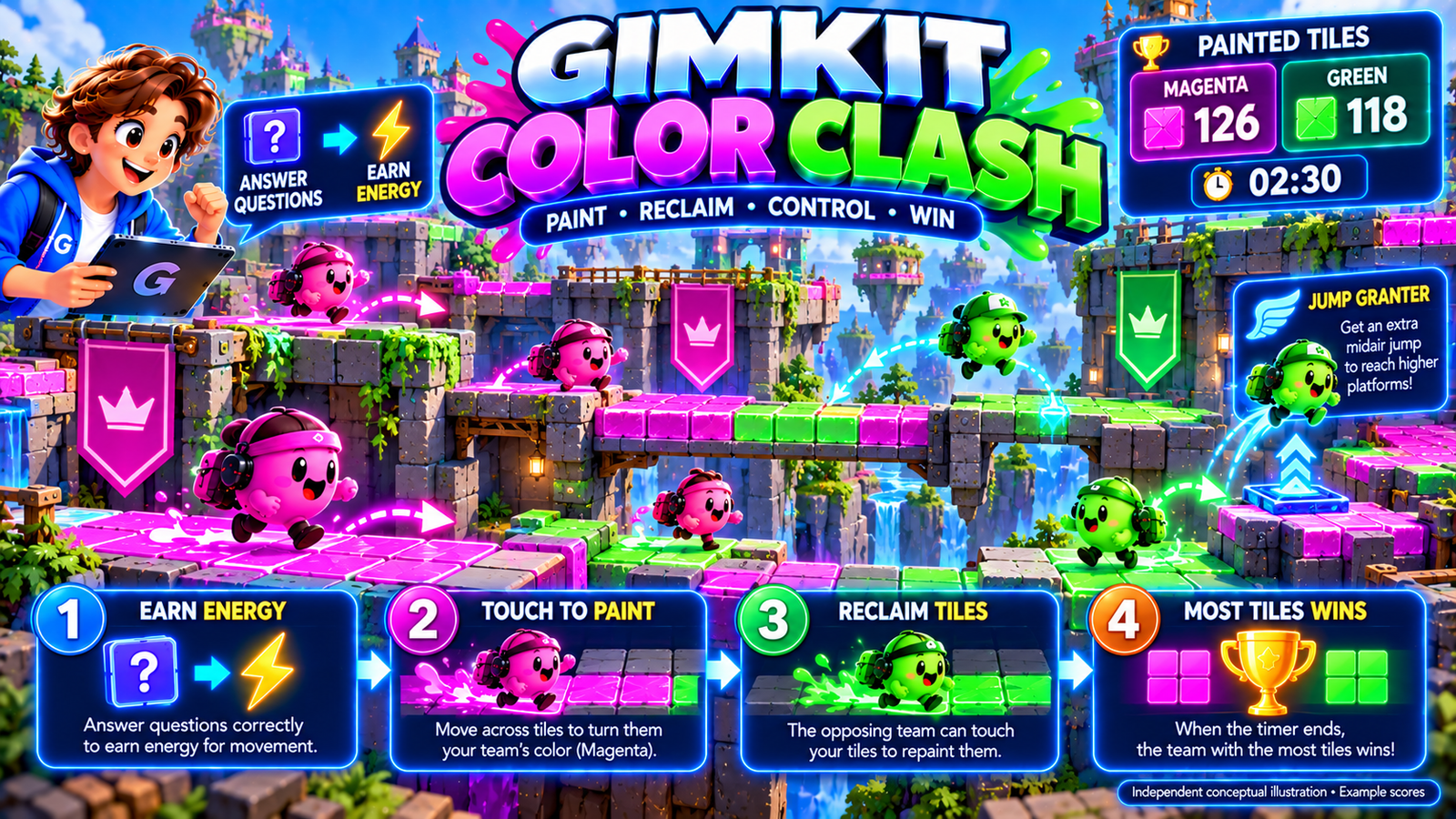
Gimkit Color Clash is a two-team, 2D platforming
game mode released on December 10, 2024.
It was featured during Gimkit's 2025 Season 2.
Players are divided into Magenta and Green teams,
then compete to change map tiles to their team's
color before the round timer reaches zero.
A painted tile is not permanently protected.
Players from the opposing team can visit and
change it back. Because control is reversible,
a team can lead for much of the match and still
lose territory in the final portion.
Verified mechanics: Historical community
documentation identifies the Magenta/Green teams,
tile painting and timed territory objective.
It is not a paint-themed drawing-and-guessing game
or a conventional cash leaderboard.
Official help documentation explains how 2D
question rewards may depend on game-specific settings.
TEAM 01
🟣 Magenta
Magenta players work toward controlling map tiles in their team's color. Their result depends on territory retained at the end.
TEAM 02
🟢 Green
Green players compete for the same map. They can take unclaimed tiles and repaint tiles previously controlled by Magenta.
MECHANIC 01
🎨 Tile Painting
Moving through the environment changes eligible tile colors to reflect team ownership.
MECHANIC 02
🔁 Recapture
Previously claimed territory can switch sides. The same map area may contribute to either team's final total.
RESOURCE
🔋 Question Energy
Players answer questions to earn energy that supports movement and gameplay in the historical mode.
VICTORY
⏱️ Timed Control
Territory ownership when time runs out determines the winner. Temporary midgame leads are not final results.
02 / Why Territory Ownership Matters
Color Clash is about current map control, not total paint used
A key distinction in Color Clash is the difference
between painting activity and current ownership.
A player might repaint the same tile several times,
but that tile can belong to only one team at a time.
Counting every paint action as a permanent point
would produce the wrong kind of territory score.
Unclaimed tiles
At the beginning of a simplified territory game,
some tiles may belong to neither team. Claiming one
gives the active team an additional controlled tile
without taking anything from its opponent.
Opponent-owned tiles
A recapture is a different event. When Magenta
takes a Green tile, Magenta gains one controlled
tile while Green loses one. The gap between
team scores changes by two tiles.
This difference is especially relevant when
comparing whether to paint new territory
or challenge territory already held by
the opponent.
Tiles as a limited resource
A map has a finite number of tiles. If every
eligible tile has been colored, gaining more
territory requires changing ownership of
an existing tile.
A team cannot continually expand its total
forever because the total number of
controllable spaces is limited.
Why final ownership is decisive
Historical Color Clash descriptions emphasize
having the most colored tiles when time ends.
That means the timing of a recapture can matter.
An early lead does not guarantee survival of
that lead through the rest of the match.
Similarly, a late recapture may change a
close outcome even if the team was behind
during the preceding minutes.
03 / Exclusive Interactive Application
Color Clash Territory Control & Recapture Arena
Operate a simplified, clickable 12-by-8 territory
board. Select Magenta or Green, then paint tiles
for the selected team. Switch sides to demonstrate
recapture, earn energy, advance the round clock
and inspect connected territories, contested
regions and the final scoring result.
Independent simulation: The rectangular
board, painting energy cost, movement-free click
controls, clock increments and connected-region
calculations are educational modeling choices.
The official game uses 2D platforming and its
own map rules. This is not a working Gimkit
client or a connected classroom match.
🎨 Magenta vs Green Territory Studio
Claim neutral territory, steal opponent tiles,
compare score margins and observe how a
timed finish changes the meaning of a lead.
🟣 Magenta Tiles
0
🟢 Green Tiles
0
⬜ Unclaimed
96
⏱️ Time Left
120s
🏁 Current Leader
Tie
1. Choose Team & Energy Rules
Both teams begin with 100 fictional energy.
Claiming a neutral tile or repainting an opponent
tile costs the same configurable amount. Painting
a tile already controlled by your team does nothing.
2. Interactive Territory Grid
Click any tile to paint it for the active team.
Change the team selection to demonstrate recapture.
This deliberate abstract board does not simulate
real 2D movement or line-of-sight constraints.
Territory board ready.
Magenta 0% • Green 0% • Unclaimed 100%
3. Clock & Scenario Controls
The clock advances only when you press a control.
There is no background timer. Scenario presets
overwrite the current board and reset the activity
record so experiments remain reproducible.
4. Team Resources & Actions
Magenta Energy
100
Green Energy
100
Tiles Repainted
0
Paint Actions
0
The board is currently tied.
5. Territory Structure
Magenta Connected Regions
0
Green Connected Regions
0
Magenta Largest Region
0
Green Largest Region
0
Connected regions use up/down/left/right tile
adjacency. They help investigate territory
shape but do not award bonus points in the
historical mode's documented victory rule.
6. Border Exposure & Recapture
Magenta Exposed Edges
0
Green Exposed Edges
0
Territory Gap
0
Neutral-to-Owned Actions
0
Capture tiles to compare border exposure.
An exposed edge is an orthogonally adjacent
rival-controlled tile boundary. This is a
geometric observation, not an official
Color Clash game statistic.
7. Territory Activity Log
No paint actions yet.
04 / Claiming and Recapturing
Why taking an opponent tile changes the score twice
A territory contest contains at least two
different types of painting actions:
capturing a neutral space and recapturing
an already owned space.
Neutral capture
Imagine Magenta controls forty tiles while
Green controls thirty. If Magenta captures
one unclaimed tile, its total rises to
forty-one, but Green remains at thirty.
The lead grows by one tile.
Recapturing Green territory
If Magenta instead paints a tile owned
by Green, Magenta gains one and
Green loses one. The original ten-tile
advantage grows to twelve.
This is an important feature of
reversible map ownership. An action
can affect both sides of a
comparison rather than one side only.
Why repainting your own tile produces no gain
The score comes from the number
of currently controlled tiles.
A tile already assigned to Magenta
cannot provide an additional
Magenta tile merely because
another Magenta player visits it.
In the independent simulator,
attempting to repaint an
already-owned tile is rejected
without spending energy.
Why territorial leads can reverse
A large early lead can disappear
if the opposing team repeatedly
recaptures the leading team's
territory. Control is temporary
until the round ends.
This distinguishes Color Clash
from a score that simply
accumulates forever after
every successful action.
05 / Map Shape and Connectivity
Connected territory versus scattered territory
Two teams may control the same number of
tiles while occupying dramatically different
shapes on the board.
One team's tiles might form a large
connected region. Another team's
tiles might be scattered across
many separate locations.
Connected components
In the territory lab, a connected
component is a group of same-color
tiles linked horizontally or vertically.
Diagonal touching is not enough
to join two components.
This rule provides a simple
way to compare spatial
organization. It is an
independent analytical feature,
not a special scoring bonus
claimed for the official mode.
Largest connected region
The lab also identifies the
number of tiles in each
team's largest connected
component. This reveals whether
a score is concentrated
in one region or distributed
among smaller areas.
Exposed boundaries
When two opposite-color tiles
share an edge, that edge
represents a direct border
between competing territories
in the mathematical grid.
A team with many exposed
boundaries occupies a
more intermingled pattern
with the opposing color
than a team whose tiles
are entirely separated.
Why shape does not automatically determine the winner
The documented historical
winning condition centers
on the number of tiles
controlled when time runs out.
The simulator therefore
does not award additional
points for large regions,
compact shapes or low
border exposure.
These metrics are offered
to make spatial relationships
understandable without
inventing an official
territory-scoring formula.
06 / Timed Matches
Why the ending changes the value of territory
The historical objective is determined
when the match timer expires.
Before that moment, tile ownership
can still change.
Early territory control
An early lead tells players
who currently controls
more of the map, but
it does not necessarily
establish who will win.
There may still be enough
time for the other team
to retake important tiles
and reverse the standings.
Middle-stage recapture cycles
During a longer contested
period, the same area
may change ownership
more than once.
The number of historical
paint events may therefore
be much greater than
the number of tiles
on the map.
Late-match control
When little time remains,
current territory ownership
becomes more immediately
relevant to the final
result. A close lead
can change after only
a few recaptures.
Why energy still matters near the finish
Under the historical description,
players earn energy
through answering questions
and spend energy moving.
The exact balance between
question participation
and movement may depend
on game settings.
In the fictional lab,
energy is the
cost of each
tile-coloring action.
This simplifies
the relationship
without claiming
that real
painting costs
energy directly.
07 / Territory Experiments
Six experiments with painting and recapture
Experiment 1: Claim neutral spaces
Begin with an empty board,
select Magenta and paint
five unclaimed tiles.
Observe how the Magenta
score increases without
reducing the Green score.
Experiment 2: Recapture opponent territory
Switch to Green and
repaint three tiles
controlled by Magenta.
Compare the total
territory gap before
and after the actions.
Experiment 3: Create a compact region
Reset the lab and
paint several
adjacent tiles
in one rectangular
area using Magenta.
Note the size of
its largest region.
Experiment 4: Scatter the same number of tiles
Reset again and
paint the same
number of tiles
in separate
locations across
the board.
The score may
be identical
while the
connected-region
metrics differ.
Experiment 5: Load a contested board
Use the
Contested Opening
preset and
identify the
current leader,
neutral space
and direct
borders between
colors.
Experiment 6: Test a close finish
Select the
Close Finish
scenario, use
the clock control
and make
a small
number of
recaptures before
the round ends.
Observe how
a narrow
territory lead
can become
a tie
or change
sides.
08 / Classroom Concepts
Territory maps as a context for mathematics
Color Clash
can serve as
a context
for thinking
about percentages,
finite sets,
spatial relationships
and changing
comparisons.
Percent of a map
A team controlling
forty-eight tiles
of a ninety-six-tile
board owns
fifty percent
of the map.
This relationship
is straightforward
to calculate
from the
independent grid.
Two-sided changes
A recapture
simultaneously increases
one team's count
and decreases
the other's.
It therefore
changes the
difference between
their scores
by two tiles,
even though
only one tile
changes ownership.
Graph connectivity
The concept
of connected
regions provides
an introduction
to graph-like
relationships on
a rectangular grid.
Tiles can be
treated as
positions linked
through horizontal
and vertical
adjacency.
Time-dependent outcomes
A temporary
lead is
not the
same as
a final
result.
That distinction
helps learners
reason about
changing states
over time.
Evidence of academic understanding
Winning the
fictional territory
simulation is
not proof
of understanding
the subject
material in
a real
Gimkit Kit.
Educational assessment
should focus
on meaningful
evidence of
the learner's
answers and
reasoning,
rather than
map control
alone.
09 / Gameplay Comparison
How Color Clash differs from other Gimkit modes
Mode
Primary Mechanic
Winning Objective
Color Clash
Reversible Magenta/Green tile ownership
Most territory at match end
Diamond Rush
Chance Blocks and changing diamond balances
Most diamonds at match end
Capture the Flag
Team flag objectives and defense
Capture opposing flag objectives
Knockback
Fragility and positional combat
Knock opponents off platforms
Apocalypse
Cooperative Horde and vault defense
Survive enemy attacks
These summaries describe the primary
identities of separate gameplay modes.
They do not guarantee current
availability or identical rules
for every historical version.
10 / Color Clash FAQs
Frequently asked questions
What is Gimkit Color Clash?
A two-team 2D platformer in which Magenta and Green players compete to color and control more map tiles before time runs out.
When was Color Clash released?
Historical community documentation records December 10, 2024.
What are the two Color Clash teams?
Magenta and Green.
How does a team paint territory?
In the historical game description, players move around the map and color tiles for their team.
Can painted tiles change ownership?
Yes. A player can repaint tiles that were previously controlled by the opposing team.
How is the winner determined?
The team holding the most painted tiles when the match time ends wins.
Does Color Clash use 2D platforming?
Yes. The historical mode is classified as a 2D platformer.
How do students earn movement energy?
Historical descriptions say correct answers provide energy. Current 2D reward settings may vary according to official host controls.
Does a recaptured tile count twice?
No. The tile belongs to one team at a time. However, transferring ownership changes the score difference by two tiles.
Do connected regions award bonus points?
No such bonus has been verified from the historical winning-condition description. Region analysis in the lab is purely educational.
Is this the same as Draw That?
No. Draw That is a drawing-and-guessing experience. Color Clash is a competitive territory-painting platformer.
Are these exact official map dimensions?
No. The 12-by-8 grid is an independent simulation.
Can the lab connect to a live Gimkit match?
No. It works locally in the browser and does not contact Gimkit servers.
Is Color Clash currently available?
Check Gimkit's official Mode Picker for current access and options.
Color Clash is a battle for the map's final colors.
Gimkit Color Clash turns the environment itself
into the competitive objective. Magenta and Green
players paint tiles, challenge rival territory
and attempt to control the most space before
the timer expires. Its defining feature is
reversible ownership: the same tile can change
sides repeatedly without increasing the size
of the map. Use the independent territory lab
to understand that relationship, and official
documentation for current gameplay options.