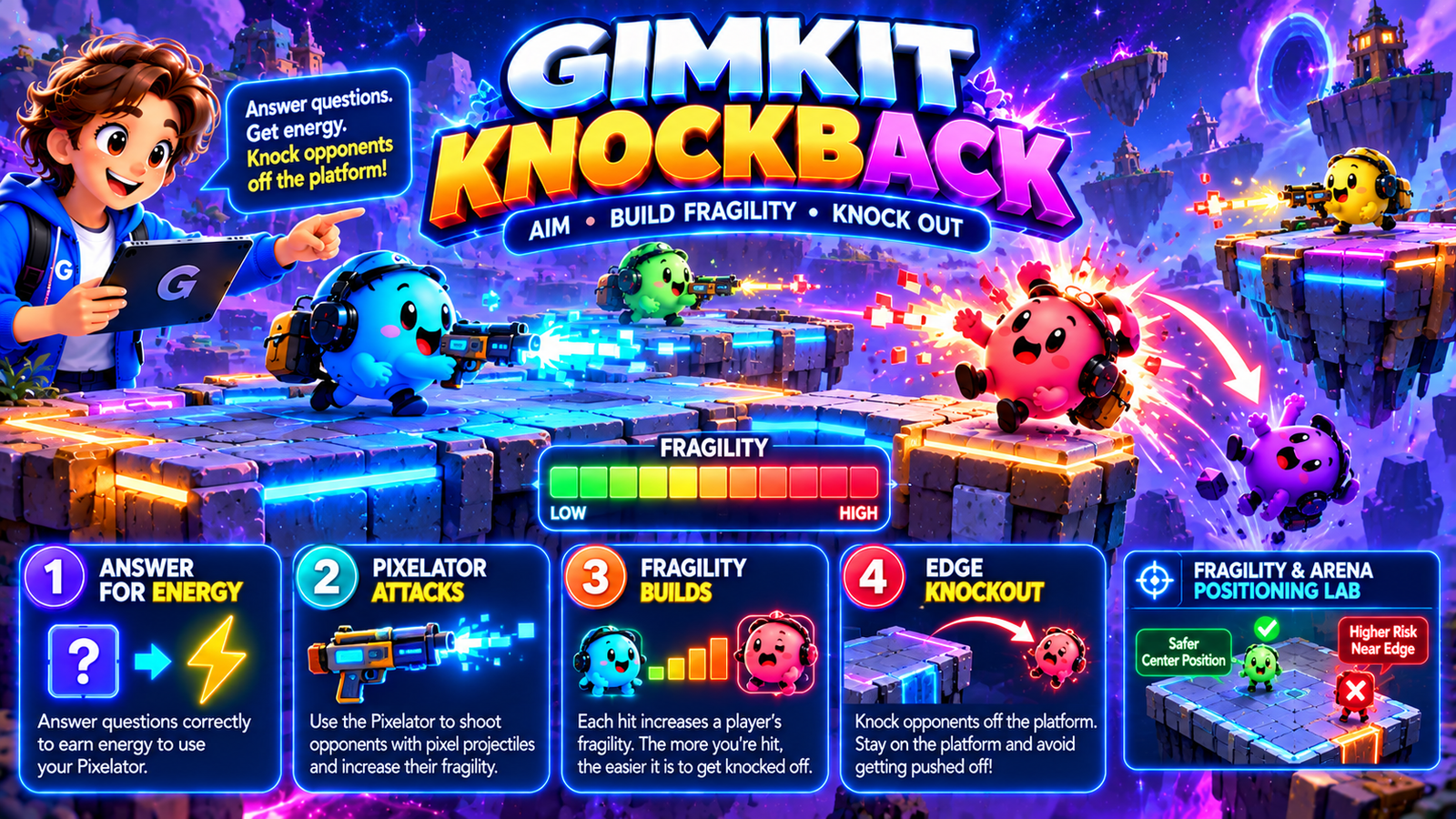
Explore the historical Gimkit Knockback mode,
where Pixelator attacks increase opponents'
fragility and powerful knockback can send
players beyond platform edges. Understand
how positioning, energy and repeated hits
influence this distinctive 2D competition.
Independent educational resource. Not operated by
or endorsed by Gimkit. The arena below is a
fictional interactive physics model, not an
official game or a connected multiplayer session.
THE PLATFORM IS THE BATTLEFIELD
🔵
🔴
⚡ Build fragility💥 Create knockback🏁 Force an edge exit
01 / Mode Identity
What is Gimkit Knockback?
Gimkit Knockback is a two-dimensional
player-versus-player mode built around
sending opponents off platforms.
Players use the Pixelator gadget,
gain energy through the game's
question system and engage in
positional combat against other players.
Its signature concept is fragility:
a percentage-based value that
increases as players are hit.
The community-maintained Gimkit Wiki
records the mode's release as
May 6, 2024 and describes
free-for-all and team-based play.
Verified distinction:
Official Gimkit Creative documentation
describes a Fragility health mode
that enables knockback and caps
fragility at 999%.
The exact knockback formula used by
the official Knockback mode is not
published in the consulted source.
This guide separates documented
mechanics from independent simulation.
PRIMARY OBJECTIVE
💥 Knock Out Opponents
Players aim to force their opponents
beyond platform boundaries rather than
simply reduce a conventional
health bar to zero.
GAME MECHANIC
📊 Fragility
Fragility increases when applicable
attacks connect. High fragility
makes a player increasingly vulnerable
to strong knockback.
GADGET
🔫 Pixelator
Historical gameplay documentation
identifies the Pixelator as the
mode's projectile gadget used
against other players.
RESOURCE
🔋 Energy
Energy connects question participation
to combat activity. Managing available
energy matters when choosing
when to fire or reposition.
SPATIAL SKILL
📍 Platform Position
A player standing close to the edge
can be in greater danger than
someone near the middle under
identical attack assumptions.
MATCH FORMAT
👥 Individual or Teams
Community records describe both
free-for-all and team formats.
The central mechanics remain
fragility and displacement.
02 / The Fragility System
Why Knockback is different from ordinary health combat
In a conventional health-based game,
a successful attack often decreases
a player's remaining health.
Defeat follows when that value reaches
a particular lower boundary.
Knockback works through a different
conceptual relationship.
Successful hits increase the
target's fragility and produce
displacement. Defeat depends on
whether that displacement carries
the target beyond the playable platform.
Fragility is vulnerability, not remaining health
A fragility percentage is not
equivalent to a health balance.
A high percentage does not mean
that a player has only a small
amount of health left.
Instead, it indicates a state
in which further knockback can
become especially dangerous.
This introduces a relationship
between earlier hits and the
consequences of later attacks.
The documented 999% cap
Gimkit's official Creative changelog
states that Fragility can increase
to a maximum of 999%.
That cap is a documented
system property, not
a number invented for this guide.
The simulated arena applies the
same upper numerical cap while
keeping the damage and displacement
calculations independent from
the official game.
Why displacement matters
A player might survive an
attack that produces a substantial
amount of movement if there is
enough safe platform nearby.
The same impulse directed toward
a nearby edge could result in
an immediate elimination.
This means position is part of
the defensive state, not merely
an aesthetic detail of the map.
Why identical hits can have different outcomes
Consider two fictional targets
with the same fragility.
One is near the platform center;
the other is close to the right edge.
A rightward attack of equal strength
affects both targets, but
the second has less room
before leaving the platform.
Their outcomes can differ
because the remaining distance
to the boundary is different.
03 / Exclusive Interactive Application
Fragility & Arena Positioning Physics Lab
Experiment with a simplified platform,
two local fighters, projectile-style attacks
and a transparent fragility formula.
Move the selected fighter, build up
an opponent's fragility and test
whether a hit causes an edge elimination.
Educational model:
Horizontal coordinates, projectile range,
movement step, attack energy cost,
fragility per hit, impulse multiplier
and edge limits are original assumptions.
The official 999% fragility cap is
documented; the simulator's formula
is not Gimkit's proprietary physics.
There are no real opponents or
official session connections.
💥 Knockback Arena Strategy Studio
A local two-fighter physics experiment
with position-dependent elimination,
configurable hit strength and
repeatable arena scenarios.
🔵 Blue Fragility
0%
🔴 Red Fragility
0%
🔋 Blue Energy
100
🔋 Red Energy
100
🏁 Eliminations
0
1. Configure the Physics Model
Arena coordinates run from 0 to 100.
Safe ground occupies 8 to 92.
A successful shot increases fragility,
then applies horizontal displacement:
base impulse × (1 + updated fragility / 100).
Every shot uses the configured energy
even when the target is out of range.
2. Live Fictional Platform Arena
LEFT EDGE: 8RIGHT EDGE: 92
0%
B
0%
R
The displayed platform is a horizontal
teaching model. It does not attempt
to reproduce actual Gimkit
jumping, gravity, collisions,
projectile travel or maps.
3. Control the Selected Fighter
Move changes position by 5 units.
A shot is aimed automatically
toward the opponent. You can also
use the Left and Right arrow keys,
and Space to fire, while the active
arena control is focused.
4. Respawn and Recovery
Recovery and respawn are independent
teaching controls. The 50% recovery
button is not a claim about an
official freely available
recovery action in the mode.
Arena ready.
5. Fighter Condition
🔵 Blue
0%
Position: 30
Active
🔴 Red
0%
Position: 70
Active
Blue Eliminations
0
Red Eliminations
0
Shots Fired
0
Successful Hits
0
6. Knockback Risk Assessment
The fighters begin at separate
positions on the safe platform.
The calculation distinguishes
current fragility, remaining distance
to the outward edge and predicted
horizontal displacement from
the configured shot.
7. Positioning Experiments
Presets create repeatable fictional
situations for comparing safe
positioning and vulnerability.
They do not modify the official game.
8. Arena Event History
No actions recorded yet.
04 / Arena Positioning
Why platform-edge positioning changes the battle
Knockback's central spatial problem
is not simply whether a player
can land a successful projectile.
The important question is where
the opponent will move after
being struck.
The middle of a platform offers more room
A player positioned near the
center has usable space
in both directions.
If an attack pushes them
horizontally, there may be
sufficient platform remaining
to survive the displacement.
This makes the center
a comparatively forgiving
position under a basic
horizontal knockback model.
However, actual platforming
also involves timing,
jumping and movement controls
not represented in this lab.
Edges create elimination opportunities
Near a platform edge,
the available safe
displacement distance is small.
A successful attack directed
outward may force the
target beyond the platform.
An opponent with low fragility
may therefore still be
vulnerable when standing
extremely close to a boundary.
Direction matters
A rightward impulse directed
at a player near the right
edge is more immediately
dangerous than the same
impulse directed toward
the center of the platform.
This relationship demonstrates
why knockback calculations
need direction as well
as numerical strength.
Repositioning changes future risk
A player who moves away
from the edge creates
more space before the
next outward hit.
That may increase
the displacement needed
to cause an elimination.
Repositioning can therefore
be a defensive action,
even if it produces
no immediate score.
Platform geometry is part of strategy
Real game environments
can include multiple platforms,
gaps and other spatial
constraints. The community
Knockback Wiki describes
seven zones and platforming
techniques such as
coyote jumps.
Those details make the
historical mode more
sophisticated than the
single straight platform
presented here.
The lab intentionally isolates
one horizontal situation
so that the effect of
edge distance remains understandable.
05 / Attacks and Energy
How the Pixelator and question energy fit together
Historical descriptions of
Gimkit Knockback identify
the Pixelator as the
combat gadget associated
with its player-versus-player
platform encounters.
Players also interact
with Gimkit's question
system to generate
energy for gameplay.
These systems connect
academic participation
with opportunities to act
inside the arena.
Energy limits action frequency
A fictional fighter
with one hundred
energy cannot
necessarily fire
indefinitely if
every shot requires
an energy payment.
The simulator lets users
configure a cost
for each projectile
and records that
amount whenever
a shot is fired.
Shots are not guaranteed hits
In the model,
a shot can miss
because the opponent
is beyond the
chosen horizontal range.
Energy is still spent
on that unsuccessful
shot. This helps
distinguish the
cost of attempting
an action from
the reward of
successfully completing it.
Hits accumulate vulnerability
A valid hit increases
the target's fragility.
The simulator adds
the selected percentage
to the existing amount,
subject to the
documented 999% cap.
Its horizontal
displacement formula
then uses the
updated fragility,
meaning repeated
hits can create
progressively greater
knockback distances.
Why high fragility changes decision-making
A target with high
fragility may need
less additional pressure
to be eliminated
near an edge.
This can change
the significance
of positioning
and recovery
as the encounter
progresses.
Question-answering is not invulnerability everywhere
The community historical
Knockback Wiki records
that players cannot
be hit while
answering questions.
It describes
projectiles passing
through the player
in that state.
This is a
specific historical
behavior. It should
not be generalized
to every Gimkit mode
or treated as a
guaranteed current
rule without checking
live gameplay.
06 / Recovery and Elimination
What happens when a player leaves the platform?
In a fragility-based
platform battle,
an elimination occurs
when the player
leaves the permitted
arena boundary
under the relevant
game rules.
Why the boundary defines the elimination
The fictional arena
contains a safe
interval from
horizontal coordinate
eight to ninety-two.
When a simulated
impulse moves a fighter
beyond either edge,
the application
marks the fighter
as eliminated.
This is intentionally
simpler than real
platform collision
and falling physics.
Fragility after a knockout
Community historical
documentation records
a 50% fragility
reduction associated
with knocking another
player off the map.
The laboratory applies
a fifty-percent reduction
to the attacker
after a successful
fictional elimination.
It does not
claim every current
official elimination
behaves identically.
Respawn is a distinct state transition
A respawn returns
a fighter to
an active arena
position.
It is not
the same event
as resisting
the knockback
that caused
the elimination.
The simulator includes
an explicit respawn
button to separate
those concepts.
Official Creative settings and fragility reset
The official Gimkit
Creative changelog
explains that
fragility can be
reduced or reset
through healing
or the Respawn device,
depending on the
Creative implementation.
The laboratory's
independent recovery
control is a
teaching convenience,
not a statement
about the exact
official Knockback
mode interface.
07 / Practical Arena Experiments
Six experiments to understand fragility and positioning
Experiment 1: Compare safe central positions
Select the Center Positions
preset and observe where
the two fighters begin.
Fire a fictional projectile
from one toward the other.
Note how far the
struck fighter moves.
A central position
leaves space for
displacement before
the player reaches
an edge.
Experiment 2: Create edge pressure
Select the Edge Pressure
preset. The red fighter
begins close to
the right boundary.
Fire a shot from
the blue fighter
and compare its
effect with the
central-position experiment.
The model illustrates
why a moderate
knockback impulse
may be sufficient
near an arena edge.
Experiment 3: Increase target fragility
Use the High Fragility
preset, which assigns
a large starting
percentage to the
red fighter.
Fire another shot
and observe how
the impulse calculation
uses the updated
fragility.
The result helps
explain the concept
of accumulated
vulnerability.
Experiment 4: Change attack strength
Increase the base
impulse while leaving
the other settings
unchanged.
Reset the arena
positions and
perform the
same fictional attack.
Compare the
resulting displacement
and identify
whether the
stronger impulse
creates an
elimination.
Experiment 5: Use a low-energy fighter
Increase the
simulated energy
cost of each
shot, then
fire repeatedly.
Eventually the
fighter may
lack enough
energy for
another attack.
Record an
independent question
action to
replenish energy.
Experiment 6: Compare recovery and respawn
Increase fragility
through successful
hits, then
use the
Recovery control.
Observe how
the fighter's
fragility changes
without necessarily
changing position.
Next, cause
an elimination
and use
Respawn to
return the
fighter to
the arena.
This separates
vulnerability recovery
from restoration
of an eliminated
player.
08 / Mode Comparisons
How Knockback differs from other Gimkit 2D modes
Experience
Primary Mechanic
Distinct Objective
Knockback
Fragility and positional displacement
Eliminate opponents by knocking them off platforms
Don't Look Down
Vertical platform challenges
Climb through increasingly demanding jumps
Blastball
Team-based ball movement
Score goals using the game ball
Snowbrawl
Snowball-based competition
Compete with opposing players using snowballs
Dig It Up
Mining, resources and permits
Build toward Mayor Cole's rescue
Apocalypse
Cooperative Horde defense
Protect the vault across enemy waves
These distinctions describe primary gameplay
concepts and are not a guarantee
that every mode is currently
available to every account.
09 / Gimkit Creative Connection
Knockback mechanics inside Gimkit Creative
A useful verified connection
comes from Gimkit's
official Creative documentation.
Knockback-style gameplay
became available as
a Creative feature
on October 15, 2024.
The official Creative changelog
The dated changelog
says creators can
add knockback mechanics
to platformer maps
and top-down maps.
It identifies
the relevant
configuration as
Map Options,
followed by
Health & Shield,
with Health Mode
set to Fragility.
Fragility versus conventional health
The Creative
configuration changes
the meaning
of incoming
gadget attacks.
Instead of
reducing a
conventional
health total,
attacks can
increase fragility
and cause
knockback.
Why this connection matters
The official
Knockback mode
is a specific
designed experience.
Creative's Fragility
setting is a
tool for
constructing different
custom experiences.
Creators may
use the
same general
mechanic within
maps that
have different
objectives,
layouts and
interactions.
This article is not a Creative editor tutorial
The purpose
of this page
is to explain
Knockback's
platform-combat
concept and
provide an
independent
mathematical
exploration.
Detailed
Creative device
configuration,
map publishing
and custom
game development
belong to
separate guides.
10 / Learning Applications
Using Knockback concepts to explore mathematical reasoning
Knockback can provide
an engaging example
of how a
changing state,
direction and
boundary constraints
interact in
a simple model.
Direction and signed movement
A numerical
position can
increase when
a fighter
moves right
and decrease
when they
move left.
This creates
a context
for understanding
signed changes
in one-dimensional
coordinates.
Threshold conditions
The model
defines a
safe platform
interval.
A fighter
remains active
when their
position stays
within that
interval.
Crossing a
boundary triggers
a different
outcome.
This illustrates
how threshold
rules function
in computational
models.
Accumulating a percentage
Fragility is
represented as
a percentage
value that
can increase
after successive
hits.
The documented
upper cap
of 999%
provides an
example of
a bounded
numerical quantity.
Comparing outcomes under controlled assumptions
By changing
one input
at a time,
users can
study whether
the altered
setting changes
displacement,
energy consumption
or elimination.
This is
a useful
habit in
mathematical
experimentation.
Separating simulations from real-world physics
The model
deliberately
lacks gravity,
momentum across
multiple frames,
vertical collisions
and real
projectile trajectories.
It is
a computational
illustration of
horizontal displacement,
not a
scientific reproduction
of the
complete game.
Separating competition from learning evidence
A player's
success in
platform combat
may depend
on reaction
time, positioning,
device performance
and game familiarity.
Therefore,
eliminations or
rankings should
not be treated
as complete
measures of
academic understanding.
11 / Frequently Asked Questions
Gimkit Knockback FAQs
What is Gimkit Knockback?
A historical 2D player-versus-player
platform mode centered on increasing
opponent fragility and knocking
players off the map.
When was Knockback released?
The community Gimkit Wiki records
May 6, 2024 as the release date.
Some Wiki metadata displays another
May date; the introductory article
uses May 6.
What gadget is used in Knockback?
The historical mode documentation
identifies the Pixelator gadget.
What is fragility?
A percentage-based vulnerability
value associated with increased
knockback after applicable hits.
What is the maximum fragility?
Official Gimkit Creative documentation
identifies a 999% upper limit
for its Fragility system.
Is Knockback a health-bar game?
Its defining mechanic is
fragility-based displacement
and platform elimination,
rather than simply reducing
a standard health bar to zero.
Can Knockback be played in teams?
The community historical
mode record describes
both team and
free-for-all formats.
Why is standing near an edge dangerous?
A player close to the
platform boundary has
less available space
before outward
knockback causes elimination.
Does the simulation reproduce the Pixelator exactly?
No. Its range,
energy cost and
impulse calculation
are explicitly fictional.
Can a player recover fragility?
Official Creative documentation
describes healing and respawning
as mechanisms that can
reduce or reset fragility.
The exact controls
depend on the experience.
Are players vulnerable while answering questions?
Community historical documentation
describes question-answering
protection from projectiles
in Knockback. Check
current behavior in
official gameplay.
Can Knockback mechanics be used in Creative?
Yes. The official
October 15, 2024
Creative changelog
documents Fragility-based
knockback for platformer
and top-down maps.
Does this lab connect to Gimkit?
No. It runs locally
in the browser
and does not access
any official account,
classroom or game.
Is Knockback currently available?
Check Gimkit's current
official Mode Picker.
Historical documentation
does not guarantee
account-specific access.
For vertical platforming without
the same fragility-based combat focus,
see
Gimkit Don't Look Down
.
For a completely different mode
where players protect a base
from attacking waves, see
Gimkit Apocalypse
.
This article is dedicated to
Knockback's fragility,
positional combat and
platform-elimination decisions.
It does not attempt to
duplicate general hosting,
account access or
Creative publishing tutorials.
FINAL PERSPECTIVE
In Knockback, position is part of survival.
Gimkit Knockback combines
fragility accumulation,
projectile attacks and
platform positioning into
a distinctive PvP experience.
Its central challenge is
not merely landing hits,
but understanding when
displacement can send
an opponent beyond an edge.
Use the independent lab
to explore these relationships
and official documentation
to verify current mode details.