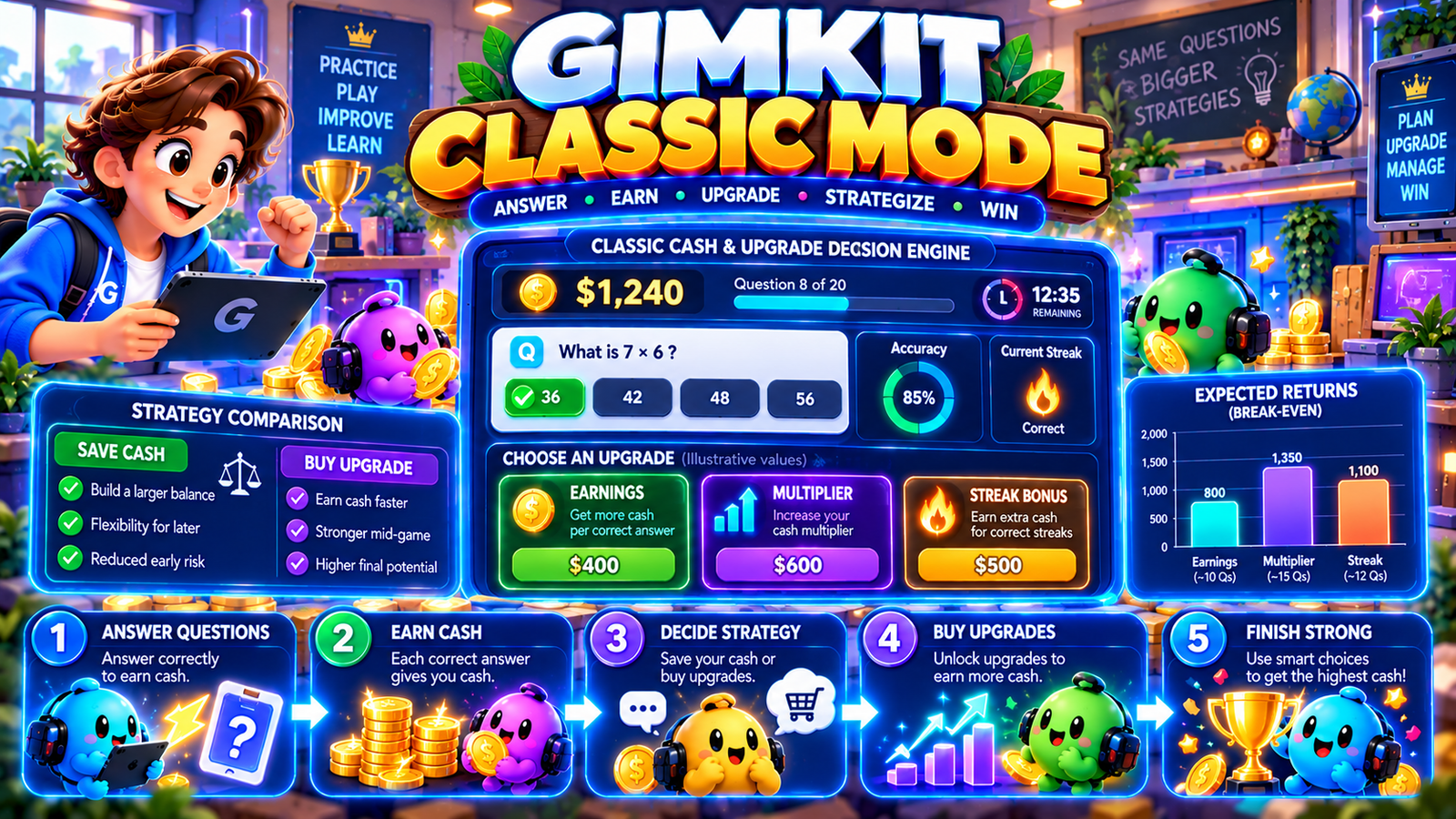
Gimkit Classic Mode: Master Cash, Accuracy & Upgrades
Discover the original Gimkit-style cash economy, where answering questions builds your balance and smart investments can change your earning potential. Learn the mechanics, explore strategic trade-offs and experiment with an independent Classic strategy lab.
Independent educational resource. Not affiliated with or operated by Gimkit. The simulator is illustrative and does not access official sessions or accounts.
What is Gimkit Classic Mode?
Gimkit Classic Mode is the original-style question-answering experience built around earning in-game cash and making investment decisions. Players answer questions from a selected Kit, accumulate currency and can use available upgrade mechanics to improve subsequent earnings. It emphasizes individual progress, repeated retrieval and decisions about spending versus saving.
The distinctive feature is that money is not merely an end-of-question score. In historically documented Classic gameplay, money can also function as productive capital: spending it on an upgrade may reduce the current balance but improve the amount earned from future correct answers.
❓ Question Answers
Correct answers generate opportunities for earnings. Accuracy and the number of answered questions influence how much progress players can make. The content of the Kit determines what knowledge students retrieve.
💰 Cash Balance
Currency represents accumulated in-game earnings. Spending cash introduces a trade-off because the same money can no longer be retained as part of the immediate balance.
📈 Upgrades
Upgrades can increase earning capacity. Their strategic value depends on purchase cost, improvement size and the number of remaining opportunities to use the benefit.
🎯 Accuracy
A strong earning setup is less useful when the player repeatedly answers incorrectly. Correct-answer rate can materially change the expected return from an investment.
⏱️ Remaining Time
The value of an upgrade depends on how many future questions can be answered before the selected game objective ends.
🏆 Individual Strategy
Players must decide when to build earning capacity and when to preserve cash. The strongest decision can change as the remaining game window shrinks.
How Classic Mode turns answers into progress
The traditional Classic economy contains a recurring decision cycle. A player answers a question, receives an outcome, and considers whether the resulting cash should be preserved or reinvested in greater earning potential.
Why early investment may help
An upgrade purchased early has more opportunities to influence future answers. If the improvement produces enough additional earnings, it can repay its cost and generate a positive return before the game ends.
This benefit depends on future activity. Buying an expensive upgrade only makes sense when enough successful question events remain to cover its expense.
Why late saving may help
An upgrade purchased near the end may have little time to recover its price. Preserving cash can therefore become more advantageous than buying additional earning capacity.
A useful strategic question is: how many more correct answers would be necessary before the purchase pays for itself?
Classic Cash & Upgrade Decision Engine
Run an independent mathematical model of the Classic cash economy. Configure your accuracy, question reward and expected remaining attempts. Buy hypothetical upgrades, log answer events, and compare whether purchasing an additional multiplier creates more expected final cash than saving.
💰 Classic Earnings Strategy Studio
Make real decisions within a fictional cash economy. All balances, upgrades, calculations and comparisons update from your selected inputs.
1. Configure Your Classic Scenario
Configuration changes affect subsequent simulated answers and future projections. They do not rewrite previous results.
2. Record Question Outcomes
Each action changes the simulated bank. Correct answers use the current multiplier. Wrong answers deduct the configured penalty, capped at the available cash balance.
3. Purchase Hypothetical Upgrades
Upgrade prices and effects belong only to this simulation. Each upgrade has a maximum of five purchases.
⚡ Multiplier
Increase correct-answer reward by 0.5×.
Level: 0/5
Next cost: $300
🎁 Correct Bonus
Add $20 to each future correct answer.
Level: 0/5
Next cost: $180
🛡️ Penalty Shield
Reduce incorrect-answer penalty by 20% per level.
Level: 0/5
Next cost: $125
🔥 Streak Bonus
Earn $10 × level × capped current streak on correct answers.
Level: 0/5
Next cost: $160
4. Transaction History
- No actions recorded.
5. Cash Projection
Compare the expected final bank when retaining current upgrades against purchasing one additional upgrade.
6. Break-even Analysis
Comparison uses expected correct and incorrect events from your selected accuracy. The model uses a conservative, capped streak approximation for projections rather than claiming to forecast real streaks.
7. Current Learning Indicators
Total attempts: 0
Observed accuracy: —
Gross cash earned: $0
Upgrade spending: $0
Actual cash penalties: $0
The central Classic decision: save cash or upgrade?
The defining decision in a cash-upgrade economy is whether to preserve the value already earned or exchange some of that value for increased earning capacity. Both options have legitimate advantages, but they perform differently under different future conditions.
Understand the immediate cost
Buying an upgrade reduces the current cash balance. This creates an immediate disadvantage relative to a player who retains the same amount. The purchase needs to generate enough additional future earnings to offset that expense.
A purchase is therefore not automatically profitable simply because it increases the reward per question. Its net value depends on the cost and the number of times its benefit can be collected.
Understand marginal earnings
Marginal earnings are the additional amount gained because of an upgrade compared with what would have been earned without it. This difference, not the total cash reward, is the relevant quantity when calculating whether an upgrade can repay itself.
Suppose a fictional correct answer produces $100 before a purchase and $150 afterward. The marginal improvement is $50 per correct answer. If the upgrade costs $500, ten subsequent correct answers would be needed merely to recover its cost, assuming no other changes.
Accuracy changes the expected payback period
When not every question is answered correctly, the number of attempts required to obtain a given number of correct answers increases.
At a hypothetical 50% correct-answer rate, an upgrade providing $50 extra per success produces $25 of additional expected earnings per attempt, before accounting for any other effects. At 80% accuracy, the expected additional earnings rise to $40 per attempt.
This relationship explains why two players with identical upgrades may experience different economic outcomes.
Remaining opportunities define the investment horizon
Even an attractive upgrade cannot repay itself without enough opportunities to earn its benefit. The remaining game window is therefore part of the investment calculation.
A player expecting only three more answers should evaluate an upgrade differently from someone expecting fifty. In the shorter window, the purchase is less likely to recover a substantial cost.
Do not confuse a multiplier with accuracy
A multiplier changes the reward attached to a qualifying outcome. It does not automatically improve the player's understanding of a question.
The academically important skill remains retrieval and reasoning. Cash mechanics are a layer surrounding that learning activity, not a replacement for subject knowledge.
Why investment strategies change during a round
Early in a session, the remaining answer horizon can be relatively large. Purchases have greater opportunity to accumulate benefits.
Near the end, the expected number of future answers becomes smaller. A cash-preservation strategy may produce a better final balance.
This transition is not governed by one universal minute mark. It depends on upgrade costs, reward improvements, accuracy and how much play remains.
Classic strategy explained through practical examples
Example 1: A profitable early multiplier
Imagine a fictional player holding $2,000. A multiplier upgrade costs $600 and adds $60 to every future correct answer. The player expects to answer twenty more questions with an accuracy of 75%.
Expected correct answers equal twenty multiplied by 0.75, giving fifteen successes. Additional expected earnings from the upgrade equal fifteen multiplied by $60, or $900.
After subtracting the $600 purchase price, the expected incremental value is $300. Under these assumptions, buying the upgrade produces a greater expected final balance than keeping the cash.
The result does not guarantee a profit for every actual sequence of answers. It reflects a mathematical expectation built from specified assumptions.
Example 2: An unattractive late multiplier
Consider the same $600 purchase, but suppose the player expects just five more questions at 75% accuracy.
The expected number of correct answers is 3.75. The upgrade adds $225 in expected earnings, substantially less than its cost.
Purchasing would produce an expected incremental loss of $375. Preserving cash is the more favorable option in this simplified comparison.
Example 3: A smaller bonus can outperform a multiplier
Suppose an available bonus upgrade costs only $150 and adds $20 to every correct answer.
A player who expects fifteen additional correct answers would gain $300 in extra earnings, providing an expected net improvement of $150.
Although this upgrade has a smaller reward effect than the expensive multiplier, its lower purchase price can make it a useful investment under a limited remaining question window.
Example 4: An accuracy problem cannot be solved by spending
A fictional player repeatedly buys reward upgrades but answers only one out of four questions correctly. The additional cash produced by each successful answer may be insufficient to recover the upgrade costs.
Improving question understanding would change the underlying success rate. No reward multiplier guarantees that improvement.
The lesson is to distinguish game optimization from learning. A more favorable cash economy does not by itself indicate greater academic mastery.
Example 5: A shield's value depends on mistakes
In a fictional economy where incorrect answers deduct cash, a penalty-reduction upgrade becomes more valuable as the expected number of penalized incorrect answers increases.
A player with high accuracy may experience relatively few opportunities to benefit from such protection.
A player with lower accuracy may benefit more frequently, but must still determine whether the amount saved exceeds the purchase price.
Importantly, the simulation's penalty shield is an independent educational mechanic, not a claim about a current Classic shop item.
What Classic Mode can and cannot tell teachers
Classic-style gameplay is well suited to repeated participation with a question set. Students can attempt many prompts within one session and receive immediate response feedback.
However, competitive game outcomes combine several influences: subject knowledge, answer frequency, upgrade decisions, accuracy and the chosen game conditions.
Cash totals are not direct mastery scores
Two learners with similar subject knowledge may finish with different balances because they made different investments.
Likewise, a learner who develops better understanding during a session may not finish first. Cash totals should therefore be interpreted as game outcomes, not stand-alone measurements of academic proficiency.
Use answer patterns to guide reflection
When appropriate evidence is available, teachers can review which academic questions were difficult, which misconceptions appeared and whether students improved their explanations.
The information must be obtained through actual supported tools, not inferred from fictional calculations on this webpage.
Help students distinguish strategic skill from content skill
A student may understand how to invest in upgrades while still misunderstanding the subject being reviewed.
Conversely, a knowledgeable student might avoid shop decisions and still answer most questions correctly.
A brief follow-up explanation can help the teacher distinguish these forms of performance.
Consider fairness and participation
Competitive cash accumulation can be exciting for some groups, but may frustrate students who begin slowly or need additional reading time.
Teachers should set expectations around respectful participation, select appropriate content difficulty and avoid presenting a final ranking as a judgment of a learner's overall ability.
Understand the limits of simulated forecasts
The tool above helps explain the mathematics of an upgrade economy. It cannot forecast the outcome of a specific Gimkit session because it does not know each player's future answers, exact live settings or the latest official shop configuration.
Its educational value lies in making decision assumptions clear and allowing users to test how the calculated result changes.
Turn the economy into a mathematical discussion
The fictional upgrade framework provides examples of proportional reasoning, expected value, break-even calculation and limited-horizon investment.
These are mathematical ideas that can be explored independently of the official product. The simulator can therefore be used as a separate educational activity without pretending to replicate every live mechanic.
Common Classic cash decisions compared
| Decision | Immediate Effect | Possible Benefit | Important Risk |
|---|---|---|---|
| Keep cash | No purchase deduction | Preserves current balance | Misses potentially profitable upgrades |
| Buy multiplier | Cash balance falls | Larger reward per future success | Not enough successes to repay cost |
| Buy correct-answer bonus | Initial cash outflow | Fixed improvement per correct answer | Payback depends on future success count |
| Reduce incorrect-answer losses | Pay protective upgrade price | Lower expected cash deductions | Few future mistakes may make it unnecessary |
| Invest near the end | Late reduction in cash | Some improved earnings | Insufficient remaining answer opportunities |
Classic Mode mistakes that weaken decision-making
Buying upgrades without calculating remaining value
A purchase may look attractive because it raises an earning figure. The relevant question is whether the additional earnings can exceed the cost before the session ends.
Confusing gross earnings with retained cash
A player can earn a large total amount and spend most of it on upgrades. Gross earnings measure accumulated rewards, while retained cash reflects the remaining balance.
Assuming the same purchase works for every player
Different players have different likely accuracy, pace and remaining opportunities. A profitable decision under one set of assumptions may be unfavorable under another.
Ignoring question accuracy
Upgrades cannot produce their expected benefits without qualifying question outcomes. A model that assumes perfect accuracy can overstate returns for a player whose accuracy is lower.
Making late purchases out of habit
Investments that were useful early in a round can become inefficient near the end. Time remaining should be included in each purchase evaluation.
Assuming historical prices are current
Independent guides and historical screenshots may show earlier values. Such references can explain how the economy was structured without guaranteeing today's specific upgrade prices or availability.
Equating leaderboard position with knowledge
A ranking reflects the game's selected scoring system and player decisions. It does not independently establish the validity of an educational assessment.
Gimkit Classic Mode FAQs
What is the main idea of Gimkit Classic Mode?
Classic focuses on answering questions, earning in-game cash and using investments to improve future earning potential.
Does Classic Mode use the 2D movement system?
Classic is generally described as a traditional non-2D question-and-cash experience, rather than a game about controlling a character through a spatial world.
Why do upgrades matter in Classic?
Historically, upgrades can improve earning potential. Their value depends on cost and the number of future opportunities to benefit.
Should a player always buy upgrades early?
No. An early purchase has more time to generate returns but can still be too expensive relative to its expected benefit.
When does saving cash become better?
Saving is more favorable when an available purchase is unlikely to repay itself before the game ends, under the chosen economic assumptions.
How does accuracy affect upgrade payback?
Lower expected accuracy means fewer future successful answers per attempt. This can increase the number of attempts needed to recover an upgrade's cost.
Are the simulator's upgrade prices official?
No. All values in the interactive studio are fictional and intended for transparent mathematical exploration.
Does this tool connect to a live Gimkit game?
No. It runs locally in the browser and does not access official sessions, student accounts, leaderboard information or private game data.
What is an upgrade's break-even point?
It is the number of additional expected attempts or successful answers required for the extra benefit to match the purchase price.
Can Classic Mode support retrieval practice?
Answering curriculum questions can create opportunities for retrieval. The educational value still depends on the questions, instruction and follow-up interpretation.
Does winning prove a student knows more?
No. Cash totals can depend on purchase strategy, answer frequency, accuracy and game settings, not just academic knowledge.
Can teachers customize game options?
Yes. Official Gimkit Help describes standard and mode-specific options. The exact choices available depend on the selected mode.
How can I confirm Classic is currently available?
Open the official Gimkit Mode Picker and review the modes and options presented for your account. Historical guides are not a substitute for current verification.
Sources and historical verification
Gimkit's official Help Center establishes the general structure of selecting a mode and configuring available options. Independent descriptions provide context about Classic's historical cash-and-upgrade economy.
- Gimkit Help — Select a Game Mode . Official guidance for the Mode Picker, description labels and selection workflow.
- Gimkit Help — Game Options Explained . Official overview of standard and mode-specific customization.
- Gimkit Help — Host a Live Game . Official context for selecting a Kit, mode and game options.
- Independent Classic Mode Explanation . Unofficial overview of traditional cash earnings and upgrades. Verify exact mechanics with Gimkit.
- Official Gimkit Platform . Check currently accessible gameplay experiences.
This article deliberately does not reproduce complete hosting instructions or the broader mode directory. Those subjects belong to their dedicated GimkitApp pages.
In Classic, every upgrade is an investment decision.
Classic Mode's cash economy turns question-answering into an experience involving accuracy, earnings, timing and financial trade-offs. Strong strategy means understanding when an investment has enough future opportunity to recover its cost. Use the independent simulator to test assumptions, and check the official Gimkit interface for current product-specific mechanics.
Return to Strategy Studio ↑