Gimkit Trust No One: Investigate Before You Accuse
Explore one of Gimkit's distinctive social-deduction
experiences. Understand hidden roles, suspicion,
investigations, discussions and voting decisions,
then experiment with an original evidence-analysis lab.
Independent educational resource — not operated by
or affiliated with Gimkit. This page does not reveal
the identity or role of anyone in an actual game.
THE HIDDEN-ROLE MYSTERY
🟦PLAYER A
🟩PLAYER B
🟪PLAYER C
🟨PLAYER D
🟥PLAYER E
❔UNKNOWN
Observe → Question → Evaluate → Discuss → Decide
01 / Mode Identity
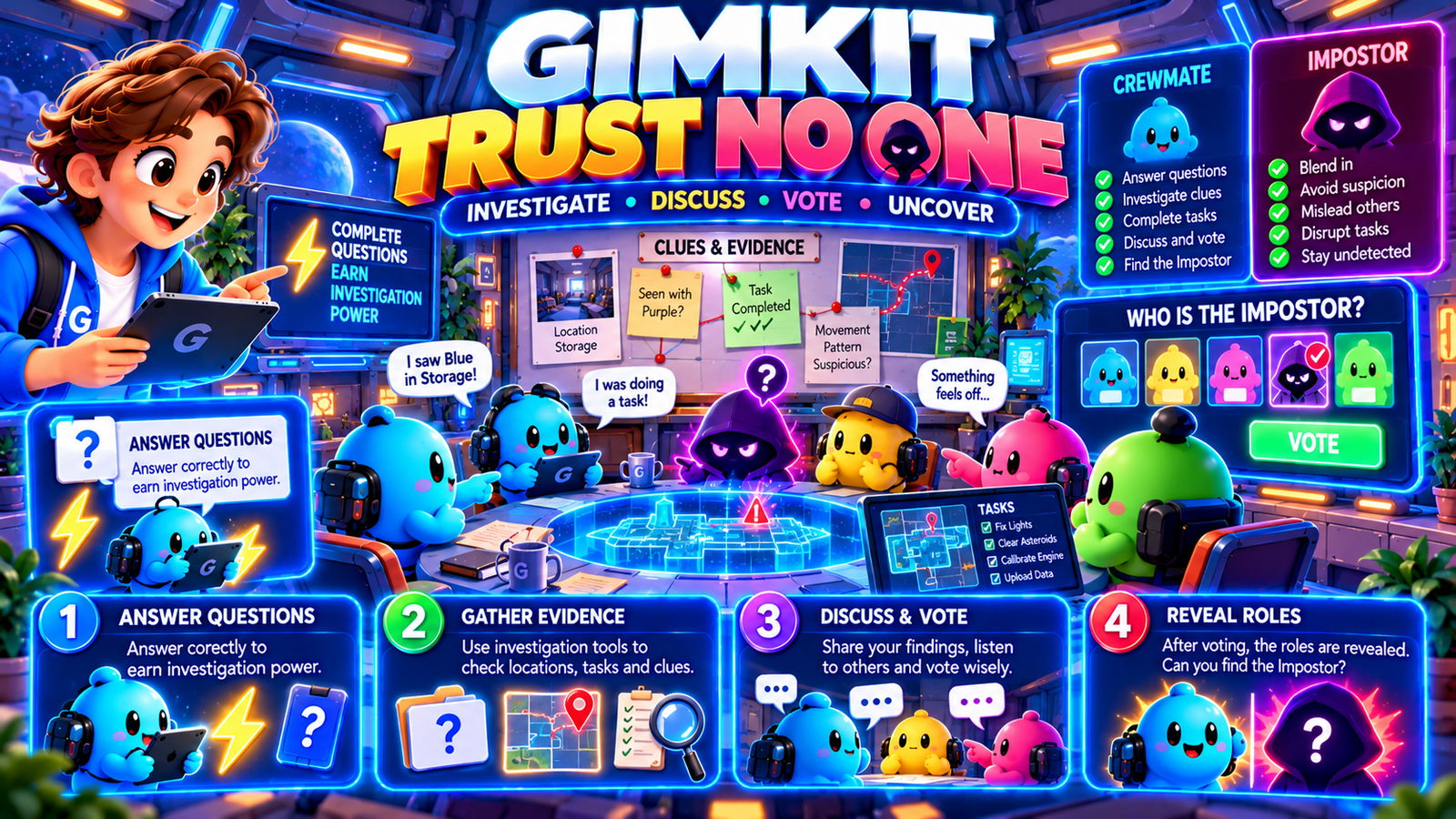
What is Gimkit Trust No One?
Gimkit Trust No One is a social-deduction game mode inspired
by hidden-role mystery games. Instead of knowing everyone's
allegiance, participants must operate with uncertainty.
Some participants hold concealed roles, while the
group attempts to identify suspicious players and make
decisions through investigations and voting.
Gimkit introduced the mode in 2020 as an Among Us-inspired
experience. Historical community descriptions feature
crewmates, impostors, information gathering and meetings.
The mechanics distinguish it from straightforward
question-answer competitions: academic participation exists
alongside social reasoning, incomplete information
and competing objectives.
Product accuracy:
This article discusses documented historical concepts
associated with Trust No One. The current availability,
precise controls and winning conditions should be verified
in Gimkit's live Mode Picker. Unofficial walkthroughs are
not authoritative evidence for every contemporary feature.
CORE CONCEPT 01
🎭 Hidden Roles
Role secrecy means that participants initially lack
complete knowledge of other players' allegiance.
Decisions must be made while important information
remains unavailable.
CORE CONCEPT 02
🔎 Investigation
Players look for indications that distinguish a genuine
teammate from a concealed adversary. An observation
becomes valuable when it meaningfully changes
an existing assessment.
CORE CONCEPT 03
🗣️ Discussion
Information can be communicated and challenged.
The quality of a discussion depends on distinguishing
observed events from guesses, assumptions
and unsupported accusations.
CORE CONCEPT 04
🗳️ Voting
A collective decision may determine whether a suspected
participant is removed. Incorrect accusations can
therefore carry consequences for the group.
CORE CONCEPT 05
📚 Questions
Classroom question content gives the experience an
academic component. The educational purpose of answering
questions should remain distinguishable from the
social mystery surrounding participants.
CORE CONCEPT 06
⚖️ Uncertainty
Players may need to decide before obtaining conclusive
evidence. Better reasoning does not eliminate
uncertainty, but it can make assumptions explicit
and reduce guesswork.
02 / Social Deduction Structure
How a hidden-role mystery unfolds
The distinguishing feature of social deduction is an
information imbalance: some participants know more about
their true objectives than others do. The visible behavior
of a player may be consistent with more than one role,
making simplistic conclusions unreliable.
🎭Roles
Unknown allegiances
❓Activity
Questions and actions
🔎Evidence
Interpret observations
🗣️Meeting
Discuss alternatives
🗳️Decision
Evaluate voting risks
Perspective of an ordinary teammate
A participant attempting to identify a concealed
adversary must think about both the available clues
and what those clues would look like if the suspected
person were innocent.
A single unusual action is rarely sufficient by itself.
It might reflect a deliberate strategy, confusion,
inattention or an ordinary mistake.
Stronger reasoning compares alternative explanations,
looks for evidence that can challenge an initial
interpretation and delays certainty when available
information remains weak.
Perspective of a concealed adversary
Hidden-role games often assign opposing objectives to
a minority of participants. A concealed player benefits
when others draw unreliable conclusions.
The underlying game-theory problem involves information
asymmetry: one side knows something that the other side
is trying to infer.
For educational discussion, the focus should remain
on fictional game mechanics rather than encouraging
students to deceive one another outside the agreed
rules of a supervised activity.
03 / Exclusive Interactive Application
Hidden-Role Investigation & Evidence Lab
Can you distinguish a genuinely informative clue from
a suspicious-looking but unreliable observation?
Use this original interactive model to update a hypothetical
belief as new evidence arrives. Compare the possible
consequences of accusing a player versus waiting for
stronger information.
Educational model — not real player detection.
Every number in this lab is a hypothetical assumption.
The results never indicate whether any actual person is
dishonest or holds a specific Gimkit role. Do not enter
real student names or personal information. The likelihood
examples are created for mathematical illustration,
not measured from real games.
🕵️ Evidence Reasoning Studio
Build a transparent hypothesis, analyze clues,
calculate revised probabilities, and review
whether a proposed accusation is justified
under your chosen assumptions.
1. Define Your Hypothetical Investigation
This is the assumed prior probability for one
fictional suspect, before considering clues.
Example: 2 equally possible hidden-role holders
among 10 players produces an initial 20% prior.
2. Investigate a Clue
Choose a fictional clue example, or enter your
own likelihood estimates. A clue matters because
of how differently it is expected under two
competing hypotheses.
These are conditional likelihoods, not two
numbers that must sum to 100%. Set both to 50%
for an uninformative clue. For dependent clues,
enter likelihoods conditional on evidence
already considered.
3. Evidence Trail
No clues analyzed yet.
Current Hypothesis Assessment
MODEL POSTERIOR PROBABILITY
20.0%
A mathematical output based on supplied
assumptions, not a verified judgment
about a person.
Starting prior
20%
Evidence entries
0
Posterior odds
1 : 4
Latest likelihood ratio
1.00×
4. Voting Decision Analysis
Examine the expected consequence of making
an accusation based on your current
hypothetical probability.
Points are user-chosen decision values,
not an official Gimkit scoring system.
Waiting is assigned a neutral baseline
of zero in this deliberately simple model.
Choose values and calculate the
decision comparison.
Model Explanation
The starting probability will be revised
whenever a valid clue is applied.
H is the fictional hidden-role hypothesis.
E is the selected clue.
04 / Understanding the Tool
How to investigate without confusing suspicion with proof
A mystery becomes interesting because different explanations
can be consistent with the same observation. A player who
speaks little during a discussion might be concealing
something, but might equally be concentrating, shy,
distracted or unsure of the game's mechanics.
If the clue is equally likely whether a hypothesis is true
or false, it provides no meaningful discriminatory
information. The investigation lab demonstrates this
principle mathematically: assigning the same likelihood
to both hypotheses leaves the probability unchanged.
Experiment A: Start with a fair prior
Select the scenario with two concealed roles among ten
fictional players. If every participant is initially
equally likely to hold such a role, a randomly selected
person's prior probability is 20%.
This does not mean every participant has a confirmed
independent 20% chance after all possible observations
have been considered. It is simply a starting assumption
before introducing player-specific information.
The scenario generator operates on one hypothetical
individual. It does not assign roles to all players,
simulate the real Gimkit role-assignment algorithm,
or account for every possible relationship
between participants.
Experiment B: Test an ambiguous observation
Choose Ambiguous Behavior. The preset assigns the same
conditional probability to the clue under both
hypotheses. Apply it and observe the result.
Even if an observation feels suspicious, its emotional
impact does not make it informative. An action that is
common among innocent participants and concealed
adversaries alike cannot reliably distinguish between them.
This distinction helps prevent an important reasoning
error: using the unusual appearance of an action as
if it were strong evidence of a particular motive.
Choose More Discriminating Clue. This preset assigns
a higher likelihood under the role hypothesis than
under the alternative. The resulting mathematical
update increases the posterior probability.
However, the numerical strength in the preset is invented
for teaching purposes. The tool does not know how
frequently any real behavior occurs among Gimkit players.
If a player uses this model for educational discussion,
the relevant learning question is why an assumed likelihood
ratio changes the conclusion—not whether the numerical
result describes an actual person.
Experiment D: Apply counter-evidence
Choose Counter-Evidence after applying a
suspicion-increasing clue. The result illustrates
how new information can lower a previously
elevated probability.
A good investigator can change their mind.
Changing a conclusion in response to stronger contrary
information is a feature of careful reasoning,
not an admission that the original uncertainty
was avoidable.
Experiment E: Examine the consequences of accusation
Open Voting Decision Analysis. Assign a fictional value
to a correct accusation and a fictional cost
to an incorrect one.
The model combines those values with the current
posterior probability to calculate the expected utility
of accusing. Its comparison deliberately treats waiting
as a zero-value baseline.
Real social-deduction decisions are more complex.
Waiting may provide additional information,
consume limited time or change the strategic
position of either team. The tool does not
attempt to model those further effects.
Its purpose is narrower: making the consequences
of an uncertain accusation visible.
05 / Evidence Interpretation
Why evidence quality matters more than accusation confidence
The central problem in a hidden-role game is not simply
finding suspicious behavior. Almost any behavior can appear
suspicious if an observer already believes someone
has an adversarial role.
Better investigation requires looking for observations
that differentiate the competing explanations.
The confidence with which someone presents a claim
does not determine whether the claim is supported.
Observation versus inference
An observation describes something that happened.
An inference is an interpretation of what that
observation might mean.
For example, the statement "Player A did not participate
in the discussion" describes an observed absence of
participation. The statement "Player A must be an impostor"
goes substantially beyond that observation.
There might be many explanations for the same behavior.
A participant may be uncertain, experiencing a technical
problem, distracted, or using a deliberate game strategy.
Separating these categories helps prevent groups from
treating guesses as established facts.
Source reliability
Players may receive information through several channels:
direct observation, a report from another participant,
a remembered previous event or an interpretation
of an apparent pattern.
Those channels can differ in reliability. A reported
observation is not necessarily false, but its accuracy
depends on the reporting participant's perception,
memory and incentives.
Reliability is therefore a question to investigate
rather than a fixed label automatically assigned
to a particular type of speaker.
Corroboration
Corroboration occurs when additional, relevant information
supports a claim. Independent corroboration can be
especially valuable because it reduces reliance
on one source.
However, agreement between several people does not
always represent independent evidence. If everyone
repeats the same original statement, counting each
repetition as a new clue creates false confidence.
Dependent evidence
The investigation lab uses sequential Bayesian updates.
When interpreting more than one clue, the likelihoods
for the new clue should reflect any dependence
on evidence already observed.
Otherwise, the same information can be counted more
than once. Suppose one student observes an event and
tells three classmates. Three reports derived from that
one observation are not equivalent to three
independent observations.
In a simplified probability model, incorrectly treating
dependent information as independent can produce
exaggerated posterior confidence.
Confirmation bias
Confirmation bias occurs when people disproportionately
seek or interpret evidence in ways that support
an existing belief.
In a social-deduction game, a group may decide early
that someone is suspicious and then reinterpret
subsequent ordinary actions as further proof.
An effective countermeasure is to ask:
what would I expect to observe if this participant
were not an adversary?
That question encourages comparison rather than
one-sided storytelling.
Absence of evidence
Not seeing an action can be meaningful only when
there was a reasonable expectation of observing it.
For example, failing to receive information from a
participant is not sufficient grounds for suspicion
if that participant had no opportunity
to provide the information.
This is an important general lesson for reasoning
with incomplete observations. Missing data and
negative evidence are not automatically
the same thing.
Calibrated uncertainty
Uncertainty does not need to be hidden.
Statements such as "this is a possible explanation"
or "we need another clue" can improve
the quality of a group decision.
Calibrated reasoning avoids claiming a level of
certainty that the available information
cannot support.
In classroom use, teachers can emphasize that
revising a conclusion when new evidence emerges
demonstrates learning, rather than
indecision or failure.
06 / Practical Reasoning Framework
Five questions to ask before a vote
QUESTION 01
What actually happened?
Identify the concrete observation. Remove descriptions
of motives and character that cannot
be observed directly.
QUESTION 02
How reliable is the source?
Consider whether information was observed firsthand,
transmitted by someone else or inferred
from partial context.
QUESTION 03
Could an innocent player do this?
Imagine reasonable alternative explanations
before treating a clue as strong evidence.
QUESTION 04
Is the evidence independent?
Determine whether several claims are genuinely
separate observations or repetitions
of the same report.
QUESTION 05
What happens if the vote is wrong?
Evaluate the potential loss caused by a mistaken
accusation and whether waiting offers an
opportunity to improve the decision.
FINAL PRINCIPLE
Separate people from game roles
Suspicion belongs to fictional game mechanics.
It must not become a personal judgment about
someone's honesty or character.
07 / Mathematics of Uncertainty
What Bayesian updating actually tells us
Bayesian reasoning provides a formal way to update
a probability when new evidence becomes available.
It combines a prior probability with information
about how likely the evidence would be under
competing explanations.
In a hidden-role illustration, the hypothesis
might be that one fictional participant
holds a particular role.
Starting with a prior
A prior probability represents a starting assessment
before incorporating the selected observation.
If a hypothetical game has one adversarial role
among ten equally likely players, the prior
for a randomly selected player would be 10%.
That percentage comes from an explicit assumption
about the scenario. It does not establish the actual
role distribution of a currently running
Trust No One match.
Likelihoods describe expected evidence
A conditional likelihood describes how likely an
observation would be if a particular hypothesis
were true.
The important comparison is not merely whether
a clue is common. It is how common that clue
would be under the hypothesis compared
with its alternative.
When the two conditional likelihoods are identical,
the evidence does not favor either explanation.
A worked numerical example
Imagine a hypothetical prior probability of 20%.
Suppose an invented clue has a 60% chance of appearing
under the hypothesis and a 20% chance
under the alternative.
Multiplying the first likelihood by the prior gives
0.60 × 0.20 = 0.12. The corresponding alternative
term is 0.20 × 0.80 = 0.16.
Dividing the first quantity by the sum gives
0.12 / 0.28, or approximately 42.9%.
This example shows how a clue with a likelihood
ratio of three can raise a 20% hypothetical prior
to approximately 42.9%.
It does not indicate that someone is actually
42.9% likely to be an impostor in Gimkit.
The answer is conditional on the invented
input assumptions.
Why prior assumptions matter
An identical clue can produce different posterior
probabilities when the starting probabilities differ.
This is not a contradiction. Evidence changes
the assessment relative to what was
initially considered plausible.
A low initial probability generally requires
more discriminating information to support
a high posterior.
The danger of invented likelihoods
In a genuine empirical analysis, likelihoods
should be supported by defensible measurements,
reliable research or clearly justified
model assumptions.
This page supplies no verified behavioral dataset
from actual Trust No One sessions. Consequently,
the simulator's preset likelihoods are teaching
examples rather than scientific estimates.
Treating such hypothetical values as facts
about a real person's intentions would be
an improper use of the model.
Expected utility versus truth
Even a relatively high probability does not
by itself determine the best action.
A decision also depends on the consequences
of acting correctly and incorrectly.
Expected utility combines those consequences
with the probability estimates under explicitly
stated assumptions.
It is a framework for comparing options,
not a machine for establishing objective truth.
08 / Classroom Implications
Using social deduction responsibly in education
Social-deduction games can create opportunities
for reasoning, discussion and reflection,
but teachers should not assume that energetic
participation automatically demonstrates
deeper learning.
The game introduces additional social pressures.
Some learners enjoy dramatic debate, while others
may prefer quieter forms of participation.
Create clear behavioral boundaries
The central classroom distinction is between
identifying a fictional in-game role and making
a claim about someone's real-world character.
Disagreements should refer to gameplay evidence
and accepted rules, not personal traits,
friendships or social status.
Teachers can explain these boundaries before
beginning a social-deduction activity and reinforce
them during emotionally charged moments.
Avoid personalizing accusations
A player can hold an adversarial role within
a game while being a trustworthy classmate
outside the game.
That distinction is particularly important
when a group is unfamiliar with
hidden-role games.
Teachers should intervene if in-game accusations
become targeted harassment, ridicule or exclusion.
Support quieter learners
A discussion-heavy activity can create an imbalance
between students who speak frequently and those
who need more time to formulate an answer.
Useful instructional adaptations may include written
reflection, structured turn-taking or short explanations
after the activity ends.
These suggestions are pedagogical practices
and should not be confused with built-in
Trust No One controls.
Teach evidence-based explanations
Ask students to state their conclusion, identify
the supporting observation and acknowledge
one plausible alternative.
This structure encourages a claim-evidence-reasoning
approach without requiring the teacher
to approve of the conclusion itself.
A student who recognizes that the evidence remains
insufficient can demonstrate strong reasoning
even if the group ultimately votes differently.
Use debriefing to separate learning from winning
The end of a round is an opportunity to discuss
which information was helpful, which assumptions
proved unreliable and how the group
handled uncertainty.
Success in a hidden-role game is affected by many
factors beyond academic knowledge. Winning therefore
should not automatically be treated as a valid
measure of subject mastery.
Protect student privacy
Students should not be asked to submit personal
information to an independent reasoning simulator.
The application on this page uses fictional scenarios
and local browser calculations. It does not connect
to Gimkit classrooms, retrieve student records or
report suspicion about real participants.
Use inclusive alternatives
Not every group benefits from the same level
of competitive social tension.
A teacher may instead use a fictional written mystery
with anonymous characters, allowing learners to practice
evidence evaluation without accusing classmates.
This distinction makes the reasoning principle available
even when a live social-deduction activity is unsuitable.
09 / Common Misinterpretations
Important mistakes to avoid in Trust No One
Assuming silence proves an adversarial role
Silence has multiple possible explanations.
Unless a game supplies specific information
that makes silence meaningfully discriminatory,
it should not be treated as proof
of a hidden role.
Accepting a confident accusation without evidence
Confidence and accuracy are different.
A forceful statement may still depend
on an unreliable interpretation
of an ordinary event.
Counting repeated rumors as independent clues
Several players may repeat a statement originating
from one observer. That repetition does not create
several independent sources of new information.
Ignoring alternative explanations
Once an investigator commits to one explanation,
it becomes easy to overlook evidence
consistent with innocence.
Deliberately considering an alternative hypothesis
helps reduce confirmation bias.
Confusing probability with certainty
A mathematically calculated probability depends
on its assumptions and inputs. A precise-looking
percentage can still be misleading
when those inputs are weak.
Using fictional game roles to judge real people
Game mechanics exist inside a defined recreational
activity. They do not justify personal accusations
or assessments of someone's honesty,
personality or trustworthiness.
Assuming old instructions represent current settings
Gimkit has changed over time. Historical walkthroughs
can help explain a mode's design, but the official
live interface determines what a host
can currently select.
10 / Focused Questions
Gimkit Trust No One FAQs
What makes Trust No One different from ordinary quiz gameplay?
It adds hidden-role social deduction, investigation
and group decisions to a question-based experience.
Players must consider incomplete information,
not only whether an academic answer is correct.
Was Trust No One inspired by Among Us?
Yes. Gimkit's original public announcement described
Trust No One as inspired by the hidden-role game Among Us.
What are the hidden roles in historical descriptions?
Community walkthroughs describe crewmate and impostor
roles. Current role counts and exact mode settings
should be checked through official gameplay.
What is the purpose of an investigation?
An investigation attempts to obtain information
that helps distinguish competing explanations
of a player's possible role or actions.
Why can voting be risky?
A decision made on weak evidence may incorrectly
target a teammate. The potential loss from a mistaken
decision creates a reason to evaluate evidence carefully.
Are all suspicious behaviors useful clues?
No. If a behavior is equally likely under competing
hypotheses, it provides little or no
discriminating information.
Does this website's lab detect impostors?
No. It computes hypothetical probability updates
using explicitly supplied assumptions. It has no
connection to actual players or Gimkit games.
Can the evidence percentages be treated as measured game data?
No. The preset values are fictional demonstrations.
They are not derived from verified records
of real Trust No One matches.
Why is it important to consider counter-evidence?
Counter-evidence can support an alternative
interpretation and prevent an early guess
from becoming an unjustified certainty.
Does repeated testimony automatically strengthen a claim?
Not when the reports depend on the same original
source. Evidence dependence must be considered
before combining clues.
Is Trust No One suitable for every classroom?
Not necessarily. Teachers should consider student
comfort, discussion norms, accessibility and
the learning objective before choosing
a socially competitive activity.
How can teachers reduce personal conflict?
Establish respectful rules, distinguish fictional
roles from real-world character, avoid personal
attacks and use a reflective debrief
after the activity.
Does winning the mode prove academic mastery?
No. The outcome can depend on reasoning,
gameplay dynamics, communication and chance.
Academic understanding should be evaluated
through appropriate learning evidence.
Is Trust No One currently available to play?
Its historical release is documented,
but its availability and settings for any
particular account should be verified
in the current official Mode Picker.
11 / Source Transparency
Documentation and further reading
The references below serve different purposes.
An original developer announcement supports the mode's
historical introduction. Official Help pages explain
the broader hosting context. Community writing gives
descriptions of historical gameplay, but should not
be treated as authoritative documentation
of current controls.
For a deeper understanding of the way players
participate in shared Gimkit experiences, explore
Gimkit Multiplayer
.
For a different form of cooperative gameplay, the
Gimkit One Way Out guide
focuses on escape objectives rather than
social deduction.
These links use the homepage's established topic
destinations. Their publication status may differ
during the ongoing article development project.
FINAL LESSON / THINK BEFORE YOU VOTE
Good investigators know what they do not know.
Trust No One offers a distinctive setting for
thinking about uncertain information, hidden motives
and group decisions. The goal of this independent guide
is not to turn students into judges of real people.
It is to illuminate how thoughtful investigation
differs from unsupported accusation.