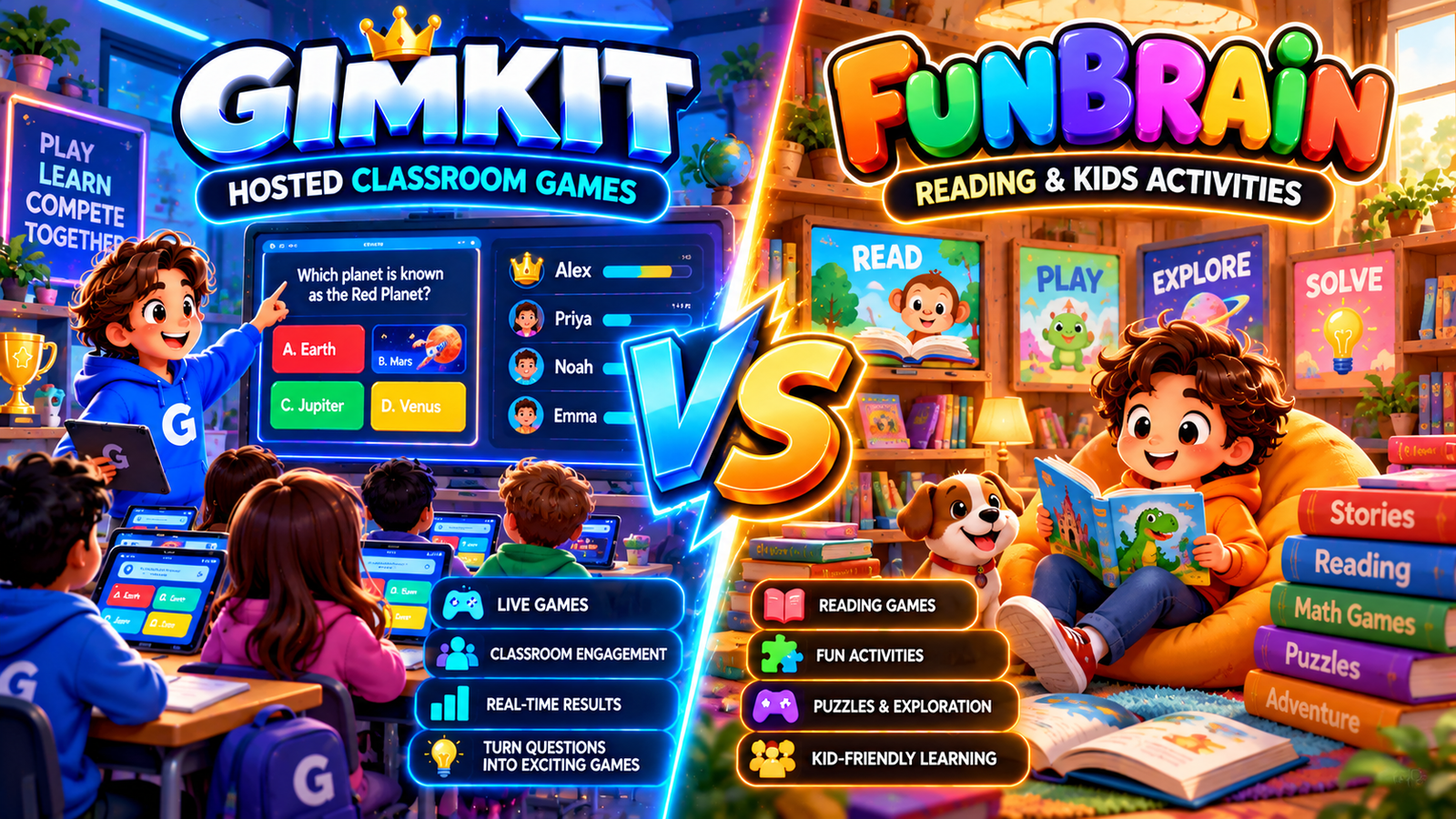
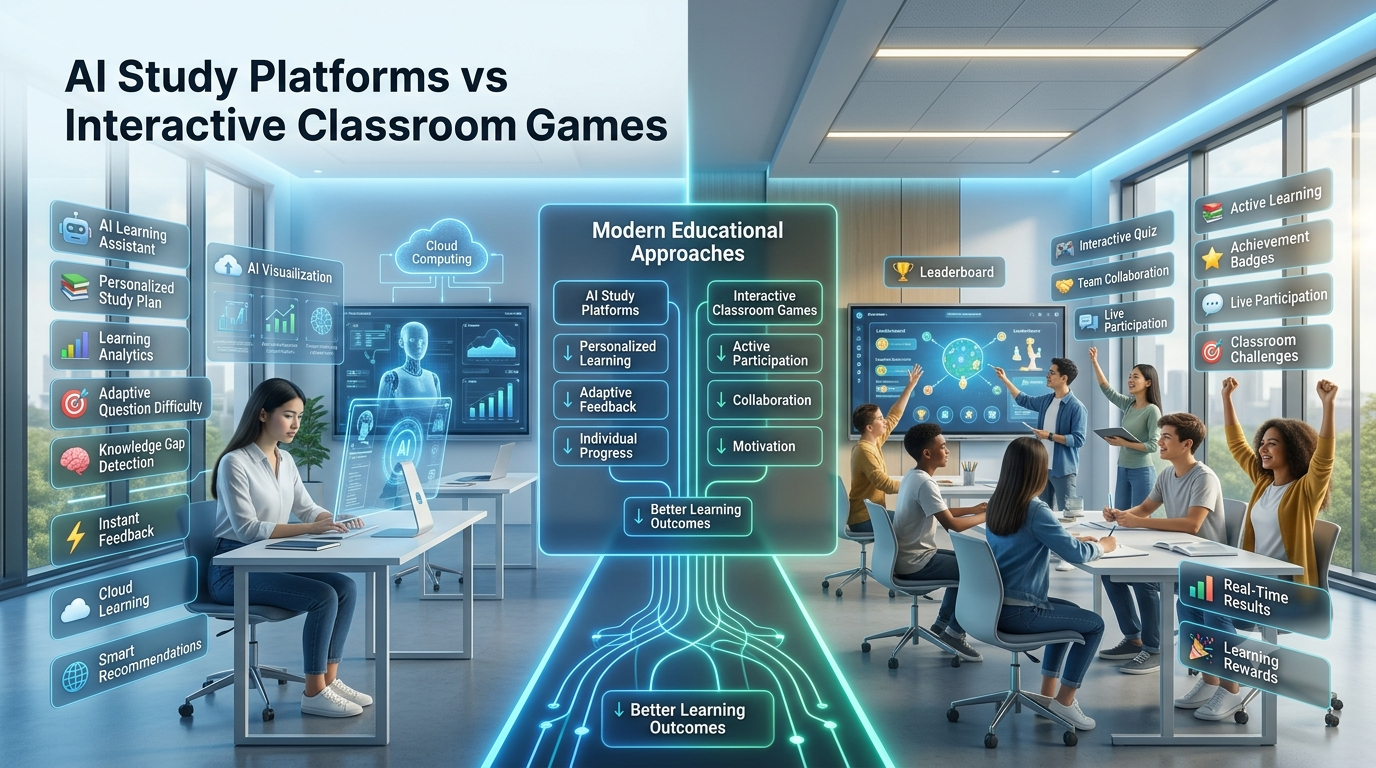
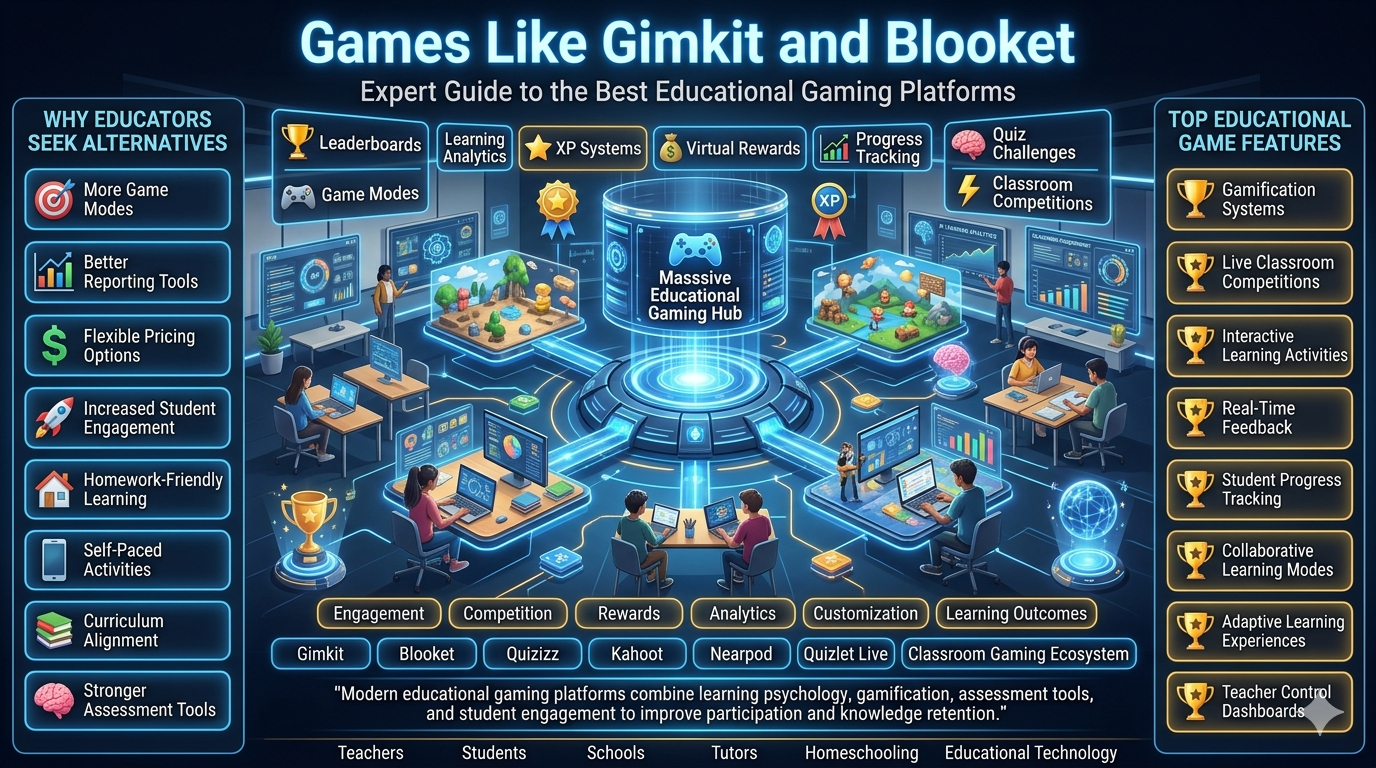
Gimkit vs Funbrain
Reading, Learning Games or Classroom Kits?
Gimkit vs Funbrain is a comparison
of different learning activities, not just two
collections of games.
Funbrain publishes a browsable
library of children's games, books, comics
and videos, organized for Pre-K through eighth grade.
Gimkit lets teachers create
or choose question Kits and use them in hosted
game modes or simple Kit Practice.
The distinction matters when choosing between
reading and media discovery and structured
question-based classroom review.
Learn how the formats change learner choice,
teacher preparation, comprehension evidence
and age-appropriate access. Then use the original
Reading-to-Recall Evidence Studio
to annotate a short passage, anchor comprehension
prompts to precise textual evidence, and prepare
a teacher-authored Gimkit Kit outline without
reproducing anyone else's books.
Pre-K through Grade 8Games, books & videosQuestion KitsEvidence-linked comprehension
GimkitApp.com is independent and is not affiliated
with Funbrain or Gimkit. Examples in the studio
are original fictional text, not copies of
Funbrain books. No private accounts or student
data are accessed.
READ → NOTICE → SUPPORT → RECALL✦ LITERACY BRIDGE
ILLUSTRATIVE READING EXCERPT
The missing map
Mina followed the stream.
The wet stones showed where the water had risen.
She knew the path was changing.
📚 Funbrain path
Discover books, games and videos
by grade and media type.
🎮 Gimkit path
Use teacher-chosen questions
for Kit Practice or a hosted game.
Direct Answer
Is Gimkit or Funbrain better for classroom learning?
The appropriate choice depends on whether children
need age-filtered digital content to explore
or a teacher-authored question activity
tied to a specified lesson.
📚
Funbrain: discovery, reading and diverse activities
Funbrain's official site offers games,
books, comics and videos for Pre-K through
Grade 8. Its searchable catalogue can be
filtered by grade and media type. Teachers
and families can browse reading and subject-related
activities without first creating a question Kit.
Best fit: when learners need a chosen
book excerpt, a literacy experience, a math/word game
or media that introduces or reinforces an idea.
The learning value of a specific activity
still needs checking.
🎮
Gimkit: targeted review with selected questions
Gimkit's core content object is the teacher-created
or selected Kit. Teachers can host a live game,
choose an available mode, and share a code or link.
Official Kit Practice links provide a simpler
independent question-and-answer experience
without game mechanics.
Best fit: when educators want to
control the exact academic prompts and conduct
question-based practice or a game-mode session.
A Kit is not a substitute for experiencing
an entire book or a long text.
Do not confuse Funbrain's content catalogue
with a teacher-managed live Gimkit session.
Funbrain's official site lists entertainment
and learning media by grade; Gimkit's official
Help Center documents Kit authoring,
Practice Mode and hosted games.
Two Different Learning Journeys
From a child's next activity
to a teacher's next question.
These platforms can support distinct parts
of a lesson, but the transfer from reading
a story to answering a question is something
educators must design, not an automatic
cross-platform integration.
🔎
Browse and select
Funbrain lets users navigate a catalogue
of games, books and videos, including
grade-banded pages. Reading selection
is an editorial and developmental decision,
not a guarantee of comprehension.
🧠
Build understanding
A learner encounters characters,
representations, explanations or game events.
The teacher asks what the experience actually
shows and which details support an interpretation.
🛠️
Prepare recall
A teacher can author a relevant Gimkit Kit
from the learning objective. The studio below
creates an evidence-linked handoff rather
than pretending to import copyrighted
Funbrain material.
What Makes Funbrain Distinct
Books, videos and games
are different response environments.
Official Funbrain listings contain recognizable
format labels and grade bands. Each format
asks the child to do something different,
even where all are described broadly
as learning activities.
📖
Children's Books
Long-form reading, sequential meaning,
characters, narration and vocabulary.
🕹️
Games
Interactive actions, puzzles and content
practice within a chosen game's own rules.
🎬
Videos
Visual and auditory explanations or stories,
often requiring follow-up discussion.
🧩
Genre and Grade Choice
Users browse by content type and grade band;
age suitability must still be examined
for each title.
🎯
Teacher-Selected Kit Practice
Gimkit provides separate, teacher-selected
question content and a practice link;
full game modes are another route.
Exclusive Working Application
Reading-to-Recall Evidence Studio
Write or paste a short excerpt you have
permission to use. Mark exact words as evidence,
classify what they support, and draft
a corresponding comprehension question.
The studio builds an annotated preview and
a transparent Gimkit Kit authoring handoff.
It does not score learners, fetch Funbrain
books or create a live Gimkit game.
PRIVATE LOCAL WORKSPACE
· Short excerpt → anchored evidence
→ teacher-authored recall
Ready
Choose an original reading excerpt
Use your own, public-domain, or otherwise
authorized text. Keep identifiable student
information out of this local tool.
Changing the passage clears existing evidence
anchors because the wording may no longer match.
The reading estimate is words divided
by the pace you choose. It is not
a grade-level readability test,
diagnostic result or proof that
the content is suitable for a learner.
Anchor a question to the actual words
Drag-select a phrase inside the rendered passage,
then click Capture Selected Text.
Or paste an exact phrase below. The app refuses
phrases it cannot locate in the source and
highlights each valid anchor.
Excerpt
0Words in excerpt
—Estimated reading minutes
0Evidence anchors
0%
Characters linked to evidence
Colored highlights denote
teacher-entered evidence anchors
—not automated proof that the inference
or answer is correct. Tap any highlight
to locate its evidence card.
Evidence collection
Evidence-linked teacher question handoff
Each row connects a source phrase,
the teacher's interpretation lens and
a question to be checked before entering
Gimkit's official Kit editor.
This is not a Gimkit CSV
import file or AI-generated assessment.
It cannot verify the teacher's expected answers.
0Authored transfer prompts
0Distinct evidence lenses
Add an evidence anchor before building
a recall handoff.
Export your authorized excerpt,
anchored prompts and reading assumptions.
JSON restores this studio's own format.
CSV is a reference sheet, not an official
Gimkit or Funbrain import. Never enter
private student records.
Studio loaded. Use the original sample
or add an authorized passage.
01 · The Real Comparison
A children's media library and a teacher-authored
game are not substitutes
Funbrain is a destination where children
and their caregivers can discover books,
videos and games. Its site is organized
by grade bands and by content type.
A visitor can open a title and participate
in the type of activity that title offers.
The learning experience is therefore heavily
influenced by the selected book, video or game.
The website is not defined primarily by
a teacher uploading a question bank
for an immediate live class competition.
Gimkit uses a different model.
Its defining content object is a Kit,
a collection of questions the teacher
selects or authors. A Kit may be used
in a hosted game with a Mode Picker
and game options, and it also has
a simpler Practice Mode link.
The experience begins with question content
and a chosen activity pathway.
Teachers typically determine what knowledge
will be rehearsed before students
begin responding.
The meaningful comparison is not which
service has the larger number of colorful
tiles or animations. It is what the student
is meant to do: read an extended text,
watch an explanation, play an individual title,
recall information from teacher-selected prompts,
or collaborate within a particular hosted game mode.
These different actions create different kinds
of evidence about learning, and no single
format proves all the others unnecessary.
This distinction also protects teachers
from an inaccurate purchase or adoption decision.
A class seeking an age-appropriate online story
is solving a different problem from a class
seeking a live retrieval-practice game.
Funbrain may serve the first goal directly;
Gimkit may serve the second.
Combining them can be sensible when the transition
is explicitly designed, but the websites
have no automatic content or student-data
integration merely because both support education.
02 · Grade-Banded Discovery
What Pre-K through Grade 8 labels
can and cannot promise
Funbrain explicitly describes its audience
as Pre-K through Grade 8. Its browsing interface
lists Pre-K and Kindergarten followed by first
through eighth grades, with additional sorting
by games, books and videos. That organization
can help a teacher or parent narrow the catalogue
before opening an activity. It should not be
mistaken for a precise reading-age diagnosis,
a guaranteed curriculum match or confirmation
that every item tagged with a grade is suitable
for every child in that grade.
The grade bands associated with specific titles
vary. An activity shown for younger children
may also appear in a broader grade range,
while a novel excerpt may be tagged for older
readers. Teachers should preview individual
material, examine its vocabulary, topics,
interaction demands and media presentation,
and decide whether it supports the learning goal.
A label is a helpful discovery filter rather
than a substitute for educational judgment.
Gimkit does not begin with the same
general-purpose collection of children's books
and videos. Teachers can author question Kits
for different subjects and ages, which gives
them control over the prompts but also makes
them responsible for matching question difficulty
to the learners. A high-quality question set
for younger children might use straightforward
language and focused concepts; for older pupils,
prompts may demand more subtle interpretation
or connections.
The evidence studio therefore includes
a grade-context selector but never translates
it into an automatic ability rating.
It counts words and helps the user annotate
evidence. It cannot infer a student's reading
level from grade alone, and it does not identify
an age-appropriate Funbrain title automatically.
That bounded design is important: a planning
aid should help people make informed selections
rather than convert a broad catalogue label
into an unsupported learning claim.
03 · Books and Extended Meaning
Reading a story is different
from answering isolated facts
A book or long excerpt invites readers
to maintain a mental representation
across multiple sentences. Characters develop
motivations, events have consequences,
and an early detail may become important later.
Comprehension can involve tracking those
relationships rather than immediately selecting
an answer from a short list. Funbrain's public
catalogue includes children's books and comics,
and recognizable titles appear among its reading
options. The exact selection available can change,
and teachers should check permissions before
copying any text for a separate resource.
Gimkit's Kit system can help a teacher review
a story by asking questions about events,
vocabulary, sequence or interpretations.
The Kit does not automatically preserve
the experience of reading the original text.
A learner who guesses the correct response
from three alternatives may not have understood
the narrative as a whole. Conversely, a pupil
who reads attentively may demonstrate understanding
through a discussion or drawing even without
scoring highly on a fast game.
The best use of a Kit after reading
is to decide which pieces of understanding
need retrieval practice and which need fuller
explanation. A simple question might ask
where a character went; a more demanding prompt
could require citing evidence for why the character
made a decision. The latter cannot be validated
merely by checking whether a keyword appears.
The teacher may need to listen to the reasoning
or examine written work.
The studio uses short authorized passages
rather than automatically ingesting Funbrain books.
Teachers identify exact quoted evidence
and compose their own follow-up prompt.
That link between question and source text
makes the author's reasoning visible and reduces
the risk of a generic question that has little
to do with what students actually read.
It is still a preparation aid,
not a machine for verifying literary interpretation.
04 · Comics and Visual Literacy
Images and dialogue add information
that plain text cannot capture
Reading comics requires attention to the order
of panels, characters' expressions, dialogue
and the information carried by illustrations.
An important event can be conveyed visually
rather than through a written sentence.
Funbrain's broader collection includes comics
alongside books, so a comparison limited
to paragraph reading would overlook part
of its media variety. The teacher should consider
what students need to notice in a visual story
and how that differs from recalling
a short definition.
A text-only question can still ask students
to describe the story, but it may miss nonverbal
evidence. If a character's expression conflicts
with what the dialogue says, the inference depends
on the drawing as much as the words.
Turning such a moment into a Gimkit Kit question
requires thoughtful media selection and a prompt
that fairly describes the relevant evidence.
The educator should not assume that a plain
exported question is equivalent to the original
comic panel.
The studio supports text excerpts and evidence
quotes, not automatic image annotation
or copyrighted panel extraction.
For comics, users can write an authorized
description of a visual detail in their own words,
then construct a separate teacher question.
They should state whether the evidence comes
from dialogue or the illustration so the response
criterion matches the intended literacy skill.
This boundary is an important part
of the comparison. Funbrain can offer
a reading or viewing experience with visuals
integral to meaning. Gimkit is a way
to organize subsequent question practice.
The transfer between those experiences
is not automatic. Teachers must decide
what information has to travel with the question
for the student's response to remain
fair and interpretable.
05 · Videos and Listening
Watching a clip is an exposure event,
not automatically proof of learning
Funbrain lists videos as a separate content type.
A video may combine speech, movement,
sound and visual demonstrations.
That combination can be useful when a process
is easier to see than to describe in one sentence,
but watching the video does not establish
that the learner understood the key idea.
Some children may need to replay a segment
or pause to discuss the explanation.
The content should be previewed for age,
clarity, length and curriculum alignment.
A teacher can ask comprehension questions
after a video, yet the questions should target
specific information rather than incidental details.
Asking for a trivial background object may create
recall activity without assessing the scientific
or literary concept that justified playing the clip.
Better prompts connect the relevant moment
to a claim: what changed, what caused it,
or which example best illustrates
the explanation.
Gimkit may be useful for a later review
when the teacher already has suitable questions
about the video. The Kit is not a video library
in the same sense as Funbrain's browsable
media pages. Teachers should avoid treating
the availability of a game mode as a direct
replacement for visual instruction,
demonstrations or careful discussion.
The studio's related-media selector allows
Book/Comic, Game or Video to be recorded
as planning context. It does not stream
or analyze any media. For videos, an original
written summary or authorized transcript excerpt
can provide the text that anchors a recall prompt.
The distinction between the original viewing
experience and its textual evidence matters
when deciding what has actually been observed.
06 · Different Kinds of Games
A Funbrain title and a Gimkit mode
have different content ownership
Funbrain's current catalogue shows specific
games such as Math Baseball, Grammar Gorillas,
Word Turtle, Word Garden and many others.
They vary by grade band and type of interaction.
A teacher can browse the catalogue and evaluate
an individual title's mechanics, but should
not assume all games share one assessment format,
progress system or reporting method.
The name of the platform alone does not
describe precisely what happens
in a selected game.
In Gimkit, the teacher generally selects
the question content separately from the available
game mode. That separation can make Kits reusable
across different activities. A correct response
may contribute to game actions or resources
in relevant modes, while Practice Mode removes
the extra game mechanics. The educational task
and the surrounding interaction need
to be considered together.
Comparing Math Baseball to a specific
Gimkit mode could be informative for a math lesson,
but it would be misleading to generalize
that single contrast to every Funbrain title.
A reading-related Funbrain activity may have
a completely different purpose from a mathematics
game. Likewise, one Gimkit mode can be collaborative
while another may have more individual competition.
For a strong comparison, identify the specific
Funbrain title, the intended learning target
and the exact Gimkit Kit or mode under consideration.
Then ask what each activity makes students do
and what responses are available for review.
The studio does not simulate Funbrain's proprietary
games or Gimkit's modes; it supports a different need:
connecting evidence from a learning text
to teacher-authored recall questions.
07 · Kit Practice Is a Separate Route
Gimkit does not require an elaborate live game
for every question
Official Gimkit documentation says that every Kit
has a Practice Mode link. It permits others
to work through questions with right-or-wrong feedback
without mode mechanics, due dates or a formal assignment.
This creates an important comparison point:
Gimkit supports a quiet, straightforward use
of questions as well as hosted gameplay.
A teacher who wants a short comprehension check
does not necessarily need to organize
a full game session.
Gimkit's separate Assignments feature
is described by its Help Center as Pro-only.
Assignments allow students to participate
independently under selected conditions and goals.
A simple Practice Mode link and an Assignment
are therefore not interchangeable terms.
Articles that collapse them into one workflow
can mislead teachers about access
and what kinds of tracking are available.
Funbrain's public catalogue follows a different
browsing model. Its free children's content
can be accessed through the games/books/videos
experience without the teacher first creating
a Kit for each item. That does not mean
it supplies the same educator-controlled
practice or assignment process as Gimkit.
The precise interaction and any persistence
depend on the individual Funbrain activity.
The evidence studio produces a teacher-facing
outline suitable for manual review before
creating Kit questions. It cannot generate
a valid official Gimkit assignment,
cannot transfer scores, and cannot represent
a Funbrain reading session as a completed
Gimkit Practice activity. Treating the systems
as separate is part of accurate product description.
08 · Learner Autonomy
Choice can support exploration
but can also change the lesson target
A browsable content catalogue can give children
meaningful options. A learner may be more interested
in a comic than a conventional prose story,
or may want to explore a math game before a reading
video. The opportunity to choose can help tailor
engagement to interests, but an open catalogue
also raises the question of whether the selected
activity actually supports the planned objective.
Choice is not the same thing as alignment.
A teacher-directed Gimkit Kit narrows the content
to material selected for a particular goal.
The teacher may prefer this when the class needs
consistent practice on a target concept.
The trade-off is that learner choice over topic
and medium is often lower during the activity.
Some Gimkit modes permit strategic choices within
gameplay, but the academic question set
is still determined by the selected Kit.
Families and teachers can combine autonomy
with purpose by offering a limited set
of reviewed Funbrain choices and then asking
children to explain what they noticed or learned.
A short reflection may be a better response
than a competitive quiz when exploration
is the priority. When retrieval is the priority,
a prepared Kit may be more efficient
than open browsing.
The studio allows the educator to record whether
the related route is a book, video or game
while keeping the actual source passage under
user control. It does not choose a Funbrain title
on the child's behalf or pretend to know
personal interests. That limitation helps separate
a discoverability feature from claims about
motivation, learning effects or individualized
instruction.
09 · Textual Evidence
A comprehension answer becomes stronger
when its support is visible
Comprehension questions are often described
as easy or hard, but the more useful distinction
is what evidence the student needs to produce.
A literal-detail question may be answered
by a clearly stated phrase. An inference question
requires the student to connect details
and draw a defensible conclusion.
Vocabulary in context requires looking at how
a word is used, and cause-and-effect questions
require identifying relationships rather than
listing disconnected events.
A question not attached to evidence may be valid,
but a teacher who cannot identify the relevant
passage details should investigate its quality.
The answer may rely on external knowledge,
ambiguous wording or a mistaken memory of the text.
Source-grounding is especially helpful when the teacher
converts a reading experience into a short
multiple-choice item for later practice.
The evidence studio requires an exact quote
from the authorized passage for each annotation.
It refuses a phrase that cannot be found
and visually highlights accepted anchors.
The teacher must still decide whether the quote
genuinely supports the expected response.
The software confirms the quote's location,
not the correctness of an interpretation
or the age suitability of the wording.
This is why the studio's primary outputs
are evidence cards and a recall-authoring handoff
rather than a score. The intended user
is preparing assessment content, not pretending
to administer an official student exam.
That unique workflow connects Funbrain-style reading
with Gimkit-style question selection
while respecting the different purposes
of the platforms.
10 · Inference and Literal Recall
Why an inference prompt needs more
than a memorable quotation
A text may state directly that a character
crossed a bridge. A literal question can ask
where the character went and accept the stated
location. But a question asking why the character
crossed the bridge requires additional support,
perhaps a previous sentence describing a goal
or a later sentence explaining the decision.
The inference is an interpretation constructed
from clues, not necessarily a sentence copied
intact from the passage.
Teachers sometimes turn an inference into
a selected-response question with several plausible
choices. That can be useful, but the distractors
should reflect reasonable alternative interpretations.
If only one choice makes grammatical sense,
students may answer correctly without understanding
the text. If the text reasonably supports two options,
the item may be unfair unless the question asks
for the best-supported inference under clearly
defined criteria.
Gimkit questions can support recall and selected
responses, but the educator remains responsible
for the quality of the inference item.
A story experienced through Funbrain or another
reading resource can supply narrative context.
The transfer into a Kit is strongest when the question
includes enough context or explicitly refers back
to the source children have read.
The studio distinguishes the "Inference + support"
evidence lens from "Explicit detail".
That label is authored by the visitor,
not detected through artificial intelligence.
Its highlighted quote reminds the teacher
to justify the expected answer. When the passage
contains several relevant sentences, users
can add distinct anchors and produce a question
that asks learners to connect them during
a discussion outside the app.
11 · Vocabulary in Context
Word knowledge is more than choosing
a familiar synonym
A vocabulary activity can ask students
to recognize a definition, but context often
provides a richer educational target.
The meaning of a word may depend on its grammatical
use, connotation or the action described around it.
A reader who correctly interprets a term in a story
is doing something different from memorizing
a dictionary entry without context.
Both can be useful, yet they should not be conflated.
Funbrain's catalogue includes reading
and word-related activities. An educator
can use a story or word game to encounter language
and then select a follow-up task that asks students
to apply it. The specific title matters:
a word-building game may practise a different
skill from interpreting figurative language
in a comic. Teachers should inspect the actual
activity before making a general claim
about vocabulary development.
In Gimkit, vocabulary can be practised
through teacher-authored Kit questions.
The author might provide a sentence and ask
what a particular word means in that sentence,
then use plausible distractors. However,
a question set containing only isolated definitions
may not assess whether students can interpret
the term in a new paragraph.
The studio's vocabulary lens asks the teacher
to anchor a precise phrase and write the expected
meaning or response criterion.
It does not look up a definition automatically
or guarantee that the chosen synonym fits the context.
The handoff helps the author remember which original
wording motivated the question so later editing
does not detach the item from its intended meaning.
12 · Cause, Effect and Sequence
Two story structures that should not
be reduced to the same quiz
Sequence concerns order: what happened first,
next and last. Cause and effect concern relationships:
which conditions contributed to an event and what
followed because of them. A learner may remember
the order of events accurately without understanding
why one event caused another.
The two skills can be assessed through related
but different prompts, and the evidence required
should match the intended goal.
A children's story about weather, for example,
might describe a stream swelling, the path becoming
muddy and a child choosing a different route.
Asking which observation happened first assesses
sequence. Asking why the child changed routes
assesses interpretation of the situation.
A teacher can use either question after a Funbrain
reading activity, but they should not assume
the answers are interchangeable.
Gimkit Kits can include teacher-selected questions
targeting both skills. A correct multiple-choice
result provides evidence about the selected response
under those conditions. More complex causal reasoning
may require a student's own explanation,
especially where multiple causes are possible.
The teacher should decide whether a selected answer
is sufficient for the objective.
The studio offers separate Cause/Effect
and Sequence/Change annotation lenses.
The difference is explicit in the handoff
so the author can review whether the prompt
fits the label. Its example story highlights
observable events and motivates a related
comprehension question. The application
cannot verify a real causal relationship
merely by recognizing words such as
"because" or "then".
13 · Reading Pace Without False Precision
Word count is descriptive;
grade-level fluency is a different question
Teachers frequently need to estimate
how long a reading activity may take.
Counting words and dividing by a chosen
reading pace offers a transparent planning
approximation, but it is not a psychometric
assessment. Reading speed depends on vocabulary,
genre, language familiarity, text complexity,
accessibility needs and whether a child reads
silently or aloud. A short paragraph full
of unfamiliar terms may require more time
than a longer familiar story.
The evidence studio counts words
in the authorized excerpt and lets the user
choose a planning pace between 60 and 260
words per minute. It displays an approximate
reading time by a simple formula.
The numbers are user assumptions rather
than grade-level norms. The tool does not
claim to determine a child's reading age
or certify that a particular Funbrain book
is appropriate.
Time estimates are still useful when used modestly.
A teacher may need to plan a five-minute reading
warm-up followed by a brief discussion,
or may want to avoid assigning a long excerpt
to a class with limited lesson time.
The estimate can help the teacher notice
that an excerpt is much longer than expected
and consider how much reflection time remains.
Gimkit's game-time planning is distinct
from reading-time planning. A Kit-based round
includes joining, question interactions
and any mode-specific actions.
A word-count estimate cannot predict
how long students will need to complete
the game. Keeping those measurements separate
prevents a comparison article from presenting
unrelated activities as though they share
one universal timing model.
14 · Copyright and Original Work
Moving from a book to a Kit
must respect the source
Reading resources often contain copyrighted
stories, illustrations and videos.
The existence of a publicly accessible title
on Funbrain does not automatically give visitors
permission to copy a whole book, redistribute
its images or rehost its content in another
educational service. Schools and teachers
need to consider licenses, permitted uses
and the context in which material will be shared.
The rules can vary with jurisdiction
and the nature of the work.
A safer planning approach is to select
a legitimate reading activity and then write
original comprehension questions that refer
to the learning objective. Where a short
quote is needed, the teacher should ensure
that the use is lawful and appropriate.
Long passages and complete media should not
be copied into a public Kit merely because
a tool can technically accept pasted text.
The studio is intentionally limited
to a short user-provided excerpt and asks
visitors to use text they have permission
to provide. Its original sample story was
written for the demo. It has no automatic
scraper, media downloader or Funbrain
content importer. It exports what the user
entered locally, which means users still
need to respect content rights when they
share those exports.
Gimkit's official Kit editor allows teachers
to create questions and choose answers.
That ability is not a general license
to reproduce external books.
A durable workflow records source attribution
where needed, writes questions with educational
purpose and keeps the original reading
experience in the authorized place.
The distinction protects both creators
and students who need reliable context
for their answers.
15 · Digital Access and Privacy
Free access does not mean identical
data or device arrangements
Funbrain publicly describes itself
as a free educational destination
for children and identifies games,
books and videos as its principal offerings.
Its About page also describes its approach
to children's personal information,
while the site has separate privacy
and advertising information.
Parents and schools should consult
the current policies and examine
the selected content rather than inferring
everything about data use from the word "free".
Gimkit has an educator account workflow
for creating Kits and hosting sessions.
Students use the supported joining process
for live games, and additional features
may have different access rules.
The difference between a general children's
website and a managed live game affects
what participants are asked to do,
what devices are needed and whether
the teacher intends to maintain activity records.
Reading an online book or watching a video
may be possible on a shared display
or a family device, depending on the content's
interface. A live Gimkit game usually requires
an appropriate student interaction route.
Neither platform can guarantee that every
learner has a device, network access
or a quiet environment.
Teachers should plan alternatives
when access conditions differ.
The studio itself requires no account
and does not connect to either official service.
The passage, evidence anchors and questions
are stored locally when the browser allows it.
The tool asks users not to enter student-identifying
information. Local storage is not an approved
school records system, so educators should
use institutional processes for any sensitive
assessment information.
16 · Motivation Is Not Mastery
Engagement can be a reason to participate,
but not proof of progress
Games, books and videos can create curiosity
and enjoyment. These experiences may help learners
approach material they would otherwise avoid,
and different children may prefer different media.
But an activity that keeps a child watching
or clicking does not, by itself,
demonstrate comprehension. A teacher needs evidence
that matches the content goal: an explanation,
a correct application, a thoughtful response
or a later demonstration of retained knowledge.
Funbrain's media variety may enable a child
to encounter a topic in several forms.
A video might introduce an animal's behavior,
a book might describe a related story,
and a game might practise a separate skill.
Their combined presence on the website
does not prove that moving among them automatically
produces an integrated lesson.
The teacher should make the connections
explicit when they matter.
Gimkit's game modes can make selected question
content interactive through progression and mode
objectives. Success in gameplay can reflect academic
answers alongside additional strategies and actions.
A leaderboard rank may determine a game outcome
without fully describing what a student learned.
The point is not to dismiss engagement
but to interpret it separately
from academic evidence.
The studio therefore produces no invented
satisfaction score, engagement rating
or learning-effectiveness percentage.
It records the teacher's text and question
design decisions. That is a more defensible
use of an independent tool than assigning arbitrary
platform grades, particularly when the comparison
concerns such different experiences as independent
reading and live hosted game modes.
17 · Home and Independent Learning
What a family can choose
versus what a teacher can assign
A parent looking for a short educational
activity may value Funbrain's browsing model.
The child can choose from the public catalogue
under adult guidance, moving between games,
books and videos. This kind of independent
exploration can be appropriate for leisure
reading or a general learning break,
but families may still wish to check media
suitability and avoid assuming that every
popular title matches an academic need.
A teacher using Gimkit may be trying to solve
a more targeted problem: the class has studied
a specific topic and needs a consistent
set of questions for practice. An official
Kit Practice link may provide simple independent
rehearsal. A separate Gimkit Assignment
has different access and configuration requirements,
documented by Gimkit's Help Center.
Families should not confuse these products
merely because each can be used outside
a traditional classroom session.
The teacher can link the two phases
by identifying one concept from a legitimate
book or video and preparing a few evidence-linked
prompts. A child could discuss the story first
and practise retrieval later.
The questions should not replace reading
or encourage guessing without attending
to the source. The purpose of the second activity
is to help recall or apply an idea encountered
in the first.
The studio is useful for a teacher
or caregiver preparing that bridge.
It does not recommend a specific title
from a child's browsing history, track individual
home activity or contact parents.
Its exported outline simply makes
the planned connection visible.
This keeps the site focused on educational
explanation while respecting the boundary
between a public content catalogue
and private learner information.
18 · Classroom Implementation
Avoid treating an online catalogue
as a ready-made live lesson
A catalogue is a source of possible materials,
not a full lesson plan. A teacher who decides
to use Funbrain should identify the specific
game, book or video and examine it in advance.
The educator needs to know how long it lasts,
how learners navigate it, whether the content
is accurate and what question will help determine
whether the objective was met.
Leaving a class to browse without guidance
may be appropriate for some choice activities,
but it is not equivalent to a controlled
curriculum review.
Gimkit requires a different setup sequence.
According to its official Help Center,
the teacher selects a Kit, chooses a game mode,
configures options, shares a code or link
and starts the session. Student participation
is then shaped by the selected game.
This can make a clear whole-class review event,
but device access, mode rules and joining
arrangements remain part of preparation.
A blended lesson might begin with
a teacher-selected Funbrain reading,
pause for a discussion of a meaningful detail,
and later use teacher-authored Gimkit questions
to reinforce a few ideas.
The transition should be visible.
The teacher must not imply that completing
the book automatically unlocks a Kit,
that the websites share student accounts
or that their results can be synchronized
without a real supported integration.
The evidence studio creates one bounded part
of this work: the source-linked question outline.
It cannot host the reading, stream media,
send a game code or judge student comprehension.
When the school has limited devices or diverse
accessibility needs, the teacher should select
a practical response method and verify
the official product capabilities
under those conditions.
19 · A Fictional Reading Example
From an observed detail
to a defensible comprehension prompt
The studio's original sample story describes
a child who notices that a stream has risen
after heavy rain and chooses a safer path
to a library. The critical detail is not simply
the location of the path. It is the relation
between the rain, the stream, the wet stones
and the character's decision.
A reader may recall the events but still miss
how the observations explain the choice.
An explicit-detail prompt can ask
what the child noticed beside the stream.
An inference prompt can ask why the child
changed her route, requiring the response
to cite the wet stones or recent rain.
A cause-and-effect prompt can ask
how the storm influenced the journey.
A sequence prompt can ask which event
occurred before the character
found the new path. Those questions target
different comprehension operations.
In the studio, selecting the phrase
about wet stones anchors one of the questions
to text that actually appears in the excerpt.
The teacher writes the prompt and the expected
response. The software then highlights
the evidence and adds it to the exported handoff.
It does not automatically decide whether
the expected response is complete or whether
the question is appropriate for any specific pupil.
That limitation is useful. Automatic question-writing
claims can be attractive, but a strong teacher
needs to know precisely why a question fits
the source. The sample gives educators a practical
model for producing a few high-quality questions
instead of generating dozens of generic items.
The independent tool remains clearly distinct
from Funbrain's actual reading interface
and Gimkit's official Kit editor.
20 · An Educational Game Example
When the goal is arithmetic practice
rather than story comprehension
Suppose a teacher is considering Funbrain's
Math Baseball for a child who needs additional
arithmetic practice. The game is listed
in Funbrain's public catalogue.
Before assigning it, the educator should open
the actual title, inspect the interaction
and check whether the problem types
match the student's current learning goal.
A general description such as "math game"
is not enough to establish the exact skills
or difficulty level.
The comparison with Gimkit changes
if the teacher has a custom set of arithmetic
questions. In Gimkit, those items can be placed
in a Kit and used through a supported activity,
with student experiences shaped by the selected mode.
The teacher controls question selection more directly,
but is also responsible for authoring and reviewing
the content. The Funbrain title is a separate
pre-existing game whose mechanics must
be inspected on their own terms.
This arithmetic example is deliberately
not the studio's central workflow.
The 99math comparison already owns math-fact
accuracy and response-time analysis.
Reusing that calculator here would create
content and tool overlap.
Instead, this page focuses on a task uniquely
suggested by Funbrain's reading-and-media catalogue:
grounding a comprehension prompt in the actual
text the child encountered.
The same method can still help
when a math word problem contains a narrative.
A teacher might ask students to identify
the information that justifies an operation
and then prepare a follow-up question.
But a text-annotation tool cannot calculate fluency,
evaluate timed answers or replace a mathematics-specific
practice app. Its scope stays anchored
to reading evidence and transfer into authored recall.
21 · Middle-Grades Content
Older readers still need critical
source and question selection
Funbrain's grade navigation extends through
eighth grade, and its catalogue includes
reading, games and videos tagged for older students.
Those labels are useful starting filters,
but teachers working with middle-grade learners
should still examine textual complexity,
subject context and whether a particular
activity challenges students appropriately.
Media that is enjoyable is not necessarily
aligned with the current standard,
and older learners may require more substantial
interpretation than the selected title supplies.
For a middle-grade science or social studies text,
a teacher can ask for evidence that supports
a claim. The task may involve distinguishing
observation from explanation, connecting events
or interpreting a term in context.
A short text excerpt can be annotated
for these purposes, but if the underlying source
is an image, graph or extended video,
the teacher must retain those essential
materials elsewhere.
Gimkit's authoring flexibility can help educators
prepare selected questions about an assigned source.
A Kit could revisit terminology or identify
relationships, while a discussion or writing assignment
examines more extended reasoning.
The combination is defensible when each task
has a distinct purpose. It should not be described
as an automatic improvement simply because
two brands appear in the same lesson.
The evidence studio's five interpretation lenses
remain applicable to older readers,
but their labels are intentionally broad.
They are organizational categories,
not standards-based scores.
The teacher should still judge the correctness
of the expected answer, the plausibility
of alternatives and the depth of the reasoning
required. The app supports authoring quality
through visibility, not hidden evaluation.
22 · Responsible Reporting
Neither a completion event nor
a game victory proves comprehension
A child may finish a chapter, complete a game
level or watch a video. Each event can be part
of a learning experience, but the event alone
cannot show what the child understood.
Similarly, a Gimkit participant may complete
a practice session or make progress in a game mode
without demonstrating all of the deeper reasoning
connected to a subject. The evidence required
depends on the learning objective.
Reading comprehension may be evaluated through
a literal question, a coherent summary,
a text-supported inference or an explanation
of vocabulary in context. A teacher should choose
a method capable of revealing the relevant skill.
A multiple-choice item can be useful for one aspect
of recognition, but an oral or written explanation
may be needed for the reasoning behind
a complex interpretation.
The studio's metrics are deliberately descriptive:
words in the passage, user-assumed reading time,
number of evidence anchors and the proportion
of excerpt characters covered by those anchors.
This last measure does not mean
"percent of comprehension covered".
A long highlighted phrase can increase coverage
without improving question quality.
The dashboard states that limitation
so a shiny number is not mistaken
for research-grade evidence.
Exported questions are also drafts.
The educator should inspect whether the quote
supports the expected answer and whether
the intended response format is appropriate.
When a teacher transfers material into Gimkit,
they must confirm the Kit contents through
the official editor. The tool does not silently
publish questions, award grades,
identify pupils or verify the interpretation
of a story.
23 · Product Boundaries and Source Reliability
What current official pages support
and what remains conditional
Funbrain's official About page describes the site
as offering free educational games, books,
comics and videos for children from Pre-K
through eighth grade. Its current homepage
shows examples and a catalogue with browse-by-grade
and browse-by-type navigation.
Those sources support the existence
and broad organization of the content library.
They do not by themselves establish that
any specific title will meet a particular
curriculum objective or that all listed
activities have identical feedback and reporting.
Gimkit's official Help Center documents
selecting Kits, choosing game modes,
hosting a live session and sharing Kit Practice
links. It also distinguishes Pro Assignments
from Practice Mode. These sources support
factual statements about workflows.
They do not prove that a particular game mode
consistently improves reading outcomes
compared with a Funbrain book,
or that a selected-response task measures
every dimension of comprehension.
Educational judgment is therefore clearly
labeled as interpretation. Saying that Funbrain
can be a direct source for reading experiences
is based on its actual books and content catalogue.
Saying that Gimkit suits teacher-authored
question practice is based on its Kit system.
The claim that combining them may be appropriate
is a lesson-design suggestion, not a claim
that an official cross-platform integration
exists or that a controlled study
demonstrated superiority.
Product details can change after publication.
Teachers should verify current site availability,
media suitability, age guidance, subscriptions
and privacy policies before implementing a lesson.
The sources near the bottom of this page
are official destinations, and the comparative
reasoning remains independent.
That boundary is essential for a trustworthy
page that aims to answer a specific search intent
without inventing a universal winner.
24 · Final Teaching Decision
Choose the learner action,
then the content environment
The most practical Gimkit versus Funbrain
decision begins with a sentence describing
what learners should do. If the objective
is to explore a story, encounter a visual
explanation or select a children's learning game,
Funbrain's catalogue is a direct place
to browse relevant material.
The teacher or family should still preview
the specific title and confirm its appropriateness.
The platform's breadth is useful for discovery,
not an automatic assessment of reading comprehension.
If the objective is to rehearse teacher-selected
questions, create a specific review experience
or host a live classroom game, Gimkit's Kit
and mode workflow is the more direct structure.
The teacher controls the prompts,
and the chosen mode determines how the question
practice becomes an activity.
Simple Practice Mode is also available
for a Kit without extra game mechanics,
while the Pro-only Assignment workflow is distinct.
Some lessons can use a reading experience
followed by questions, but the link
between them must be authored carefully.
A strong follow-up does more than ask students
to remember an incidental fact.
It may require a quote-supported inference,
a vocabulary explanation or a connection
between cause and effect.
The teacher should ensure that the source
remains accessible to students who need
to revisit it and that copied materials
are used lawfully.
The Reading-to-Recall Evidence Studio supports
that exact preparation task by linking a phrase
in an authorized excerpt to an original
teacher-authored question. It is purposefully
different from Gimkit's Knowledge Arena,
the strategic tools on earlier comparison pages
and the decision navigators on the separate
Funbrain guide. Its value lies in making
content-to-question transfer transparent.
The ultimate choice is not a universal score:
it is the format that best fits the actual
reading, viewing, playing or recall objective.
At-a-Glance Feature Matrix
Gimkit vs Funbrain:
compare the actual learning workflow.
These distinctions describe documented
product structures, not a validated ranking
or a claim that one tool universally
improves learning more.
Decision
Funbrain
Gimkit
Teacher interpretation
Primary identity
Children's games, books, comics and videos
Teacher-selected question Kits and game modes
Media discovery and question practice
solve different tasks.
Grades and discovery
Browsable Pre-K through Grade 8 categories
Questions selected or authored
for a target group
Grade labels do not replace
previewing actual content.
Books and reading
Library of reading and comic experiences
Kit questions can review a text
A Kit is not a substitute
for reading the original narrative.
Games
Individual games with varied interactions
Modes use teacher-chosen Kit content
Compare a specific title
with a specific mode.
Video content
Video catalogue and grade browsing
Not primarily a video-discovery library
Viewing needs an appropriate
comprehension check.
Live hosting
Not the defining shared-kit
classroom workflow
Kit → Mode Picker → options
→ code/link → game
Choose a managed live review
when that is the objective.
Independent practice
Browse and use selected media or games
Shareable Kit Practice links;
separate Pro Assignments
Not equivalent progress-tracking systems.
Content ownership
Curated site library with source-specific rights
Teacher-created or selected question Kits
Do not copy copyrighted books
into question banks without permission.
Appropriate evidence
Depends on title, task and follow-up
Responses appropriate to question
format and game mode
Completion and game victory
do not prove comprehension.
Focused Questions
Gimkit versus Funbrain FAQs.
Short answers to the exact
discovery-versus-Kit comparison.
What is the biggest difference between Gimkit and Funbrain?
Funbrain is a children's library of games,
books, comics and videos. Gimkit uses
teacher-created or selected question Kits
for practice and hosted game modes.
Does Funbrain have reading books?
Yes. Its current official catalogue
has books and comics with grade-related browsing,
alongside games and videos.
Which grades does Funbrain serve?
Funbrain officially describes content
for Pre-K through eighth grade.
Individual titles have their own grade bands
and should be reviewed for suitability.
Can Funbrain replace a hosted Gimkit classroom game?
Not as the same workflow. Funbrain offers
individual learning media and games;
Gimkit specifically documents Kit-based live hosting,
game modes and joining routes.
Is Gimkit only for live competitions?
No. Official Gimkit Help states that each Kit
has a shareable Practice Mode link,
without game mechanics, due dates
or formal assignments.
Does Gimkit have independent assignments?
Yes, but official documentation identifies
Assignments as a Pro feature. It is separate
from simpler Kit Practice links.
Can I import a Funbrain book into Gimkit automatically?
Neither this page nor the official cited workflows
establish an automatic Funbrain-book-to-Gimkit import.
Follow applicable copyright and platform rules
when authoring your own questions.
Is Funbrain free?
Funbrain describes itself as a free educational
website. Confirm current titles, access,
advertising and privacy information
on its official pages.
What is the Reading-to-Recall Evidence Studio?
An independent browser tool that anchors
teacher-authored comprehension prompts
to exact text in a short authorized excerpt.
It does not access student accounts
or auto-grade comprehension.
Does evidence coverage measure
how much a child understands?
No. Coverage refers only to the characters
in the source that have been highlighted
with evidence anchors. It says nothing
about reading mastery or student achievement.
Can I use the tool with Funbrain videos?
You can author a short licensed or original
transcript excerpt or summary, but the app
does not stream, download or inspect actual videos.
Which is better for vocabulary?
It depends. Funbrain supplies different reading
and word activities; Gimkit allows teacher-selected
vocabulary questions. Examine the specific activity
and whether the objective is encountering words
in context or rehearsing their meanings.
Can both tools be used in one lesson?
Yes. A teacher could assign an authorized reading
or media experience and then create related
Kit questions. It is a manually designed
lesson sequence, not a native platform integration.
Does the studio use artificial intelligence
to judge answers?
No. It checks whether a phrase exists
in the supplied text and organizes questions
written by the user. The teacher must evaluate
academic accuracy and interpretations.
Official Sources
Verify Funbrain content
and Gimkit workflows at their sources.
Source links support feature and catalogue claims,
not universal learning-effectiveness claims.
This page remains an independent
educational comparison.
Reviewed October 2026. Availability, policies
and products can change. Verify original titles
and permissions before use. This page provides
no official vendor connection, reading-level diagnosis,
guaranteed SEO ranking or student outcome claim.
Read the source. Find the evidence.
Author the next question.
Use the evidence studio to make the bridge
from children's media to classroom recall
explicit and reviewable.