Gimkit Farmchain: Build a Smarter Farm
Discover how farming, crops, water, energy, research and teamwork connect inside Gimkit Farmchain. Study the economic decisions behind this distinctive 2D experience, then experiment with an original farm simulation.
Independent educational resource. Not operated by or affiliated with Gimkit. The interactive simulator is illustrative and does not connect to the official game.
What is Gimkit Farmchain?
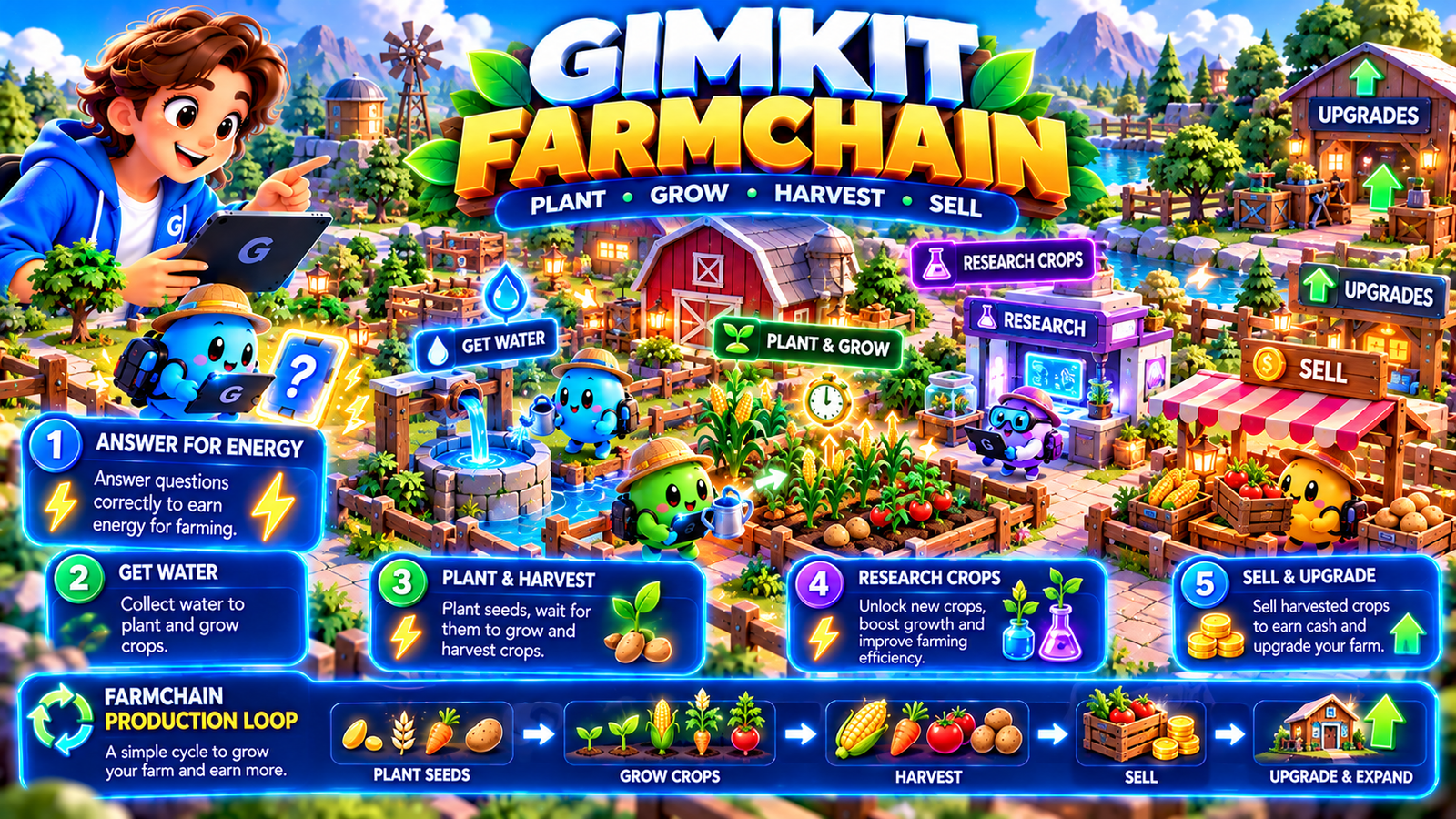
Gimkit Farmchain is a farming-themed 2D game mode built around growing crops and managing the resources required to produce them. Its design connects question-based participation with resource acquisition and a collaborative agricultural economy. Rather than treating every answer as an isolated scoring event, the mode encourages players to think about what their available resources make possible next.
Community documentation describes Farmchain as a cooperative farming experience in which crops, money, energy, water and research support progression. Gimkit's official Help Center independently confirms that Farmchain is among the 2D modes in which a host can adjust energy granted per correct question. Exact crop costs and historical gameplay configurations are not established by that official article and should not be assumed to remain unchanged.
⚡ Energy
Energy represents the bridge between answering questions and performing resource-consuming farming actions. Spending it on one action reduces what remains for other opportunities.
💧 Water
Water introduces an additional production constraint. Having sufficient energy alone may not be enough to complete the intended planting cycle.
🧪 Research
Historical Farmchain descriptions include research as a progression mechanism. It creates a choice between near-term production and access to new opportunities.
🌽 Crops
Different crop choices may involve different costs, maturity periods and returns. Those differences make planting decisions strategically meaningful.
💰 Money
Selling harvested produce generates purchasing power. Reinvestment can turn an early, modest farm into a more productive operation.
🤝 Cooperation
When players share a farm objective, production becomes a coordination problem. Clear decisions about resource priorities can matter as much as individual activity.
How the Farmchain resource cycle works
Farmchain is best understood as a connected production system. Farming is not simply a matter of repeatedly collecting a reward: a player must consider whether enough resources exist to plant, whether a crop has matured, and whether harvesting produces an outcome worth the investment.
Why a production cycle matters
A production cycle contains several distinct decisions. The first is how to acquire productive inputs. The second is which output to pursue. The third is when to collect the result. The fourth is whether to consume or reinvest the return. A mistake at any stage can reduce the value of earlier work.
The cycle also explains why a large balance of one resource does not necessarily indicate a successful farm. If the corresponding complementary resource is missing, that abundance may remain unusable.
Production bottlenecks
A bottleneck is the constraint that currently prevents progress. For a crop that requires both water and energy, a shortage of either input can stop planting.
Suppose a fictional crop needs 100 energy and 10 water. A player holding 500 energy and 4 water cannot plant it, even though the energy requirement has been exceeded. More energy does not solve the immediate problem; the next useful action must address the water shortage.
This simple relationship is the foundation of practical resource allocation in farming economies.
Farmchain Crop & Resource Simulation Lab
Operate a simplified farm economy using a transparent, adjustable model. Earn energy through hypothetical questions, convert energy into water or research, plant crops, advance simulation time, harvest produce and reinvest your money. Every action changes the actual local simulation state.
🌱 Independent Farm Economy Studio
Manage six plots, plan resource investments and explore production trade-offs without an account or game connection.
Your Six Farm Plots
Growth is based on simulation minutes, not real-world waiting. Mature crops remain harvestable in this introductory model; spoilage is not simulated.
🌽 Plant a Crop
📈 Farm Analysis
Total Harvests: 0
Planting Energy Spent: 0
Harvest Revenue: 0
Available Plots: 6
📝 Farm Activity
- Farm simulation initialized.
Simulation Crop Economics
| Crop | Energy | Water | Seed Cost | Research Required | Growth | Sale |
|---|---|---|---|---|---|---|
| 🌽 Corn | 100 | 5 | $0 | 0 | 1m | $15 |
| 🌾 Wheat | 160 | 8 | $10 | 0 | 2m | $40 |
| 🥔 Potato | 240 | 12 | $25 | 5 | 3m | $90 |
| 🍇 Grapes | 380 | 17 | $80 | 10 | 4m | $240 |
| 🍉 Watermelon | 600 | 25 | $180 | 20 | 6m | $560 |
Research is a cumulative unlock threshold in this model. It is not consumed when planting. Seed expenses are deducted from money; energy and water are deducted separately.
How to use the Farmchain simulation effectively
The most useful way to explore this application is to treat it as a series of experiments. Instead of trying to maximize its fictional money total immediately, choose a question, change one decision, and observe what happens to the farm. The goal is understanding cause and effect.
Experiment 1: Establish a baseline farm
Start with the default resources. Select Corn, choose an empty plot and plant it. Advance the simulation by one minute, then harvest the resulting crop. Observe the resource deductions and sale revenue. The experiment introduces the full production loop while minimizing the number of dependencies involved.
The result should demonstrate that earning revenue and creating net value are not identical. The crop consumes productive inputs. Its sale value should be interpreted alongside the energy and water required to grow it.
Experiment 2: Run into a resource bottleneck
Plant more than one crop and watch the available water balance. If water becomes insufficient, attempt another planting action. The simulator should reject the request and explain which resource is missing.
This rejection is important. A credible resource simulator must not allow quantities to become negative merely because a user clicks a button. A genuine constraint changes the available actions and therefore influences strategy.
Experiment 3: Compare crop investment requirements
Select a more advanced crop. The interface shows its requirements. Some varieties need a larger seed budget, additional research, more energy and more water. Their greater hypothetical sale values therefore involve increased preparation and production costs.
A high-value crop does not automatically offer the best option under every condition. If a farm has limited remaining time, an expensive crop that cannot mature before the deadline would provide less immediate value than a smaller crop that can be harvested.
Experiment 4: Change the question reward rate
Gimkit's official game-options documentation describes adjustable energy rewards per correct question in Farmchain. The simulation allows you to explore the general effect of different reward rates, without reproducing official values or attempting to forecast the balance of a live game.
Lower values require more successful question events to accumulate a target energy balance. Higher values reduce that count. This relationship makes it easier to understand why the balance between questions and in-world activity can affect the rhythm of a learning game.
Experiment 5: Compare idle and productive plots
Look at the number of plots in active production. A farm can possess large resource reserves but still generate little output if most plots remain empty. Conversely, filling every plot can create problems if the farm cannot afford enough inputs for subsequent planting cycles.
This experiment illustrates productive capacity. Available plots are a form of capacity, while energy, water and purchased seeds are operating inputs. A working farm needs both.
Understanding the economic structure of Farmchain
Farming games are particularly useful examples of resource economics because nearly every successful action requires a combination of inputs and time. Farmchain brings these relationships into a playful setting. The player must consider how resources are obtained, how they are spent, and how the resulting output advances the farm.
Scarcity creates meaningful choices
A resource is scarce when the amount available is smaller than the amount people would use if it had no cost. In a farming system, a shortage does not necessarily mean that a resource is rare in the game world. It may simply mean that the player has not yet acquired enough for the desired production plan.
Energy can be valuable because different actions draw on the same balance. Spending energy on immediate planting may leave less available for water acquisition or research. The economic challenge is therefore not merely to collect energy, but to decide where each unit provides the most useful next outcome.
Opportunity cost: what you give up
Opportunity cost is the value of the next-best alternative forgone when making a decision. In Farmchain, dedicating scarce resources to one crop can prevent another crop from being planted at that moment.
Consider a fictional situation in which a farm can grow either two inexpensive crops or one resource-intensive crop. The expensive crop offers a higher individual payout, but its value must be compared with the combined outcomes of the cheaper alternative.
The correct decision depends on costs, available water, remaining time, production capacity and the ability to reinvest. There is no universal rule that the most expensive seed is always the best purchase.
Liquidity and reinvestment
Money already committed to seeds cannot be used again until the crop is harvested and its output is sold. This introduces liquidity: having enough immediately available purchasing power to finance the next action.
A farm that spends its entire balance on slow-growing produce can temporarily lose flexibility. Even if that produce is profitable eventually, the farm may lack the money necessary to exploit another opportunity in the meantime.
Reinvestment therefore benefits from timing. Players can learn to distinguish the value of future output from the resources required to keep the farm operating in the present.
Why production time matters
Harvest revenue alone cannot measure production efficiency. Suppose one fictional crop yields $100 after ten minutes, while another yields $40 after two minutes. On the same plot and with an unlimited supply of inputs, the second crop could potentially generate greater repeated revenue over a ten-minute period.
That comparison becomes less straightforward once the amount of energy, water, purchasing capital and active attention is considered. The faster crop might consume more inputs per unit of final revenue.
A useful strategy compares the whole process rather than concentrating on one attractive number.
Research as a progression investment
In community descriptions of historical Farmchain gameplay, research functions as a means of gaining access to new productive choices. Research is different from an immediate crop harvest because its benefit may arrive indirectly. A farm may spend resources before being able to exploit the newly available crop category.
This resembles an investment in productive capability. A player may sacrifice some immediate resources to improve the range of future actions. Such an investment makes sense when the game has enough time remaining to benefit from the upgraded possibilities.
Resource throughput and system balance
Throughput is the rate at which a system produces useful output. A farm needs a consistent flow of inputs, functioning plots, opportunities for harvesting and sufficient purchasing capacity.
If one stage operates much more slowly than the others, it limits the entire process. Producing water rapidly is less useful when no planting plots remain available. Unlocking a costly crop is less valuable when the farm cannot afford its required seed purchase.
Balanced production is not necessarily equal spending across every resource. Instead, it involves recognizing the current limiting factor and responding to that constraint deliberately.
Teamwork in a shared farming economy
The collaborative character of Farmchain makes it an interesting subject for studying coordination. A group may contain players who prefer different activities, react at different speeds or value different outcomes. If those decisions are not coordinated, work can become fragmented even when everyone is contributing effort.
Agree on a shared objective
Cooperation is more effective when participants understand the outcome they are working toward. In a farming game, a team might prioritize immediate production, broader crop availability or more consistent resource acquisition. The choice should be guided by the current game rules and the objective displayed by the host's selected mode.
A shared plan does not need to be complicated. A team can first identify the largest obstacle, decide which actions would address it, and review the result after a short period of play.
Understand the difference between roles and rules
Players can voluntarily discuss who will focus on which actions, but an educational guide should not invent official Farmchain job classes or enforced team roles. Dividing attention among planting, water collection and longer-term investments is a planning example, not a claim that Gimkit assigns those responsibilities automatically.
Informal roles can still serve a useful purpose. They reduce the likelihood that several participants will independently pursue the same low-priority resource while neglecting a more important shortage.
Balance participation opportunities
In classrooms, collaborative games should offer meaningful opportunities for learners with different levels of confidence. A learner who answers questions more slowly should not automatically become an observer while faster peers control every decision.
A teacher may use brief discussion prompts to help a group explain its resource choices and ensure that students understand the relationship between the academic questions and the gameplay outcomes.
These are suggested instructional practices, not guaranteed features of the Farmchain interface.
Communication reduces duplicated effort
Resource allocation becomes easier when the group can share what it needs. If available water is already sufficient but planting energy is low, directing additional effort toward water acquisition might delay the next productive action.
A simple shared question can improve decisions: what currently prevents the farm from producing its next valuable crop? The answer turns an overwhelming economic system into a manageable immediate problem.
Evaluate teamwork through decisions, not only scores
A team's final money total can reflect successful coordination, but it does not explain how well students communicated, understood resource trade-offs or participated in decisions.
A short reflection after gameplay can ask students to describe a resource shortage, the decision the group made, and whether an alternative would have produced a better result.
This provides a richer instructional opportunity than treating the final leaderboard as a complete measurement of learning.
Teaching economic thinking through Farmchain
Farmchain can be used as a discussion context for resource allocation, agricultural production, cooperation and decision-making under constraints. That does not mean playing the mode automatically develops economic literacy. Teachers need to connect the gameplay to explicit educational questions and opportunities for explanation.
Resource-allocation discussion
An instructor can present students with a simplified resource situation before or after a game. For example, a farm has enough energy for several planting actions but limited water. Students must explain which resource should be acquired next and why.
The important part of the exercise is not the chosen fictional crop. It is whether learners correctly recognize that production requires complementary inputs.
Comparing production alternatives
Students can examine two hypothetical crops with different sale prices, growth times and input costs. They can estimate which crop produces more sale revenue per unit of time and then consider how resource expenses might change the conclusion.
This introduces a distinction between gross revenue and net benefit. It also shows that seemingly simple optimization problems become more complex when additional constraints are introduced.
Planning under a deadline
A fictional farm has six minutes remaining and two planting options. One crop requires eight minutes to mature, while another requires two minutes. Even if the longer crop offers a greater nominal payout, the shorter crop may be more useful before the deadline.
Students can explain the difference between a potentially valuable investment and an investment that can actually deliver its return in time.
Group decision reflection
After a collaborative round, ask each group to identify one decision that improved progress and one decision that created an avoidable delay. Students should support their explanations using information they genuinely observed instead of inventing performance measurements.
This approach can help develop explanatory reasoning and reflection. It should be treated as an instructional opportunity rather than evidence that Farmchain itself guarantees improved achievement.
What teachers should not assume
A lively game is not necessarily an effective assessment. Students may succeed because of fast interactions, familiarity with game mechanics, prior knowledge or teamwork. Those factors can be valuable, but they complicate interpretations of the final result.
Use independent questions, short written explanations or other appropriate checks when determining whether learners understand the subject under instruction.
Historical crop mechanics versus the live game
The unofficial Gimkit Wiki contains detailed historical Farmchain information, including crop varieties, currencies, growth periods and selling values. Such documentation can help readers understand the mode's design history, but it is not a guarantee that those numbers or features remain identical in the current service.
What official Help establishes
Gimkit lists Farmchain among 2D experiences whose energy reward per correct answer may be adjusted through host-side game balance options. The official documentation explains the principle of 2D game balancing.
What community records add
Fan-maintained material describes farming resources, a wider crop economy, research progression and historical multiplayer configurations. These details should be read with a date-and-source qualification.
What this page demonstrates
The interactive tool illustrates resource constraints with new fictional values. It does not authenticate historical figures, replicate the official software or predict actual game outcomes.
Common Farmchain planning mistakes
Planting without checking all requirements
A crop may require several resources simultaneously. Focusing only on money or only on energy can make a purchase or planting action appear affordable when another input is insufficient. Review every required resource before committing to a production plan.
Investing too late in a production cycle
A late investment may not have enough time to generate its expected benefit. This is especially relevant when crop maturity takes time or research investment must be followed by additional farming actions. Estimate the complete sequence rather than counting only the first action.
Ignoring the role of shared resources
Collaborative activity becomes less efficient when players make disconnected decisions. Pay attention to the current shortage and whether an attempted action benefits the shared objective. A farm with abundant water does not automatically need more water.
Confusing simulation data with official values
The educational model on this page deliberately uses simple numbers. Its crop costs and growth times should never be cited as official Gimkit statistics. Official gameplay must be understood through the currently available interface and verified product materials.
Assuming more correct answers always produce an optimal farm
Questions can support resource acquisition, but the subsequent resource choices matter too. A large quantity of resources may be used inefficiently if a player misunderstands the production requirements. Game performance and academic understanding should not be treated as interchangeable measurements.
Relying on outdated mode screenshots
Historical guides may show older menus, crop values, map layouts or mode settings. Compare those references with the currently available official interface before interpreting them as step-by-step instructions.
Frequently asked questions
What is the main objective of Gimkit Farmchain?
Farmchain revolves around farming and resource-based progression. Community documentation describes harvesting and selling crops as central activities, while the exact winning conditions depend on the selected game settings and version.
Is Farmchain a 2D Gimkit mode?
Yes. Gimkit's official game-options documentation identifies Farmchain among its 2D experiences.
How does energy affect farming?
Energy supports resource-consuming actions in the historical Farmchain economy. Official Help also confirms that the energy reward per correct question can be adjusted through 2D game balance settings.
Why does Farmchain include water?
Community historical descriptions identify water as an input to crop production. Requiring complementary inputs makes farming a resource-allocation problem rather than a single-currency transaction.
What is research used for in Farmchain?
Community records describe research as a way to unlock additional crops. Exact requirements should be checked against the current game when available.
Are expensive crops always more profitable?
No. A crop's sale value alone cannot determine its efficiency. Resource costs, seed costs, growth time and the remaining activity window all matter.
Can players coordinate their farming decisions?
Farmchain has been documented as a collaborative farming experience. Players can benefit from discussing resource needs and production priorities. Voluntary team planning should not be confused with an officially enforced role system.
Can a teacher adjust question rewards?
Gimkit's official game-options reference states that energy earned per correct question can be customized for Farmchain.
Do the crop values in this simulator match Gimkit?
No. The simulator deliberately uses original, simplified educational values. It is not a clone of the official Farmchain economy.
Does the Farmchain simulator save data to Gimkit?
No. It has no Gimkit connection, login integration or access to student records. Simulation state is held locally during the current page session.
How can Farmchain support a classroom lesson?
Teachers can use the farming economy as a context for discussing scarcity, opportunity cost, input requirements and collaborative choices. Learning should be checked through appropriate reflection or assessment rather than assumed from scores.
Is Farmchain available in Gimkit today?
Historical and Help Center records establish that the mode exists, but they do not prove availability in every current account. Consult the live official Mode Picker for the latest accessible options.
Verified documentation and further reading
Product-specific information should be checked against official documentation. Historical details from community sources are useful for context but are not substitutes for the live product.
- Gimkit Help — Game Options Explained . Official resource describing mode-specific settings and Farmchain's adjustable energy reward.
- Gimkit Help — 2D Game Modes . Official introduction to 2D environments, Gims and mode selection.
- Gimkit Help — Select a Game Mode . Official explanation of the Mode Picker and how hosts review mode descriptions.
- Community Gimkit Wiki — Farmchain . Unofficial historical reference for crops, resources, events and mode history.
- Official Gimkit Website . Source for the current product and actual account-based gameplay.
Related guides on GimkitApp
To explore the wider spatial gameplay concepts behind Gimkit's 2D experiences, see the Gimkit 2D reference . For a different resource-based experience, the Gimkit Fishtopia guide focuses on fishing instead of farming. Both have their own distinct gameplay subject.
These are existing homepage card destinations; their publication status may change while the topic library is being completed.
A farm succeeds through decisions, not just resources.
Gimkit Farmchain offers a distinctive way to think about production, scarcity, reinvestment and shared objectives. The strongest understanding comes from recognizing how the different parts of the farming system depend on one another. Use the independent simulator to experiment, consult official documentation for current settings, and treat historical details with appropriate caution.
Return to Farm Simulation ↑