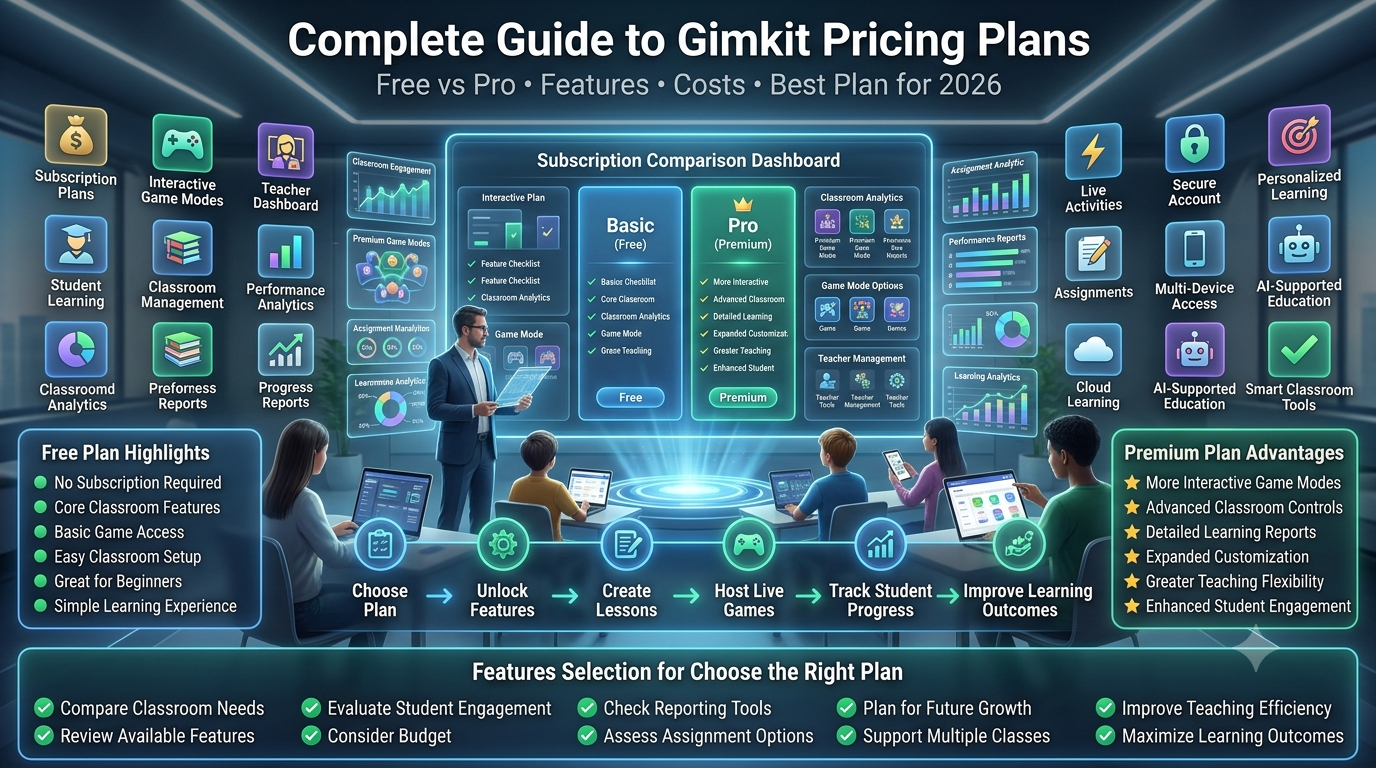
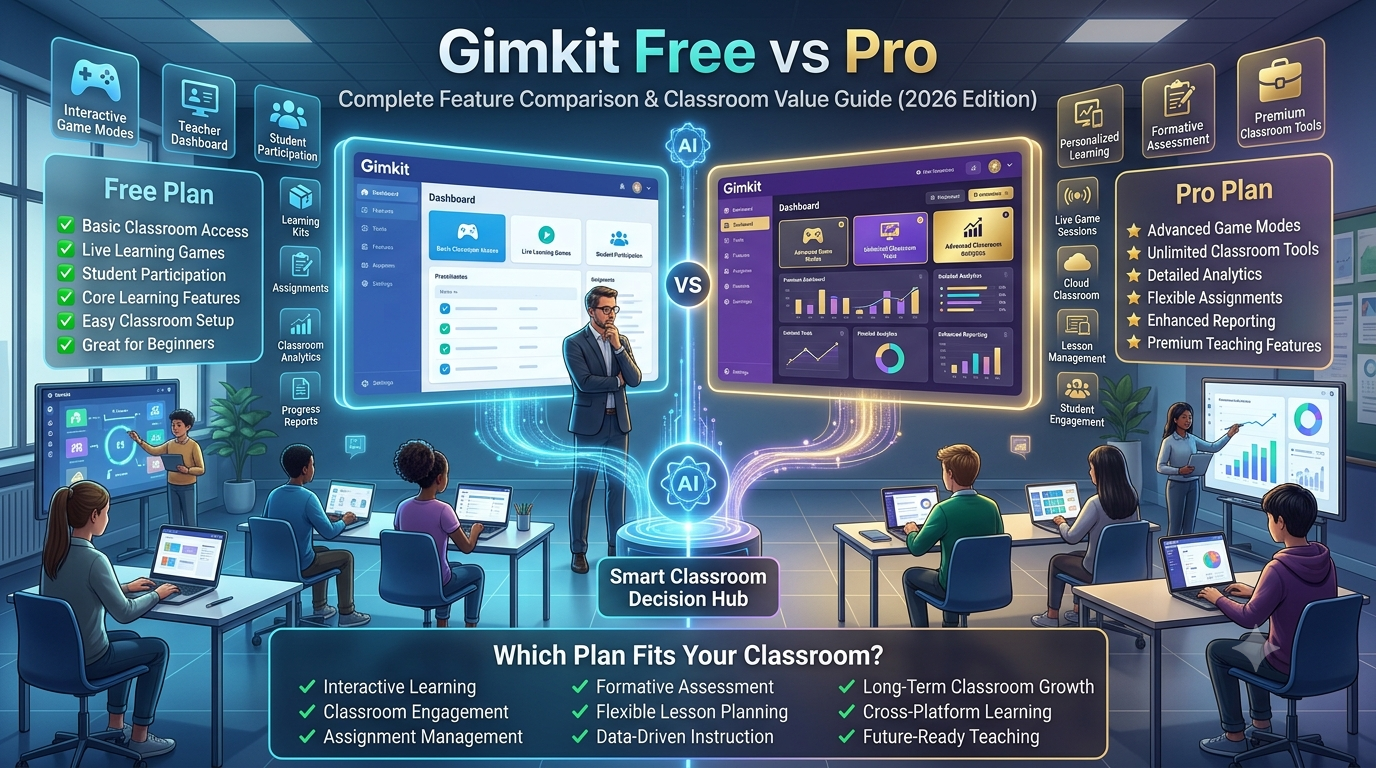
Gimkit Pro is the paid educator subscription that expands access beyond the free Gimkit Basic plan. Its documented benefits include unrestricted game-mode access, independent Assignments, audio questions and image uploads.
This guide explains exactly what Pro unlocks, what remains available on Basic, how a new Educator trial works, what happens when paid access ends and how school-managed group licenses differ from individual subscriptions.
You can also use our original Pro Entitlement & Lifecycle Lab to examine whether specific planned teaching activities remain accessible as an account moves between Basic, trial, paid or group-license states.
Basic vs Pro capabilities14-day educator trialAssignments and media accessDowngrade continuityGroup membership
Access is more than a plan label
Original educator entitlement model, not an official Gimkit dashboard.
Basic account
Core educator features
Active Pro access
Additional capabilities
Paid period ends
Entitlements may change
Created resources
Retained after downgrade
Group license
Requires actual membership
This illustration distinguishes account access, subscription entitlements and retained content.
Direct Answer
What is Gimkit Pro?
Gimkit Pro is an optional paid subscription for Gimkit Educator accounts. It provides access to Pro-exclusive game modes, Assignments, audio questions and image uploads while retaining the core features of the free Gimkit Basic offering.
The official Account FAQ distinguishes Educator and Student accounts and identifies Pro as an educator upgrade. The free Basic plan does not expire after a short promotional period. Educators can continue to create and use Kits, host supported live games, organise Classes and access game reports under Basic, subject to the actual product restrictions and documented participation limits.
The difference is therefore not that Basic offers no useful classroom functions. Gimkit expressly describes Basic as a robust free offering. Pro becomes relevant when an educator needs one or more capabilities reserved for paid access. Those capabilities are identifiable, and a responsible decision should begin with them rather than with a generic claim that every teacher must subscribe.
Gimkit's current official documentation describes new Educator accounts as receiving fourteen days of Pro trial access. Once that trial ends, the account returns to Basic unless a paid subscription or another applicable entitlement provides ongoing Pro access. This creates an important distinction between trying a feature during onboarding and depending on that feature later in a teaching period.
Paid access can also come through Gimkit Groups. A school or department may purchase a group license, but an individual educator receives Pro through that arrangement only when their Educator account has joined the applicable group. An institutional purchase does not automatically prove that every teacher's account already has an active entitlement.
The original application on this page examines these distinctions over a user-specified timeline. It accepts planned uses of official capabilities and calculates which declared subscription state would be needed at the relevant time. It does not process payment, authenticate an account or query current billing records.
Important: The Pro Entitlement Lab is a planning model. Its results are based on official feature descriptions and the subscription states you enter. They are not proof that Gimkit has activated, renewed, cancelled or assigned any subscription.
01 / CAPABILITIES
Identify paid features
Separate paid-only educator functions from features that remain available under Basic.
02 / TIME
Examine access changes
See how a planned trial ending, paid-period expiration or new entitlement affects future requirements.
03 / CONTINUITY
Protect teaching workflows
Distinguish retaining created materials from keeping permission to use Pro-dependent functions.
Part One — The Free Foundation
What educators can do with Gimkit Basic
1. Basic is a continuing free educator offering
Gimkit Basic is the platform's free educator plan. The official Account FAQ says that opening and maintaining a Gimkit account is free and that Basic can be used indefinitely. That statement is important because it prevents the fourteen-day Pro trial from being confused with a fourteen-day expiration of the entire account.
When a trial ends, the educator does not automatically lose the right to use Gimkit. The account can continue on Basic. The limitation is that certain additional capabilities are reserved for paid Pro access. This makes the transition a change in entitlements rather than the disappearance of the account itself.
A sensible plan comparison starts by identifying what the educator genuinely needs. If the intended activities depend only on available Basic features, a paid upgrade is not technically required for those stated purposes. If the educator relies on Assignments, audio questions or Pro-exclusive modes without the Basic restrictions, the outcome may be different.
The Entitlement Lab follows that distinction. A planned activity marked as core Basic functionality remains available across Basic and Pro states. Paid-dependent activities are evaluated separately using the declared entitlement at the intended time.
2. Kit creation does not universally require Pro
Gimkit allows educators to create Kits using a free Educator account. The official Create an Account and Create a Kit guides explain that educators need an account to author Kits, but they do not establish Pro as a universal requirement for writing ordinary question material.
This distinction is often obscured by overly broad descriptions of free-versus-paid educational software. The existence of paid media functionality does not mean all content creation is paid. A Kit containing ordinary supported questions can be created within the Basic offering, while specific enhanced media features have their own access conditions.
The practical planning question is therefore whether the educator simply needs to create or edit question content, or whether the lesson depends on an additional Pro-only capability within that content. Those are different requirements and should be recorded separately.
Our application includes standard Kit work as a Basic-compatible requirement. It does not build, import or edit actual questions because those processes belong to the dedicated Gimkit Create and Gimkit Questions pages.
3. Featured live modes remain available on Basic
The official Pro FAQ explains that educators using Basic can host Gimkit's Featured modes. Featured access is not the same as unrestricted access to every mode. Gimkit rotates the Featured selection, which means a particular mode may not remain in the same access category indefinitely.
This distinction matters because an educator can continue running supported live activities without holding Pro. However, relying on a specific Pro-exclusive mode for an entire term requires consideration of the subscription that permits that access under the intended conditions.
The official Player Maximums documentation also describes a restricted Basic participation allowance for Pro-exclusive modes. This is different from claiming that Basic has a universal five-player limit for all live games. Featured modes and Pro-exclusive modes have different access conditions.
The application therefore separates ordinary Featured-mode hosting from a requirement for unrestricted Pro-exclusive access. It does not pick a specific mode or compare player counts, since the separate Gimkit Game Modes page owns those detailed eligibility decisions.
4. Classes are not a Pro-only educator feature
Gimkit's official Pro FAQ identifies class rostering among the capabilities available to Basic educators. This means a teacher does not need to assume that every use of Classes requires an active paid subscription.
A Class is an organisational relationship involving educators and students. Its existence is different from the paid ability to create independent Assignments. Both concepts may appear together in a classroom workflow, but that relationship does not turn the Class feature itself into an exclusively paid function.
A teacher might maintain Class organisation while moving between Basic and Pro. The precise features available within an activity still depend on the relevant entitlement. A retained Class does not prove that every activity associated with it can be newly created under Basic.
The Entitlement Lab treats ordinary Class organisation as a Basic-compatible requirement and independent assignment creation as a paid requirement. This prevents a common reasoning error in which an entire classroom workflow is declared unavailable because one component is Pro-specific.
5. Game reports remain part of the free offering
The official Account FAQ and Pro FAQ describe collecting reports as a Basic educator capability. This establishes that a teacher does not need Pro solely because they want to review reports from supported live games.
The distinction between report access and Assignments is important. An Assignment is a particular independent activity workflow that Gimkit identifies as Pro-only. General live-game reporting is not therefore automatically a Pro feature.
A third-party comparison table that describes all reports as paid would misrepresent the official free plan. Likewise, promising advanced paid-only analytics that Gimkit does not document would create unsupported expectations.
This page limits itself to the entitlement question. It does not retrieve report data, calculate student performance or recreate reporting dashboards. Its application records the need for ordinary reporting as Basic-compatible while leaving actual report analysis to specialist resources.
6. Basic is not simply a restricted trial
A trial provides temporary access to a set of paid capabilities. Basic is a continuing free plan. They may be experienced by the same educator at different moments, but they are not equivalent products.
For a new educator, this distinction becomes visible after the initial Pro trial expires. Pro-only features may no longer be available for new work unless the account receives continuing Pro access. Core Basic workflows can nevertheless remain available.
A reliable guide should not use language such as “Gimkit becomes unusable after fourteen days.” That would contradict Gimkit's official description of Basic. Nor should the guide imply that every function encountered during the trial is guaranteed under Basic.
The Entitlement Lab illustrates this separation through a planned transition from trial to Basic. Requirements for standard Kits, Classes and ordinary reports continue through the transition. Requirements for Pro-only capabilities can change status when the entitlement changes.
7. The correct Basic question is capability-specific
A question such as “Is Gimkit Basic enough?” is too broad without an intended activity. A teacher using only standard Kit content and currently Featured modes has a different requirement from a teacher creating assignments for independent homework.
The most defensible answer begins by listing the precise capabilities the educator needs. Each capability can then be checked against Gimkit's documented Basic and Pro distinction. This produces a factual requirement analysis rather than a generic statement that one plan is always better.
It is also important to distinguish frequency from entitlement. Using a feature occasionally does not automatically make a Pro-only feature available on Basic. The technical question is whether the feature is included at the time of use. How often the educator needs it may affect a separate financial decision, but not the published access rule.
The interactive lab intentionally does not generate a popularity score or a subscription purchase recommendation. It shows when planned work requires paid capabilities and leaves economic choices to the specialised pricing content.
Part Two — Officially Documented Pro Capabilities
What Gimkit Pro actually unlocks
8. Unrestricted access to Pro-exclusive game modes
The official Pro FAQ explains that Pro provides unrestricted access to game modes, including those designated Pro Exclusives. Basic users can play the rotating Featured selection, but do not receive the same unrestricted entitlement for every mode.
This is one of Pro's principal differences. An educator whose lesson depends on access to a particular non-Featured mode may need active Pro to host it without the documented Basic limitation. The distinction is about mode access, not about possessing an entirely different account type.
The entitlement should also be separated from gameplay capacity. The official Player Maximums documentation specifies hard live-game limits, including a separate limit for 2D modes. A Pro subscription does not erase those published technical caps.
This page focuses on whether the account has the required mode entitlement. The detailed question of which named mode is currently Featured, what player limit applies and whether a particular format fits a group belongs to Gimkit Game Modes.
9. Assignments are a paid educator capability
Gimkit's official Assignments Explained article states that Assignments are available to paid Pro members. Assignments allow educators to provide supported independent activities that students can complete outside a live hosted session.
This is a substantive capability difference. The free plan can support ordinary hosting and content preparation, while the paid assignment workflow introduces a separate way of delivering activity without everyone participating in one live event.
A teacher preparing work for a particular date should check that Pro access will be active when the assignment-related capability is needed. Having trial access today does not automatically prove that the same paid function will remain available after the trial ends.
The Entitlement Lab models this timing. It can show a planned assignment feature requirement as available during a declared trial period and unavailable under a later Basic state. It does not create an assignment or determine every possible effect on an assignment that was created earlier.
10. Assignments have separate mode compatibility rules
Pro entitlement is necessary for the documented Assignment feature, but it is not the only condition affecting an actual assignment. Gimkit also states that assignments use supported 2D modes that do not require a team or group.
This matters because paid access alone is not a universal assurance that any selected mode can become homework. The educator needs both the assignment entitlement and a supported activity configuration.
The two conditions belong to different analytical levels. Subscription status answers whether the account can use the paid assignment workflow. Mode eligibility answers whether the chosen gameplay format supports that workflow.
The present application checks only the subscription-level requirement. It does not accept mode candidates or calculate assignment-mode compatibility. That separation prevents this page from duplicating the Game Modes comparison tool.
11. Audio questions are a Pro feature
Gimkit's official Account FAQ identifies audio questions among the benefits of Pro. The Create a Kit documentation also states that audio questions are available to paid Gimkit members.
This is important for educators whose instructional material depends on recorded audio rather than text alone. A lesson could require audio for listening comprehension, pronunciation examples or a specific kind of media-based prompt, but the pedagogical purpose does not alter the entitlement rule.
The official Kit editor controls how audio questions are actually created and saved. An independent Pro guide should not invent an external uploader that claims to place recordings into the authenticated account.
Our application models audio-question authoring as a paid capability. If the selected future account state is Basic, a planned new audio-question task is flagged. This is a feature-access check rather than an analysis of recording quality or content accessibility.
12. Image uploads are distinct from ordinary question creation
The official Add an Image to a Question article states that image uploads are available to paying subscribers. It describes adding a photo within Gimkit's question editor and selecting a supported source.
An image upload requirement is therefore more specific than the general ability to create a Kit. An educator can need ordinary question authoring without needing paid file uploads. Another educator may rely on original visual material and consequently need the relevant Pro entitlement.
This difference is especially important when reviewing an existing teaching workflow. Describing all question creation as Pro-only would misrepresent Basic. Describing all visual media options as freely available would also oversimplify the documented upload rule.
The Entitlement Lab includes a dedicated image-upload capability. It checks the declared subscription state at the intended time without accepting images, uploading files or attempting to manipulate real questions.
13. Pro features do not turn every student into a subscriber
Gimkit Pro is documented as an educator upgrade. The official Account FAQ states that students do not need accounts simply to join ordinary live games or assignments. This is separate from the educator's need to hold the correct entitlement when creating those activities.
An educator may have Pro access while students participate through supported activity links or joining methods. The existence of paid hosting features does not imply that every learner must purchase a Pro subscription.
Student accounts serve other functions, including certain Class relationships and account-based progression features. Those account purposes should not be confused with the educator subscription described on this page.
The application is designed for Educator entitlement planning. It does not ask for student billing information, invent a Student Pro role or evaluate student cosmetic purchases as educator subscription benefits.
14. Pro access is not the same as an account role
Gimkit officially identifies Educator and Student as account types. Basic and Pro concern the entitlement associated with eligible educator access. A paid plan does not create a third standard account type called Pro User.
This distinction matters when someone is interpreting an account screen. An Educator on Basic is still an Educator. An Educator during a trial is also an Educator. What changes is the set of capabilities accessible to that account during the relevant entitlement period.
The same principle applies to teachers included under a school or department license. The teacher's underlying account remains an Educator account; membership in a valid group supplies Pro access through a separate licensing arrangement.
The Entitlement Lab therefore models access state and source rather than pretending to change a person's account identity. Its controls do not contact Gimkit or determine whether a real user has the correct role.
15. Paid access does not guarantee every possible configuration
A Pro subscription grants documented paid capabilities, but each feature can still have its own technical and operational conditions. Assignments require supported formats. Live game modes have published player limits. Media functions depend on their actual editor options.
It would be inaccurate to describe Pro as removing every restriction from the whole Gimkit platform. Paid access solves certain entitlement conditions; it does not replace technical compatibility, account role requirements or official activity configuration.
A clear feature-access analysis should therefore state which question has been answered. This page answers whether a declared educator entitlement includes a named capability under the currently documented plan rules.
The lab uses the phrase “Available under the modeled entitlement” instead of “Guaranteed to work.” That wording is intentional. It records a valid subscription-level conclusion while preserving the authority of the real Gimkit service over the final action.
Part Three — Trial, Cancellation and Continuity
How Gimkit Pro access changes over time
16. The fourteen-day Pro trial is a temporary entitlement
The official Account FAQ explains that new Educator accounts begin with fourteen days of Pro access. This temporary entitlement provides an opportunity to experience the paid capabilities before the account continues on Basic unless another paid entitlement applies.
The important distinction is between the trial's duration and the account's duration. Fourteen days describes the introductory Pro window. It does not describe the life of the free account.
The trial can be useful for understanding the features, but future lesson planning requires more caution. An educator who creates a plan around a Pro-only activity should know whether the activity will still be permitted on the date it is needed.
The interactive lab allows the user to enter the number of days remaining in a declared trial and then select the expected next entitlement. This is a hypothetical transition, not a real trial-expiration lookup.
17. A trial's expiration can affect future teaching tasks
An educator might prepare standard Kits during the trial and plan to run ordinary Featured modes later. Those tasks can remain Basic-compatible. The same educator might also plan an independent assignment after the trial period, which introduces a Pro-only requirement.
A single label such as “trial ending” does not explain which future work is affected. The answer depends on the feature used after that point.
A useful lifecycle analysis therefore combines two dimensions: the account's entitlement state and the date of the intended activity. The relevant feature is checked at that time rather than simply against today's access.
The lab performs that comparison for each planned requirement. It can distinguish paid-dependent tasks occurring before an entered transition from those occurring after it. The result is a concrete feature-access explanation rather than a vague subscription warning.
18. Cancellation is different from immediate loss of Pro
Gimkit's official Cancel Your Subscription article states that cancellation does not immediately end Pro access. The user retains the paid entitlement through the end of the time already purchased.
This creates an important intermediate state: a subscription can be cancelled for future renewal while Pro capabilities are still available during the remaining paid period.
A guide that treats every cancelled subscription as instantly Basic would misrepresent this documented behaviour. The correct timing depends on the actual expiration date shown by Gimkit.
The Entitlement Lab includes a “Cancelled, paid period active” state. The user provides the remaining duration and expected later state. Until the modeled boundary, the application evaluates Pro capability; after it, the selected later entitlement applies.
19. Ending a subscription does not erase created resources
Gimkit's official Pro FAQ says users keep the Kits, Assignments, Classes and Seasons they have created when moving between subscription levels. The cancellation article reinforces that created content is retained after the paid period ends.
This is a major continuity distinction. A loss of Pro entitlement should not be described as automatic deletion of every educational resource previously created under paid access.
However, preserving an existing object and possessing permission to create or use additional paid features are not identical. An Assignment may remain associated with the account while the ability to initiate new Pro-only work depends on current entitlement.
The lab's continuity notes explicitly separate retained content from future feature access. It does not promise that every archived or retained object's individual functions remain usable in exactly the same way after downgrade.
20. Downgrading should be considered at the feature level
When an educator moves from Pro to Basic, some capabilities remain available while others are restricted. The change is not necessarily a uniform loss across the entire account.
Standard Kit management, Class organisation and ordinary reporting are documented Basic capabilities. Pro-exclusive mode access without Basic limitations, Assignments, audio questions and image uploads are paid capabilities.
The relevant question is what the educator expects to do after the transition. If the future task is viewing ordinary reports, the Basic offering remains relevant. If the future task is creating a new independent assignment, the paid requirement becomes central.
The lab models individual planned tasks rather than assigning the educator a generic “downgrade risk score.” The output names the affected capability, its planned timing and the modeled access condition.
21. Paid monthly and annual plans share Pro capabilities
Gimkit documents monthly and annual Pro subscriptions. The difference between those arrangements is their billing cadence, not a separate published feature tier with fundamentally different educator functionality.
An educator holding valid Pro access through either individual subscription cadence can use the paid capabilities associated with Pro, subject to normal platform conditions.
The subscription duration matters when assessing what will happen in the future. An annual subscription may cover a different interval from a monthly subscription, but the actual renewal or expiration status must be checked in the user's official billing information.
The lab represents an active individual paid entitlement without inventing a different feature list for each billing cadence. Financial cost comparisons remain outside this page's exclusive application because the site's pricing articles own that search intent.
22. Future access should never be assumed from today's badge
A teacher may see Pro status in the account today while intending to use a paid feature several weeks or months later. The present badge alone does not establish whether the subscription or group membership will still be active at that later point.
An accurate timeline needs a declared future state. The educator might plan to renew, move to Basic, join a group or remain uncertain while awaiting an institutional decision.
The Entitlement Lab deliberately asks for an expected transition rather than predicting one. Its results describe the entered scenario, not an independently verified payment schedule.
This is particularly important when modelling subscriptions that can auto-renew. If the user does not know whether renewal will occur, the correct planning state is uncertain until official billing information confirms the arrangement.
Part Four — Institutional Access
Gimkit Pro through school and department group licenses
23. Gimkit Groups is an institutional licensing route
Gimkit Groups provides a way for schools and departments to supply Pro access to eligible educators through a shared institutional arrangement. It is different from each teacher independently maintaining a personal monthly or annual subscription.
The official Groups documentation describes two license levels: Department and School. These involve institutional coverage and management, rather than a separate set of game modes or an alternative student account type.
The important entitlement question for an individual educator is whether the person's account is actually a member of an active applicable license. Knowing that an organisation purchased a license is not sufficient evidence of every teacher's individual access.
The lab models a confirmed active group membership separately from an unverified institutional entitlement. The latter produces a verification requirement rather than falsely granting Pro features to the user.
24. Department licensing covers a defined teacher group
Gimkit's official group guidance describes Department licensing as providing Pro upgrades for up to twenty teachers. This offers a way to organise access for a defined set of educators through one institutional purchase.
The figure describes licensed teacher capacity, not the number of students who can participate in a live game. It would be incorrect to treat a twenty-teacher Department license as a twenty-student classroom participation limit.
Likewise, the existence of unused institutional capacity does not automatically assign a seat to every educator. Accounts must be added to the group through the documented member process.
The current page explains this distinction without attempting to calculate a group purchase or estimate institutional cost savings. Its concern is whether a particular Educator account should be treated as having confirmed Pro entitlement.
25. School licensing covers educators within its documented scope
Gimkit also offers a School license. Official group documentation describes coverage for teachers at one school and gives further conditions for arrangements spanning buildings.
The existence of a school-level license provides a potential route to Pro access for eligible educators, but actual membership still matters. A teacher who has not joined the group cannot reasonably assume their account has already been upgraded.
Institutional license capacity and real account entitlement are therefore separate ideas. One concerns the organisation's license. The other concerns whether an individual Educator account is included and active.
The lab reflects that separation. Confirmed group membership is modelled as Pro access; group purchase without confirmed membership is classified as uncertain until the appropriate manager or official account page establishes the status.
26. Group membership upgrades an Educator account
The official Manage Your Group article explains that members and managers must have Educator accounts. When an Educator joins an applicable Gimkit group license, that account receives Pro access through the group.
This distinction matters because a group purchase is not a separate student activity or a replacement educational profile. The licensed teacher retains their Educator identity while receiving the relevant paid capability from the organisation.
The membership process takes place in Gimkit's official Groups system. An independent article should not ask for manager credentials, generate fake invitations or claim it can add teachers to a license.
The Entitlement Lab instead records a user-declared state of confirmed group membership. It cannot check that declaration. When the state is uncertain, the application explains that a manager or the actual official Group page should provide confirmation.
27. Group licenses have a distinct renewal lifecycle
Gimkit Groups documentation states that group licenses run for 365 days and do not automatically renew. This differs from the ordinary automatic billing cadence described for individual monthly and annual Pro subscriptions.
A school-managed educator may therefore experience a change in entitlement when the institutional license period ends if a replacement or renewed group license has not provided continuing access.
An important practical point is that the actual date depends on the real group purchase and renewal status. A third-party tool cannot infer the date merely from the name of the institution.
The lab allows educators or administrators to enter an expected future access change. It does not contact the Groups system, initiate renewals or guarantee the date on which an individual account's membership ends.
28. Group managers and members have different responsibilities
Gimkit Groups is managed by authorised group managers. The official documentation describes the role of managers in maintaining licenses and member access.
A teacher who expects Pro through an existing institutional purchase may need to confirm that the correct account has joined the group. That is different from personally purchasing a new subscription or troubleshooting a gameplay setting.
The entitlement analysis should therefore distinguish “my institution has a license” from “my Educator account is a confirmed active member.” The two statements are related but not equivalent.
The lab deliberately treats unverified group membership as unknown Pro access. This prevents an institutional label from being mistaken for an official account entitlement and directs the user toward the legitimate manager or account interface for verification.
29. Group coverage can change without deleting classroom resources
An educator may create Kits, Classes or Assignments while covered by an institutional license. If the teacher's paid entitlement later ends, Gimkit's published Pro FAQ explains that created content remains associated with the account across subscription changes.
That preservation should not be confused with an indefinite promise that every Pro-only operation continues unchanged after institutional coverage expires.
For example, existing content may remain retained while creating new Assignments or using other paid capabilities requires a current Pro entitlement. The exact controls available for a retained object remain subject to Gimkit's actual product rules.
The lab presents preservation and future entitlement separately. It can identify which upcoming feature needs would become unavailable under a modeled Basic state without claiming that the user's past teaching materials have vanished.
Exclusive Page 14 Interactive Application
Gimkit Pro Entitlement & Lifecycle Lab
Model the Pro capabilities you expect to use, declare your current educator entitlement and specify an anticipated future change. The lab checks each planned task against the access state expected on its intended day.
FEATURE-ACCESS AND CONTINUITY ENGINE
Plan the capability. Check the entitlement. Understand the transition.
A transparent local planning model. No payment, subscription changes, actual account status or official license records are accessed.
1. Describe the educator's current access
Choose what you know from the official account or group information.
This is an assumption entered by you, not a billing prediction.
Enter a whole number of days from now, 0–365.
Current phase
Educator Pro trial
Declared active Pro trial.
→
After stated change
Gimkit Basic
Future state is user-declared.
The transition is illustrative. Confirm actual expiry or renewal dates through Gimkit.
2. Add planned educator capability requirements
Each row represents one intended use of a documented feature. Enter when that capability will be needed and whether it is essential or optional for your own planning.
Maximum twelve anonymous requirements. Dates are represented as offsets from today, not as calendar appointments or real Gimkit activity records.
3. Entitlement analysis at the planned time
0Planned requirements
0Covered by model
0Paid access missing
0Need verification
4. Continuity and preservation notes
5. Export your entitlement brief
Your declared scenario is stored in your browser where local storage is permitted. Nothing is sent to Gimkit. The lab does not request payment information, passwords or real account identifiers.
What the Entitlement Lab actually calculates
The lab evaluates a future capability requirement against the educator access state entered for the corresponding point in time. If the user declares an active trial lasting fourteen more days, a task planned on day seven is tested against Pro and a task planned on day twenty is tested against the selected subsequent state.
For Basic-compatible functions, the modeled requirement remains available across Basic and Pro. For paid capabilities, the result depends on whether the expected state provides Pro entitlement. A confirmed group membership can provide such access, whereas unverified group membership is treated as uncertainty.
The lab does not predict whether an individual subscription will renew. The user decides which future transition to model. This is particularly important for recurring paid subscriptions, cancelled periods and institutional renewals.
Each output includes the capability requirement, intended timing, modeled entitlement and explanatory reason. The final brief also documents what is known about retaining created resources after downgrade.
The application does not provide game-mode recommendations, player-cap calculations, price comparisons, Kit editing or authenticated billing controls. Those are different problems assigned to other pages or the official Gimkit service.
Part Five — Transparent Entitlement Logic
How the Pro Entitlement Lab reaches its conclusions
30. A feature requirement is different from a plan preference
An educator may prefer a particular subscription without needing every capability that subscription provides. A feature requirement is more specific. It identifies an action that the educator expects to perform, such as creating an independent assignment or uploading an image into a question.
The lab starts with actual planned capabilities rather than asking whether the user generally likes paid software. This produces a checkable relationship between the activity and the documented entitlement.
For example, ordinary Kit work and image uploading can both occur in the broader context of preparing question material, but they do not have the same Basic-versus-Pro classification. The application models them as separate features.
The result is not a subjective score for the quality of a plan. It is a feature-level statement about whether the declared account state supplies a capability identified in Gimkit's official documentation.
31. The current entitlement and future entitlement are separate inputs
A plan's present state does not always establish its future state. A trial may end, a paid subscription may continue, a cancelled period may expire or a school may provide a new group entitlement.
The lab therefore records two states and a user-declared change point. Requirements before the change are evaluated using the current state. Requirements at or after the change are evaluated using the expected future state.
This is a transparent rule rather than an attempt to forecast billing activity. If the educator expects no change, they can select an equivalent future entitlement. If future coverage is uncertain, they can choose Unknown instead of making an unsupported assumption.
The approach also makes it possible to see why the same paid feature could be accessible in one period and unavailable in another without changing the nature of the feature itself.
32. A trial is treated as Pro only while declared active
New Educator accounts receive an introductory Pro trial according to Gimkit's official Account FAQ. The lab models this as a current state supplying Pro capabilities until the declared change boundary.
The duration field is entered by the user because the application does not know when the particular account was created. It cannot calculate the user's actual remaining trial time without account information, which it does not access.
If the educator enters fourteen days and a future Basic state, tasks planned after that period will be checked against Basic. Tasks before that point can use the modeled trial entitlement.
This illustrates a real timing distinction without pretending to confirm the actual trial expiration date or automatically renew a subscription.
33. Cancelled but active access retains Pro in the model
The official cancellation article says Pro remains available through the paid period after cancellation. This means cancellation status and entitlement status are not always identical at the present moment.
The lab includes a distinct cancelled-but-active state to represent this condition. It treats the account as Pro during the user-declared remaining paid period and uses the expected later entitlement after that point.
The application does not tell Gimkit to cancel a subscription. It also cannot establish the real expiration date or whether a payment has been processed.
This distinction helps prevent the false conclusion that an educator loses every paid capability immediately upon selecting an official cancellation option.
34. Unverified group membership cannot be counted as Pro
A school purchasing a Gimkit Group license does not establish that every educator's account has already joined it. Official Groups documentation describes educators receiving Pro when they become active members.
The lab consequently separates confirmed active group membership from membership that is pending or unverified. The latter is not silently treated as paid access.
For a feature requiring Pro, an unverified group state produces a request for confirmation. The educator may need to inspect their official account or contact the authorised group manager.
The model does not independently inspect membership, manage Group invitations or grant paid capabilities.
35. Basic-compatible features remain visible in the results
A tool that reports only paid requirements can create the impression that everything else disappears after downgrade. The lab avoids this by retaining ordinary Basic-compatible tasks in the requirement list.
If a planned task involves standard Kits, Classes or reports, the application identifies it as covered under Basic according to the official plan descriptions.
This does not guarantee every detail of the activity. It addresses the broad subscription requirement rather than technical configuration, user role or individual resource state.
Keeping free and paid features in the same timeline makes the transition more meaningful. It shows the scope of the change instead of equating downgrade with complete loss of the account.
36. Essential and optional requirements have different planning significance
An educator may describe a capability as essential for a planned teaching workflow or optional as an enhancement. That designation belongs to the educator and is not determined by Gimkit's official subscription documentation.
The lab records this distinction so the exported brief can identify which blocked requirements represent the educator's highest-priority needs.
The label does not change the feature's entitlement. An optional Assignment still requires Pro. An essential ordinary Kit activity remains Basic-compatible under the documented feature classification.
This prevents subjective urgency from being mistaken for technical access. The application displays priority for planning purposes while keeping the actual capability rule independent.
37. A preservation guarantee is not an action guarantee
Gimkit states that users keep created Kits, Assignments, Classes and Seasons when changing subscription levels. This is a content-retention statement.
It would be too broad to convert that statement into a promise that every Pro-only control remains usable indefinitely under Basic. The documentation separately identifies which capabilities require Pro.
The lab's preservation panel therefore describes retained resources while checking new planned actions against current or expected entitlement.
This distinction is especially useful when an educator has already invested time creating materials and is evaluating a later subscription change.
38. The lab does not estimate subscription prices
The site already contains specialist pricing material. A feature-access analysis solves a different problem: identifying which educator capabilities are documented under a particular entitlement.
A subscription's cost is relevant to a purchasing decision, but price alone does not establish whether the desired feature is included. An inexpensive plan without a required capability and a more expensive plan with that capability cannot be compared meaningfully without knowing what the educator needs.
This lab therefore avoids a generic savings calculator. It provides entitlement evidence that could inform a separate financial evaluation.
The official pricing FAQ and actual checkout remain the authoritative sources for commercial amounts and current billing terms.
39. Local exports preserve assumptions rather than account facts
The lab creates readable text, CSV and JSON records. These outputs contain the declared subscription phases, planned capability requirements, computed statuses and relevant limitations.
They do not contain authenticated account records, real subscription receipts, payment methods, Class rosters or student data.
A user can export a scenario and restore its JSON later in the same application. The import routine checks the expected structure and allowed feature identifiers before accepting it.
The purpose is reproducibility: users can examine why a result was produced and change the scenario when their official entitlement information becomes clearer.
Part Six — Realistic Educator Scenarios
Examples of Gimkit Pro entitlement decisions
40. A new educator planning work after the trial
A new educator has just opened an account and received a fourteen-day Pro trial. The teacher wants to prepare a Kit immediately and create an independent Assignment several weeks later.
The Kit requirement is not automatically a paid feature. Ordinary Kit creation is documented within the free educator offering. The Assignment requirement is different because official Gimkit documentation identifies Assignments as Pro-only.
The lab can model the current trial followed by Basic after fourteen days. A standard Kit task on day three remains covered. An Assignment task on day twenty-one is flagged because the modeled entitlement is Basic at that point.
The example does not instruct the teacher to purchase a subscription. It establishes which future activity requires paid access so the teacher can evaluate the official options.
41. A teacher whose only requirement is regular live hosting
An educator wants to continue using ordinary Kits and currently Featured live modes for classroom review. No independent assignments, media uploads or unrestricted Pro-exclusive mode access are included in the intended workflow.
Under the documented Basic-versus-Pro distinction, these declared requirements do not inherently justify a technical need for the paid-only capabilities.
The lab can represent this scenario using standard Kit work and Featured live hosting. Both remain classified as Basic-compatible even when the expected future state is the free plan.
This outcome does not guarantee that a particular mode remains Featured forever. Current mode availability must still be checked through Gimkit. The result concerns the generic Basic entitlement, not a specific mode roster.
42. A teacher who relies on audio-based questions
A language educator plans to add audio questions to new lesson content. Gimkit's Account FAQ and Kit creation documentation identify audio questions as a paid capability.
The important requirement is not simply that the teacher has an account. It is that the relevant Pro entitlement is active when the audio-question authoring action needs to occur.
The lab can record that feature as essential on the intended day. If the current plan is Basic and no Pro transition is expected, the requirement is marked unavailable under the modeled entitlement.
The application does not accept audio files or analyse pronunciation. Those tasks require the actual official editor and potentially separate content-authoring guidance.
43. A science educator preparing visual questions
A teacher wants to upload images into questions used for identifying scientific structures. The official image-upload documentation identifies uploaded images as available to paying subscribers.
The teacher may still use Basic for other question work, but the specific upload requirement introduces an additional entitlement condition.
The lab can show that difference by recording standard Kit authoring and image uploading as separate requirements. The first may remain available on Basic while the second requires active Pro access.
This scenario demonstrates why feature-level planning is more accurate than describing all content creation as entirely free or entirely paid.
44. A cancelled subscription with time remaining
An educator has cancelled Pro renewal but still has several weeks of paid access left. The official cancellation documentation says the educator retains Pro through the paid period.
A paid feature needed during that remaining interval may therefore still be covered. The same feature may no longer be available for new work after the modeled entitlement changes to Basic.
The lab can represent this situation using the Cancelled, paid period active state and a transition date supplied by the educator.
The outcome is conditional on that declared date. Only Gimkit's actual Plan and Billing information can confirm the account's real expiration.
45. A school has purchased a license but one teacher is not yet a member
A school has an active Gimkit Group license, but an educator has not confirmed that their own Educator account joined it.
The purchase may provide a route to Pro access, yet the teacher's individual entitlement remains unverified. Gimkit Groups documentation makes membership part of how an educator receives the upgrade.
The lab treats the current state as Group membership not confirmed. Paid-feature requirements return a verification outcome instead of assuming an active Pro license.
The appropriate next step is to confirm the account's actual membership through Gimkit or the authorised Group manager, not to rely on a third-party entitlement badge.
46. A teacher moves from personal Pro to a group license
An educator currently has an individual paid subscription but expects a school-managed Group entitlement to become active. The two arrangements provide Pro access through different sources.
If the transition is confirmed and continuous, the educator may not need to experience a gap in paid capabilities. If the future membership is uncertain, the entitlement cannot be treated as guaranteed.
The lab allows the user to model a future Group state or an Unknown state. This highlights the consequences of confirmed versus unconfirmed coverage without calculating refunds or manipulating subscriptions.
Official Gimkit documentation remains responsible for the real membership and billing relationship.
47. A department renews its group license
A school department uses Gimkit Groups and intends to renew before the current license ends. The official Group documentation describes licenses lasting 365 days without automatic renewal.
An educator planning a Pro-only activity beyond that period should consider whether the replacement entitlement will actually be active at the time.
The lab can represent continuing Group membership as an expected future state. If renewal has not been confirmed, Unknown is the more accurate declaration.
It cannot complete renewal, verify institutional payment or determine the actual membership date. Those operations belong to the official Groups system.
48. A teacher needs Pro modes but does not need Assignments
Not every Pro user requires every Pro feature. An educator may be interested primarily in unrestricted access to Pro-exclusive modes while continuing to use ordinary live hosting rather than independent homework.
The relevant paid requirement is mode access. The absence of an Assignment need does not remove the possible Pro requirement for the desired mode entitlement.
The lab can model unrestricted Pro-exclusive mode access as a standalone planned capability. It does not calculate which specific game mode the teacher should use or whether a class fits a particular player limit.
Those separate questions remain with the Mode Picker and the dedicated Gimkit Game Modes page.
49. A teacher needs Pro features at different times
An educator may need image uploads early in a teaching period, Assignments several weeks later and ordinary reports throughout the term.
A single present-day Pro badge cannot establish whether all those future actions will be covered. The relevant entitlement must be considered when each capability is needed.
The lab allows several planned requirements with different day offsets. It checks them individually against the modeled transition, making it possible to identify a future access gap affecting one feature but not another.
This is a better explanation than a generic conclusion that the teacher either “needs Pro” or “does not need Pro” without identifying when and why.
50. An educator's access is uncertain before the academic term
A teacher expects the school to provide Gimkit Pro but has not received confirmation of membership or the license's status.
If the teacher plans paid-dependent activities, describing them as fully covered would be premature. The institution may still be completing its licensing or membership process.
The lab can record the present entitlement as unknown and the future state as expected Group membership if that is the scenario being evaluated.
The result remains a conditional planning analysis rather than a claim that the school's license has been activated. Official confirmation should precede any consequential assumption about available features.
51. A downgrade does not require recreating every Kit
An educator has created several Kits during a paid period and later returns to Basic. Gimkit's official Pro FAQ states that created resources remain retained when subscription levels change.
That continuity means a teacher should not assume that every existing Kit must be created again merely because paid access has ended.
At the same time, the teacher should distinguish the presence of a retained resource from permission to use Pro-specific authoring capabilities in future work.
The lab's preservation summary explains this difference. It does not inspect the real Kits or promise that every paid-only editing operation remains enabled after downgrade.
Part Seven — Pricing Context and Source Accuracy
Gimkit Pro subscription prices and important billing distinctions
52. Gimkit documents monthly and annual Pro subscriptions
The Gimkit Pro FAQ updated in May 2026 lists individual paid Pro options with monthly and annual billing. It states a monthly price of $14.99 and lists an annual price of $59.88 in its subscription-options section.
However, the same FAQ contains an example using $59.98 for the annual amount. This is an internal inconsistency in the official source. A responsible guide should flag the difference rather than silently treat both amounts as identical.
Actual checkout information is the relevant authority when a user is deciding what to purchase. Prices, taxes and future adjustments may also affect what an individual account is charged.
The purpose of this page is to explain the Pro entitlement and its lifecycle. It does not offer a savings calculator or claim that a static listed amount is guaranteed for every transaction.
53. Billing cadence and feature access answer different questions
The monthly and annual Pro arrangements are different billing choices for the same broad paid educator entitlement. Their practical financial consequences depend on the user's intended subscription duration and current checkout terms.
The feature question is narrower: does the educator need a documented Pro capability during the period in which the subscription will be active?
An educator may have a short-term need for Assignments or a continuing need for unrestricted game-mode access. Both create a paid capability requirement, even though they may lead to different financial preferences.
This page intentionally avoids reproducing the detailed financial analysis available in the site's dedicated subscription-selection article. The Entitlement Lab supplies feature-level evidence that can be considered alongside separate cost information.
54. Group licenses have separate commercial terms
Gimkit's official Groups documentation lists Department and School licensing options. These are purchased and managed through the institutional Groups system rather than treated as additional individual monthly billing tiers.
Official documentation also describes group licenses as running for 365 days without automatic renewal. The purchasing workflow may support institutional payment methods that differ from individual subscriptions.
The relevant entitlement condition for a teacher remains confirmed membership in an active group. An organisation's total license price does not prove that a particular educator account already has Pro access.
For actual institutional prices, quotes, payments and membership management, the official Gimkit Groups service remains the source of truth.
55. Receipts and renewal status belong to Gimkit's account system
Gimkit's official Pro FAQ identifies Plan and Billing under account Settings as the place where relevant charges and receipts can be viewed.
This is significant because a third-party article should not ask readers to submit billing credentials, upload payment receipts or rely on an independent simulation to verify whether a renewal succeeded.
The Entitlement Lab therefore treats the current and expected subscription states as user declarations. When the outcome depends on actual payment or renewal, the user should confirm the relevant status through the authenticated official service.
This keeps subscription understanding separate from account management. The page can explain what an active entitlement means without impersonating the billing interface.
Access state
Documented meaning
Planning consideration
Gimkit Basic
Continuing free educator access to core features.
Paid-only capabilities are not generally available without an applicable exception.
Educator Pro trial
Introductory Pro access documented for new educators.
Determine whether future work falls after the actual trial expiry.
Active individual Pro
Paid educator entitlement under Gimkit's subscription terms.
Confirm the applicable paid period and renewal status.
Cancelled, period active
Paid Pro access continues until the already-paid period ends.
Evaluate future Pro-only work against the expiration date.
Active Group member
Educator account receives Pro through valid group membership.
Confirm actual membership and institutional license continuity.
Group unverified
An institutional purchase or invitation has not established current access.
Ask the official Group manager or inspect actual account status.
Frequently Asked Questions
Gimkit Pro questions answered
What is Gimkit Pro?
Gimkit Pro is an optional paid educator subscription that provides capabilities beyond the free Basic offering, including Pro-exclusive mode access, Assignments, audio questions and image uploads.
Is Gimkit Pro required to create an account?
No. Gimkit account creation is free. Pro is a separate optional educator entitlement.
Is Gimkit Basic permanently free?
According to Gimkit's official Account FAQ, Basic can be used indefinitely. The expiration of the introductory Pro trial does not automatically terminate the educator account.
What features are exclusive to Gimkit Pro?
Gimkit identifies unrestricted Pro-exclusive mode access, Assignments, audio questions and image uploads as paid educator capabilities.
Can Basic educators still create Kits?
Yes. Ordinary Kit creation is available with a free Educator account. Particular paid media-upload or audio capabilities have separate requirements.
Can I host Gimkit games without Pro?
Yes. Basic includes access to the rotating Featured modes. Other mode-specific and player-cap restrictions may apply.
Does Basic limit every live game to five players?
No. Gimkit's five-player Basic restriction applies to Pro-exclusive modes. Featured modes have different access conditions, while general and 2D hard limits are documented separately.
Do educators need Pro to use Classes?
Gimkit's Pro FAQ identifies Class rostering as a Basic capability. Classes and paid Assignments should not be treated as the same entitlement.
Can Basic educators collect reports?
Yes. Gimkit describes collecting game reports as part of the Basic offering.
Are Gimkit Assignments a Pro feature?
Yes. The official Assignments Explained article states that Assignments are available to paid Pro members.
Does Pro allow every mode to become an assignment?
No. Assignment support has separate restrictions involving eligible 2D modes that do not require team or group play.
Are audio questions included with Basic?
Gimkit documents audio questions as a paid feature. Standard Kit creation should not be confused with the paid audio capability.
Are uploaded images available on Basic?
The official Add an Image to a Question documentation states that image uploads are available to paying subscribers.
How long is the Gimkit Pro free trial?
The official Account FAQ describes a fourteen-day trial for new Educator accounts.
What happens after my Pro trial ends?
Gimkit describes educator accounts returning to Basic when the introductory trial expires unless a paid entitlement provides continuing Pro access.
Will my Kits disappear if I downgrade?
Gimkit states that users retain created Kits and other documented resources when changing subscription levels.
Are created Assignments deleted after Pro ends?
The official Pro FAQ says created Assignments are retained across subscription changes. Retaining an object should not be confused with retaining permission for every Pro-only operation.
Does cancelling Pro immediately remove access?
No. Gimkit says cancellation does not immediately end paid access. Pro remains available for the already-paid period.
Does cancelling Pro automatically delete my account?
No. Cancelling a subscription and deleting an account are separate operations. Gimkit documents content retention when paid access ends.
Do monthly and annual Pro have different features?
The official Pro FAQ describes them as billing options for the same Pro tier. It does not identify a separate monthly-only versus annual-only educator capability list.
How much is Gimkit Pro monthly?
The official Pro FAQ updated in May 2026 lists $14.99 per month. Verify the current amount at official checkout before purchasing.
How much is Gimkit Pro annually?
The official FAQ lists $59.88 in one section but uses $59.98 in another example. Because those figures conflict, confirm the amount in the actual Gimkit checkout.
What is a Gimkit Group license?
It is an institutional licensing arrangement through which a department or school can provide eligible teachers with Pro access.
Does buying a Group license automatically upgrade every teacher?
No. Official Groups documentation explains that Educator accounts receive Pro access by joining an applicable active group.
How long does a Gimkit Group license last?
Gimkit's Groups documentation describes a 365-day license period without automatic renewal.
Can students purchase Gimkit Pro as a standard account upgrade?
The official Account FAQ identifies Pro as an optional paid add-on for Educator accounts. The standard account types are Educator and Student.
Do students need Pro to join a teacher's assignment?
No. The educator's account must meet the assignment entitlement requirement, but Gimkit states that students can participate in assignments without holding Pro subscriptions.
Can this page check my actual Pro subscription?
No. The Entitlement Lab cannot authenticate or inspect a Gimkit account. It uses the access information you declare.
What does the Entitlement Lab calculate?
It compares planned educator capabilities with a current and expected future entitlement, applying the documented Basic-versus-Pro feature distinctions.
Can the lab predict whether my subscription will renew?
No. The future state is entered by the user. Official billing and institutional membership records determine what actually happens.
What does Group membership unverified mean?
It means the application cannot assume that a real educator account has received Pro solely because an institution may have purchased a license.
Why does the lab distinguish retained content from feature access?
Gimkit documents retention of created resources after downgrade, while paid capabilities still require the relevant entitlement for new supported actions.
Does the lab provide payment or cancellation buttons?
No. It does not process transactions, manage subscriptions or change accounts. Those operations must occur through Gimkit.
Can I save my entitlement scenario?
Yes. The lab supports local browser storage, readable text exports, CSV and JSON, including JSON restoration within this independent application.
Is the lab's JSON compatible with Gimkit?
No. Its format belongs to GimkitApp.com's independent entitlement planner and is not an official billing, subscription or game configuration file.
What is the best way to confirm my actual paid access?
Inspect your authenticated Gimkit account, its relevant Plan and Billing information, or official Groups membership. The product itself remains authoritative for real entitlements.
Separate Financial Decision Topic
When feature entitlement and subscription choice meet
Knowing which Gimkit capabilities require Pro is one part of the decision. Choosing between monthly billing, annual billing or an applicable institutional purchase is a different financial question.
The site's guide to choosing a Gimkit subscription plan discusses that wider subscription-selection problem. The current page concentrates on what the educator entitlement unlocks and how feature availability may change over time.
Keeping these questions separate prevents a cost-comparison calculator from being presented as a substitute for feature-level access verification.
Source Transparency
Official Gimkit sources supporting this page
The following Help Center resources describe Gimkit Basic, Pro access, trial conditions, Assignments, uploaded media, subscription cancellation, retained resources and institutional group licensing.
Source discrepancy: The official Pro FAQ contains conflicting annual-price figures. The amounts on this independent page are informational snapshots, not binding purchase offers. Check Gimkit's current checkout for the final amount.
Editorial independence: GimkitApp.com is an independent educational information website. It is not operated, authorised or endorsed by Gimkit. Pro entitlements, billing, refunds, subscriptions, institutional licenses and user permissions remain controlled by Gimkit.
Know which capabilities you need—and when you need them.
Gimkit Basic retains meaningful educator functionality. Gimkit Pro unlocks additional documented features. Trial periods, cancellation and group memberships change the timing of access, not the fundamental distinction between a retained resource and an active paid entitlement.