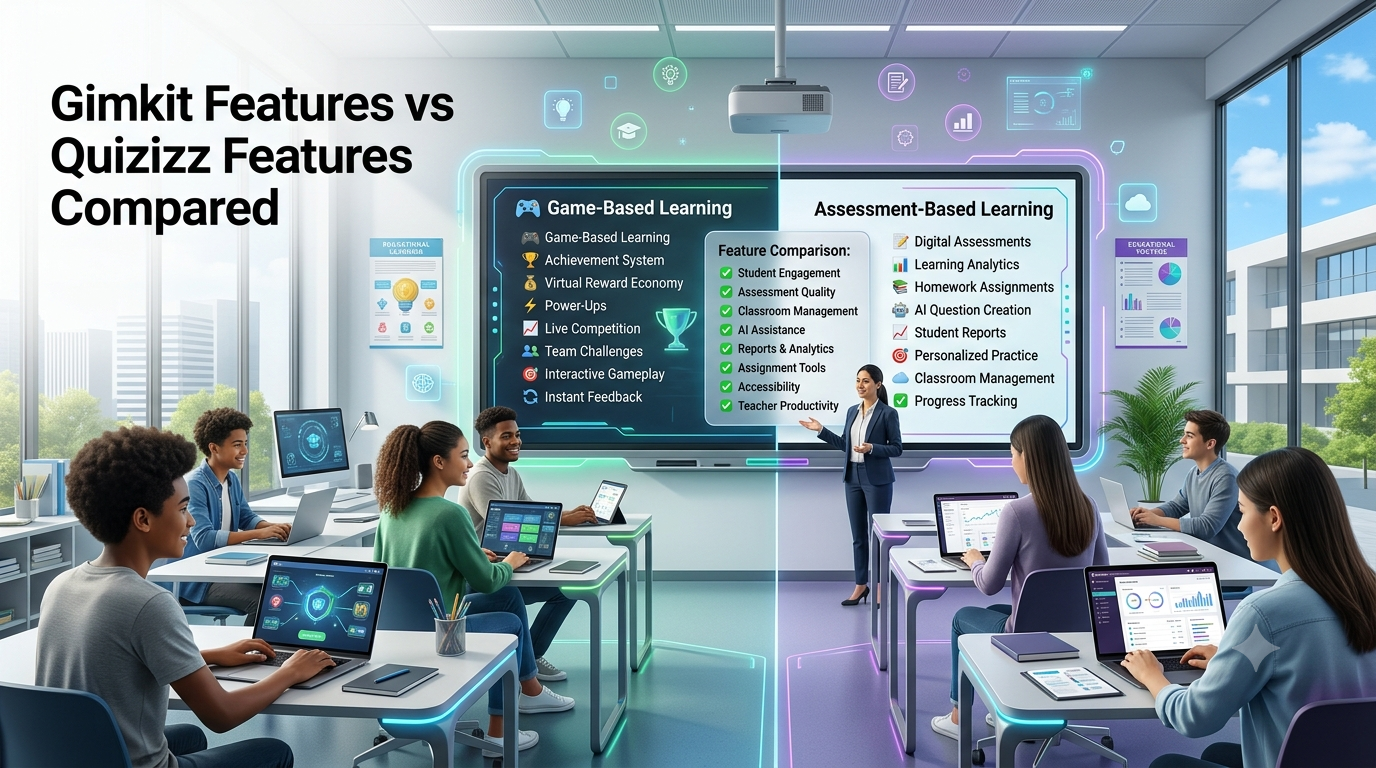
Gimkit vs Quizizz: When two classroom platforms both turn questions into interactive activities, the real difference is not whether students can answer questions. Both can do that well. The more useful question is what the platform does with the answer afterward.
That is where Gimkit and Quizizz begin to separate.
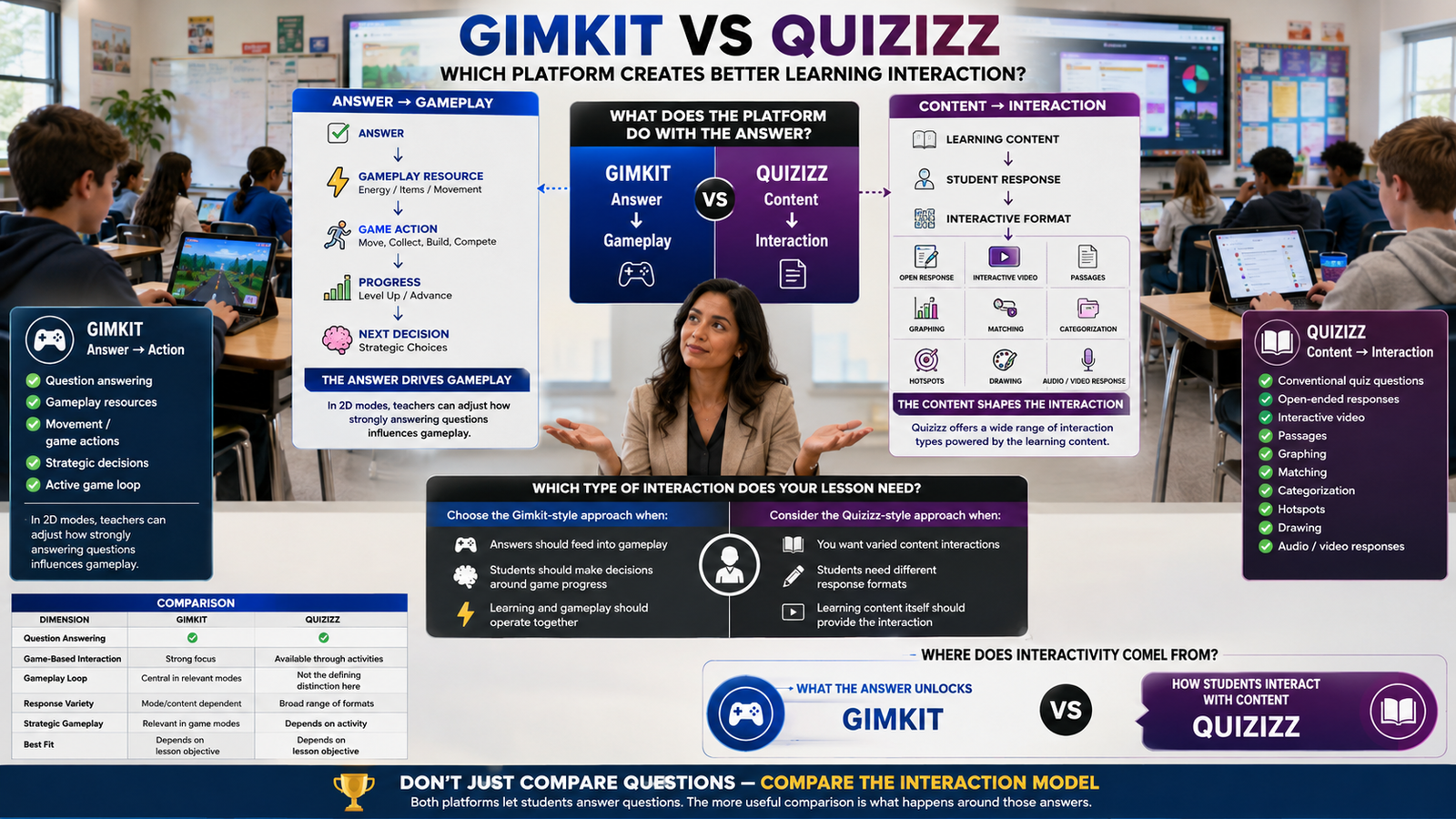
Gimkit is built around making answers part of an active game loop. In its 2D modes, students can answer questions to earn things such as energy, movement, or other gameplay resources, while teachers can adjust how strongly answering questions influences gameplay.
Quizizz takes a broader approach to interactivity. Its current question system includes conventional quiz formats alongside open-ended responses, interactive video, passages, graphing, matching, categorization, hotspots, drawing, audio/video responses, and other formats.
So the comparison is not simply “Which one is more fun?”
It is:
Does interactivity come mainly from what the answer unlocks, or from how students interact with the learning content itself?
That distinction gives us a much cleaner way to compare the two.
Looking for comprehensive classroom resources and educational technology insights? Explore GimkitApp for expert guides, teaching strategies, game modes, and the latest updates to enhance student engagement.
Gimkit vs Quizizz: The Core Difference
Gimkit
Quizizz
Primary interaction model
Questions feed into gameplay
Questions can become different types of learning interactions
What makes an answer meaningful?
It can affect progress or gameplay
It can provide feedback, assessment evidence, practice, or interaction
Strongest identity
Game-centered learning
Interactive learning and assessment
Gameplay depth
High in game-focused modes
Available in selected experiences
Question-format breadth
More focused
Very broad
Strategic element
Strong in relevant game modes
Depends on the selected experience
Assessment flexibility
Good
Very strong
Best conceptual fit
“Answer, then do something in the game.”
“Interact with the content in more ways.”
This is the foundation for everything that follows.
Gimkit’s official documentation, for example, describes modes where answering questions directly produces resources used to move through the game. In One Way Out, students answer questions to gain energy, then use that energy to move through a collaborative game objective.
Quizizz, meanwhile, can make the question itself substantially more interactive. Its March 2026 documentation lists formats ranging from multi-select and open-ended questions to interactive video, passages, graphing, matching, categorization, hotspots, and audio/video responses.
That is a fundamentally different design choice.
What Does “Interactive” Actually Mean Here?
The word interactive gets used too loosely in classroom technology.
A question appearing on a student’s screen does not automatically make the learning experience deeply interactive.
There are at least two different layers:
1. Interaction with the question
The student might:
choose several answers
type a response
manipulate a graph
match items
reorder information
identify something in an image
respond to a video
work through a passage
Quizizz has particularly broad support for this kind of interaction.
2. Interaction with the game
The student’s answer might instead determine:
movement
resources
progress
strategic options
team objectives
game outcomes
This is where Gimkit becomes especially distinctive. Its 2D game modes let hosts adjust the balance between answering questions and gameplay, so correct answers can have a deliberately stronger or weaker effect on the game.
The distinction
Quizizz can make the question more interactive.
Gimkit can make the consequence of answering more interactive.
That is a much more precise comparison than simply calling both platforms “gamified.”
How Gimkit Turns an Answer Into Gameplay
Gimkit’s most distinctive design choice is that the question does not have to be the final event.
A correct response can become an input into the next part of the activity.
In its 2D experiences, for example, Gimkit documents different resources earned through correct answers—including snowballs in Snowbrawl, bait in Fishtopia, and energy in several other modes.
That creates a loop like this:
Question → Answer → Game resource → Action → Progress
The student is therefore solving two connected problems:
Can I answer the question correctly?
and
What can I do with the result?
That second layer is what gives Gimkit its strongest game-like character.
A useful example
Imagine students are reviewing vocabulary.
In a conventional quiz, a correct answer might simply produce:
Correct → next question
In a game-driven Gimkit mode, the same correct answer can instead produce:
Correct → resource → movement/action → continued objective
The academic question remains the source of progress, but the student experiences that progress through gameplay.
That connection is not incidental. Gimkit explicitly gives hosts controls for balancing the educational and gameplay sides of supported 2D modes. If students are progressing too slowly, the reward per question can be increased; if gameplay is overwhelming the question-answering component, the reward can be reduced.
Pro Insight: The strength of Gimkit isn’t simply that it has games. It’s that the question can function as a gameplay mechanic.
How Quizizz Makes the Question Itself More Interactive
Quizizz approaches the problem from the other direction.
Instead of relying primarily on a game world to make answering meaningful, it gives teachers more ways to design the actual interaction around the content.
Its current documentation lists question types including:
multiple choice
multi-select
true/false
fill in the blanks
open-ended
interactive video
passages
graphing
matching
categorization
reorder
drag-and-drop
hotspots
drawing
audio response
video response
Availability can vary by question type and plan.
That matters because not every learning objective is best represented by a standard multiple-choice question.
Consider a geography lesson.
A teacher might want students to identify a location visually rather than choose an option from a list. A hotspot-style interaction can better match that objective.
Or consider mathematics.
A graphing or mathematical-response interaction can require students to express an answer rather than simply recognize it.
Or consider reading comprehension.
A passage can provide shared context for multiple questions instead of treating every question as an isolated item.
Here, the interactivity is happening inside the learning task.
The Important Difference: Consequence vs Interaction
This is the cleanest way to understand the platforms.
Type of interactivity
Gimkit
Quizizz
Answer triggers gameplay
Core strength
Experience dependent
Answer affects game resources
Strong
Limited/experience dependent
Strategic gameplay
Strong in relevant modes
Experience dependent
Rich question interaction
More focused
Strong
Interactive video
Not its central model
Yes
Passage-based questioning
Not its central model
Yes
Graphing interaction
Not its central model
Yes
Open-ended response
Supported question creation
Supported
Game-world objective
Strong
Experience dependent
The table should not be interpreted as “Gimkit has no question interaction” or “Quizizz has no games.”
The point is where each platform concentrates its design effort.
Gimkit’s official game-mode library includes experiences built around movement, resources, collaboration, competition, and objectives, all connected to answering questions.
Quizizz’s current question system puts much more emphasis on the variety of ways students can respond to and work with content.
Why This Difference Matters for Learning
The distinction becomes important when choosing a platform for a particular learning task.
If the teacher wants students to practice the same knowledge repeatedly while remaining inside a motivating game loop, Gimkit’s structure can be particularly useful.
If the teacher wants students to demonstrate understanding through different response types, Quizizz’s broader interaction model becomes more valuable.
Neither approach is inherently more educational.
The question is whether the mechanic matches the learning objective.
For example:
Learning objective
More natural fit
Rapid recall practice
Both
Repeated review
Both
Strategy around correct answers
Gimkit
Game-based reinforcement
Gimkit
Visual identification
Quizizz
Complex response formats
Quizizz
Interactive video learning
Quizizz
Passage-based comprehension
Quizizz
Competitive game activity
Gimkit
Broad assessment design
Quizizz
This is why the phrase “more interactive” needs context.
A student moving through a game world after answering correctly is interacting deeply with the gameplay.
A student analyzing a passage, manipulating a graph, or responding inside an interactive video is interacting deeply with the learning content.
Those are different forms of engagement.
Gimkit’s Hidden Strength: The Answer Does More Than Mark Progress
One of Gimkit’s more interesting learning mechanics is Smart Repetition.
Gimkit says questions are presented at each student’s own pace, and questions a student initially misses are prioritized for repetition in live games and assignments. The repetition is student-specific rather than simply giving every learner the exact same sequence.
That creates another important connection:
Answer → identify weakness → targeted repetition
This is different from merely attaching a leaderboard to a quiz.
The gameplay may attract attention, but the repetition mechanism can also turn individual answers into a basis for what that student sees again.
📌 Why this matters: A game mechanic is most useful educationally when it changes what students actually practice—not merely how the score looks.
Quizizz’s Strength: Interactivity Can Match the Content
Quizizz has a different advantage.
Because its current question system supports many response formats, the teacher can choose an interaction that is closer to the concept being taught.
For example:
Content
More suitable interaction
Vocabulary recognition
Multiple choice / fill in the blank
Multiple valid answers
Multi-select
Reading comprehension
Passage
Visual identification
Hotspot / labeling
Mathematical relationships
Graphing / math response
Video-based instruction
Interactive video
Written reasoning
Open-ended
Sequencing
Reorder
Classification
Categorize
That is a different kind of flexibility from Gimkit’s game-mode flexibility.
Gimkit varies the game around the questions.
Quizizz can vary the interaction inside the questions.
That distinction is probably the most useful takeaway from this entire comparison.
So, Which One Makes Every Question Feel More Interactive?
There isn’t one universal answer because “interactive” can mean two different things.
If you mean:
“Does the answer immediately matter to what happens in the game?”
Gimkit has the stronger model.
Its game modes can make correct answers generate resources or enable actions that contribute directly to the objective.
If you mean:
“Can the question itself become a richer, more varied learning interaction?”
Quizizz has the stronger model.
Its current question system supports a substantially wider range of response and content interactions.
So the opening question has a surprisingly precise answer:
Gimkit makes answers feel more consequential inside gameplay. Quizizz makes the questions themselves more adaptable as interactive learning tasks.
That is the distinction the rest of the comparison should be judged against.
Which Platform Fits a Teacher’s Workflow Better?
Gimkit’s live workflow is deliberately game-oriented. A teacher selects a Kit, chooses a game mode, configures the available options, and launches the activity. Its current help documentation also shows that different modes can have substantially different objectives and mechanics.
Quizizz is more flexible when the teacher’s activity is not necessarily supposed to become a full game. Its broader question and session ecosystem allows the same basic content to support different instructional purposes.
That creates an important workflow difference:
Teacher starts with…
Gimkit’s natural direction
Quizizz’s natural direction
A set of review questions
Turn them into gameplay
Turn them into an interactive session
A competitive lesson
Build a game around it
Add competition through an available mode
A misconception to diagnose
Practice through the game
Use varied questions/feedback
A longer review block
Sustain gameplay
Mix practice with other activity types
A formal assessment
Possible, but not its strongest identity
More natural fit
A multimedia lesson
Not its central workflow
More natural fit
The distinction is not about which platform can do something.
It is about which platform makes that workflow feel native rather than adapted.
Gimkit for Live Classroom Review
Gimkit is particularly well suited to a teacher who wants the review session itself to become an active game.
Its current game library includes 2D experiences with very different objectives. In One Way Out, for example, students answer questions to gain energy, then use that energy to explore, solve obstacles, and work toward escaping together. In Don’t Look Down, answering questions fuels progress through an obstacle course.
That means a teacher isn’t simply choosing a visual theme for a quiz.
The mechanic changes what students do with their correct answers.
Classroom example
A science teacher has finished a unit on ecosystems and wants a 25-minute review.
Students still need content knowledge to progress, but the progress is expressed through the game.
That makes Gimkit especially useful when repetition is necessary but the teacher wants the repetition to have a visible purpose.
Quizizz for Live Learning
Quizizz is better suited to situations where the teacher doesn’t want every activity to revolve around the same gameplay structure.
Its strength is the ability to use different kinds of questions and learning experiences depending on the lesson.
That matters in a classroom because not every concept should be tested in exactly the same way.
For example:
Teaching objective
More suitable interaction
Recall a definition
Standard question
Select multiple valid ideas
Multi-select
Explain reasoning
Open-ended response
Interpret a visual
Hotspot / visual interaction
Work from shared reading
Passage
Understand content in a video
Interactive video
Work with numerical relationships
Graphing/math interaction
Quizizz’s current documentation lists these and other question formats, with availability depending on the question type and plan.
The practical advantage is not simply having more buttons.
It’s being able to choose a response format that better matches the thing students are actually supposed to demonstrate.
Gimkit vs Quizizz for Repeated Practice
Repeated retrieval can be useful, but repetition has a classroom problem:
Students can become tired of doing the same thing before they become confident with the material.
Gimkit addresses that problem through gameplay.
Quizizz can address it through structured practice and, in its mastery-oriented experiences, repeated exposure to material.
Gimkit also has Smart Repetition, which prioritizes questions a student initially misses so those questions can appear again rather than treating every question as equally mastered. Gimkit says this is used in live games and assignments.
That creates a meaningful educational distinction from simple gamification.
Compare the two approaches
Repetition problem
Gimkit approach
Quizizz approach
“Students are bored answering the same type of question.”
Add a game loop
Change activity/question experience
“Students keep missing one concept.”
Revisit missed questions through practice mechanics
Use targeted practice/mastery workflows
“Students need motivation to continue.”
Gameplay provides another incentive
Gamification + progress/feedback
“Students need a different way to demonstrate understanding.”
Less central to the platform model
Broader response formats
So if the challenge is primarily motivation during repetition, Gimkit has a natural advantage.
If the challenge is varying how understanding is practiced, Quizizz has the broader toolkit.
Which Is Better for Formative Assessment?
This is one area where the comparison should be handled carefully.
A formative assessment is useful when the teacher can turn student responses into an instructional decision.
The important sequence is:
Response → identify what students know → identify what they don’t know → adjust instruction
A game score alone doesn’t automatically provide that insight.
Quizizz has an advantage when the assessment itself needs to be more varied because teachers can use different question formats to probe different kinds of understanding.
For example, asking:
“Which answer is correct?”
and asking:
“Explain why your answer is correct.”
do not produce the same evidence.
That distinction makes Quizizz particularly useful when the teacher wants the activity to function as both interaction and assessment.
Gimkit remains useful for formative review, especially when the goal is to expose students to repeated retrieval while keeping the class active.
Assessment fit
Assessment need
Better fit
Fast recall check
Both
Game-based formative review
Gimkit
Varied response formats
Quizizz
More assessment-oriented workflow
Quizizz
Repeated retrieval after the check
Both
Strategic game performance
Gimkit
The important point is that assessment quality depends on the questions and interpretation, not the game layer alone.
Gimkit vs Quizizz for Homework
Homework changes the problem because the teacher is no longer controlling the room.
Students need to know:
what they have to complete,
what counts as completion,
how much work is expected,
and whether they can return later.
Gimkit supports asynchronous Assignments. Teachers can select a Kit and an eligible game mode, set assignment options and goals, and review results afterward. Gimkit’s current documentation also says that when Classes are used, students can save assignment progress and teachers can track completion.
There is also a significant distinction between Assignment and Practice in Gimkit.
Practice removes the assignment-style goals, scoring, game mechanics, modes, and reporting, leaving students with questions and answers for skill practice.
That is useful because it shows Gimkit isn’t forcing every student interaction to remain competitive.
Homework decision
Homework objective
Better fit
Make independent review feel game-like
Gimkit
Set a game-based completion goal
Gimkit
Let students practice without game mechanics
Gimkit Practice
Use varied response formats
Quizizz
Build assessment-style homework
Quizizz
Combine different learning activities
Quizizz
The better choice therefore depends on whether homework is supposed to be practice through gameplay or a broader learning/assessment task.
What About Students Who Don’t Enjoy Competition?
This is an important consideration that feature comparisons often ignore.
A platform can be highly engaging for one student and distracting for another.
Gimkit’s current game-mode system is broader than simply “everyone competes for the highest score.” Its mode picker includes labels for experiences such as calming, strategic, and collaborative, and its game library includes collaborative modes.
That means a teacher does not necessarily have to choose the loudest or most competitive experience.
For example, One Way Out is explicitly collaborative: the group has to get everyone safely to the escape pods.
This is an important strength because it gives the teacher more control over how students interact socially, not just whether they interact.
Quizizz can also support different participation structures, but its broader advantage lies in giving teachers multiple ways to structure the learning task rather than primarily varying the game itself.
The practical takeaway
Don’t ask:
“Which platform is competitive?”
Ask:
“Which type of participation do I want this particular class to experience?”
That question produces a better decision.
Which Platform Handles Different Learning Paces Better?
A classroom rarely moves at one speed.
One student may understand a concept immediately.
Another may need three more attempts.
A third may need an explanation before attempting the question again.
This is where the distinction between game progression and learning progression becomes important.
Gimkit can adapt repetition through mechanisms such as Smart Repetition and can give teachers mode-specific controls that alter how quickly gameplay progresses.
Quizizz’s broader session and practice ecosystem can be useful when the teacher wants the activity itself to accommodate different learning structures.
The better choice depends on what needs to vary:
What needs to vary?
Stronger fit
Game speed
Gimkit
Gameplay difficulty/conditions
Gimkit
Repetition of missed questions
Both
Response method
Quizizz
Learning activity format
Quizizz
Assessment structure
Quizizz
This is a subtle but valuable distinction:
Gimkit gives the teacher more ways to tune the game.
Quizizz gives the teacher more ways to tune the learning activity.
Where Gimkit Has a Real Advantage
Gimkit’s strongest advantage appears when the educational content needs a motivating structure around it.
Consider a teacher who has 30 review questions and knows students need to encounter them repeatedly.
The problem isn’t finding more questions.
The problem is:
How do I keep the practice meaningful enough that students continue participating?
Gimkit’s game architecture gives the teacher an answer: make correct responses useful inside the activity.
Its current game options even let teachers adjust the balance between question answering and gameplay in supported 2D modes. Gimkit explicitly describes this as a way to prevent either side from overwhelming the other.
That is a practical design control, not just cosmetic gamification.
Where Quizizz Has a Real Advantage
Quizizz becomes stronger when the teacher’s challenge is not motivation alone, but instructional variety.
Suppose a teacher wants students to:
read a short passage,
answer comprehension questions,
respond to an open-ended prompt,
interpret a graph,
and complete a video-based question.
That is not one simple quiz.
It is a sequence of different learning interactions.
Quizizz’s broad question-format system is designed for exactly this kind of variation.
Here, adding a deeper game system would not necessarily solve the teacher’s problem.
The content itself needs to become more interactive.
That is Quizizz’s stronger territory.
The Trade-Offs Teachers Should Know
No platform wins every category.
Gimkit’s trade-off
Its greatest strength—gameplay depth—can also become the thing a teacher has to manage.
If the game becomes too prominent, students may focus heavily on the objective, competition, or mechanics rather than the academic content.
Gimkit partly addresses this through configurable game options, including controls over how much reward students receive for correct answers in supported 2D modes.
The teacher therefore needs to choose the mode and settings deliberately.
Quizizz’s trade-off
Its breadth can create the opposite problem.
When a platform offers many question formats and learning possibilities, the teacher has more design decisions to make.
More flexibility is useful—but only when the selected interaction actually improves the lesson.
A richer question type is not automatically a better question.
The strongest activity is the one that matches the learning objective.
A Better Way to Choose Between Them
Instead of asking:
“Which platform has more features?”
Use this decision rule:
Your actual problem
Better starting point
Students need more repetition
Either
Students dislike repetitive review
Gimkit
Students need to practice through strategy
Gimkit
Students need richer response types
Quizizz
Teacher needs varied assessment evidence
Quizizz
Lesson needs multimedia interaction
Quizizz
Review needs a strong game objective
Gimkit
Homework should feel like a game
Gimkit
Activity needs to resemble structured assessment
Quizizz
Teacher wants one activity to support several response styles
Quizizz
This is a more useful decision framework than simply counting features.
What Should a Teacher Actually Test Before Choosing?
If you’re deciding between the two for your own classroom, don’t compare them only from the teacher dashboard.
Run the same 10-question topic through each platform.
Then observe four things:
Student behavior
Do students spend their attention on the content or mostly on the mechanics?
Answer quality
Are students thinking carefully, or rushing because speed/competition matters?
Feedback value
Can you quickly identify what students misunderstood?
Repeat value
Would you willingly use the same activity again next week, or does it lose its usefulness after one session?
That small test tells you more about platform fit than a long feature list.
Gimkit vs Quizizz: Which Platform Offers More Value?
“Value” should not mean the number of features on a pricing page.
For a teacher, value is closer to:
usefulness × frequency of use × learning fit × workflow efficiency
A platform with dozens of features is not necessarily better value if you regularly use only two of them.
Value factor
Gimkit
Quizizz / Wayground
Strong free starting point
Yes
Yes
Game-centered review
Excellent fit
Good
Variety of instructional formats
Good
Excellent
Independent practice
Yes
Yes
Homework workflow
Yes, especially with Pro
Strong
Assessment flexibility
Good
Stronger
Game customization
Strong
Good
Broader instructional ecosystem
More focused
Stronger
School/district infrastructure
Available through Groups
More extensive
Best value for game-first teachers
Gimkit
—
Best value for multi-purpose instructional use
—
Wayground
Gimkit currently offers a free Basic version with live games, classes, and reports; Pro adds unrestricted game-mode access, Assignments, audio questions, and image uploads. Gimkit’s published individual Pro pricing is currently $14.99/month or $59.88 annually, although pricing and availability should always be checked before purchase.
Wayground’s current plan structure includes Starter, Individual, and School & District plans, with features varying by region. Its Starter plan includes basic question types, live and asynchronous activities, basic reports, and limited access to its instructional suite; paid and institutional plans expand question types, storage, reporting, integrations, accommodations, and other capabilities.
The practical conclusion
If you primarily want a classroom game that students can repeatedly play around your review material, Gimkit’s focused model can deliver excellent value.
If you want one platform to cover quizzes, lessons, passages, videos, practice, assessment, and more, Wayground’s broader ecosystem may justify its higher-tier options more easily.
Which Platform Is Better for Teachers?
There isn’t one answer because teachers don’t all have the same workflow.
A teacher who spends most of the week running short review games has different needs from a teacher building structured assessments and asynchronous assignments.
Teacher profile
Better fit
Why
Wants energetic review games
Gimkit
Gameplay is central to the experience
Uses games several times a week
Gimkit
Its game-mode ecosystem becomes more valuable with frequent use
Wants varied question formats
Wayground
Broader interaction types
Builds lessons as well as quizzes
Wayground
Instructional formats extend beyond quizzes
Needs multimedia activities
Wayground
Interactive media is part of the platform
Mainly needs retrieval practice
Gimkit
Strong connection between questions and gameplay
Needs formal assessment workflows
Wayground
Broader assessment and reporting ecosystem
Wants students to practice independently
Both
Both support asynchronous use
Wants a simple game-first tool
Gimkit
Less conceptual distance between question and game
Wants a broader teaching platform
Wayground
More instructional functions in one ecosystem
This is also why comparing their feature counts can be misleading.
Gimkit’s focus is part of its value.
Wayground’s breadth is part of its value.
Neither should be penalized for being designed differently.
Which Platform Is Better for Students?
Student experience deserves its own comparison because the teacher’s favorite feature may not be the student’s most useful feature.
Gimkit can make students feel that their answers have immediate consequences. Correct responses can provide resources that affect movement, strategy, or progress in supported game modes.
Wayground can make the learning interaction itself more varied. Its current Starter plan, for example, includes gamified features such as power-ups, leaderboards, avatars, and memes, while the wider platform supports multiple delivery modes and instructional formats.
Student need
Better fit
Wants a strong game objective
Gimkit
Enjoys strategy and game mechanics
Gimkit
Benefits from repeated practice inside gameplay
Gimkit
Needs different ways to answer
Wayground
Learns through video or passages
Wayground
Needs more varied assessment interactions
Wayground
Prefers asynchronous practice
Both
Needs accessibility accommodations
Wayground has broader documented options
Wants a less game-dominant learning activity
Wayground
Wayground’s current plans document accommodations such as Read Aloud, Extra Time, and Participant Attempts, while its broader platform supports differentiated delivery.
That doesn’t make it automatically “better for students.”
It means it gives teachers more ways to adapt the activity to different instructional needs.
What About Cost?
Pricing changes, and this is one area where an article should not pretend a number is permanent.
As of the latest official information available in August 2026, Gimkit lists Gimkit Basic as its free tier and Gimkit Pro at $14.99/month or $59.88/year. Gimkit says Basic includes featured modes, classes, and reports, while Pro unlocks all game modes plus Assignments and additional question media features.
Wayground’s official documentation says its plans and features can vary by region. Its current structure includes a free Starter plan, an Individual plan, and School & District plans. The Starter tier has limits on storage, question types, and some advanced capabilities, while higher plans expand those areas.
What matters more than the sticker price
If you are paying for…
Ask yourself
Gimkit Pro
Will I regularly use the additional game modes and Assignments?
Wayground Individual
Will I actually use premium question types, broader resources, and advanced capabilities?
School/District access
Do teachers need shared resources, integrations, reporting, and administration?
A teacher who only needs occasional classroom review may not need a paid tier at all.
A teacher who uses the platform throughout the school year can evaluate the subscription differently because the cost is spread across many lessons and activities.
The best-value plan is the one whose unlocked capabilities change your actual workflow—not the one with the longest feature list.
Where Gimkit Wins
Gimkit deserves the stronger recommendation when these conditions are present:
1. The game is part of the lesson—not decoration
If students need to answer questions in order to gain resources, move, survive, build, escape, or complete another objective, Gimkit’s design is unusually well matched to that purpose.
2. Repeated review is the main challenge
Gimkit’s Smart Repetition can prioritize questions students previously missed, making repeated exposure more targeted rather than simply replaying an identical sequence.
3. You want control over the balance between academics and gameplay
In supported 2D modes, teachers can adjust rewards earned from correct answers, giving them direct control over how strongly question answering drives game progression.
4. You want different types of game experiences
Gimkit’s mode picker includes labels such as calming, strategic, and collaborative, so the platform is not limited to one style of competition.
If your classroom problem is “How can I turn review into an activity students actively want to continue?” Gimkit is the stronger starting point.
Where Quizizz / Wayground Wins
Wayground becomes the stronger choice when the lesson requires more than a game-based review loop.
1. You need different forms of student response
Its current ecosystem includes a broad range of question and activity types, allowing teachers to select an interaction based on the learning objective rather than forcing every concept into the same response pattern.
2. You teach through multiple formats
Wayground currently positions itself across assessment, practice, instruction, interactive videos, passages, flashcards, and other resources.
3. You need a broader instructional workflow
For teachers who want one platform to support live instruction + independent practice + assessment + homework + reporting, Wayground has the broader architecture. Its official product information specifically lists formative and summative assessment, homework, review, independent practice, whole-group instruction, and guided practice among its use cases.
4. You work at school or district scale
Wayground’s School & District plans include features such as LMS integrations, standards-aligned reporting, shared libraries, administrative dashboards, and district-level support.
If your classroom problem is “How can I build different kinds of learning activities without moving between several tools?” Wayground has the stronger case.
Where Neither Platform Should Be Your Automatic Choice
This comparison also needs a “neither” category.
Sometimes the correct answer is not to add another game.
If students need:
a deep written explanation,
a long-form project,
authentic research,
sustained discussion,
hands-on experimentation,
complex collaborative creation,
or an extended performance task,
then neither Gimkit nor Quizizz/Wayground should be treated as the entire learning environment.
They can support those workflows in limited ways, but an interactive quiz platform is not a substitute for every instructional method.
That distinction matters because engagement technology should support the learning objective, not become the objective itself.
Gimkit vs Quizizz: Final Decision Matrix
If you want the shortest practical answer, use this:
Your situation
Pick
Confidence
“I want review to feel like a real game.”
Gimkit
Very high
“I want answers to directly influence gameplay.”
Gimkit
Very high
“I want strategic or collaborative game experiences.”
Gimkit
High
“I want targeted repetition inside gameplay.”
Gimkit
High
“I need lots of different question formats.”
Wayground
Very high
“I want passages, videos, lessons, and assessments.”
Wayground
Very high
“I need broader instructional workflows.”
Wayground
Very high
“I need more assessment flexibility.”
Wayground
High
“I need school/district integrations and administration.”
Wayground
High
“I only need occasional quiz games.”
Either
Depends on workflow
“I want one platform for many instructional purposes.”
Wayground
High
“I want one platform specifically for game-based review.”
Gimkit
Very high
Gimkit vs Quizizz: Which One Is Better Overall?
If “better” means better at turning question answering into a genuine game mechanic, Gimkit has the clearer advantage.
If “better” means better at supporting a wide range of interactive teaching, practice, and assessment experiences, Quizizz—now Wayground—has the broader advantage.
That leads to a more honest final verdict:
Category
Winner
Game-centered interaction
🏆 Gimkit
Answer → gameplay connection
🏆 Gimkit
Game-mode variety
🏆 Gimkit
Strategic gameplay
🏆 Gimkit
Targeted game-based repetition
🏆 Gimkit
Question/response variety
🏆 Wayground
Instructional formats
🏆 Wayground
Multimedia learning
🏆 Wayground
Assessment flexibility
🏆 Wayground
Broader teaching ecosystem
🏆 Wayground
School/district infrastructure
🏆 Wayground
Best overall for game-first teaching
🏆 Gimkit
Best overall for multi-purpose instruction
🏆 Wayground
The final answer in one sentence:
Choose Gimkit when you want the answer to power the game; choose Quizizz/Wayground when you want the learning activity itself to have more forms, formats, and instructional possibilities.
That is a more useful conclusion than declaring one platform the universal winner.
Can Teachers Use Both Gimkit and Quizizz?
Yes—and for some teachers, that is actually the strongest workflow.
The two platforms don’t have to compete for exactly the same job.
A teacher could use Wayground when introducing, explaining, checking, or assessing a concept through varied interactions, then use Gimkit later for repeated game-based retrieval and review.
For example:
Teach concept → Interactive assessment → Identify weak areas → Gimkit review → Revisit difficult material
That approach avoids forcing one platform to do everything.
It also reflects the most important lesson from this comparison:
The platform should follow the instructional purpose, not the other way around.
For the latest gaming news, expert reviews, and walkthroughs, readers can also visit IGN, one of the world’s leading gaming websites.
Final Verdict: Gimkit vs Quizizz
Gimkit and Quizizz began from a similar classroom need—making question answering more engaging—but their current directions are increasingly distinct.
Gimkit has kept a strong game-centered identity. Its game modes, game-specific mechanics, adjustable reward systems, Classes, Assignments, and Smart Repetition make it particularly compelling when review needs to become an active game experience.
Quizizz has evolved into Wayground, a broader instructional platform. Its current product includes assessment, practice, instruction, interactive media, differentiated delivery, reporting, and school/district capabilities alongside gamified experiences.
So there is no contradiction in reaching two different conclusions:
Gimkit can be the better platform for game-based learning.
Wayground can be the better platform for broader interactive instruction.
And if your original question is specifically “Which platform makes every question feel more interactive?”, the answer depends on what you mean by interactive:
More interactive as a game mechanic → Gimkit
More interactive as a learning task → Quizizz/Wayground
That is the real dividing line—and it gives teachers a much more reliable basis for choosing than a simple feature count.