Intrinsic Motivation in Educational Settings | Intrinsic motivation is the internal desire to learn, explore, understand, or master something because the activity itself feels interesting, meaningful, satisfying, or enjoyable. In educational settings, it describes situations where students engage with learning not primarily because of grades, prizes, punishment, approval, or other external consequences, but because they find value or satisfaction in the learning process itself.
🎯 Why Intrinsic Motivation Matters
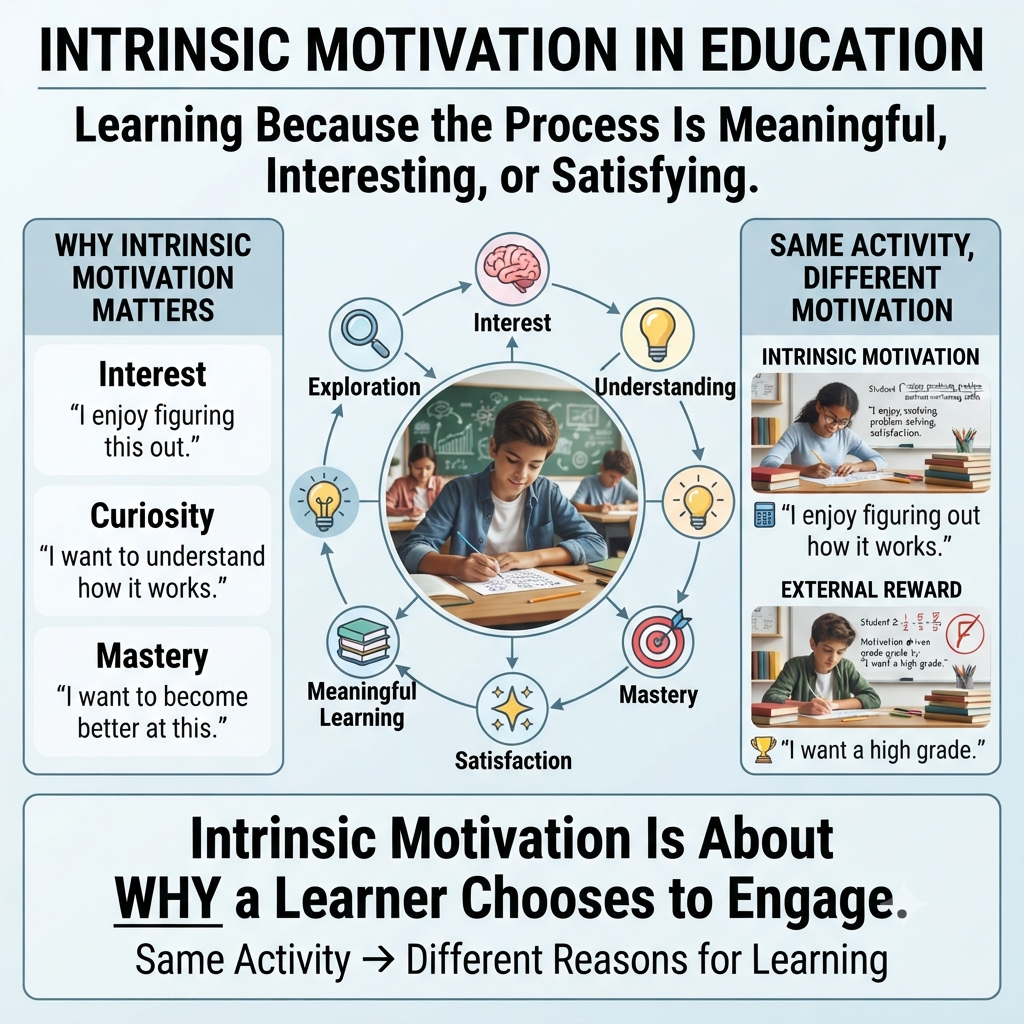
This distinction matters because students can perform the same classroom activity for very different reasons.
🧮 Interest – One student may solve a mathematics problem because they genuinely enjoy figuring out how the problem works.
🏆 External Reward – Another may do the same problem only to earn a high grade.
👥 Same Activity, Different Motivation – Both students are participating, but the psychological source of their motivation is different.
Intrinsic motivation therefore concerns why a learner chooses to engage, not simply whether the learner completes the activity.
Looking for comprehensive classroom resources and educational technology insights? Explore GimkitApp for expert guides, teaching strategies, game modes, and the latest updates to enhance student engagement.
What Is Intrinsic Motivation in Education?
In education, intrinsic motivation refers to a learner’s internally driven willingness to participate in learning activities because the activity provides inherent interest, enjoyment, curiosity, challenge, or satisfaction.
A student who reads an additional chapter because they want to discover what happens next, experiments with a science concept because they are curious about the result, or practices a difficult skill because mastering it feels rewarding is demonstrating behavior consistent with intrinsic motivation.
The important feature is the internal reason for engagement.
External outcomes can still exist. A motivated student may receive a grade, praise, certificate, or other reward, but those outcomes are not necessarily the primary reason the student participates.
A useful way to understand the concept is:
Intrinsic motivation → “I want to do this because the activity itself is interesting or satisfying.”
This differs from:
Extrinsic motivation → “I want to do this because it leads to a separate outcome.”
The distinction is about the source and quality of motivation rather than whether a student happens to receive an external reward.
Why Intrinsic Motivation Matters in Educational Settings
Learning requires more than exposure to information. Students must often direct attention toward a task, persist when it becomes difficult, explore ideas, make mistakes, seek understanding, and continue working when immediate rewards are absent.
Intrinsic motivation can support these learning behaviors because the activity itself provides a reason to remain engaged.
For example, consider a student learning programming. If the student is interested in understanding how a program works, debugging a problem can become part of the challenge rather than simply an obstacle. The student may continue experimenting even after the required assignment has been completed.
That difference is educationally significant.
When students develop genuine interest in what they are learning, learning can become less dependent on continuous external prompting. The student has a reason to continue that comes from the activity, the discovery process, or the satisfaction of developing competence.
This does not mean that intrinsic motivation guarantees high achievement or that external motivation is always harmful. Educational motivation is more complex than a simple intrinsic-versus-extrinsic division. The value of intrinsic motivation becomes clearer when examining how students experience and approach learning activities.
Intrinsic Motivation Is About the Learning Experience
A common misunderstanding is to define intrinsic motivation simply as “wanting to get good grades” or “being motivated to succeed.”
Those goals can certainly produce effort, but they do not automatically indicate intrinsic motivation.
The more useful question is:
What makes the student want to engage with the activity?
Consider four students completing the same history project:
Student
Main reason for participation
What it suggests
Student A
Enjoys discovering historical events
Interest-driven motivation
Student B
Wants to understand why events happened
Curiosity and understanding
Student C
Wants the highest grade in the class
Strong external outcome orientation
Student D
Wants to avoid disappointing the teacher
Pressure or approval-based motivation
The observable behavior—completing the project—may look identical. The underlying motivational experience can be very different.
This is why educational research and practice should avoid judging motivation solely from visible behavior.
A student who completes every assignment is not necessarily intrinsically motivated, while a student who spends additional time exploring a topic out of curiosity may reveal a stronger internal interest in learning.
The Main Sources of Intrinsic Motivation in Learning
Intrinsic motivation can emerge from several characteristics of the learning experience. These sources often overlap rather than operating independently.
Interest
Interest makes an activity personally engaging. A student who finds astronomy fascinating may voluntarily read about planets beyond what the curriculum requires.
Interest can be connected to an existing personal preference, but it can also develop as students encounter meaningful and well-designed learning experiences.
Curiosity
Curiosity creates a desire to discover or understand something that is not yet fully known.
A teacher who presents an intriguing question—rather than immediately providing the answer—can create an opportunity for students to investigate, predict, test, and revise their understanding.
Enjoyment
Enjoyment refers to the positive experience associated with performing the activity itself.
For example, a student may enjoy writing stories, solving puzzles, conducting experiments, drawing diagrams, or discussing ideas even when there is no immediate external reward.
Challenge
Appropriately challenging tasks can make learning intellectually satisfying.
A task that is too easy may provide little stimulation, while a task that is overwhelmingly difficult may produce frustration. The educational challenge is to create opportunities where students can experience meaningful progress and increasingly understand what they are capable of doing.
Mastery and Competence
Students can experience satisfaction from becoming better at something.
A learner who initially struggles with a mathematical concept but eventually solves increasingly complex problems may find the process of improvement rewarding in itself.
This makes the experience of developing capability an important part of motivational quality.
Meaningful Exploration
Students are more likely to become internally engaged when learning gives them opportunities to investigate questions, test ideas, make connections, and discover relationships.
The experience is not merely about receiving information. It involves actively making sense of something.
Intrinsic Motivation and the Desire to Learn
Intrinsic motivation is closely connected to the idea of learning for the sake of learning.
This does not mean that intrinsically motivated students never care about grades, careers, examinations, recognition, or other outcomes. Real students usually have multiple reasons for learning at the same time.
A student might:
enjoy solving mathematical problems,
want a good examination result,
hope to enter a particular university,
appreciate the teacher’s encouragement,
and want to understand the subject more deeply.
These motives can coexist.
The important point is that intrinsic motivation identifies the internal value found in the learning activity itself.
That distinction prevents an overly simplistic view in which students must be either “intrinsically motivated” or “extrinsically motivated.” Motivation can involve multiple influences, and their relative importance can change depending on the task, environment, learner, and circumstances.
Intrinsic Motivation and Student Choice
Choice is often relevant to intrinsic motivation because students can experience greater ownership when they have meaningful control over aspects of their learning.
For example, instead of requiring every student to demonstrate understanding through the same format, a teacher might allow students to choose between creating a presentation, writing an explanation, designing a model, or producing another appropriate form of work.
However, simply offering choices does not automatically create intrinsic motivation.
Poorly designed choices can create confusion, unnecessary workload, or decision fatigue. Likewise, giving students choices between tasks they find equally meaningless does little to create genuine interest.
The quality of the choice matters.
Useful educational choice generally gives students meaningful control while preserving a clear learning purpose.
Intrinsic Motivation and the Classroom Environment
Students do not develop motivation in isolation. The learning environment can influence how they experience an activity.
A classroom can communicate:
“Complete this because I said so.”
Or it can communicate:
“Here is a worthwhile problem. Explore it, make sense of it, and see what you can discover.”
These environments may produce different motivational experiences even when the academic objective is identical.
An environment that supports curiosity, meaningful participation, appropriate challenge, developing competence, and respectful teacher-student relationships can provide conditions in which intrinsic motivation is more likely to emerge.
This does not mean that teachers should remove structure. Effective learning environments generally require clear expectations, appropriate boundaries, instructional guidance, and purposeful activities.
The goal is not maximum freedom.
The goal is meaningful engagement within a well-designed learning environment.
Intrinsic Motivation Is Not the Same as Enjoyment Alone
Another important distinction is that intrinsic motivation should not be reduced to whether students are having fun.
Learning can be intrinsically motivating even when it is demanding.
A student may struggle through a complex physics problem, repeatedly revise an essay, debug a program, or practice a musical technique for an extended period. The activity may not be easy, yet the learner can still find satisfaction in understanding, improving, discovering, or mastering it.
Therefore:
Fun can contribute to motivation, but intrinsic motivation is broader than fun.
It can involve curiosity, interest, intellectual challenge, exploration, satisfaction, and the desire to develop competence.
This distinction is particularly important in education because meaningful learning is not always immediately entertaining.
A Simple Educational Model
Intrinsic motivation in educational settings can be understood through a basic relationship:
Meaningful Learning Activity
↓
Interest / Curiosity / Challenge
↓
Internal Engagement
↓
Sustained Effort and Exploration
↓
Learning Experience
↓
Understanding, Skill Development, or Mastery
This is not a rigid psychological formula. It is a practical way to visualize how the characteristics of a learning activity can influence the learner’s internal experience and subsequent behavior.
The pathway can also work differently for different students. An activity that creates curiosity for one learner may feel irrelevant to another. A challenge that stimulates one student may overwhelm another.
That is why intrinsic motivation cannot be created through a single universal classroom technique.
What Intrinsic Motivation Looks Like in a Classroom
Intrinsic motivation is internal, so teachers cannot directly observe a student’s psychological state. They instead observe behaviors and patterns that may provide evidence about how students are engaging with learning.
Potential indicators include:
voluntarily exploring a topic beyond the minimum requirement,
asking questions because the student genuinely wants to understand,
persisting with an interesting but difficult problem,
experimenting with different approaches,
seeking deeper explanations,
showing sustained attention to an activity,
choosing to continue working without immediate external pressure,
expressing genuine interest in understanding how or why something works.
None of these behaviors proves intrinsic motivation by itself.
For example, a student may ask many questions because participation is graded. Another student may persist because they are afraid of receiving a poor grade.
The behavior must therefore be interpreted in context rather than treated as direct proof of an internal motivational state.
Intrinsic Motivation Does Not Mean Removing Rewards
One of the most common oversimplifications is the idea that intrinsic motivation requires eliminating every reward, grade, rule, or external expectation.
That is not a practical description of education.
Schools operate through structures such as assessments, deadlines, grades, curriculum requirements, attendance expectations, and academic standards. External factors are part of educational systems.
The more useful question is how these structures interact with students’ experience of learning.
A classroom can maintain clear academic expectations while also giving students opportunities to experience curiosity, competence, meaningful choice, and satisfaction in learning.
The objective is therefore not to create a classroom with zero external motivation.
It is to create learning conditions in which students can develop reasons to engage that go beyond external pressure alone.
The Educational Value of Intrinsic Motivation
The importance of intrinsic motivation becomes particularly visible when learning requires sustained involvement.
A student may memorize information for an examination because a grade is approaching. But deeper learning can require the student to continue questioning, connecting ideas, practicing, correcting mistakes, and applying knowledge in unfamiliar situations.
Internal interest can provide one source of energy for that process.
This is why intrinsic motivation is relevant to more than classroom participation. It connects to the learner’s relationship with the learning activity itself.
A student who begins to see learning as something worth exploring may become less dependent on constant external prompts to initiate every task.
That does not mean the student will always be motivated. Fatigue, difficulty, competing responsibilities, teaching quality, prior knowledge, emotional experiences, and the learning environment can all affect engagement.
Intrinsic motivation is therefore best understood as one important component of the broader motivational system surrounding learning.
The Core Principle
The central idea can be summarized simply:
Intrinsic motivation in education occurs when students engage in learning because the activity itself provides interest, curiosity, enjoyment, challenge, satisfaction, or a sense of developing competence.
Its educational importance lies not merely in making students participate, but in influencing how they experience learning and why they choose to continue engaging with it.
From this foundation, the next layer is to examine the psychological conditions that make intrinsic motivation more or less likely to develop—particularly the roles of autonomy, competence, relatedness, interest, challenge, feedback, and the design of learning activities.
Intrinsic Motivation in Educational Settings: Psychological Foundations, Classroom Practice, Assessment, and Long-Term Development
Intrinsic motivation becomes most useful as an educational concept when it moves beyond the simple idea of “students enjoying learning.” Its deeper significance lies in understanding the conditions under which learners experience an activity as personally interesting, worthwhile, challenging, and satisfying enough to engage with it for its own sake.
A student does not become intrinsically motivated simply because a teacher makes a lesson entertaining. Genuine internal motivation develops through the relationship between the learner, the activity, the learning environment, and the meaning the learner assigns to the experience.
The foundation introduced earlier can therefore be extended into a more practical question:
What conditions make intrinsic motivation more likely to develop and remain active during learning?
The Psychological Foundations of Intrinsic Motivation
One of the most influential frameworks for understanding motivation in education is Self-Determination Theory (SDT), associated with researchers Edward Deci and Richard Ryan.
Within this broader framework, human motivation is understood partly through three basic psychological needs:
Autonomy — experiencing a meaningful sense of choice and volition.
Competence — experiencing effectiveness and the ability to develop capability.
Relatedness — experiencing meaningful connection and belonging with others.
These needs should not be treated as three classroom tricks. They describe psychological conditions that can influence how learners experience their activities.
For intrinsic motivation specifically, the most important idea is that students are more likely to become internally engaged when the activity allows them to experience themselves as active participants rather than merely passive recipients of external demands.
Autonomy
Autonomy means experiencing a sense that one’s actions are personally endorsed rather than entirely controlled by external pressure.
In a classroom, autonomy can be supported through meaningful choices, opportunities for student input, rationales for activities, and room for students to approach appropriate tasks in different ways.
Autonomy does not mean allowing students to do whatever they want.
A structured classroom can still support autonomy when students understand the purpose of an activity and have meaningful opportunities to participate in how they complete it.
Competence
Students are more likely to remain interested in learning when they can experience progress.
Competence is not simply “being good at something.” It also involves experiencing effectiveness while developing a skill.
This is why appropriately challenging tasks matter.
If every task is effortless, students may experience little intellectual stimulation. If every task is far beyond their current ability, repeated failure can undermine their willingness to continue.
Effective learning design therefore creates opportunities for students to encounter difficulty while also experiencing achievable progress.
Relatedness
Learning is social even when the activity itself is individual.
Teacher-student relationships, peer interactions, classroom belonging, and a sense of being respected can influence how students experience educational activities.
A student who feels safe asking questions and making mistakes may be more willing to explore an unfamiliar idea than a student who expects embarrassment whenever they are wrong.
Relatedness therefore matters not because students must always work collaboratively, but because the social environment can influence whether learning feels supportive and psychologically safe.
How Teachers Can Support Intrinsic Motivation
Teachers cannot directly manufacture intrinsic motivation in students. They can, however, design conditions that make internal engagement more likely.
Several practices are particularly relevant.
Give Students Meaningful Choices
Choice can support autonomy when it is genuine and connected to the learning objective.
For example, students might choose:
which question to investigate,
which example to analyze,
which topic to explore within a defined area,
which appropriate format to use for demonstrating understanding,
which strategy to use when solving a problem.
The important word is meaningful.
Giving students ten superficial options does not necessarily create autonomy. A smaller number of purposeful choices may be more effective.
Explain Why the Learning Matters
Students are more likely to engage with a demanding activity when they understand its purpose.
Instead of presenting a task only as an instruction, teachers can explain what students are expected to discover, practice, understand, or eventually apply.
A meaningful rationale does not guarantee intrinsic motivation, but it can reduce the feeling that an activity is arbitrary.
Create Appropriate Challenge
Challenge should require thought without making success feel impossible.
An effective challenge gives students something to figure out rather than simply something to complete.
For example, instead of asking students to reproduce an example exactly, a teacher might ask them to modify it, explain why it works, predict what will happen when a condition changes, or design their own solution.
This turns learning into an active intellectual task.
Allow Students to Investigate
Inquiry can provide natural opportunities for curiosity.
Questions such as:
“Why does this happen?”
“What would happen if we changed this?”
“Can you find another explanation?”
“How could you test this idea?”
can shift students from simply receiving answers toward actively constructing understanding.
Support Progress
Students need evidence that effort is producing learning.
Breaking a complex task into meaningful stages can help learners recognize improvement without reducing the activity to a series of meaningless rewards.
A student who can see that they now understand something that previously seemed confusing has an internally meaningful reason to continue.
Feedback and Intrinsic Motivation
Feedback can either support or undermine a learner’s motivational experience depending on how it is delivered and what it communicates.
Feedback that provides useful information about performance can help students understand:
what they are doing successfully,
what needs improvement,
why an error occurred,
what strategy might work next,
how their understanding is developing.
This type of information can strengthen a learner’s sense of competence.
By contrast, feedback that primarily communicates control, comparison, or judgment may shift attention away from learning itself.
Compare:
“You are number one in the class.”
with:
“Your explanation correctly identifies the cause, but the evidence needs to be connected more clearly to your conclusion.”
The first emphasizes comparative status. The second provides information that can help the learner improve.
This does not mean praise is automatically harmful. The educational value of feedback depends on its purpose, wording, context, and how students interpret it.
The Role of Grades and Rewards
Grades, prizes, points, certificates, badges, and other external incentives are common parts of education.
They can serve legitimate functions. Grades communicate achievement, assessments provide information, and rewards can sometimes encourage participation in particular circumstances.
The important issue is that external incentives can change what students focus on.
If a student becomes primarily concerned with:
“What do I need to do to get the reward?”
attention may shift away from:
“What can I discover or understand through this activity?”
This is one reason educators should distinguish between motivating students to perform a task and helping students value the learning activity itself.
The relationship is not as simple as “rewards destroy intrinsic motivation.”
The effects of rewards depend on factors such as the type of reward, how expected it is, what the reward communicates, the nature of the task, and how students interpret the situation.
Therefore, educators should avoid both extremes:
Extreme 1: Every reward is harmful.
Extreme 2: Rewards are always the best way to motivate students.
A more useful approach is to consider whether the learning environment keeps attention connected to curiosity, mastery, meaning, and competence while using necessary external structures appropriately.
Competition and Intrinsic Motivation
Competition can make an activity exciting for some students, but it does not automatically create intrinsic motivation.
A competitive classroom activity can produce different experiences:
One student may enjoy the challenge itself.
Another may enjoy testing their skill.
Another may become focused entirely on defeating classmates.
Another may become anxious about losing.
Another may disengage because repeated comparison makes success feel unattainable.
The same activity can therefore produce different motivational experiences across learners.
Competition should be treated as an instructional design choice, not as a universal motivational solution.
The educational question is not simply:
“Will competition increase participation?”
It is:
“What kind of motivation and learning experience will this activity create for these students?”
Intrinsic Motivation and Educational Games
Games and gamified activities can create conditions that support intrinsic motivation, particularly when they provide meaningful challenge, exploration, feedback, progression, and opportunities to make decisions.
However, the presence of game mechanics does not automatically make learning intrinsically motivating.
Points, leaderboards, badges, timers, rewards, and rankings can increase visible participation while still making students primarily focused on external outcomes.
An educational game is more likely to support intrinsic engagement when students also have reasons to enjoy the activity itself—such as solving problems, exploring possibilities, mastering a skill, making meaningful decisions, or overcoming an interesting challenge.
This distinction is particularly important when evaluating classroom technology.
More activity does not automatically mean more intrinsic motivation.
The quality of the learner’s experience matters.
Intrinsic Motivation in Digital and Online Learning
Digital learning environments can provide unusual opportunities for intrinsic motivation.
Students may be able to:
explore content at their own pace,
choose learning pathways,
interact with simulations,
receive immediate information about performance,
investigate topics beyond the minimum curriculum,
experiment without the consequences associated with real-world failure.
At the same time, digital platforms can also overemphasize external mechanics.
Constant points, streaks, rankings, notifications, countdowns, and reward systems can shift attention toward completion and competition.
The technology itself is therefore not the source of intrinsic motivation.
The motivational experience depends on how the technology structures the learning activity.
Intrinsic Motivation in Different Subjects
Intrinsic motivation can appear across almost every academic domain, although the experience may look different.
Mathematics
Students may enjoy discovering patterns, solving puzzles, proving relationships, or finding efficient solutions.
Science
Curiosity may emerge through experimentation, prediction, observation, and explanation.
Reading
Students may read because they become absorbed in a story, interested in an idea, or curious about a subject.
Writing
Students may enjoy expressing ideas, constructing stories, communicating arguments, or improving their ability to write.
History
Students may become interested in understanding causes, consequences, human decisions, and connections between events.
Art and Design
Intrinsic motivation may emerge through experimentation, creative expression, problem-solving, and developing technique.
The subject itself does not guarantee intrinsic motivation. The design of the learning experience matters.
Age and Developmental Differences
Intrinsic motivation can be relevant across childhood, adolescence, higher education, and adult learning, but its expression can change with development and context.
Younger learners may show motivation through exploration, questioning, experimentation, and play-like discovery.
Older students may become increasingly interested in complex problems, personal interests, intellectual independence, career-related subjects, identity, and mastery.
This does not mean younger learners are intrinsically motivated while older students are not.
Instead, the activities that feel meaningful and the reasons learners value them can change over time.
Educational environments should therefore avoid assuming that one motivational strategy will work equally well for every age group.
Individual Differences Matter
Students do not enter classrooms with identical interests, experiences, abilities, expectations, or prior knowledge.
The same activity can therefore produce very different motivational responses.
One student may find a task fascinating.
Another may find it irrelevant.
A third may be interested but lack the prerequisite knowledge needed to engage successfully.
A fourth may enjoy the challenge but become discouraged after repeated failure.
Intrinsic motivation should therefore be understood as a dynamic interaction between:
Learner
↕
Learning Activity
↕
Learning Environment
↕
Meaning and Experience
This is why effective motivational practice requires observation and adjustment rather than a fixed formula.
How to Recognize Intrinsic Motivation in Students
Because motivation is internal, teachers should be cautious about treating any single behavior as definitive evidence.
Instead, look for patterns.
Possible indicators include:
voluntary exploration beyond required work,
spontaneous questions,
persistence when external rewards are absent,
interest in understanding rather than merely finishing,
experimentation with different solutions,
willingness to tackle challenging tasks,
enthusiasm about discovering new information,
continued engagement after the minimum requirement has been completed,
seeking feedback to improve understanding,
returning voluntarily to an activity.
These indicators become more informative when considered together.
For example, a student who repeatedly explores a topic after completing the required task provides stronger evidence of internal interest than a student who completes the same task only when points are available.
Still, teachers should avoid making psychological diagnoses from classroom behavior alone.
How Can Intrinsic Motivation Be Assessed?
There is no single classroom observation that can definitively measure intrinsic motivation.
Assessment can instead combine several sources of information.
Student Self-Reports
Students can describe why they engage with a particular activity.
Questions might explore whether they:
enjoy the activity,
find it interesting,
want to understand it,
continue because they personally value the experience,
would engage with it even without a reward.
Self-report provides direct access to students’ perceptions, although responses can be influenced by memory, expectations, and social desirability.
Behavioral Evidence
Teachers can examine patterns such as:
voluntary participation,
persistence,
exploration,
time spent on optional learning,
choice of challenging activities,
continued engagement without immediate rewards.
Behavior provides useful evidence but should not be interpreted in isolation.
Learning Artifacts
Projects, written work, experiments, questions, designs, and other outputs can sometimes reveal the depth of students’ exploration and investment.
A student who voluntarily investigates multiple solutions may demonstrate a different relationship with learning than one who completes only the minimum requirements.
rather than assuming that one visible behavior proves intrinsic motivation.
Common Barriers to Intrinsic Motivation
Several classroom conditions can make internal engagement more difficult.
Excessive Control
When students experience every action as externally controlled, they may have fewer opportunities to experience ownership of learning.
Constant Reward Dependence
If every activity is connected to points or prizes, students may increasingly focus on the external outcome.
Meaningless Tasks
Students are less likely to become deeply interested in activities they cannot understand or connect with.
Poorly Matched Difficulty
Tasks that are consistently far too easy or impossibly difficult can reduce opportunities for satisfying challenge.
Excessive Comparison
Constant ranking can redirect attention from personal improvement toward social comparison.
Fear of Failure
Students who expect mistakes to result in embarrassment or punishment may become reluctant to experiment or explore.
Lack of Feedback
When students cannot understand whether or how they are improving, developing competence becomes more difficult.
Repetition Without Purpose
Practice is necessary in many subjects, but repetitive activities become less engaging when students cannot see their purpose or progression.
These barriers do not guarantee that intrinsic motivation will disappear. They simply illustrate why motivational experiences depend heavily on context.
Common Misconceptions About Intrinsic Motivation
“Students Must Enjoy Everything They Learn”
No.
Education includes difficult, repetitive, unfamiliar, and sometimes frustrating activities. Intrinsic motivation does not require constant enjoyment.
A student can find value and satisfaction in mastering something difficult even when every moment of the process is not pleasurable.
“Intrinsic Motivation Means No Grades”
No.
Grades are part of many educational systems. Their presence does not automatically determine whether a student can experience intrinsic motivation.
The more relevant question is how assessment is designed and interpreted within the broader learning environment.
“Rewards Always Destroy Intrinsic Motivation”
No.
The relationship between rewards and intrinsic motivation is more nuanced.
The type of reward, context, expectations, task characteristics, and meaning students attach to the reward can all matter.
“Fun Activities Are Automatically Intrinsically Motivating”
No.
Fun can help create interest, but entertainment alone is not equivalent to intrinsic motivation.
An activity can be entertaining without producing meaningful curiosity, mastery, or learning.
“High-Achieving Students Are Always Intrinsically Motivated”
No.
Achievement tells us what students accomplished, not necessarily why they accomplished it.
A high-performing student may be driven primarily by grades, competition, parental expectations, career goals, personal interest, mastery, or a combination of several motives.
“Teachers Can Make Students Intrinsically Motivated”
Not directly.
Teachers can create supportive conditions, meaningful activities, appropriate challenges, useful feedback, and opportunities for choice.
But students ultimately experience motivation internally.
The teacher’s role is therefore better understood as designing conditions that support internal engagement rather than attempting to manufacture a particular psychological state.
A Practical Framework for Supporting Intrinsic Motivation
Teachers who want to strengthen intrinsic motivation can use the following sequence when designing a learning activity.
1. Start With Meaning
Ask:
Why should students care about this activity?
Connect the task to a meaningful question, problem, idea, curiosity, or learning purpose.
2. Create an Appropriate Challenge
Ask:
Is this difficult enough to require thinking but realistic enough to support progress?
3. Provide Meaningful Choice
Ask:
Where can students exercise legitimate control without losing the learning objective?
4. Encourage Exploration
Allow students to test ideas, make predictions, investigate alternatives, and learn from mistakes where appropriate.
5. Provide Informative Feedback
Show students how their thinking or performance is developing rather than focusing only on judgment.
6. Support Competence
Break complex learning into manageable progress points so students can recognize genuine improvement.
7. Maintain Supportive Relationships
Create an environment in which students can ask questions, make mistakes, and seek help without unnecessary fear or humiliation.
8. Reduce Unnecessary Control
Keep necessary academic structure while avoiding avoidable pressure, meaningless rules, and excessive external manipulation.
9. Observe the Response
Look at what students actually do.
Do they explore?
Do they ask questions?
Do they persist?
Do they continue after the required task?
Do they show interest in understanding?
10. Refine the Activity
Use what you observe to improve the next learning experience.
Intrinsic motivation is not produced by one technique. It develops through repeated experiences in which learning feels meaningful, achievable, interesting, and personally worthwhile.
Intrinsic Motivation and Long-Term Learning
One of the most valuable aspects of intrinsic motivation is its potential relationship with a learner’s long-term relationship with education.
A student who discovers that learning itself can be interesting may become more willing to explore outside formal requirements.
That can contribute to behaviors such as:
reading beyond assigned material,
practicing independently,
asking deeper questions,
exploring unfamiliar subjects,
developing personal interests,
continuing to improve after formal instruction ends.
This is especially relevant in education because formal schooling eventually ends, while learning does not.
The long-term educational goal is therefore not simply to make students complete today’s assignment. It is also to help learners develop the capacity to find value in understanding, exploration, practice, and mastery.
Intrinsic motivation is one part of that larger goal.
Intrinsic Motivation and Lifelong Learning
Lifelong learning depends partly on a person’s willingness to continue developing knowledge and skills beyond compulsory educational environments.
External incentives may motivate specific learning activities—a professional qualification, a promotion, an examination, or a required certification.
But sustained curiosity and personal interest can provide another reason to keep learning when no immediate external reward exists.
A person who learns because they genuinely want to understand a subject can continue exploring it even when formal requirements disappear.
This is why intrinsic motivation has significance beyond the classroom.
It can influence how learners perceive the activity of learning itself.
For the latest gaming news, expert reviews, and walkthroughs, readers can also visit IGN, one of the world’s leading gaming websites.
What Teachers Should Ultimately Focus On
The practical objective should not be:
“How can I make every student love every lesson?”
That is unrealistic.
A more useful objective is:
“How can I design learning experiences in which students have meaningful reasons to become interested, explore, improve, and continue learning?”
That shift changes instructional decisions.
Instead of asking only whether students completed a task, educators can also ask:
Did the task create curiosity?
Did students understand its purpose?
Was the challenge appropriate?
Did students experience progress?
Did they have meaningful choices?
Did feedback help them improve?
Could students explore ideas rather than simply reproduce answers?
Did the classroom environment support safe participation?
Were external incentives overshadowing the learning itself?
These questions provide a more useful way to think about motivational quality.
The Relationship Between Intrinsic Motivation and Learning Quality
Intrinsic motivation should not be treated as a magic ingredient that automatically produces academic success.
Learning still depends on instructional quality, prior knowledge, practice, effective explanations, feedback, time, resources, and many other factors.
A highly interested student can still misunderstand a concept.
A motivated learner can still use an ineffective strategy.
A student can enjoy an activity without achieving the intended learning objective.
Therefore, intrinsic motivation works best when paired with good pedagogy.
The strongest educational environment is not one in which students are simply enthusiastic.
It is one in which motivation and instructional design work together:
Meaningful motivation
Effective instruction
Appropriate challenge
Useful feedback
Opportunities for practice
↓
More productive learning experiences
This distinction keeps the concept scientifically and educationally grounded.
A Complete View of Intrinsic Motivation in Education
Intrinsic motivation can now be understood as part of a larger educational relationship:
Learning Activity
→ creates opportunities for
Interest, Curiosity, Challenge, Exploration
→ supported by
Autonomy, Competence, Relatedness
→ influences
Internal Engagement
→ which can support
Persistence, Exploration, Practice, and Deeper Involvement
→ contributing to
Understanding, Skill Development, and Mastery
The pathway is not automatic or identical for every learner.
Students differ.
Activities differ.
Classrooms differ.
Teachers differ.
Educational systems differ.
The same instructional strategy can therefore produce different motivational experiences in different contexts.
The goal is not to find a universal “intrinsic motivation button.”
The goal is to understand the conditions that make meaningful internal engagement more likely.
Professional Takeaway
For educators, the most useful principle is simple:
Do not design learning only around what students will receive for completing it. Design learning around what students can discover, understand, create, practice, solve, and eventually master through the activity itself.
Grades, assessments, deadlines, standards, and other external structures remain important parts of education. But they do not have to be the only reasons students engage.
When students experience learning as meaningful, appropriately challenging, personally engaging, and capable of producing genuine progress, the activity itself can become a source of motivation.
That is the central educational value of intrinsic motivation.
Professional Recommendations & Expert Reviews
Intrinsic Motivation in Educational Settings begins when students find personal value in what they are learning.
Intrinsic Motivation in Educational Settings encourages learners to study because they genuinely want to understand new ideas.
Intrinsic Motivation in Educational Settings helps students become more engaged with classroom activities.
Intrinsic Motivation in Educational Settings supports learning driven by curiosity rather than external rewards.
Intrinsic Motivation in Educational Settings encourages students to explore challenging concepts independently.
Intrinsic Motivation in Educational Settings helps learners develop greater ownership of their education.
Intrinsic Motivation in Educational Settings supports deeper engagement with academic content.
Intrinsic Motivation in Educational Settings encourages students to ask questions and seek meaningful answers.
Intrinsic Motivation in Educational Settings helps create a classroom culture centered on curiosity and discovery.
Intrinsic Motivation in Educational Settings supports consistent participation during lessons.
Intrinsic Motivation in Educational Settings encourages learners to focus on mastery instead of simply achieving grades.
Intrinsic Motivation in Educational Settings helps students recognize the personal benefits of acquiring new skills.
Intrinsic Motivation in Educational Settings supports independent thinking and self-directed learning.
Intrinsic Motivation in Educational Settings encourages learners to persist when academic tasks become difficult.
Intrinsic Motivation in Educational Settings helps students view challenges as opportunities to improve.
Intrinsic Motivation in Educational Settings supports greater confidence through meaningful achievement.
Intrinsic Motivation in Educational Settings encourages students to take an active role in classroom learning.
Intrinsic Motivation in Educational Settings helps learners become more comfortable exploring unfamiliar topics.
Intrinsic Motivation in Educational Settings supports stronger concentration during educational activities.
Intrinsic Motivation in Educational Settings encourages students to connect lessons with their interests.
Intrinsic Motivation in Educational Settings helps teachers create more engaging learning experiences.
Intrinsic Motivation in Educational Settings supports a stronger sense of academic purpose.
Intrinsic Motivation in Educational Settings encourages students to recognize progress beyond test scores.
Intrinsic Motivation in Educational Settings supports long-term interest in learning.
Intrinsic Motivation in Educational Settings encourages students to experiment, question, and discover.
Intrinsic Motivation in Educational Settings helps learners develop persistence through challenging tasks.
Intrinsic Motivation in Educational Settings supports greater responsibility for personal learning.
Intrinsic Motivation in Educational Settings encourages students to set meaningful academic goals.
Intrinsic Motivation in Educational Settings helps learners appreciate the process of developing new abilities.
Intrinsic Motivation in Educational Settings supports stronger classroom participation without constant external rewards.
Intrinsic Motivation in Educational Settings encourages teachers to provide meaningful choices when appropriate.
Intrinsic Motivation in Educational Settings helps students feel more connected to their educational experiences.
Intrinsic Motivation in Educational Settings supports learning environments where curiosity is valued.
Intrinsic Motivation in Educational Settings encourages students to take intellectual risks.
Intrinsic Motivation in Educational Settings helps learners recover more positively from mistakes.
Intrinsic Motivation in Educational Settings supports a growth-oriented approach to academic development.
Intrinsic Motivation in Educational Settings encourages students to focus on improvement rather than comparison.
Intrinsic Motivation in Educational Settings helps learners become more persistent when facing setbacks.
Intrinsic Motivation in Educational Settings supports deeper understanding through active exploration.
Intrinsic Motivation in Educational Settings encourages students to connect classroom concepts with real-life situations.
Intrinsic Motivation in Educational Settings helps teachers build lessons around meaningful learning objectives.
Intrinsic Motivation in Educational Settings supports greater student autonomy.
Intrinsic Motivation in Educational Settings encourages learners to make thoughtful decisions about their learning.
Intrinsic Motivation in Educational Settings helps students develop stronger study habits over time.
Intrinsic Motivation in Educational Settings supports sustained engagement during longer learning activities.
Intrinsic Motivation in Educational Settings encourages learners to pursue knowledge beyond required assignments.
Intrinsic Motivation in Educational Settings helps students recognize their own strengths and areas for growth.
Intrinsic Motivation in Educational Settings supports greater satisfaction from mastering difficult concepts.
Intrinsic Motivation in Educational Settings encourages teachers to recognize effort, progress, and curiosity.
Intrinsic Motivation in Educational Settings helps create classrooms where learning has meaning beyond grades.
Intrinsic Motivation in Educational Settings supports positive relationships between students and their learning goals.
Intrinsic Motivation in Educational Settings encourages learners to participate because they value the activity itself.
Intrinsic Motivation in Educational Settings helps students become more reflective about their progress.
Intrinsic Motivation in Educational Settings supports stronger problem-solving through genuine intellectual interest.
Intrinsic Motivation in Educational Settings encourages students to explore multiple approaches to difficult problems.
Intrinsic Motivation in Educational Settings helps learners develop confidence through personal accomplishment.
Intrinsic Motivation in Educational Settings supports meaningful collaboration when students share interests and ideas.
Intrinsic Motivation in Educational Settings encourages students to take greater responsibility for classroom tasks.
Intrinsic Motivation in Educational Settings helps teachers move beyond reward-based approaches when appropriate.
Intrinsic Motivation in Educational Settings supports learning experiences that feel purposeful and relevant.
Intrinsic Motivation in Educational Settings encourages students to maintain interest even when immediate rewards are absent.
Intrinsic Motivation in Educational Settings helps learners develop resilience through personally meaningful challenges.
Intrinsic Motivation in Educational Settings supports stronger knowledge retention when students actively engage with ideas.
Intrinsic Motivation in Educational Settings encourages learners to continue improving after completing an assignment.
Intrinsic Motivation in Educational Settings helps create sustainable academic habits.
Intrinsic Motivation in Educational Settings supports classrooms where students feel capable, involved, and valued.
Intrinsic Motivation in Educational Settings encourages teachers to provide opportunities for exploration and creative thinking.
Intrinsic Motivation in Educational Settings helps learners discover personal reasons to value education.
Intrinsic Motivation in Educational Settings supports greater willingness to learn from mistakes and feedback.
Intrinsic Motivation in Educational Settings encourages students to pursue mastery even when progress is gradual.
Intrinsic Motivation in Educational Settings helps transform learning from an obligation into a personally meaningful experience.
Intrinsic Motivation in Educational Settings supports stronger academic engagement by connecting curiosity, autonomy, competence, and purpose.
Intrinsic Motivation in Educational Settings encourages learners to become more independent thinkers who actively seek knowledge.
Intrinsic Motivation in Educational Settings demonstrates that students are more likely to sustain engagement when they find learning interesting, meaningful, challenging, and personally valuable.
Frequently Asked Questions
1. How can teachers increase intrinsic motivation in students?
Teachers can support intrinsic motivation by designing learning experiences that provide meaningful choice, appropriate challenge, curiosity, opportunities for exploration, useful feedback, and a clear sense of progress. Students are more likely to engage internally when they understand why an activity matters and experience themselves as active participants rather than simply completing instructions for a reward or grade.
Practical approaches include allowing students to choose between appropriate ways of completing a task, connecting lessons to meaningful questions, giving students opportunities to investigate problems, and providing feedback that helps them understand how to improve. Teachers should also avoid making every learning activity dependent on points, prizes, rankings, or constant external pressure.
The goal is not to make every lesson entertaining. Instead, teachers should create conditions where students can experience interest, curiosity, competence, autonomy, and satisfaction from learning itself.
2. What is the difference between intrinsic and extrinsic motivation in education?
The primary difference is the reason behind the learner’s engagement.
Intrinsic motivation occurs when students engage because the activity itself is interesting, enjoyable, challenging, meaningful, or satisfying. For example, a student reads about space because they genuinely want to understand more about the universe.
Extrinsic motivation involves an outcome that is separate from the activity itself. A student may study because they want a high grade, a certificate, praise, a reward, or to avoid punishment.
The two forms of motivation can exist simultaneously. A student might enjoy learning mathematics while also caring about examination results. Therefore, educational motivation should not be treated as a simple choice between “intrinsic” and “extrinsic.”
The important question is:
What is making the student want to engage with the learning activity?
3. Does intrinsic motivation improve student learning?
Intrinsic motivation can support learning by encouraging students to engage more deeply with activities, persist through appropriate challenges, explore questions, and continue working toward understanding or mastery. However, intrinsic motivation by itself does not guarantee academic success.
Effective learning also depends on factors such as instructional quality, prior knowledge, practice, feedback, learning strategies, available resources, and the difficulty of the material.
For example, a student may be highly interested in biology but still misunderstand a complex concept without appropriate instruction. Conversely, a student may achieve a high grade while being motivated primarily by external outcomes.
The strongest educational approach combines productive motivation with effective teaching and learning design. Intrinsic motivation can make students more willing to engage with learning, while good instruction helps ensure that this engagement leads toward genuine understanding and skill development.
4. Can rewards and grades reduce intrinsic motivation?
Rewards and grades do not automatically eliminate intrinsic motivation. Their effects depend on the type of reward, how it is presented, the learning activity, the student’s interpretation, and the surrounding classroom environment.
The potential problem occurs when external rewards become the main focus of attention. If students begin thinking primarily about points, prizes, rankings, or grades, they may become less focused on curiosity, understanding, exploration, or mastery.
For example, compare these two orientations:
“I want to solve this because I want to understand how it works.”
versus
“I only need to solve this to get the points.”
Both students may complete the task, but their motivational experiences are different.
Grades and assessments remain necessary components of many educational systems. The practical goal is therefore not to remove every external incentive, but to ensure that external structures do not become the only reason students engage with learning.
5. How do you know if a student is intrinsically motivated?
Intrinsic motivation cannot be observed directly because it is an internal psychological experience. Teachers can instead look for patterns of behavior and ask students about their reasons for engaging with an activity.
Possible indicators include voluntary exploration, spontaneous questions, persistence with challenging tasks, experimenting with different approaches, seeking deeper explanations, continuing beyond the minimum requirement, and showing interest even when no immediate reward is available.
However, none of these behaviors proves intrinsic motivation by itself.
A student may persist because an assignment is graded. A student may ask questions because participation is required. A student may complete additional work because they want recognition.
For this reason, the strongest assessment combines student self-report, observed behavior, the learning context, and the characteristics of the activity.
The key question is not simply:
“Is the student participating?”
It is:
“Why is the student choosing to engage with this activity?”
Final Synthesis
Intrinsic motivation in educational settings refers to internally driven engagement with learning because the activity itself is experienced as interesting, satisfying, meaningful, challenging, or enjoyable.
Its educational significance extends beyond simple participation.
It can influence how students approach difficult tasks, whether they explore ideas, how persistently they work, whether they seek understanding rather than merely completion, and whether learning becomes personally valuable.
The strongest conditions for supporting intrinsic motivation generally involve:
meaningful learning purposes,
appropriate challenge,
opportunities for autonomy,
experiences of competence and progress,
supportive relationships,
informative feedback,
opportunities for curiosity and exploration,
carefully designed choice,
and thoughtful use of external structures.
At the same time, intrinsic motivation should not be romanticized.
It does not eliminate the need for teaching, structure, assessment, practice, discipline, or external requirements. Nor does it guarantee academic achievement by itself.
Its value lies in something more fundamental: helping learners develop reasons to engage with learning that exist within the learning experience itself.
When students begin to ask questions because they genuinely want answers, practice because they want to improve, investigate because they are curious, and continue because understanding itself feels worthwhile, education moves beyond task completion.
Learning becomes something the learner actively wants to pursue.
That is the deeper role of intrinsic motivation in educational settings.