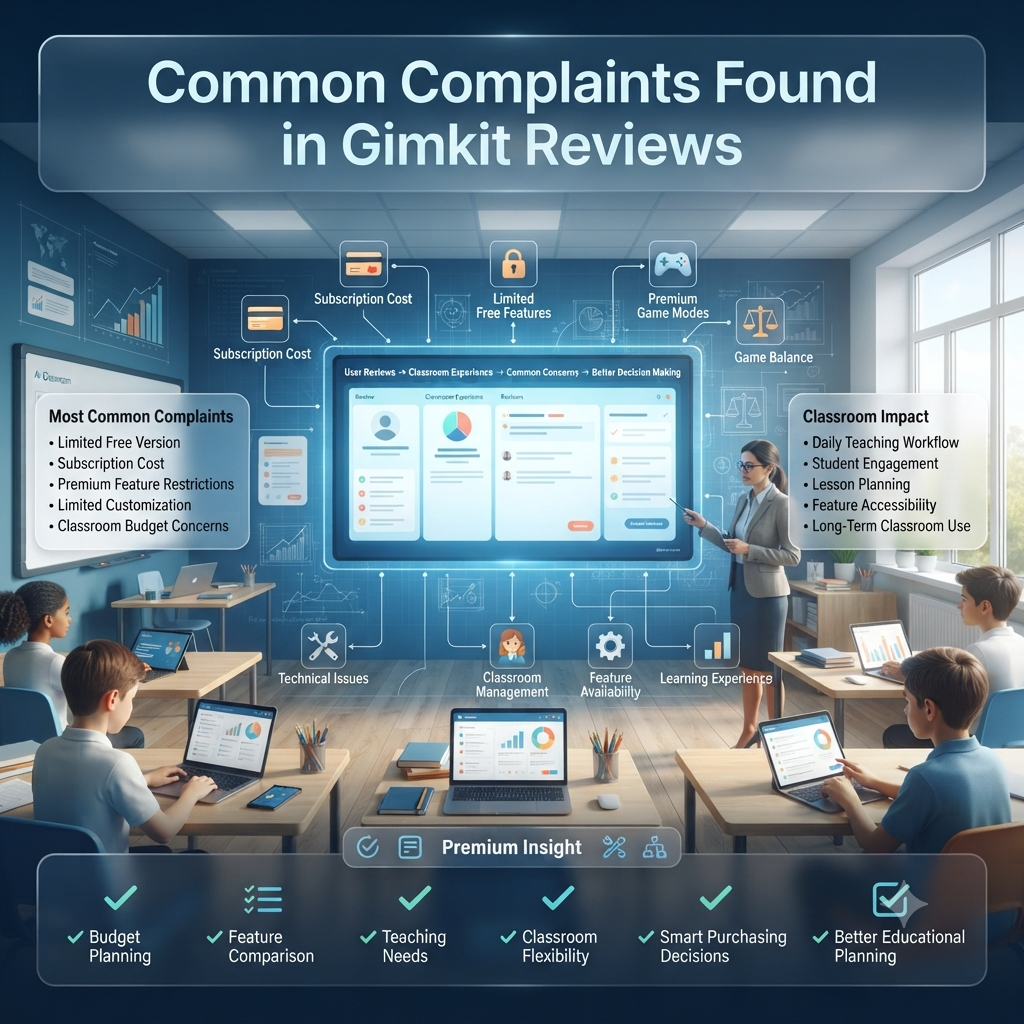
Common Complaints Found in Gimkit Reviews | Most Gimkit reviews are overwhelmingly positive, but recurring complaints tend to focus on pricing, premium feature restrictions, internet dependency, classroom management, game balance, and reporting capabilities. Interestingly, many of these complaints are not flaws in the platform itself—they often reflect differences in teaching styles, classroom environments, expectations, or available technology.
Common Areas Mentioned in Reviews
💳Pricing – Concerns about subscription costs and premium access.
🔒Premium Feature Restrictions – Some features require a paid plan.
📶Internet Dependency – Stable internet is needed for smooth gameplay.
🏫Classroom Management – Experiences vary depending on classroom setup and teaching style.
⚖️Game Balance – Some users discuss differences in gameplay balance.
📊Reporting Capabilities – Feedback often mentions analytics and reporting features.
🎓Teaching Style Differences – Classroom experiences differ based on instructional methods.
💻Technology Availability – Device access and internet quality influence user experience.
Why It Matters
Why Looking at Gimkit Reviews Matters
Choosing an educational platform isn't just about its feature list—it's about understanding how those features perform in real classrooms with real teachers and real students. While marketing pages naturally emphasize strengths, user reviews provide valuable insights into the day-to-day experiences educators encounter after weeks or months of classroom use. These real-world perspectives help teachers set realistic expectations and determine whether the platform supports their instructional goals.
Questions Reviews Can Help Answer
❓Is Gimkit suitable for everyday classroom instruction?
❓What challenges do teachers experience after extended use?
❓Which frustrations are most common among students?
❓Are technical issues frequent or only occasional?
❓Is the paid version worth the investment?
❓Do reported problems affect learning outcomes or classroom engagement?
Looking beyond star ratings provides a more balanced understanding of Gimkit's strengths and limitations, helping educators make informed decisions based on real classroom experiences rather than promotional descriptions alone.
Sources
Where Do Most Gimkit Reviews Come From?
Not all reviews carry the same level of credibility. The value of a review often depends on who is writing it, how long they have used the platform, and the context in which they use it.
Common review sources include:
Review Source
What You Can Learn
Teacher review websites
Long-term classroom experiences and instructional feedback
Educational communities
Practical teaching strategies, troubleshooting, and honest discussions
Video demonstrations
Real classroom examples and feature walkthroughs
Professional educator forums
Curriculum integration, assessment practices, and classroom management insights
App stores
Technical performance, usability, and device compatibility
Social media discussions
Quick opinions, feature requests, and emerging concerns
⭐ Expert Insight: A single negative review rarely tells the full story. Patterns that appear across many independent educators are far more meaningful than isolated complaints.
Teacher Perspective
Why Do Teachers Leave Negative Reviews?
Most negative reviews are not written because a platform is "bad." Instead, they often reflect a mismatch between expectations and classroom realities.
Common reasons include:
💰 Budget Limitations
A teacher may appreciate Gimkit's features but feel constrained by the free version or the cost of a subscription.
⏳ Limited Preparation Time
Creating or customizing question sets can require planning, especially when teachers want lessons closely aligned with curriculum standards.
💻 Technology Challenges
Internet reliability, aging school devices, or restricted school networks can affect gameplay even when the platform itself functions properly.
🏫 Classroom Dynamics
Highly energetic game modes may be exciting for some classes while becoming distracting in others.
📊 Assessment Expectations
Teachers seeking detailed learning analytics or long-term performance tracking may expect capabilities typically found in dedicated assessment platforms.
Student Perspective
Why Do Students Leave Negative Reviews?
Students often evaluate Gimkit differently than teachers.
Their opinions are usually shaped by the gameplay experience rather than instructional outcomes.
Students commonly mention:
🎮Wanting access to more game modes
🏆Frustration with competitive leaderboards
📶Losing progress after internet interruptions
💻Performance differences across devices
😕Feeling disadvantaged when classmates answer more quickly
These concerns do not necessarily indicate poor educational quality, but they can influence motivation and enjoyment.
Overview
The Most Common Categories of Complaints
After reviewing recurring discussions across educational communities, most complaints fall into a few broad themes.
Category
Typical Concern
Potential Classroom Impact
Pricing
Premium subscription required for many features
Budget planning
Gameplay
Competition can overshadow learning
Student focus
Technical Issues
Internet dependency and occasional lag
Interrupted lessons
Analytics
Limited depth for long-term assessment
Progress monitoring
Classroom Management
Excited students become noisy or distracted
Lesson pacing
Device Compatibility
Older hardware may perform more slowly
Uneven classroom experience
Content Preparation
Teachers often create or adapt their own question sets
Additional planning time
Feature Availability
Some advanced tools require paid access
Lesson flexibility
Notice that most concerns relate to implementation rather than the educational concept itself.
Perspective
Understanding the Difference Between a Complaint and a Platform Weakness
One of the biggest mistakes readers make is assuming every complaint reflects a flaw in the software.
In reality, educational technology sits at the intersection of:
🎓Teaching methods
🧒Student behavior
💻School technology
📘Curriculum requirements
🖥️Device quality
🏫Classroom management
A challenge experienced in one classroom may not exist in another.
Example
Imagine two teachers using the same Gimkit activity.
Teacher A
Small class of 18 students Reliable Wi-Fi Chromebooks with updated browsers Established classroom routines
Class of 42 students Unstable internet Mixed personal devices Limited time for setup
Result:
⚠ Frequent disconnections, slower pacing, more classroom management challenges.
The platform is identical, but the classroom conditions produce very different experiences.
⭐ Expert Insight: Context matters as much as the software itself.
Perception
Expectations vs Reality
Many complaints arise because users expect Gimkit to perform roles it was never designed to fulfill.
Consider the following comparison:
Common Expectation
Reality
Complete Learning Management System
Interactive review platform
Full assessment software
Formative assessment tool with gamification
Automatic curriculum builder
Requires teacher-created or selected content
Replacement for daily teaching
Works best alongside instruction
Universal solution for every learner
One strategy within a balanced classroom
Understanding the platform's intended purpose helps educators evaluate reviews more accurately.
User Groups
How Different Users Experience Gimkit
Not everyone interacts with Gimkit in the same way.
Teachers Focus On
📝Lesson preparation
🙋Student participation
🏫Classroom management
🎯Assessment accuracy
📊Reporting
⏱️Time efficiency
📘Curriculum alignment
Students Focus On
🎉Fun
🏆Competition
🎁Rewards
🎮Game variety
⚡Speed
🥇Winning
🎨Visual design
School Administrators Focus On
💰Budget
📜Licensing
🔐Data privacy
📈Scalability
🎓Teacher adoption
🧑🏫Training requirements
💹Return on investment
Each group naturally emphasizes different strengths and weaknesses.
Myths & Facts
Common Misunderstandings Behind Negative Reviews
Not every negative review reflects a genuine platform limitation. Sometimes frustration stems from misunderstandings about how the platform is intended to be used.
"Everything useful is locked behind a paywall."
Reality: The free version offers meaningful functionality for many classrooms, but advanced game modes and expanded features are part of the paid subscription. Whether this is a limitation depends on how frequently the platform is used.
"Students only care about winning."
Reality: This can happen if gameplay is left entirely unchecked. Teachers who pause for discussion, review incorrect answers, and connect game outcomes to lesson objectives often maintain a stronger balance between engagement and learning.
"Gimkit doesn't teach anything."
Reality: Gimkit is primarily designed to reinforce and assess previously taught concepts. It is not intended to replace direct instruction or comprehensive lesson delivery.
"Technical problems mean the platform is unreliable."
Reality: Many reported issues are linked to local internet quality, browser performance, or older devices rather than the platform itself. Testing classroom technology before lessons can reduce many of these challenges.
Patterns
Why Some Complaints Repeat Across Reviews
When multiple educators raise similar concerns over time, it often points to broader implementation patterns rather than isolated experiences.
The most frequently repeated themes include:
💳Subscription value for individual teachers.
📶Dependence on stable internet connectivity.
⚖️Balancing competition with meaningful learning.
📊Desire for deeper analytics and reporting.
⏳Time needed to prepare high-quality question sets.
🏫Managing highly energetic classrooms during gameplay.
These recurring topics deserve closer examination because they affect day-to-day teaching decisions more than isolated technical glitches.
Summary
Key Takeaways from User Reviews So Far
Before diving into each complaint in detail, several important conclusions emerge from the broader review landscape:
Most educators value Gimkit for increasing classroom engagement and participation.
The majority of complaints relate to implementation, expectations, or resource limitations rather than fundamental flaws in the platform.
Teachers who integrate Gimkit into a broader instructional strategy generally report more positive experiences than those who rely on it as a standalone teaching solution.
Classroom context—including internet quality, device availability, class size, and teaching style—plays a significant role in shaping user satisfaction.
Understanding these patterns helps educators make informed decisions and adopt best practices before challenges arise.
Deep Dive
Deep Analysis of the Biggest Complaints Teachers & Students Report
Quick Answer: The majority of recurring Gimkit complaints revolve around seven major areas: subscription pricing, limited free features, classroom competition, internet dependency, reporting limitations, content preparation, and classroom management. Most of these concerns are genuine, but they are highly dependent on teaching style, school infrastructure, and classroom goals rather than flaws in Gimkit's educational model.
Complaint #1 — "The Free Version Feels Too Limited"
One of the most frequently discussed topics in Gimkit reviews is the difference between the free plan and the paid subscription. Many teachers begin with the free version, enjoy the platform, and then discover that several advanced tools, game modes, and classroom options require upgrading.
For educators who use Gimkit occasionally, this may not be a significant issue. However, teachers who rely on it several times each week often find the free plan restrictive.
Why This Frustrates Teachers
Teachers invest time creating question sets, introducing the platform to students, and integrating it into lesson plans. When they later encounter feature restrictions, it can disrupt instructional planning.
Common frustrations include:
Popular game modes require premium access.
Classroom variety decreases over time without premium modes.
Some customization options are unavailable.
Teachers cannot always use the activity they originally planned.
Schools with limited budgets may not provide subscriptions.
Real Classroom Scenario
A middle school science teacher plans a review week for an upcoming exam. Monday's activity works well using the free version. On Wednesday, the teacher wants to introduce another engaging game mode to prevent repetition—but discovers it requires a paid subscription. Instead of improving lesson variety, the teacher must redesign the activity at the last minute.
How Different Teachers View This Complaint
Teacher Type
Impact Level
Why
Occasional Gimkit User
Low
Free version often meets basic needs.
Weekly User
Moderate
Feature limitations become noticeable.
Daily User
High
Premium features significantly improve long-term classroom variety.
School District License
Low
Subscription concerns are largely removed.
⭐ Expert Insight: The complaint is often less about price and more about lesson continuity. Teachers appreciate consistency and dislike redesigning activities because a planned feature isn't available.
Complaint #2 — "Students Care More About Winning Than Learning"
Gamification is Gimkit's greatest strength—but it is also one of the most debated aspects of the platform.
Many reviews note that students become deeply invested in earning virtual currency, upgrading abilities, and climbing leaderboards. While this increases participation, some educators worry that academic thinking can become secondary.
Why This Happens
Games naturally activate motivation through rewards, competition, and progression. These mechanics encourage repeated participation, but they can also shift attention toward the game itself rather than the learning objective.
Students may:
Rush through questions to earn more rewards.
Focus on leaderboard positions.
Spend more time thinking about upgrades.
Celebrate victories without reflecting on mistakes.
Signs Competition Is Becoming a Problem
Teachers often notice patterns such as:
Students asking about scores before discussing answers.
Guessing instead of reading carefully.
Strong players consistently dominating.
Quiet students becoming discouraged.
Increased classroom noise and off-task conversations.
Best Practice
Instead of ending the lesson immediately after gameplay: Pause after important questions. Review incorrect answers together. Ask students to explain their reasoning. Connect questions back to lesson objectives. Encourage discussion before starting another round.
⭐ Expert Tip: The most effective teachers use Gimkit as a learning accelerator, not simply as a classroom game.
Complaint #3 — "Creating Good Question Sets Takes Time"
One misconception is that Gimkit provides complete curriculum coverage for every subject and grade level.
While many community-created kits exist, teachers frequently customize or create their own content to ensure it matches their curriculum.
Why Preparation Time Matters
A well-designed question set can dramatically improve learning.
A poorly designed one may: confuse students, reinforce misconceptions, include outdated terminology, fail to align with current lesson objectives.
Teachers Commonly Spend Time On
Writing new questions
Reviewing existing community kits
Editing inaccurate questions
Aligning questions with standards
Updating old review material
Example Workflow
A history teacher wants students to review World War II. Instead of immediately using the first public kit available, the teacher: removes inaccurate questions, updates historical terminology, adds classroom-specific vocabulary, reorganizes question order. The preparation takes 20 minutes—but produces a far better learning experience.
Complaint #4 — Internet Dependency
Unlike paper quizzes, Gimkit depends on a stable internet connection.
Most classrooms experience smooth gameplay, but unreliable networks can affect lesson flow.
Common Technical Complaints
Teachers report situations where:
Students disconnect unexpectedly.
Questions load slowly.
Games temporarily freeze.
Devices respond at different speeds.
Weak Wi-Fi interrupts gameplay.
Root Causes
Interestingly, these problems often originate outside Gimkit itself.
Possible causes include:
School Wi-Fi congestion.
Outdated browsers.
Older Chromebooks.
Weak wireless access points.
Too many devices sharing one network.
Prevention Checklist
✔ Test Wi-Fi speed. ✔ Update browsers. ✔ Close unnecessary browser tabs. ✔ Restart older devices. ✔ Ask students to join early. ✔ Keep a backup review activity available.
Complaint #5 — Reporting Isn't Detailed Enough
Teachers love data—but different teachers need different types of information.
Gimkit provides useful reports for classroom review, yet some educators wish the analytics were more comprehensive.
Frequently Requested Improvements
Teachers often request:
Long-term mastery tracking
Semester progress reports
Skill-specific performance analysis
Better export options
Growth trend visualization
Whole-class comparison reports
Why This Matters
Imagine a teacher preparing parent conferences.
Instead of seeing only today's performance, they may want: monthly improvement, repeated misconceptions, standards mastery, historical trends, intervention recommendations.
Those needs extend beyond the platform's primary purpose as an interactive review tool.
Complaint #6 — Large Classes Become Harder to Manage
Gamification naturally increases excitement.
In classrooms with 15 students, this energy may feel motivating.
In classrooms with 45 students, the same excitement can become difficult to manage.
Common Challenges
Teachers mention:
Increased classroom noise
More technical questions
Students moving around unnecessarily
Celebrations becoming disruptive
Harder to regain attention
Professional Classroom Workflow
Experienced teachers often establish routines such as:
Explain expectations before launching the game.
Review behavioral rules.
Start with a short practice round.
Pause periodically for discussion.
Debrief after gameplay.
These routines reduce many classroom management issues.
Complaint #7 — Older Devices Struggle
Not every school has identical technology.
Some classrooms contain: new Chromebooks, aging Windows laptops, shared tablets, personal smartphones, older desktop computers.
Performance differences become more noticeable during visually intensive game modes.
Possible Symptoms
Slow loading.
❄ Browser freezing.
Lower frame rates.
Delayed animations.
Longer login times.
Recommended Solutions
Teachers frequently improve performance by:
Updating browsers.
Clearing cache periodically.
Closing background applications.
Using modern devices where available.
Testing activities before class.
Complaint #8 — Some Students Simply Don't Enjoy Gamification
An important observation rarely discussed is that not every learner is motivated by games.
Different students have different learning preferences.
Some thrive with: Interactive competition.
Others prefer: Reading independently. Written review sheets. Problem-solving exercises. Quiet study. Direct instruction.
This isn't a weakness of Gimkit—it reflects the diversity of learners found in every classroom.
⭐ Expert Insight: Effective teachers rarely rely on a single instructional strategy. Gamification works best when combined with discussion, reflection, collaborative learning, and traditional review methods.
At a Glance
Complaint Severity Matrix
Complaint
Frequency in Reviews
Educational Impact
Can Teachers Reduce It?
Subscription Cost
Medium
Yes
Competition
Medium–High
Yes
Internet Issues
☆
Medium
Partially
Limited Analytics
☆
Medium
⚠ Partially
Content Preparation
☆
Medium
Yes
Classroom Management
☆
High
Yes
Older Devices
☆☆
Medium
⚠ Depends on school hardware
Different Learning Styles
☆☆
Low–Medium
Yes
Root Causes
Why These Complaints Exist: The Psychology, Classroom Reality & Platform Comparisons
Quick Answer: Most recurring Gimkit complaints are influenced by human behavior rather than software limitations. Factors such as teacher expectations, student motivation, classroom management styles, technology infrastructure, and curriculum goals all shape how educators perceive the platform. Understanding these root causes helps schools separate temporary frustrations from genuine long-term limitations.
Looking Beyond the Reviews
Reading hundreds of reviews can create the impression that Gimkit has numerous problems. However, experienced educators know that every classroom technology tool receives criticism—even the highest-rated platforms.
The important question is not whether complaints exist, but:
Why do they happen?
Who experiences them most often?
Can they be prevented?
Do they affect learning outcomes?
Are they unique to Gimkit or common across educational technology?
When these questions are answered, reviews become much more meaningful than simple star ratings.
The Psychology Behind Negative Reviews
One interesting pattern across educational software is that users are far more likely to leave a review after a frustrating experience than after an ordinary successful lesson.
For example:
A teacher who enjoys 40 smooth Gimkit sessions may never write a review.
But if one lesson is interrupted by Wi-Fi problems during a school observation, that experience is much more likely to appear online.
This phenomenon is known as negative experience bias, and it influences reviews across nearly every educational platform.
⭐ Expert Insight: Reviews are valuable, but they often represent the strongest emotions rather than the average classroom experience.
Teacher Expectations vs Platform Reality
Many complaints arise because teachers expect Gimkit to perform roles outside its primary purpose.
Before adopting any educational platform, it's helpful to understand what Gimkit is—and what it is not.
Expectation
Reality
Complete digital classroom
Interactive review platform
Curriculum creator
Question-based reinforcement tool
Full assessment system
Formative assessment solution
Learning Management System (LMS)
Classroom engagement platform
Replacement for instruction
Companion to instruction
When expectations align with the platform's intended role, satisfaction generally increases.
Different Teachers, Different Experiences
The same feature can be viewed positively or negatively depending on teaching style.
Teacher A: Interactive Learning Advocate
This teacher enjoys: Group activities, Classroom discussion, Student participation, Friendly competition. For them, Gimkit becomes a powerful engagement tool.
Teacher B: Traditional Instruction Focus
This teacher prefers: Silent independent work, Written assessments, Structured lectures, Minimal classroom noise. The energetic nature of Gimkit may feel distracting rather than motivating.
Key Observation: Neither teacher is wrong. Their instructional philosophies simply differ.
Why Students View Gimkit Differently Than Teachers
Teachers measure success through learning.
Students often measure success through enjoyment.
This difference explains why the same classroom session can receive completely different feedback.
Teachers Usually Evaluate
Knowledge retention
Assessment accuracy
⏱ Classroom efficiency
Curriculum alignment
Student understanding
Students Usually Evaluate
Fun
Competition
Rewards
Speed
Visual design
Excitement
Example
A teacher may feel disappointed because students guessed several answers. Students leave class saying: "That was the best lesson all week!"
Both perspectives are valid because each group is evaluating different outcomes.
Administrator Perspective: A Different Set of Concerns
School leaders rarely focus on game mechanics.
Instead, administrators ask questions such as:
Is the subscription worth the investment?
Will teachers actually use it?
Does it meet privacy requirements?
Can learning outcomes be demonstrated?
🖥 Does existing technology support it?
Can it be implemented across multiple grade levels?
This explains why administrators sometimes hesitate even when teachers love the platform.
Are Gimkit Complaints Unique?
One of the biggest misconceptions is that these challenges belong only to Gimkit.
In reality, nearly every gamified learning platform receives similar feedback.
Comparison of Common Complaints
Complaint
Gimkit
Kahoot!
Blooket
Quizizz
Quizlet
Premium Features
Internet Dependency
Classroom Noise
⚠ Less Frequent
Rare
Student Competition
⚠ Moderate
Minimal
Device Performance
⚠
⚠
⚠
⚠
⚠
Question Preparation
Observation: Many criticisms are common characteristics of digital learning platforms rather than Gimkit-specific problems.
Does Competition Help or Hurt Learning?
This is one of the most debated topics in educational technology.
The answer is surprisingly balanced.
Benefits of Competition
Healthy competition can:
Increase participation.
Improve attention.
Encourage repeated practice.
Make review sessions memorable.
Motivate reluctant learners.
Many students who rarely volunteer during traditional lessons become highly engaged during game-based activities.
Potential Drawbacks
Competition may become counterproductive when:
Winning becomes the only goal.
Students rush through questions.
Lower-performing learners lose confidence.
Speed replaces careful thinking.
Leaderboards discourage struggling students.
Professional Recommendation
Competition should support learning—not replace it. Teachers who pause to discuss questions, celebrate improvement rather than only high scores, and rotate game formats tend to maintain a healthier classroom balance.
Technology Is Often the Hidden Factor
A recurring pattern in reviews is that many "platform issues" are actually infrastructure issues.
Consider two classrooms using the exact same Gimkit activity.
Classroom A
High-speed Wi-Fi. Updated devices. Modern browsers. Stable network. Experience: Smooth gameplay with minimal interruptions.
This isn't unique to Gimkit—it's a reality for most interactive classroom tools.
Complaints That Are Often Misunderstood
Not every repeated criticism reflects a platform weakness.
Let's separate myths from reality.
Myth
Reality
Gimkit only works for younger students.
Many secondary schools and universities also use it effectively.
Students never learn because they're playing games.
Learning depends on how teachers facilitate reflection and discussion.
Free version is useless.
Many educators successfully use it for occasional classroom review.
Every technical issue is Gimkit's fault.
Network quality and device performance often play a larger role.
Gamification replaces teaching.
It works best as reinforcement after instruction.
Understanding these distinctions helps educators evaluate reviews more critically.
What Review Trends Reveal About the Future
Looking across years of user feedback, a few consistent themes emerge.
Educators increasingly value:
Richer learning analytics,
More customizable game experiences,
Collaborative rather than purely competitive modes,
Improved mobile performance,
Easier content creation,
AI-assisted question generation,
Stronger curriculum alignment.
Many of these requests reflect broader trends in educational technology rather than dissatisfaction with Gimkit alone.
Did You Know? As digital learning evolves, teachers are placing greater emphasis on tools that combine engagement with actionable learning data. Platforms that successfully balance both are likely to remain popular in the coming years.
Decision Matrix: Should These Complaints Change Your Decision?
Your Situation
Recommendation
Why
You want highly engaging review sessions
Strong Fit
Gamification increases participation.
Limited classroom budget
⚠ Evaluate Free Plan First
Determine whether premium features are essential.
Unreliable internet
⚠ Use with Caution
Technical issues may interrupt lessons.
Need advanced assessment analytics
⚠ Supplement with Other Tools
Gimkit focuses on formative review.
Large, energetic classes
With Classroom Routines
Clear expectations reduce disruptions.
Prefer traditional instruction
⚠ Blend Teaching Methods
Use Gimkit as reinforcement rather than the primary strategy.
Solutions
Professional Solutions, Best Practices & Expert Recommendations for Every Common Complaint
Quick Answer: Most Gimkit complaints can be minimized—or even eliminated—through thoughtful lesson planning, clear classroom expectations, reliable technology, and using the platform as a formative assessment tool rather than a complete teaching solution. Experienced educators don't avoid these challenges; they prepare for them.
From Complaints to Classroom Success
After understanding the most common criticisms and the reasons behind them, the next step is learning how experienced teachers successfully overcome these challenges.
One interesting observation appears repeatedly across long-term educators:
The teachers who report the highest satisfaction with Gimkit are rarely the ones who simply launch a game. They intentionally design the learning experience before, during, and after gameplay.
This shift—from using Gimkit as entertainment to using it as an instructional strategy—often determines whether reviews remain positive or become negative.
🛠 Complaint-to-Solution Framework
Instead of viewing complaints as barriers, treat them as opportunities to improve implementation.
Common Complaint
Root Cause
Professional Solution
Premium features cost money
Expectation mismatch
Evaluate usage before subscribing.
Students guess answers
Competition outweighs reflection
Pause gameplay for discussion and explanation.
Classroom becomes noisy
No behavioral expectations
Establish routines before every session.
Weak internet causes interruptions
School infrastructure
Test the network and prepare a backup activity.
Reports feel limited
Different assessment needs
Combine Gimkit with quizzes, observations, or LMS reports.
Lesson preparation takes time
Quality content requires planning
Build a reusable question library over time.
Older devices lag
Hardware limitations
Update browsers and test devices before class.
⭐ Expert Insight: Most complaints become manageable when teachers focus on instructional planning instead of expecting technology to solve every classroom challenge.
A Professional Teacher Workflow That Reduces Complaints
Highly effective educators often follow a consistent structure instead of opening Gimkit immediately.
Phase 1 – Before the Game
Preparation has the greatest impact on classroom success.
Checklist Before Launching
Define one clear learning objective.
Review or edit question accuracy.
Test classroom internet connectivity.
Confirm student devices are ready.
Explain classroom expectations.
⏱ Decide how long the activity will run.
Choose the game mode that best supports the lesson.
⚠ Common Mistake: Teachers sometimes spend more time selecting an exciting game mode than verifying the quality of the questions.
Phase 2 – During Gameplay
Many educators simply observe students playing.
Experienced teachers do much more.
They continuously monitor:
Which questions confuse multiple students.
Which misconceptions appear repeatedly.
Which students need additional support.
Classroom conversations.
Participation patterns.
Whether students are rushing instead of thinking.
Best Practice: Walk around the classroom instead of remaining at your desk. Quick conversations often reveal misconceptions before they become long-term learning gaps.
Phase 3 – After the Game
This is the stage many classrooms skip—but it often produces the greatest learning gains.
Instead of ending the lesson when the leaderboard appears:
Review:
Incorrect answers.
Difficult concepts.
Student reasoning.
Common mistakes.
Alternative solutions.
This reflection transforms gameplay into meaningful learning.
Best Practices Recommended by Experienced Teachers
Across educational communities, several habits appear consistently among educators who report successful long-term use.
1. Use Gimkit as Reinforcement, Not Initial Instruction
Students learn new concepts most effectively through explanation, modeling, discussion, and guided practice. Gimkit works best after students already understand the topic.
2. Rotate Teaching Strategies
Even highly engaging activities lose their impact if repeated every day. A balanced classroom might include: Gimkit review, Group discussion, Direct instruction, Independent practice, Reflection activities, Reading assignments, Collaborative problem-solving. This variety keeps engagement high while supporting different learning preferences.
3. Celebrate Growth, Not Just Winners
Leaderboards naturally reward high performers. However, many teachers also recognize: Most improved student. Best teamwork. Strongest explanation. Greatest progress. Thoughtful participation. This approach encourages a growth mindset rather than focusing solely on competition.
4. Build a Personal Question Library
Creating high-quality question sets requires time. Instead of rebuilding lessons each semester, organize kits by: Subject, Grade, Unit, Learning objective, Academic year. Over time, preparation becomes significantly faster.
Decision Matrix
Is Gimkit Right for Your Classroom?
Choosing the right instructional tool depends on your classroom goals—not just popularity.
Classroom Goal
Gimkit Recommendation
Why
Increase participation
Excellent
Gamification motivates many learners.
Review before exams
Excellent
Encourages active recall and repetition.
Introduce completely new concepts
☆☆☆ Limited
Better used after instruction.
Long-term progress tracking
☆☆ Moderate
Useful for formative review but not a full analytics platform.
Collaborative review
☆ Strong
Team-based activities support peer learning.
Formal summative assessment
☆☆☆ Limited
Better paired with dedicated assessment tools.
Advantages vs Limitations
Major Advantages
High student engagement.
Encourages active participation.
Fast classroom review.
Supports retrieval practice.
Promotes collaborative learning in many game modes.
Easy student access through web browsers.
Flexible across multiple subjects.
⚠ Potential Limitations
Premium subscription unlocks many advanced features.
Reliable internet is essential.
Analytics may not satisfy every assessment need.
Requires thoughtful question design.
Energetic gameplay requires classroom management.
Competition may not motivate every learner equally.
Expert Tips
Expert Tips That Rarely Appear in Reviews
Experienced educators often develop small habits that dramatically improve the classroom experience.
Tip #1 – Keep Sessions Short
Twenty focused minutes usually produce better engagement than one extended session.
Tip #2 – Mix Easy and Challenging Questions
Starting with simpler questions builds confidence before introducing more complex thinking.
Tip #3 – Explain the "Why"
When reviewing incorrect answers, don't simply reveal the correct choice. Discuss why the answer is correct and why the other options are less suitable.
Tip #4 – Use Data Immediately
After each session: Identify common misconceptions. Adjust tomorrow's lesson. Form small intervention groups. Provide targeted feedback. The real value lies not just in playing the game—but in responding to what the results reveal.
Avoid These
Mistakes That Often Lead to Negative Reviews
Many frustrations stem from avoidable implementation errors rather than platform limitations.
🔁Using Gimkit Every Day – Even engaging activities become predictable without variety.
🚫Ignoring Student Reflection – Gameplay without discussion reduces opportunities for deeper understanding.
⚡Choosing Speed Over Learning – Students should feel encouraged to think carefully rather than simply answer quickly.
📋Skipping Question Review – Community-created kits can save time, but teachers should always verify accuracy and curriculum alignment.
🎲Assuming Every Student Loves Competition – Some learners prefer collaboration, independent study, or quieter review activities. Offering variety creates a more inclusive classroom.
Looking Ahead
Future Improvements Teachers Hope to See
As educational technology continues to evolve, reviewers frequently suggest enhancements such as:
AI-assisted question creation.
Richer mastery and growth analytics.
Greater game customization.
More collaborative game experiences.
Improved optimization for older devices.
Easier content organization.
Deeper curriculum alignment tools.
These requests reflect a desire for platforms that combine engagement with actionable instructional insights.
Verdict
Final Verdict: Should Common Complaints Stop You from Using Gimkit?
For most educators, no.
The recurring complaints found in Gimkit reviews are real, but they rarely outweigh the platform's strengths when used with intention. Pricing, internet dependency, classroom management, and limited analytics are important considerations, yet they are also common challenges across many digital learning tools.
The most successful teachers view Gimkit as one component of a balanced instructional approach. They introduce concepts through direct teaching, reinforce understanding through interactive gameplay, analyze results afterward, and adapt future lessons based on student performance.
When used this way, Gimkit becomes far more than a game—it becomes a practical tool for increasing engagement, encouraging retrieval practice, and making formative assessment more interactive.
Quick Reference Checklist for Teachers
Before your next Gimkit session, ask yourself:
Have I clearly defined today's learning objective?
Are my questions accurate and curriculum-aligned?
Have I tested the classroom internet and devices?
Do students understand the game expectations?
Have I planned time to review misconceptions after gameplay?
Am I using Gimkit to reinforce learning rather than replace instruction?
Do I have a backup activity if technical issues occur?
If you can answer "Yes" to each question, you're already addressing many of the concerns most commonly mentioned in Gimkit reviews.
Locked Section
Professional Recommendations & Expert Reviews
Common Complaints Found in Gimkit Reviews often mention limited access to advanced features on the free plan.
Common Complaints Found in Gimkit Reviews include concerns about subscription pricing for some educators.
Common Complaints Found in Gimkit Reviews mention that certain game modes require a paid subscription.
Common Complaints Found in Gimkit Reviews highlight occasional internet dependency during live games.
Common Complaints Found in Gimkit Reviews mention that unstable connections can interrupt gameplay.
Common Complaints Found in Gimkit Reviews include requests for additional customization options.
Common Complaints Found in Gimkit Reviews mention a learning curve for first-time users.
Common Complaints Found in Gimkit Reviews highlight the need for more onboarding guidance.
Common Complaints Found in Gimkit Reviews include feedback about feature availability between plans.
Common Complaints Found in Gimkit Reviews mention that some teachers want more free resources.
Common Complaints Found in Gimkit Reviews highlight occasional classroom setup challenges.
Common Complaints Found in Gimkit Reviews mention that large classes may require additional planning.
Common Complaints Found in Gimkit Reviews include requests for expanded reporting features.
Common Complaints Found in Gimkit Reviews mention that beginners sometimes need extra practice with settings.
Common Complaints Found in Gimkit Reviews highlight occasional browser compatibility concerns.
Common Complaints Found in Gimkit Reviews include feedback about managing multiple classes efficiently.
Common Complaints Found in Gimkit Reviews mention that students can become overly competitive without guidance.
Common Complaints Found in Gimkit Reviews highlight the importance of balancing gameplay with instruction.
Common Complaints Found in Gimkit Reviews include requests for additional accessibility improvements.
Common Complaints Found in Gimkit Reviews mention occasional login or connection difficulties.
Common Complaints Found in Gimkit Reviews highlight the need for reliable classroom internet.
Common Complaints Found in Gimkit Reviews include suggestions for more built-in teaching templates.
Common Complaints Found in Gimkit Reviews mention that classroom management still requires active teacher involvement.
Common Complaints Found in Gimkit Reviews highlight requests for more detailed analytics.
Common Complaints Found in Gimkit Reviews include feedback about subscription flexibility.
Common Complaints Found in Gimkit Reviews mention occasional delays during peak classroom usage.
Common Complaints Found in Gimkit Reviews highlight requests for additional export options.
Common Complaints Found in Gimkit Reviews include suggestions for expanded question management tools.
Common Complaints Found in Gimkit Reviews mention that some features are easier to learn with experience.
Common Complaints Found in Gimkit Reviews highlight the importance of teacher preparation before gameplay.
Common Complaints Found in Gimkit Reviews include requests for more classroom automation features.
Common Complaints Found in Gimkit Reviews mention occasional device performance differences.
Common Complaints Found in Gimkit Reviews highlight that older devices may perform less smoothly.
Common Complaints Found in Gimkit Reviews include suggestions for additional game customization.
Common Complaints Found in Gimkit Reviews mention the need for clearer feature comparisons between plans.
Common Complaints Found in Gimkit Reviews highlight requests for more offline-friendly options.
Common Complaints Found in Gimkit Reviews include feedback about managing notifications more efficiently.
Common Complaints Found in Gimkit Reviews mention that teachers prefer quicker classroom setup options.
Common Complaints Found in Gimkit Reviews highlight requests for expanded classroom controls.
Common Complaints Found in Gimkit Reviews include suggestions for additional reporting filters.
Common Complaints Found in Gimkit Reviews mention that some users prefer simpler navigation.
Common Complaints Found in Gimkit Reviews highlight occasional confusion when exploring new features.
Common Complaints Found in Gimkit Reviews include requests for more flexible classroom settings.
Common Complaints Found in Gimkit Reviews mention that game pacing may require teacher adjustment.
Common Complaints Found in Gimkit Reviews highlight the importance of matching game modes to lesson goals.
Common Complaints Found in Gimkit Reviews include suggestions for additional student management tools.
Common Complaints Found in Gimkit Reviews mention that new updates sometimes require adjustment.
Common Complaints Found in Gimkit Reviews highlight requests for more built-in instructional guidance.
Common Complaints Found in Gimkit Reviews include feedback about simplifying advanced options.
Common Complaints Found in Gimkit Reviews mention that classroom success depends on thoughtful implementation.
Common Complaints Found in Gimkit Reviews highlight occasional concerns about screen time during extended sessions.
Common Complaints Found in Gimkit Reviews include suggestions for more flexible scheduling features.
Common Complaints Found in Gimkit Reviews mention requests for additional assessment options.
Common Complaints Found in Gimkit Reviews highlight interest in broader classroom integrations.
Common Complaints Found in Gimkit Reviews include feedback about expanding teacher support resources.
Common Complaints Found in Gimkit Reviews mention that classroom results improve with regular practice.
Common Complaints Found in Gimkit Reviews highlight requests for more detailed student insights.
Common Complaints Found in Gimkit Reviews include suggestions for additional customization settings.
Common Complaints Found in Gimkit Reviews mention that effective classroom use often improves over time.
Common Complaints Found in Gimkit Reviews highlight that many concerns decrease as teachers become familiar with the platform.
Common Complaints Found in Gimkit Reviews include requests for faster access to frequently used tools.
Common Complaints Found in Gimkit Reviews mention that clear lesson planning improves the overall experience.
Common Complaints Found in Gimkit Reviews highlight suggestions for expanding classroom management options.
Common Complaints Found in Gimkit Reviews include feedback about improving navigation for new users.
Common Complaints Found in Gimkit Reviews mention that thoughtful game selection improves student engagement.
Common Complaints Found in Gimkit Reviews highlight requests for additional teacher customization controls.
Common Complaints Found in Gimkit Reviews include suggestions for expanding reporting capabilities.
Common Complaints Found in Gimkit Reviews mention that reliable technology improves classroom experiences.
Common Complaints Found in Gimkit Reviews highlight the importance of choosing suitable game modes.
Common Complaints Found in Gimkit Reviews include recommendations for continued platform improvements.
Common Complaints Found in Gimkit Reviews mention that user feedback often helps shape future updates.
Common Complaints Found in Gimkit Reviews highlight that most concerns relate to preferences rather than core functionality.
Common Complaints Found in Gimkit Reviews include balanced feedback from educators with different classroom needs.
Common Complaints Found in Gimkit Reviews demonstrate that understanding common concerns helps teachers prepare for smoother classroom implementation.
Common Complaints Found in Gimkit Reviews ultimately show that while educators commonly mention pricing, premium feature limits, internet reliability, customization requests, analytics, and classroom management preferences, many also report that proper planning and familiarity significantly improve the overall Gimkit experience.
FAQ
Top 5 Trending FAQs About Gimkit Reviews
1Is Gimkit worth paying for based on user reviews?
Most long-term user reviews suggest that Gimkit's paid plan offers good value for teachers who use the platform frequently for formative assessments, classroom review, homework, and interactive learning. Premium features such as additional game modes, advanced assignments, and greater classroom flexibility can make lessons more engaging and efficient. However, teachers who use Gimkit only occasionally often find that the free plan provides enough functionality for basic classroom activities.
Ultimately, the decision should be based on your teaching frequency, classroom goals, and whether the premium features support your instructional workflow rather than on the subscription alone.
What reviewers commonly highlight:
Excellent student engagement.
More classroom flexibility with premium features.
Useful for frequent classroom use.
Strong formative assessment capabilities.
Free version suits occasional users.
Best value for regular educators.
2What is the biggest complaint about Gimkit?
The most frequently mentioned concerns in user reviews relate to subscription limitations rather than the learning experience itself. Some teachers would like more features in the free version, while others mention that reliable internet access is essential for smooth gameplay. A few educators also note that students may focus too heavily on competition if games are not supported by clear learning objectives and classroom discussions.
Most of these challenges can be minimized through thoughtful lesson planning and balanced use of the platform.
Common concerns include:
Limited free-plan features.
Subscription cost for premium tools.
Dependence on stable internet.
Potential overemphasis on competition.
Device availability in some classrooms.
Need for varied instructional methods.
3Do students actually learn while using Gimkit?
Yes. Educational reviews consistently indicate that Gimkit is most effective when used as part of a broader instructional strategy rather than as a standalone activity. The platform supports retrieval practice, formative assessment, vocabulary reinforcement, and concept review, helping students strengthen long-term retention through repeated active recall.
Teachers achieve the strongest learning outcomes by combining gameplay with direct instruction, classroom discussions, and post-game reflection to address misconceptions and deepen understanding.
Best practices for learning success:
Align games with lesson objectives.
Use high-quality question sets.
Discuss answers after gameplay.
Review misconceptions together.
Combine games with traditional instruction.
Monitor student progress regularly.
4Are Gimkit reviews mostly positive or negative?
Overall, Gimkit receives largely positive feedback from educators who appreciate its engaging game mechanics, ease of classroom integration, and ability to motivate students. Many teachers report higher participation levels, increased enthusiasm during review sessions, and improved classroom interaction. Negative reviews generally focus on pricing, feature availability, or technical limitations rather than questioning the educational effectiveness of the platform.
As with any educational technology, user satisfaction depends on how well the platform aligns with classroom needs and teaching goals.
Frequently praised strengths:
High student engagement.
Interactive learning experience.
Easy classroom implementation.
Flexible quiz customization.
Strong teacher feedback tools.
Effective review and revision platform.
5Can teachers avoid most common Gimkit complaints?
Yes. Many common concerns can be prevented through careful classroom planning and intentional use. Teachers who design curriculum-aligned quizzes, establish clear expectations, rotate instructional methods, and use Gimkit as one part of a balanced lesson typically report better outcomes. Preparing devices, testing internet connections, and reviewing game settings before class also reduces technical issues.
The most successful classrooms treat Gimkit as a teaching enhancement rather than the entire lesson, ensuring that engagement always supports meaningful learning.
Ways to avoid common issues:
Plan games around learning objectives.
Create accurate and challenging question sets.
Balance competition with collaboration.
Test classroom technology beforehand.
Rotate between different teaching strategies.
Use post-game reflection and feedback.
Conclusion
Conclusion
No educational platform is perfect, and Gimkit is no exception. The complaints most often found in reviews—such as subscription costs, internet reliance, classroom management challenges, and limited analytics—are valid considerations, but they should be evaluated within the broader context of real classroom environments.
Rather than asking whether Gimkit is flawless, a more practical question is whether it supports your teaching goals, student needs, and available resources. For many educators, the answer is yes. Its ability to transform review sessions into engaging, interactive learning experiences continues to make it a valuable part of modern classrooms.
Ultimately, the strongest reviews share one common theme: Gimkit delivers the greatest value when teachers use it intentionally, combine it with effective instructional practices, and view it as a tool to enhance learning—not replace great teaching.
Technology & Awareness
Understanding Technology in the Modern World
Technology today shapes almost every part of daily life, from how people work and
communicate to how they learn, play, and make decisions. Having a solid knowledge of
technology is no longer optional — it helps individuals stay informed, adapt to new
tools quickly, and separate genuine innovation from passing trends. Whether it's
understanding how software and platforms function, staying updated on digital
developments, or simply knowing where to find reliable information, a curious and
informed mindset makes it far easier to navigate an increasingly connected world.