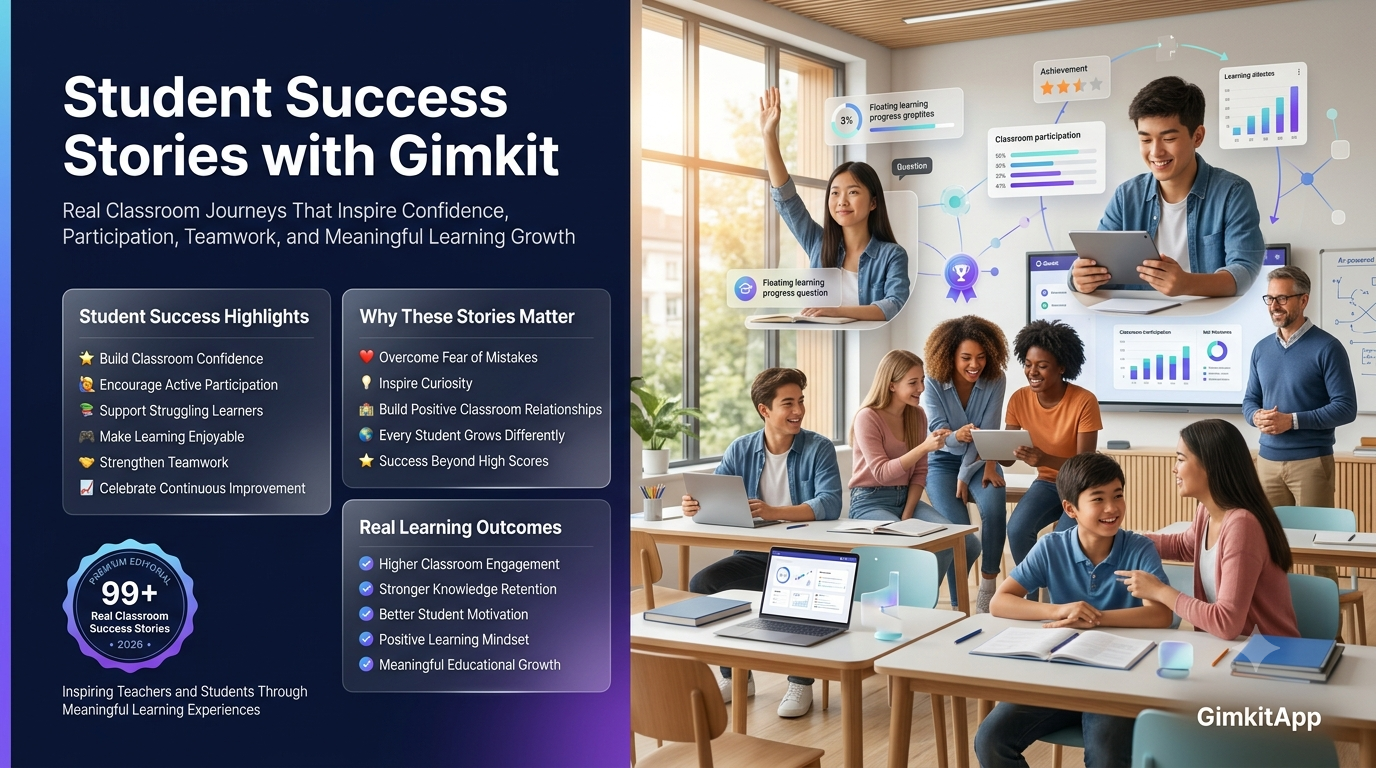
Automating Your Classroom with Gimkit | Managing a modern classroom involves much more than simply delivering lessons. Teachers balance lesson planning, attendance, formative assessments, homework, classroom discussions, grading, student engagement, and progress tracking—often within limited instructional time. When repetitive administrative tasks consume a large part of the day, educators have less time to focus on meaningful instruction, individual student support, and creating engaging learning experiences.
🚀 How Gimkit Simplifies Classroom Workflows
📚 Supports Daily Teaching Tasks – Helps organize learning activities more efficiently, reducing repetitive classroom work.
📝 Create Reusable Learning Resources – Build quizzes and activities once, then reuse them for future lessons and review sessions.
🎯 Assign Independent Practice – Allow students to complete learning activities at their own pace inside or outside the classroom.
📊 Monitor Student Performance in Real Time – Track participation, accuracy, and progress during live games and assignments.
✅ Reduce Manual Administration – Spend less time creating new quizzes, tracking participation, and managing repetitive tasks.
🧠 Make Data-Driven Teaching Decisions – Use student performance insights to identify learning gaps and adjust instruction accordingly.
Rather than creating every activity from scratch or manually monitoring classroom participation, Gimkit streamlines routine teaching responsibilities through interactive, easy-to-manage learning experiences. This allows educators to dedicate more time to instruction, classroom discussions, and personalized support for individual students.
💡 More Than a Traditional Quiz Platform
🎮 Combines Learning with Engagement – Blends game-based learning with meaningful classroom activities that keep students motivated.
🏫 Supports Classroom Management – Offers features that help teachers organize lessons, monitor progress, and manage learning more effectively.
🔄 Fits Into Everyday Teaching – Can be integrated into regular classroom routines instead of being used only for occasional review games.
📈 Encourages Continuous Learning – Supports ongoing practice, assessment, and student growth throughout the school year.
🤝 Creates a Smarter Teaching System – When used thoughtfully, Gimkit becomes part of a broader instructional workflow that improves efficiency, engagement, and overall learning outcomes.
Automating your classroom workflow with Gimkit means designing repeatable teaching processes—such as lesson reviews, homework, formative assessments, vocabulary practice, and progress monitoring—so that routine classroom tasks require less manual effort while students remain actively engaged in learning.
Looking for comprehensive classroom resources and educational technology insights? Explore GimkitApp for expert guides, teaching strategies, game modes, and the latest updates to enhance student engagement.
Why Classroom Workflow Automation Matters
Many teachers associate automation with technology replacing human interaction. In education, the goal is the opposite.
Automation removes repetitive tasks so teachers can spend more time where their expertise matters most:
Individual student support
Classroom discussions
Small-group instruction
Feedback and coaching
Lesson improvement
Differentiated learning
Instead of repeatedly preparing similar review games every week, educators can create reusable instructional resources that continue delivering value throughout an entire semester.
A well-designed workflow also creates consistency. Students quickly learn classroom routines, spend less time waiting for instructions, and transition more smoothly between learning activities.
Understanding Classroom Workflow Before Using Gimkit
Before introducing any educational technology, it helps to understand what a classroom workflow actually includes.
A complete instructional workflow often consists of several connected stages:
Teaching Stage
Typical Teacher Task
How Gimkit Can Support It
Lesson Preparation
Create review materials
Build reusable Kits from existing content
Lesson Delivery
Check understanding
Host live interactive game sessions
Practice
Reinforce learning
Assign independent practice through Assignments
Assessment
Measure comprehension
Review performance reports and question accuracy
Intervention
Support struggling learners
Identify weak concepts using performance data
Revision
Prepare future lessons
Reuse, edit, or duplicate existing Kits
Rather than treating each stage as a separate activity, experienced teachers often connect them into one continuous learning cycle.
This approach minimizes repeated work while improving instructional consistency.
What “Automation” Actually Means Inside Gimkit
Automation in Gimkit does not mean the platform teaches students without a teacher.
Instead, it refers to reducing repetitive administrative work through reusable systems and structured classroom routines.
Examples include:
Creating a Kit once and using it across multiple classes.
Assigning independent practice without running a live game every time.
Organizing content into reusable topic libraries.
Monitoring student understanding through built-in reports instead of manually checking every answer.
Using consistent classroom routines that students quickly recognize.
The real efficiency comes from planning once and benefiting repeatedly.
Core Areas You Can Automate with Gimkit
1. Lesson Review Sessions
Many teachers spend significant time preparing review activities before quizzes or exams.
Instead of rebuilding review questions each week, create subject-specific Kits that can be updated over time.
For example:
Algebra equations
Cell biology
World geography
English vocabulary
Historical timelines
Chemistry formulas
As your curriculum grows, these Kits become a reusable instructional library rather than one-time resources.
💡 Pro Tip: Organize Kits by unit rather than by individual lesson. This makes future planning much easier.
2. Vocabulary Practice
Vocabulary instruction is one of the easiest classroom tasks to automate.
Instead of printing worksheets every week:
Build vocabulary Kits.
Assign them as independent practice.
Reuse them before assessments.
Update difficult words when necessary.
Students receive repeated exposure while teachers eliminate repeated preparation.
3. Homework Distribution
Homework often requires:
Creating documents
Printing papers
Uploading files
Explaining instructions repeatedly
With Gimkit Assignments, teachers can provide structured independent practice that students complete outside live class sessions.
Because assignments remain organized within the platform, teachers spend less time managing paperwork and more time reviewing learning outcomes.
4. Formative Assessment
Frequent low-stakes assessments help teachers identify misconceptions before major exams.
Instead of creating new quizzes every week:
Maintain reusable assessment Kits.
Adjust questions after each unit.
Compare class performance over time.
Identify learning gaps earlier.
Regular formative assessment becomes part of the teaching routine rather than an additional workload.
Building a Repeatable Weekly Classroom Workflow
One of the biggest productivity gains comes from using the same instructional cycle every week.
A practical example looks like this:
Monday
Introduce the new lesson.
Explain key concepts.
↓
Tuesday
Run a short live Gimkit review.
Identify common misunderstandings.
↓
Wednesday
Assign independent practice.
↓
Thursday
Review reports.
Provide targeted support for struggling students.
↓
Friday
Conduct a final review game before moving to the next topic.
Because the structure remains consistent, both teachers and students spend less mental energy managing routines and more energy focusing on learning.
⭐ Expert Insight: The most effective classroom automation doesn’t remove teacher involvement—it creates predictable systems that allow teachers to intervene exactly where students need help most.
For the latest gaming news, expert reviews, and walkthroughs, readers can also visit IGN, one of the world’s leading gaming websites.
Designing a Reusable Content Library
Teachers who use Gimkit regularly often discover that their greatest time savings come months later, not immediately.
Instead of viewing every Kit as a single-use activity, think of each one as part of a growing curriculum resource library.
A well-organized library might include:
Science
│
├── Biology
├── Chemistry
├── Physics
└── Earth Science

Mathematics
│
├── Algebra
├── Geometry
├── Statistics
└── Calculus

Language Arts
│
├── Vocabulary
├── Grammar
├── Reading Skills
└── Literature

Social Studies
│
├── Geography
├── History
├── Government
└── Economics
Over time, this structured approach dramatically reduces lesson preparation because existing Kits can be updated instead of recreated.
Common Mistake
⚠ Creating every Kit from scratch.
Many new users rebuild similar review activities for every class. This increases preparation time and leads to inconsistent question quality.
A better approach is to maintain a central collection of reusable Kits, duplicate them when necessary, and make small adjustments for different classes or learning levels.
Build a Standardized Teaching Cycle Instead of Isolated Activities
Many teachers use Gimkit only before quizzes or exams. While effective, this limits its potential.
A stronger approach is to integrate Gimkit into a recurring instructional cycle where each activity supports the next.
Teaching Phase
Teacher Goal
Gimkit’s Role
Expected Outcome
Introduce
Teach new concepts
Traditional instruction
Build foundational understanding
Check Understanding
Identify misconceptions
Short live review session
Immediate formative feedback
Practice
Reinforce learning
Independent Assignment
Improve retention
Analyze
Review reports
Performance analytics
Identify learning gaps
Support
Help struggling students
Targeted review Kits
Personalized intervention
Reassess
Measure improvement
Follow-up game
Confirm mastery
This cycle creates a predictable learning routine that students quickly become comfortable with while reducing repetitive planning for teachers.
Turn Assessment Data into Teaching Decisions
One of Gimkit’s most valuable strengths is that it helps teachers move beyond simply recording scores.
Performance reports can reveal patterns such as:
Questions most students answered incorrectly
Concepts that require reteaching
Students who may need additional support
Topics the class has already mastered
Areas where instruction was especially effective
Instead of asking, “Who passed?”, a more useful question becomes:
“What should I teach differently tomorrow?”
That shift transforms assessment from evaluation into instructional planning.
⭐ Expert Insight: The most effective teachers use assessment data to improve future lessons—not just to assign grades.
Create Subject-Based Resource Libraries
As your content grows, organization becomes just as important as creation.
Rather than storing dozens of unrelated Kits, organize them into structured curriculum collections.
Example Organization
Mathematics
├── Unit 1
├── Unit 2
├── Final Review

Science
├── Biology
├── Chemistry
├── Physics

English
├── Grammar
├── Reading
├── Vocabulary

History
├── Ancient Civilizations
├── World Wars
├── Modern History
This structure makes it much easier to locate resources, duplicate existing Kits, and update content without starting over.
📌 Quick Note: Naming Kits consistently (for example, “Grade 8 – Unit 3 – Ecosystems”) saves significant time later, especially when managing multiple classes.
Differentiate Learning Without Creating Multiple Lessons
Students rarely learn at the same pace.
Instead of preparing entirely separate lessons, many teachers use Gimkit to provide additional practice where it’s needed most.
Examples include:
Assigning extra vocabulary practice to language learners
Creating review Kits for students preparing for reassessments
Offering enrichment activities for advanced learners
Reinforcing prerequisite concepts before introducing new material
This approach supports diverse learning needs while keeping lesson planning manageable.
Reduce Repetitive Administrative Tasks
Several classroom tasks are repeated every week.
Examples include:
Preparing review questions
Sharing practice activities
Explaining game rules
Checking understanding
Recording participation
Identifying struggling students
When these tasks follow a consistent workflow, teachers spend less time managing logistics and more time interacting with students.
Think of automation as standardization, not replacement.
Use Live Games Strategically
Live sessions are most effective when they have a clear instructional purpose.
Instead of playing only for engagement, consider using them to:
Review yesterday’s lesson
Introduce a new unit with prior knowledge questions
Check understanding halfway through class
Prepare students before a test
Reinforce difficult concepts after instruction
Changing the purpose of each session keeps activities meaningful while avoiding game fatigue.
💡 Pro Tip: Short, focused review sessions are often more effective than long games covering too many topics at once.
Make Classroom Transitions Faster
Every classroom loses valuable minutes during transitions.
A predictable Gimkit routine can reduce downtime.
Example
Beginning of Class
Students enter
Join the activity
Review previous learning
↓
Middle of Class
Teach new concepts
Pause to check understanding
↓
End of Class
Quick review
Exit reflection
Assign independent practice if needed
When students know the routine, less instructional time is spent explaining what comes next.
Encourage Student Ownership
Automation isn’t only about helping teachers.
Students also benefit when classroom expectations remain consistent.
Over time they learn to:
Prepare before review sessions
Monitor their own progress
Recognize areas needing improvement
Build confidence through repeated practice
Develop independent study habits
These habits contribute to long-term learning rather than short-term memorization.
Common Mistakes That Limit Workflow Efficiency
Even experienced educators sometimes reduce Gimkit’s effectiveness through avoidable habits.
Common Mistake
Why It Causes Problems
Better Approach
Creating new Kits every week
Increases planning time
Reuse and update existing Kits
Making games too long
Student attention decreases
Keep sessions focused
Ignoring performance reports
Missed teaching opportunities
Review data after each activity
Using games only before exams
Limits continuous learning
Integrate regular review cycles
Organizing Kits inconsistently
Difficult to locate resources
Use consistent naming and folders
Avoiding these small issues leads to a smoother, more sustainable classroom workflow.
Workflow Checklist for Teachers
Before each instructional unit, verify the following:
✅ Learning objectives are clearly defined
✅ Relevant Kit is updated
✅ Questions align with lesson outcomes
✅ Independent practice is prepared
✅ Review schedule is planned
✅ Performance reports will be reviewed afterward
✅ Follow-up support is ready for struggling learners
This checklist helps maintain consistency across lessons without adding unnecessary complexity.
Scaling Classroom Workflow Automation with Gimkit for Long-Term Success
Creating a few engaging games is relatively easy. Building a classroom system that continues saving time throughout an entire school year requires a different mindset. The most successful educators don’t treat Gimkit as an occasional activity—they integrate it into a structured teaching routine where every Kit, Assignment, and review session has a clear purpose.
Long-term efficiency comes from planning once, improving continuously, and reusing intelligently.
Build a Year-Round Teaching System
Instead of thinking lesson by lesson, organize your resources around the entire curriculum.
A sustainable workflow might look like this:
Academic Stage
Primary Goal
Recommended Workflow
Beginning of Unit
Measure prior knowledge
Short diagnostic review
During Instruction
Reinforce learning
Live review sessions after key lessons
Independent Practice
Extend learning
Assign practice outside class
Mid-Unit Check
Identify misconceptions
Analyze performance reports
Before Assessment
Review essential concepts
Focused revision Kits
After Assessment
Address learning gaps
Targeted intervention activities
Following the same instructional cycle across every unit reduces planning time while giving students a familiar learning experience.
Balance Automation with Active Teaching
Automation should simplify routine tasks—not replace professional judgment.
Gimkit works best when teachers continue to:
Explain difficult concepts
Lead meaningful classroom discussions
Answer questions in real time
Provide constructive feedback
Adapt instruction based on student needs
Encourage collaboration and critical thinking
Interactive games reinforce learning, but they are most effective when paired with strong instructional practices.
⭐ Expert Insight: Technology supports great teaching; it doesn’t replace it. Students benefit most when digital activities are integrated into thoughtful lesson design rather than used as stand-alone entertainment.
Troubleshooting Common Classroom Challenges
Even a well-planned workflow can encounter obstacles. Recognizing them early makes classroom management much smoother.
Challenge
Possible Cause
Practical Solution
Students focus more on competition than learning
Games are overused or objectives are unclear
Explain learning goals before each session and vary activity types
Low participation
Content is too difficult or repetitive
Adjust question difficulty and mix different review strategies
Reports don’t provide useful insights
Questions are too easy or too broad
Design questions that assess understanding instead of simple recall
Preparation still takes too long
Resources are recreated repeatedly
Maintain and update a reusable Kit library
Students progress at different speeds
Learning needs vary across the class
Provide additional practice or targeted review where needed
Treat these challenges as opportunities to refine your workflow rather than signs that the platform isn’t working.
Best Practices for Sustainable Classroom Automation
The teachers who save the most time usually follow a few consistent habits:
Plan for Reuse
Design Kits that can support multiple classes, future semesters, or curriculum updates instead of one-time activities.
Keep Content Current
Review older Kits occasionally to remove outdated questions, improve wording, or align with curriculum changes.
Focus on Learning Objectives
Every game should reinforce a specific concept or skill rather than simply increasing classroom excitement.
Review Performance Regularly
Assessment data becomes valuable only when it influences future instruction. Look for patterns instead of focusing solely on individual scores.
Maintain Consistent Routines
Students participate more confidently when review sessions, assignments, and classroom expectations follow a familiar structure.
What Gimkit Does Well—and Where Teachers Still Lead
Like any educational platform, Gimkit has strengths as well as practical limitations.
Strengths
Teacher Responsibility
Increases classroom engagement
Provide clear instruction and context
Supports formative assessment
Interpret results and plan next steps
Encourages active participation
Foster discussion and deeper understanding
Makes review sessions more interactive
Connect activities to curriculum goals
Simplifies reusable practice resources
Differentiate instruction when needed
Understanding this balance helps educators use the platform more effectively without expecting it to solve every instructional challenge.
Looking Ahead: The Future of Classroom Workflow Automation
Educational technology continues to evolve, but one trend remains consistent: teachers need tools that reduce administrative work while improving learning experiences.
Future classroom workflows are likely to place greater emphasis on:
Personalized learning pathways
Data-informed instructional planning
Flexible in-class and remote learning
Collaborative digital classrooms
More efficient formative assessment
Better integration between teaching resources and learning analytics
Regardless of new features or technologies, the core principle will remain the same—technology should create more time for meaningful teaching, not more complexity.
Professional Recommendations
If you’re introducing Gimkit into your classroom workflow, start small and build gradually.
Begin with one reusable Kit for each unit, establish a consistent weekly review routine, and use performance insights to refine future lessons. As your resource library grows, preparation becomes faster, classroom transitions become smoother, and instructional decisions become more informed.
Avoid trying to automate every aspect of teaching. Instead, automate repetitive processes while keeping student interaction, discussion, and personalized support at the center of your classroom practice.
Professional Recommendations & Expert reviews
Automating Your Classroom with Gimkit helps simplify routine classroom activities through interactive technology.
Automating Your Classroom with Gimkit supports more efficient lesson management every day.
Automating Your Classroom with Gimkit encourages consistent student participation with minimal manual setup.
Automating Your Classroom with Gimkit helps teachers save valuable instructional time.
Automating Your Classroom with Gimkit supports organized classroom workflows throughout the school year.
Automating Your Classroom with Gimkit encourages smoother transitions between learning activities.
Automating Your Classroom with Gimkit helps reinforce lesson objectives through automated practice.
Automating Your Classroom with Gimkit supports continuous classroom engagement.
Automating Your Classroom with Gimkit encourages students to participate independently.
Automating Your Classroom with Gimkit helps create consistent learning experiences.
Automating Your Classroom with Gimkit supports efficient classroom organization.
Automating Your Classroom with Gimkit encourages teachers to focus more on instruction than administration.
Automating Your Classroom with Gimkit helps simplify classroom review sessions.
Automating Your Classroom with Gimkit supports regular formative assessment.
Automating Your Classroom with Gimkit encourages meaningful student interaction with lesson content.
Automating Your Classroom with Gimkit helps reduce repetitive classroom tasks.
Automating Your Classroom with Gimkit supports personalized learning opportunities.
Automating Your Classroom with Gimkit encourages better classroom time management.
Automating Your Classroom with Gimkit helps maintain student engagement throughout lessons.
Automating Your Classroom with Gimkit supports flexible teaching across different subjects.
Automating Your Classroom with Gimkit encourages active participation through interactive activities.
Automating Your Classroom with Gimkit helps strengthen classroom routines.
Automating Your Classroom with Gimkit supports more organized lesson delivery.
Automating Your Classroom with Gimkit encourages students to review concepts consistently.
Automating Your Classroom with Gimkit helps improve classroom efficiency through automation.
Automating Your Classroom with Gimkit supports collaborative learning experiences.
Automating Your Classroom with Gimkit encourages teachers to monitor learning progress more easily.
Automating Your Classroom with Gimkit helps create engaging educational experiences.
Automating Your Classroom with Gimkit supports better classroom participation.
Automating Your Classroom with Gimkit encourages students to remain motivated throughout lessons.
Automating Your Classroom with Gimkit helps reinforce important learning objectives.
Automating Your Classroom with Gimkit supports consistent educational experiences for every learner.
Automating Your Classroom with Gimkit encourages balanced instruction and interactive practice.
Automating Your Classroom with Gimkit helps teachers streamline classroom management.
Automating Your Classroom with Gimkit supports continuous learning through regular engagement.
Automating Your Classroom with Gimkit encourages efficient use of classroom technology.
Automating Your Classroom with Gimkit helps reduce preparation time for review activities.
Automating Your Classroom with Gimkit supports stronger classroom communication.
Automating Your Classroom with Gimkit encourages meaningful learning through structured activities.
Automating Your Classroom with Gimkit helps students build confidence with consistent practice.
Automating Your Classroom with Gimkit supports productive learning environments.
Automating Your Classroom with Gimkit encourages teachers to simplify repetitive educational processes.
Automating Your Classroom with Gimkit helps improve lesson consistency across multiple classes.
Automating Your Classroom with Gimkit supports long-term classroom organization and efficiency.
Automating Your Classroom with Gimkit demonstrates that thoughtful automation can improve participation, engagement, and instructional effectiveness.
Key Takeaways
Classroom automation is about improving efficiency, not replacing teachers.
Reusable Kits reduce repeated lesson preparation.
Consistent instructional routines save time and improve classroom organization.
Performance reports are most valuable when they guide future teaching decisions.
Independent practice can reinforce learning beyond live classroom sessions.
Organized resource libraries become more valuable over time.
Effective automation supports differentiated instruction without creating unnecessary workload.
The strongest classrooms combine thoughtful teaching with purposeful technology.
Final Thoughts
Gimkit becomes most valuable when it’s viewed as part of a complete instructional workflow rather than a standalone classroom game. By building reusable resources, following consistent teaching routines, and using assessment insights to improve instruction, educators can reduce repetitive tasks while creating more opportunities for active learning and meaningful student support.
The real advantage isn’t simply saving time—it’s using that time to focus on what matters most: helping students understand, apply, and retain what they learn.
Frequently Asked Questions (FAQs)
1. Can Gimkit fully automate classroom management?
Short Answer: No. Gimkit can automate many repetitive classroom tasks, but it cannot replace effective teaching or classroom leadership.
Automation in Gimkit is designed to reduce administrative workload rather than eliminate the teacher’s role. It helps streamline activities such as lesson reviews, independent assignments, formative assessments, and progress tracking. However, teachers still make the most important instructional decisions—explaining complex concepts, adapting lessons, facilitating discussions, and providing individualized support.
A productive classroom depends on the combination of technology-driven efficiency and teacher expertise. Gimkit handles repetitive processes, while educators focus on developing critical thinking, creativity, collaboration, and deeper understanding.
⭐ Expert Insight: Think of Gimkit as a teaching assistant, not an automated teacher. The platform saves time, but meaningful learning still depends on thoughtful instruction and human interaction.
2. What’s the best way to use Gimkit without increasing lesson preparation time?
Short Answer: Create reusable resources instead of building new activities for every lesson.
One of the biggest mistakes teachers make is designing every game from scratch. A more sustainable approach is to organize Kits by grade level, subject, unit, or learning objective. Once a high-quality Kit is created, it can be updated, duplicated, and reused across multiple classes or future school years.
For example, a science teacher who creates a comprehensive “Cell Biology” Kit can reuse it for revision sessions, homework, formative assessments, and end-of-unit reviews with only minor adjustments. Over time, this creates a growing curriculum library that significantly reduces preparation time.
Best Practices
Create one master Kit for each unit.
Update questions instead of rebuilding entire activities.
Use consistent naming conventions for easier organization.
Archive outdated content instead of deleting it.
Review and improve Kits after each teaching cycle.
This approach transforms Gimkit into a long-term productivity tool rather than a one-time classroom activity.
3. Does Gimkit improve student learning or just increase engagement?
Short Answer: Engagement alone doesn’t improve learning—how teachers use Gimkit makes the difference.
Game-based learning captures students’ attention, but lasting learning occurs when classroom activities align with clear educational objectives. Gimkit becomes much more effective when teachers use it to reinforce recently taught concepts, identify misconceptions, encourage retrieval practice, and guide future instruction through performance insights.
Research in educational psychology consistently shows that active recall, spaced practice, and timely feedback contribute more to long-term retention than passive review. Gimkit supports these strategies when integrated into a well-planned instructional workflow.
Students are more likely to retain knowledge when games are connected to learning goals rather than used solely as entertainment.
💡 Professional Recommendation: Before launching any game, ask yourself one question: “What specific learning outcome should students achieve by the end of this activity?” If you can answer that clearly, the session is much more likely to produce meaningful results.
4. How can teachers use Gimkit effectively in classrooms with mixed learning abilities?
Short Answer: Use performance insights to provide targeted support instead of teaching every student the same way.
Every classroom includes students who learn at different speeds and with different levels of confidence. Gimkit allows teachers to identify patterns in student understanding, making it easier to provide additional practice where it’s needed most.
A practical workflow might include:
Students who demonstrate mastery move on to enrichment activities.
Students with partial understanding receive focused review.
Students struggling with foundational concepts complete additional guided practice before advancing.
This targeted approach supports differentiated instruction without requiring teachers to create entirely separate lesson plans for every learner.
Common Mistake
Many educators assume differentiation means designing multiple versions of every lesson. In reality, small adjustments to practice activities and follow-up support often provide the greatest impact while remaining manageable.
5. What is the biggest mistake teachers make when trying to automate their classroom workflow with Gimkit?
Short Answer: Focusing on the technology instead of the teaching process.
Some teachers believe automation means using Gimkit more frequently. In practice, successful classroom automation is about building consistent instructional systems rather than simply increasing the number of games.
A strong workflow includes planning, teaching, reviewing, assessing, analyzing results, and improving future lessons. Gimkit supports each of these stages, but only when it is intentionally integrated into the overall learning experience.
Signs of an Effective Workflow
✔ Learning objectives are clearly defined before every activity.
✔ Kits are organized and reusable.
✔ Performance reports inform future instruction.
✔ Students understand classroom routines.
✔ Games reinforce learning rather than interrupt it.
✔ Teachers regularly refine activities based on classroom outcomes.
⭐ Final Expert Takeaway: The most successful educators don’t ask, “How can Gimkit do more?” They ask, “How can Gimkit help me teach more effectively?” That shift in perspective transforms the platform from a simple review game into a valuable component of a smarter, more efficient, and student-centered classroom workflow.