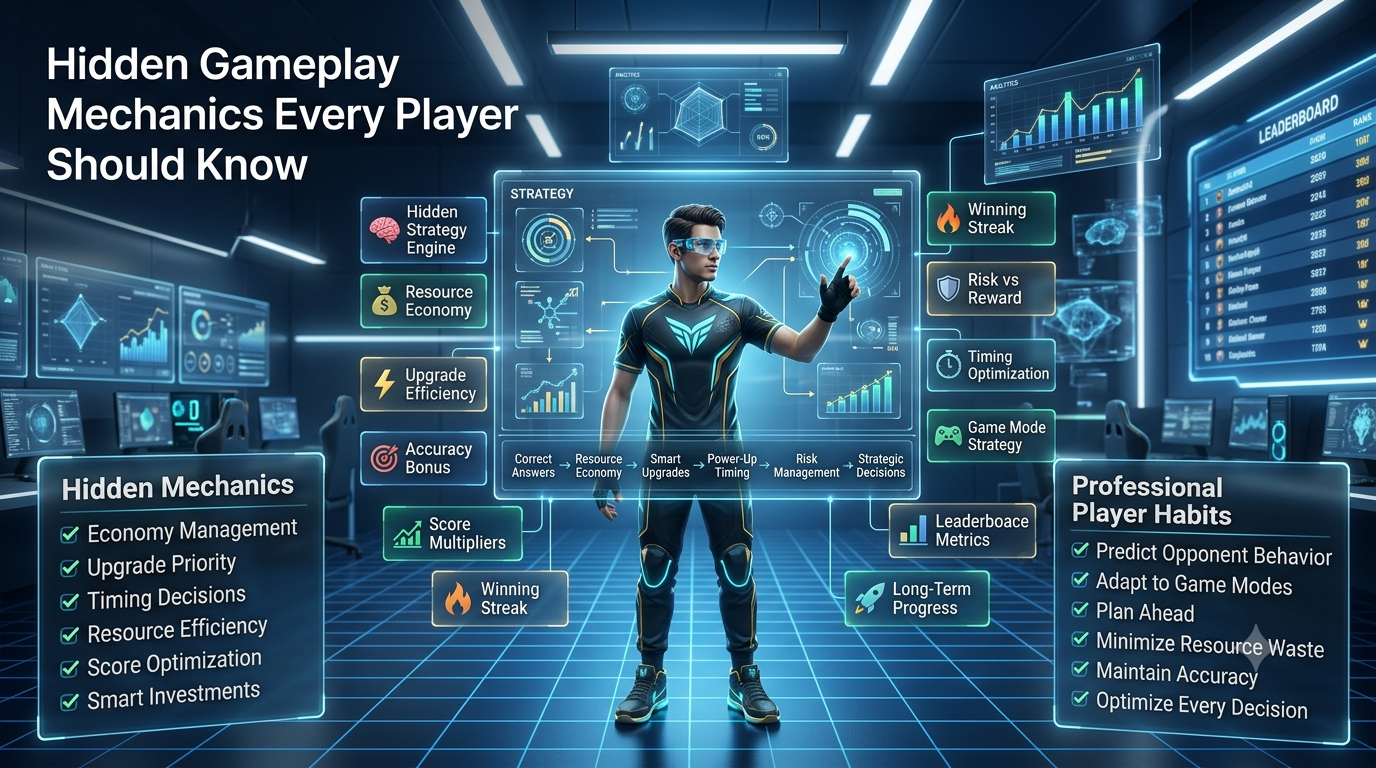
Hidden Gameplay Mechanics Every Player Should Know-Many players believe success in Gimkit depends only on answering questions quickly. While speed certainly matters, experienced players know that the game’s real depth comes from understanding the hidden gameplay mechanics operating beneath the surface. These subtle systems influence everything from cash generation and upgrade efficiency to power-up timing, risk management, and long-term scoring potential. Learning these mechanics often separates average players from consistent leaderboard champions.
As Gimkit has evolved, its game modes have introduced increasingly sophisticated interactions. Resource management, movement decisions, strategic purchases, prediction skills, and timing all contribute to overall performance. Some mechanics are clearly explained within the interface, while others become apparent only after hundreds of matches or careful observation. Recognizing these patterns allows players to make smarter decisions instead of relying purely on fast quiz answers.
Whether you’re a student aiming to dominate classroom competitions or a teacher looking to understand why certain players consistently outperform others, this guide explores the less obvious systems that influence every match. From invisible economic cycles and upgrade priorities to psychological tactics and advanced optimization strategies, you’ll gain a deeper understanding of how experienced players maximize every opportunity.
Unlike basic tutorials that explain controls or purchasing upgrades, this guide focuses on the mechanics that many players overlook. By mastering these hidden systems, you’ll improve consistency across nearly every game mode while making better decisions under pressure.
Understanding Hidden Gameplay Mechanics
Every successful competitive game contains layers of mechanics that aren’t immediately obvious. Gimkit is no exception. While answering questions correctly earns money, the surrounding systems determine how effectively that money converts into long-term advantages. Small improvements in decision-making often produce larger gains than simply increasing answer speed.
Hidden mechanics usually emerge through repeated gameplay. Players begin noticing patterns such as certain upgrades providing greater value than expected, specific purchasing sequences producing faster income growth, or strategic patience outperforming aggressive spending. None of these observations require secret knowledge—they simply come from understanding how the game’s systems interact.
Another important concept is that mechanics rarely operate independently. Cash generation affects upgrade timing, upgrades influence answer efficiency, movement decisions affect resource collection, and resource collection creates opportunities for stronger investments. Viewing the game as an interconnected system helps players identify optimization opportunities that are invisible when focusing on individual features alone.
Understanding these relationships encourages smarter gameplay instead of reactive decision-making. Rather than purchasing upgrades simply because they’re available, experienced players evaluate how each decision supports their overall strategy during different stages of a match.
Why Small Decisions Create Big Advantages
One of the biggest misconceptions among new players is believing that only major decisions influence match outcomes. In reality, dozens of seemingly minor choices gradually accumulate into significant competitive advantages over time.
For example, delaying an upgrade by only thirty seconds may appear insignificant. However, if that upgrade increases earnings throughout the remainder of the match, the lost income compounds continuously. Similar effects occur when players hesitate before answering questions, spend resources inefficiently, or choose lower-value upgrades early in the game.
This compounding principle explains why experienced players often seem to accelerate away from the competition. Their success usually isn’t caused by a single brilliant move. Instead, it’s the result of hundreds of efficient micro-decisions that consistently generate slightly better outcomes.
Thinking in terms of cumulative advantages changes how players approach every match. Instead of searching for one powerful trick, they focus on improving every small interaction with the game’s systems.
The Invisible Economy Behind Every Match
Although players see money increasing after each correct answer, Gimkit’s economy extends far beyond visible cash totals. Every purchase represents an investment whose value depends on future opportunities rather than immediate satisfaction.
Consider two hypothetical players with identical earnings. One spends resources immediately whenever possible, while the other waits until certain upgrades create stronger long-term returns. Even if both players answer questions equally well, their economic trajectories gradually diverge because investment efficiency differs.
The hidden economy also includes concepts such as income acceleration, delayed returns, upgrade synergy, and opportunity cost. These factors continuously shape match outcomes without being explicitly highlighted on the scoreboard.
Viewing money as an investment tool rather than simply a currency encourages more disciplined decision-making. Players begin asking whether each purchase improves future earning potential instead of merely providing immediate benefits.
Early Game Momentum and Snowball Effects
The opening minutes of a Gimkit match often influence the remainder of the game far more than many players realize. Strong early decisions create momentum that compounds over time, making later upgrades easier to afford and expanding strategic flexibility.
This phenomenon is commonly known as the snowball effect. Early investments increase earning potential, which generates additional income, allowing even stronger upgrades to be purchased sooner. Each efficient decision reinforces previous advantages.
Conversely, inefficient early purchases can slow progression significantly. Recovering from poor investment choices becomes increasingly difficult because competitors continue expanding their own economic advantages during the same period.
Rather than rushing into every available upgrade, experienced players prioritize investments that maximize long-term growth instead of short-term excitement.
Risk Versus Reward Decision Making
Every competitive match requires balancing safety against potential rewards. Some opportunities promise significant gains but expose players to greater risks, while others offer slower yet more reliable progress.
Successful players constantly evaluate whether taking additional risks aligns with their current position. Someone leading comfortably may prefer consistency over aggressive strategies, whereas a player trailing behind might intentionally pursue higher-risk opportunities capable of closing the gap.
Understanding this balance prevents emotional decision-making. Instead of reacting impulsively, experienced players assess expected outcomes before committing resources or changing strategies.
As matches progress, effective risk management becomes increasingly valuable because mistakes often carry larger consequences during later stages.
Hidden Cash Generation Patterns
Cash generation depends on far more than simply answering questions correctly. Various gameplay systems influence how efficiently earnings accumulate throughout a session.
Several factors commonly affect long-term income:
Gameplay Factor
Long-Term Impact
Correct answer consistency
Stable earnings growth
Upgrade sequencing
Higher investment efficiency
Reduced downtime
Increased earning opportunities
Resource preservation
Better purchasing flexibility
Strategic timing
Improved economic scaling
Players who recognize these relationships begin optimizing the complete earning process rather than focusing solely on question accuracy.
Instead of asking, “How can I earn more money right now?” experienced competitors ask, “How can I maximize my earning rate over the entire match?”
Understanding Opportunity Cost
Opportunity cost is one of the least discussed yet most influential mechanics in Gimkit. Every purchase automatically prevents another purchase from being made at the same time.
For example, choosing a lower-value upgrade today may delay access to a stronger investment later. Although the immediate decision appears reasonable, its long-term consequences can reduce overall efficiency.
Professional strategy games frequently revolve around opportunity cost because resources are always limited. Gimkit follows the same principle. Every decision carries hidden trade-offs that affect future options.
Developing awareness of opportunity cost encourages players to compare multiple possible investments before committing resources. This habit leads to stronger long-term planning instead of reactive spending.
Efficient Upgrade Timing
Choosing the right upgrade matters, but choosing when to buy it often matters even more. Many players purchase improvements the instant they have enough cash, assuming immediate upgrades always provide the greatest benefit. In reality, timing can dramatically affect your long-term economy. An upgrade purchased slightly later may unlock a stronger sequence of investments, while an impulsive purchase can delay more valuable opportunities.
Think of every upgrade as an investment with a return period. Income-boosting upgrades usually become more valuable the earlier they’re acquired because they have more time to generate additional earnings. Conversely, upgrades that primarily improve end-game performance may deliver greater value when purchased after establishing a stable income stream. Understanding this distinction helps players avoid spending based purely on availability.
Another overlooked aspect is adapting upgrade timing to match length. In shorter games, expensive investments may never recover their cost before the match ends. Longer sessions allow players to benefit from gradual economic growth, making early investments increasingly rewarding. Experienced competitors mentally estimate how much gameplay remains before deciding whether to prioritize growth or immediate performance.
Indicators That It’s Time to Upgrade
Instead of following a fixed order every match, watch for signals that indicate an upgrade is worth purchasing.
Situation
Recommended Focus
Reason
Early match
Economy improvements
More time to generate value
Mid-game
Balanced investments
Maintain growth while improving efficiency
Late game
Immediate impact upgrades
Limited time for long-term returns
Trailing behind
High-value recovery options
Close the gap efficiently
Leading comfortably
Consistent scaling
Protect existing advantage
Power-Up Value Beyond Their Description
Power-ups often appear straightforward because their descriptions explain their direct effects. However, experienced players recognize that their true value depends heavily on context. A power-up that seems average during one stage of a match may become extremely valuable under different circumstances.
Timing is one of the biggest hidden variables. Activating an ability during a period of rapid earning can amplify its overall impact, while using it during downtime may waste much of its potential. Skilled players rarely trigger power-ups immediately after obtaining them. Instead, they wait until surrounding conditions maximize their effectiveness.
Synergy is another important factor. Some abilities become significantly stronger when combined with specific upgrades or game situations. Rather than evaluating power-ups individually, think about how they interact with your current strategy. This systems-based mindset often produces greater overall gains than treating each mechanic independently.
Finally, avoid assuming that rare or expensive power-ups are automatically the strongest. Their effectiveness depends on your position, the game mode, and how efficiently you can capitalize on their benefits.
Movement Optimization Techniques
In game modes involving player movement, efficiency extends beyond simply reaching objectives quickly. Every unnecessary detour, hesitation, or poorly planned route reduces productive time that could otherwise contribute to earning resources or completing objectives.
Experienced players often plan several actions ahead instead of reacting moment by moment. While traveling toward one objective, they identify the next destination, minimizing idle decision-making. This continuous planning creates smoother gameplay and reduces wasted movement.
Movement efficiency also includes maintaining awareness of environmental hazards, interactive objects, and high-value locations. Constantly adjusting routes based on changing conditions often yields better results than following the same path every match.
Good movement is less about speed alone and more about maintaining productive activity throughout the game.
Habits of Efficient Players
Plan your next destination before reaching the current one.
Avoid unnecessary backtracking.
Stay aware of nearby objectives while answering questions.
Adapt routes as the match evolves.
Reduce idle time between decisions.
Map Awareness Fundamentals
Many players focus exclusively on answering questions and upgrading equipment, overlooking the importance of understanding the map itself. Strong map awareness provides information that influences positioning, timing, and strategic planning.
Learning common pathways, resource locations, objective placements, and high-traffic areas enables players to anticipate opportunities before they appear. Instead of reacting after something happens, experienced competitors position themselves advantageously in advance.
Map awareness also improves defensive decision-making. Recognizing where opponents are likely to travel helps players avoid unnecessary conflicts or prepare for encounters when beneficial.
Over time, familiarity with map layouts reduces cognitive workload. Players spend less energy navigating and more energy making high-level strategic decisions.
Resource Management Strategies
Winning consistently requires managing every available resource efficiently. While money is the most obvious resource, successful players also manage time, opportunities, upgrades, movement, attention, and decision-making capacity.
Time is particularly valuable because every second spent inactive represents potential progress lost. Fast but thoughtful decisions keep momentum high throughout the match. Likewise, preserving flexibility by avoiding unnecessary commitments allows players to adapt as circumstances change.
Resource management also involves recognizing diminishing returns. Investing repeatedly into one area may eventually produce smaller benefits than strengthening weaker aspects of your strategy. Maintaining balance generally creates greater long-term consistency.
Viewing resources as interconnected systems rather than isolated mechanics encourages more informed decisions across every phase of gameplay.
Smart Spending Priorities
Spending efficiently requires evaluating future value instead of immediate satisfaction. New players often purchase upgrades simply because they become available, whereas experienced competitors compare multiple options before investing.
A useful framework is to divide purchases into three categories:
Priority
Purpose
Typical Timing
Growth
Increase future earning potential
Early game
Efficiency
Improve overall consistency
Mid-game
Performance
Maximize immediate results
Late game
Following this progression helps maintain steady development without neglecting critical aspects of gameplay.
Another useful habit is delaying purchases briefly when multiple upgrades are close in cost. Waiting a short time may unlock a significantly stronger investment, improving long-term efficiency without sacrificing much immediate progress.
Defensive Versus Aggressive Playstyles
Every match presents situations where either aggressive expansion or cautious play becomes the better choice. Neither strategy is universally superior because effectiveness depends on current conditions.
Aggressive players prioritize rapid growth, accepting greater risks in exchange for potentially larger rewards. This approach works well when early momentum creates opportunities to build a significant lead. However, overly aggressive decisions may leave little room for recovery after mistakes.
Defensive players focus on consistency, minimizing unnecessary risks while gradually strengthening their position. Although progress may appear slower initially, disciplined play often produces reliable long-term results, particularly in competitive lobbies where opponents frequently make costly errors.
The strongest competitors shift between these styles instead of committing to one throughout an entire match. Recognizing when to transition is itself an advanced gameplay mechanic.
Timing Purchases for Maximum Impact
The value of a purchase depends not only on what you buy but also on the circumstances surrounding the purchase. Strategic timing can significantly increase the effectiveness of otherwise ordinary upgrades.
For example, buying an income-enhancing upgrade immediately before entering a highly productive period allows its benefits to compound rapidly. Purchasing the same upgrade moments before the match ends would provide only a fraction of its potential value.
Similarly, performance-focused upgrades often become more impactful during periods where immediate output matters most. Understanding these timing windows transforms average investment decisions into highly efficient strategic choices.
Players who consistently evaluate context before spending resources usually outperform those following fixed purchasing routines regardless of changing match conditions.
Recognizing Momentum Shifts
Matches rarely progress in a perfectly predictable manner. Momentum shifts occur whenever one player gains a series of efficient decisions that accelerate their progress relative to others. Recognizing these turning points allows you to respond before the gap becomes too large.
Common indicators include noticeably faster upgrade progression, increasingly efficient resource generation, or repeated successful objective completion by competitors. Rather than continuing the same strategy, experienced players reassess their priorities when momentum begins shifting.
Sometimes maintaining a steady approach remains appropriate. In other situations, recovering from a disadvantage requires calculated adjustments, such as emphasizing higher-value investments or reducing unnecessary risks. Flexibility is often more valuable than stubborn consistency.
Understanding momentum also improves confidence. Instead of assuming a temporary setback guarantees defeat, players learn to identify realistic opportunities for recovery while avoiding panic-driven decisions.
Predicting Opponent Behavior
One of the least discussed skills in competitive Gimkit gameplay is learning to predict what other players are likely to do next. While every participant makes independent decisions, most players follow recognizable patterns. Identifying those patterns allows you to prepare for situations before they happen instead of reacting after the opportunity has passed.
Newer players usually spend resources as soon as they become available, prioritize visible upgrades, and make decisions based on immediate rewards. Experienced players, however, often delay purchases, plan several actions ahead, and adapt their strategy according to the current state of the match. Recognizing which type of opponent you’re facing helps you anticipate their next move more accurately.
Prediction also involves observing momentum rather than individual actions. A player who suddenly accelerates in earnings may have invested efficiently earlier, while someone slowing down might be saving for a major upgrade. Instead of focusing only on leaderboard positions, pay attention to behavioral trends that reveal strategic intent.
Over time, developing this observational skill improves your own decision-making because you’ll begin thinking several moves ahead instead of concentrating only on your current action.
Reading Match Flow Instead of the Scoreboard
Many competitors check the leaderboard frequently but overlook the overall rhythm of the match. The scoreboard shows current standings, while match flow reveals where the game is heading.
A player sitting in third place may actually be positioned for a strong finish if they’ve recently improved their earning efficiency. Conversely, someone leading early might have already reached the point of diminishing returns because their investment strategy lacked long-term planning.
Experienced players evaluate several indicators simultaneously:
Observation
Possible Meaning
Rapid rank improvement
Efficient investment sequence
Stable earnings over time
Consistent strategy
Frequent position changes
High-risk gameplay
Sudden slowdown
Saving resources or inefficient spending
Gradual climb
Strong long-term economy
Thinking beyond current rankings allows you to respond proactively rather than chasing numbers that may quickly change.
Hidden Scoring Factors
Although correct answers remain the primary source of progress, overall performance is influenced by many indirect factors. These hidden contributors often explain why two players with similar accuracy finish with very different results.
Scoring efficiency depends on how effectively each correct answer is converted into future opportunities. Players who invest wisely generate more value from identical performance because every correct response supports a stronger economic foundation.
Several hidden elements contribute to overall scoring efficiency:
Consistent answer streaks.
Reduced idle time.
Efficient upgrade timing.
Smart resource allocation.
Productive movement.
Strategic patience.
Adaptation to changing match conditions.
Rather than viewing score as a direct reflection of knowledge alone, think of it as the combined outcome of numerous interconnected systems working together throughout the match.
Decision Fatigue During Long Matches
Longer sessions introduce a challenge many players never consciously recognize: decision fatigue. Every purchase, movement choice, upgrade evaluation, and strategic adjustment consumes mental energy. As fatigue increases, players become more likely to make impulsive decisions.
Professional competitors in many strategy games reduce this burden by developing repeatable decision frameworks. Instead of evaluating every option from scratch, they follow established priorities that simplify routine choices while reserving mental focus for unexpected situations.
For example, rather than asking dozens of questions whenever resources become available, experienced players quickly evaluate:
Does this investment improve long-term efficiency?
Will it pay for itself before the match ends?
Does it fit my current strategy?
Is waiting likely to create a stronger opportunity?
This structured thinking reduces hesitation and helps maintain consistent performance throughout extended games.
Common Mistakes Even Experienced Players Make
Skill does not eliminate mistakes. Even highly experienced players occasionally fall into habits that reduce efficiency. Recognizing these patterns makes them easier to avoid.
One common error is becoming overconfident after gaining an early lead. Instead of continuing disciplined decision-making, some players begin making unnecessary purchases simply because they can afford them. This weakens long-term efficiency and may allow opponents to recover.
Another frequent mistake is following the same strategy regardless of game mode. Different modes reward different behaviors, so adapting to changing objectives remains essential. Players who rely exclusively on familiar routines often struggle when mechanics shift.
Tunnel vision is another hidden problem. Focusing exclusively on answering questions may cause players to overlook economic opportunities, strategic upgrades, or changes occurring elsewhere in the match.
Expert Recommendations for Consistent Improvement
Improvement comes from refining habits rather than searching for secret tricks. The strongest players rarely depend on one powerful mechanic. Instead, they consistently execute numerous small optimizations that accumulate throughout each match.
Professional Workflow
Answer Correctly
        │
        ▼
Evaluate Current Economy
        │
        ▼
Compare Upgrade Options
        │
        ▼
Choose Highest Long-Term Value
        │
        ▼
Maintain Efficient Movement
        │
        ▼
Observe Opponent Trends
        │
        ▼
Adjust Strategy
        │
        ▼
Repeat Until Match Ends
Following a structured workflow helps eliminate unnecessary hesitation while improving consistency across different game modes.
Optimization Techniques Used by Strong Players
Optimization focuses on increasing efficiency rather than increasing effort. Skilled competitors rarely appear rushed because they minimize wasted actions instead of trying to perform more actions.
Some effective optimization habits include:
Optimization Area
Benefit
Faster purchasing decisions
Less downtime
Planned upgrade sequence
Better economy
Efficient movement
Higher productivity
Adaptive strategy
Improved flexibility
Reduced unnecessary risks
Greater consistency
Continuous observation
Better prediction
These improvements may seem small individually, but together they create a significant competitive advantage over the course of an entire match.
Adapting to Different Game Modes
Each Gimkit mode emphasizes different mechanics, making adaptability one of the most valuable skills a player can develop. A strategy that dominates one mode may perform poorly in another because objectives, pacing, and player interactions vary considerably.
Before every match, quickly identify the primary objective rather than assuming previous habits will remain effective. Some modes reward aggressive economic growth, while others prioritize survival, movement, teamwork, or objective control.
Experienced players mentally adjust several areas before the match begins:
Investment priorities.
Movement planning.
Resource conservation.
Risk tolerance.
Upgrade timing.
Team coordination when applicable.
This flexibility allows players to maximize performance regardless of how gameplay changes between sessions.
Future Gameplay Trends
As Gimkit continues evolving, future updates are likely to introduce additional mechanics that reward strategic thinking alongside academic knowledge. New game modes, balance adjustments, interactive objectives, and expanded customization options may further increase the importance of adaptability.
Rather than memorizing fixed strategies, players should focus on developing transferable skills such as economic planning, efficient decision-making, pattern recognition, and resource management. These core abilities remain valuable even when specific mechanics change.
Players who understand the underlying systems behind gameplay generally adapt much faster to updates than those relying solely on memorized routines. Building strategic awareness today prepares you for tomorrow’s changes without requiring a complete overhaul of your playstyle.
Key Takeaways Checklist
Use this checklist before your next match:
✅ Prioritize long-term investments over impulsive purchases.
✅ Build a strong economy during the early stages.
✅ Consider opportunity cost before spending resources.
✅ Time upgrades according to match length.
✅ Observe opponent behavior instead of watching only the leaderboard.
✅ Adapt strategies for different game modes.
✅ Minimize downtime between decisions.
✅ Maintain efficient movement whenever applicable.
✅ Stay flexible when momentum shifts.
✅ Focus on consistent optimization rather than searching for shortcuts.
Summary
Hidden gameplay mechanics often determine the difference between average and exceptional performance. While correct answers provide the foundation for success, long-term results depend on how effectively players manage resources, time upgrades, recognize economic patterns, predict opponents, and adapt to changing situations. Small optimizations repeated consistently produce larger advantages than isolated moments of brilliance.
By approaching Gimkit as a connected strategic system instead of a simple quiz game, players gain a deeper understanding of how every decision influences future opportunities. Developing these habits leads to stronger consistency, improved efficiency, and better results across virtually every game mode.
Frequently Asked Questions (FAQs)
What are hidden gameplay mechanics in Gimkit?
Hidden gameplay mechanics are systems that influence performance without always being obvious to players. They include upgrade timing, economic efficiency, opportunity cost, movement optimization, strategic resource management, and adapting to different match situations. While these mechanics don’t replace answering questions correctly, they determine how effectively you convert knowledge into long-term advantages. Players who understand these underlying systems usually perform more consistently across different game modes.
Key points:
Go beyond answering questions quickly.
Focus on long-term efficiency.
Learn how game systems interact.
Improve consistency through smarter decisions.
Why do experienced players seem to earn money much faster?
Experienced players rarely have a secret advantage. Instead, they usually make better investment decisions during the opening stages of a match. Early economic upgrades, reduced downtime, efficient spending, and avoiding unnecessary purchases create a compounding effect that increases earnings over time. Small improvements made repeatedly throughout a match eventually become significant differences on the leaderboard.
Key points:
Strong early investments.
Efficient upgrade order.
Minimal idle time.
Consistent decision-making.
Is answering questions faster always the best strategy?
Not necessarily. Accuracy and strategic planning are often more valuable than pure speed. Answering quickly while making poor investment decisions can reduce your overall performance. The strongest players balance speed with thoughtful resource management, ensuring that every correct answer contributes to long-term growth rather than only immediate gains.
Key points:
Accuracy remains essential.
Strategy supports long-term success.
Balance speed with planning.
Avoid rushing unnecessary decisions.
Should I buy upgrades as soon as I can afford them?
Immediate purchases are not always the most efficient choice. Sometimes waiting briefly allows access to a higher-value upgrade that produces greater long-term returns. Before spending resources, consider how much time remains in the match, your current economy, and whether the investment supports your overall strategy.
Key points:
Evaluate future value.
Consider remaining match time.
Compare multiple upgrade options.
Avoid impulse spending.
What is opportunity cost in Gimkit?
Opportunity cost refers to what you give up when choosing one investment instead of another. Every purchase limits your ability to buy something else at the same time. Understanding this concept helps players compare potential returns instead of selecting upgrades simply because they’re immediately available.
Key points:
Every purchase has a trade-off.
Compare long-term value.
Think beyond immediate rewards.
Plan several steps ahead.
How important is movement in certain game modes?
In movement-based modes, navigation efficiency can be just as important as answering questions correctly. Planning routes, avoiding unnecessary detours, and maintaining awareness of objectives reduce wasted time and increase productivity. Efficient movement helps players complete more meaningful actions throughout a match.
Key points:
Reduce unnecessary travel.
Plan routes in advance.
Stay aware of objectives.
Minimize idle movement.
Can different game modes require different strategies?
Yes. Every game mode emphasizes different mechanics and objectives. A strategy that works well in one mode may be less effective in another. Successful players adjust their upgrade priorities, movement patterns, spending habits, and risk tolerance according to the specific rules and objectives of each match.
Key points:
Adapt before every match.
Understand each objective.
Stay flexible.
Avoid relying on one strategy.
How can I consistently improve without simply playing more games?
Practice becomes much more effective when combined with deliberate analysis. Instead of only increasing playtime, review your decisions after each match. Identify inefficient purchases, missed opportunities, unnecessary risks, or moments where better planning could have improved results. Continuous reflection often produces faster improvement than repetition alone.
Key points:
Review every match.
Learn from mistakes.
Build better habits.
Improve decision quality.
Conclusion
Mastering hidden gameplay mechanics transforms the way you approach Gimkit. Instead of relying solely on quick answers, you’ll begin recognizing how every decision influences future opportunities. Smart upgrade timing, efficient resource management, calculated risk-taking, movement optimization, and strategic planning work together to create consistent success over many matches.
Perhaps the most valuable lesson is that winning rarely depends on one spectacular move. Strong players build advantages gradually through hundreds of small, efficient decisions. They understand when to invest, when to wait, when to adapt, and when to change strategy based on the evolving state of the game.
As Gimkit continues introducing new modes and gameplay features, these foundational principles will remain valuable because they focus on decision-making rather than memorizing fixed tactics. Players who understand the underlying systems adapt more quickly, improve more consistently, and perform confidently regardless of how the game evolves.