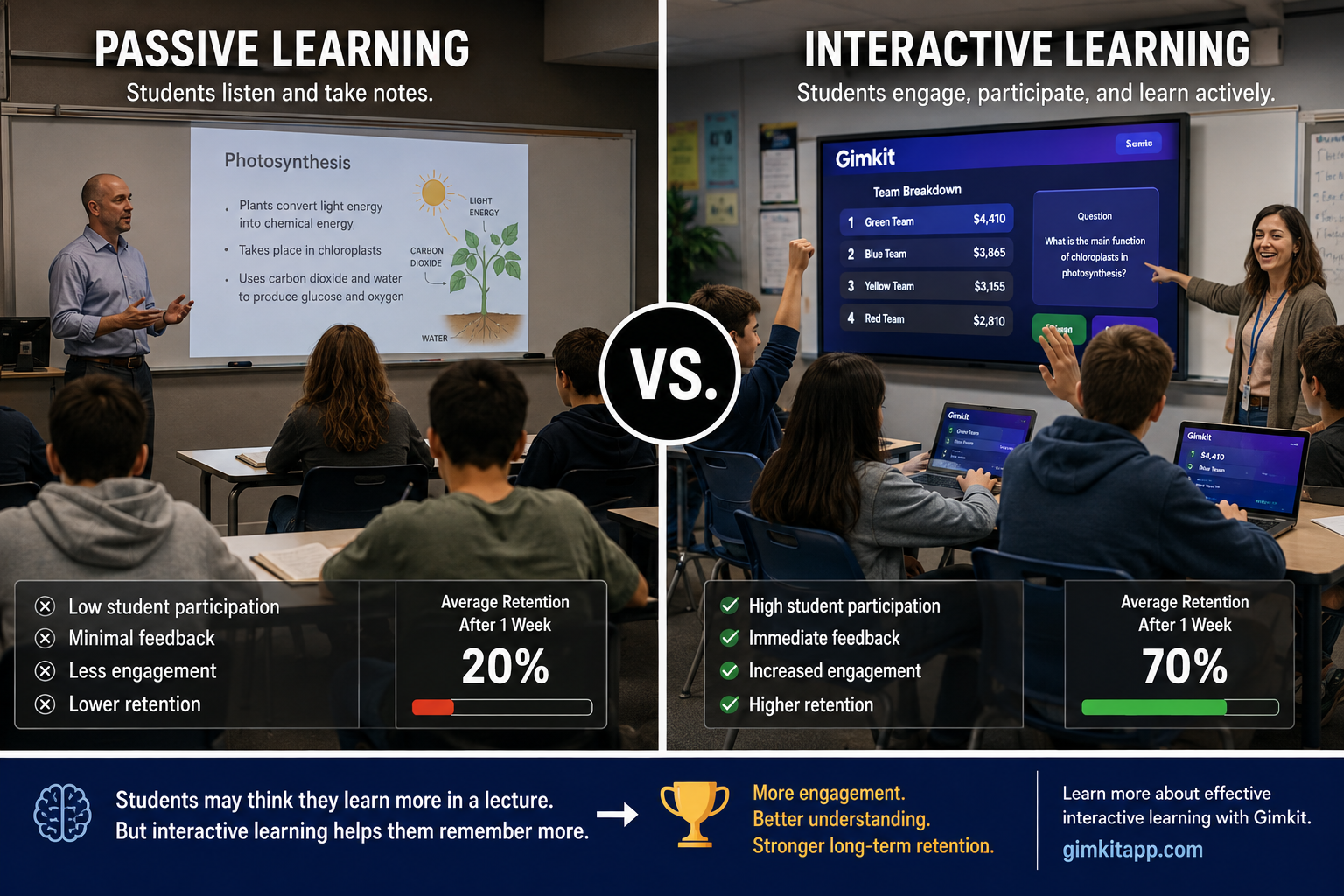
Interactive Learning vs Passive Learning in Classrooms-Walk into two classrooms teaching the exact same lesson. In one, students sit quietly, take notes, and listen to a lecture. In the other, students answer questions on their devices, watch their score change in real time, spend in-game currency on power-ups, and argue with a teammate about the right answer. Ask both groups afterward how well they learned the material, and something strange happens almost every time: the lecture group says they learned more. Test them a week later, and it’s usually the opposite group that actually retained it.
That gap — between how learning feels and how much learning actually happens — is the entire story of the interactive-versus-passive learning debate. It is also, not coincidentally, the exact mechanism that game-based review platforms like Gimkit are built to exploit in the student’s favor. This guide walks through what the peer-reviewed research says, why it says it, and how a tool like Gimkit fits into that evidence rather than just riding a “gamification” trend.
Looking for comprehensive classroom resources and educational technology insights? Explore GimkitApp for expert guides, teaching strategies, game modes, and the latest updates to enhance student engagement.
Quick Answer
Interactive learning consistently outperforms passive learning on test scores, retention, and skill transfer, and the effect has now been replicated across K–12, higher education, medical training, and corporate settings. A landmark randomized trial in undergraduate physics found that students in active classrooms learned more even though they felt like they had learned less — a pattern later confirmed in a replication. Recent meta-analyses covering gamified and game-based instruction report medium-to-large positive effect sizes on learning outcomes, engagement, and knowledge retention.
Passive learning — straight lecture, reading, watching a video without interruption — still earns its place for delivering large amounts of brand-new information to a big group quickly. But used as the only method, it is the weaker choice on nearly every outcome that matters once students move past first exposure into application, review, and retention. Game-based retrieval tools such as Gimkit sit squarely inside the “interactive” side of this research because their entire mechanic — answer a question, get instant feedback, use the result strategically — is built on the same cognitive levers researchers have identified for decades: retrieval practice, immediate feedback, and social processing.
What Passive Learning Actually Means in a Classroom
Passive learning is instruction where students receive information without being required to act on it in the moment. The traditional lecture. A video watched start to finish without pause. A textbook chapter read silently. Notes copied word-for-word from a slide. In each case, the student’s job is to absorb and record — not to produce, question, or apply anything.
This is not automatically bad teaching. Passive formats have real strengths:
They are efficient for covering a large volume of new material quickly.
They scale to large lecture halls or whole-school assemblies at essentially zero marginal cost per student.
They suit certain kinds of foundational, sequential content — a first exposure to unfamiliar vocabulary or a historical timeline often needs to happen before students have anything to discuss or apply.
The problem is not that passive learning exists. The problem is that it is frequently used as the only format, for content that would clearly benefit from more cognitive engagement than listening or reading alone provides — and review sessions, in particular, are where passive habits (re-reading notes, watching the same recorded lecture again) persist the longest even though they are among the weakest study strategies measured in the literature.
What Interactive Learning Actually Means in a Classroom
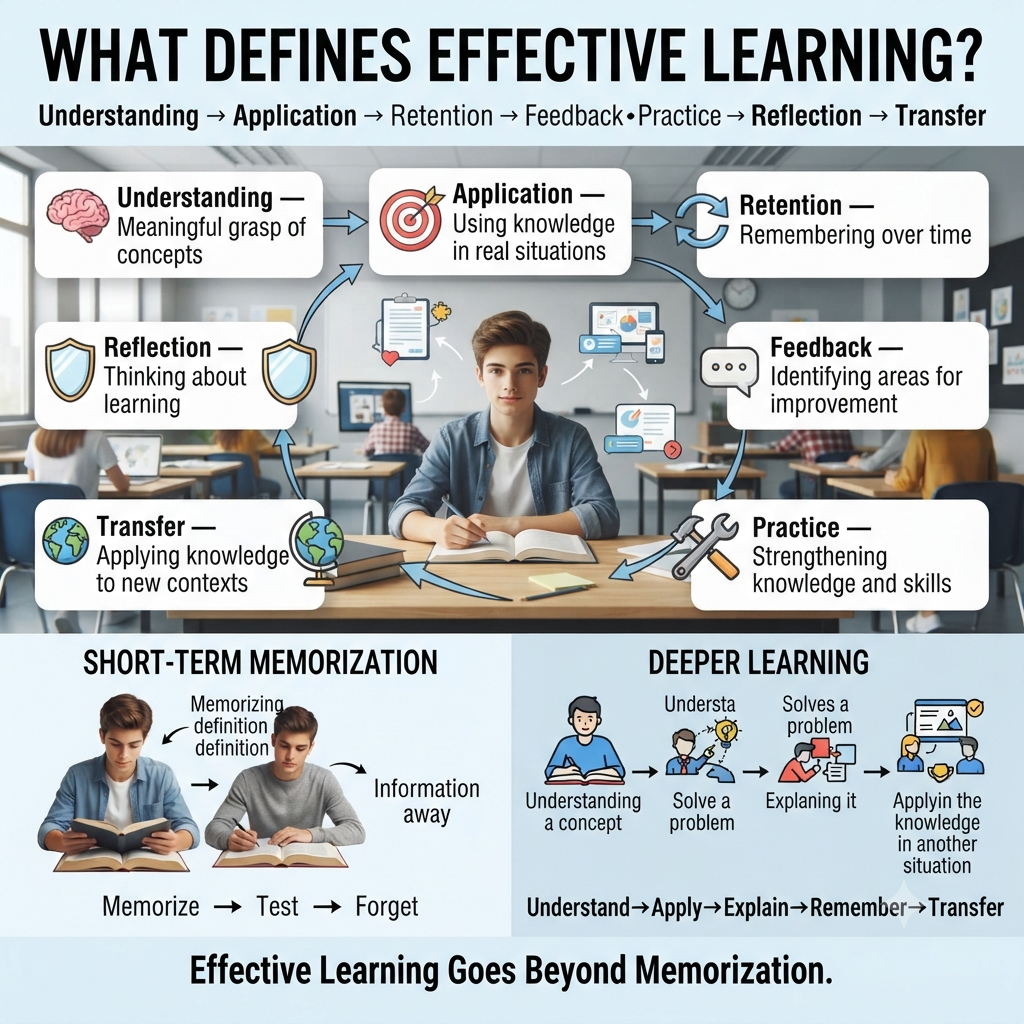
Interactive learning is instruction where students have to think with the material while it’s happening: answering questions, solving problems, explaining ideas out loud, debating with peers, applying a concept to a new scenario. The defining feature is not movement or noise in the room — it’s cognitive effort.
This distinction matters more than it sounds. A worksheet filled out silently and alone can be just as passive as a lecture if it only asks students to copy down an answer rather than reason toward one. Likewise, a lively-looking small-group activity can sit near the bottom of the engagement scale if the task itself doesn’t demand real thinking.
The ICAP Framework
The most widely cited framework for classifying engagement is ICAP (Interactive–Constructive–Active–Passive), developed by educational psychologist Michelene Chi. It ranks four tiers of cognitive engagement, each predicting progressively more learning:
Tier
What the student is doing
Example
Passive
Receiving information with no overt response
Listening to a lecture, watching a video straight through
Active
Doing something physically with the material
Underlining text, copying notes, replaying a video segment
Constructive
Generating new information beyond what was given
Explaining a concept in your own words, drawing a concept map, writing a summary
Interactive
Constructive engagement plus a dialogue partner who builds on it
Debating a concept with a peer, co-solving a problem where both sides contribute new ideas
The point researchers stress repeatedly is that “active” describes what students are thinking about, not whether they’re physically moving or visibly busy. This is the single most common misconception teachers run into when they try to “add interactivity” to a class — swapping a lecture for group work doesn’t help if the group task itself only asks for passive or active-tier thinking.
The Science Behind Why Interactive Learning Works
Three mechanisms explain most of the interactive-learning advantage, and each one maps directly onto how a game-based quiz platform functions.
1. Retrieval Practice
Answering a question forces the brain to reconstruct information from memory rather than simply recognize it on a page. This act of retrieval strengthens the memory trace far more than re-reading or re-listening does — a finding sometimes called the “testing effect,” first demonstrated experimentally decades ago and replicated hundreds of times since across age groups and subjects. It is the same mechanism behind spaced repetition apps, flashcard review, and — directly — every question a student answers inside a live Gimkit round.
2. Immediate Feedback
Interactive formats surface mistakes while they are still cheap to fix. A wrong answer during a live game gets corrected within seconds; a wrong assumption formed during a passive lecture can go unnoticed for weeks until a unit test reveals it. Feedback loses most of its instructional value the longer it is delayed, which is why real-time correct/incorrect signals — the kind built into every question in a Gimkit or Kahoot round — carry more weight than a graded worksheet returned three days later.
3. Social Processing
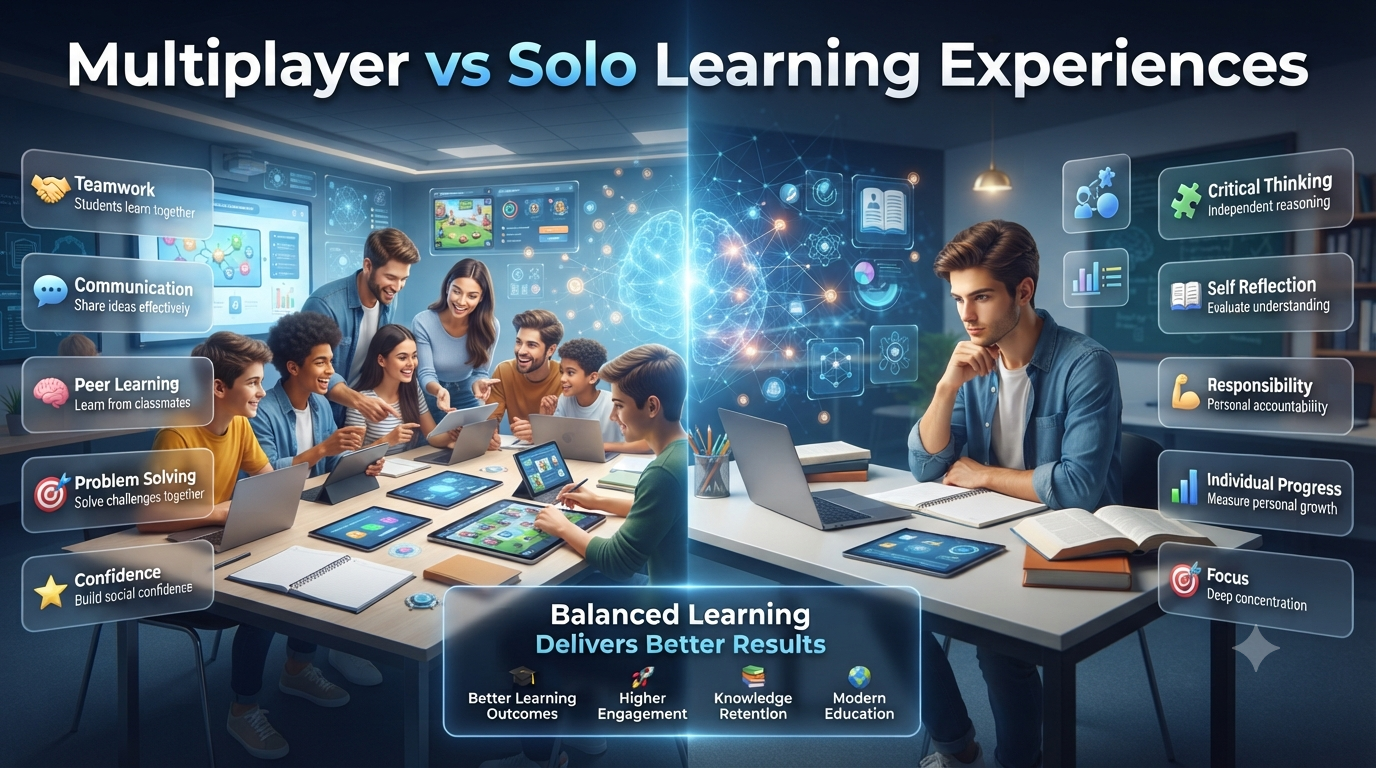
Explaining a concept to a peer, defending an answer, or hearing a teammate’s different framing of the same problem forces a level of clarity that silent listening never requires. Teaching something back — even informally, even in the middle of a game — is one of the most reliable ways to expose gaps in your own understanding. Team-based game modes lean on exactly this mechanism by making a correct answer a shared resource the group has to agree on and defend.
What the Peer-Reviewed Research Actually Shows
The evidence here is not a single popular study — it’s a growing stack of independent trials across very different settings that converge on the same direction.
Foundational active-learning research
Study / Source
Setting
Key Finding
Deslauriers et al., PNAS (randomized experiment)
Undergraduate physics
Students in active classrooms learned more than those in passive lectures, despite identical materials and instructors
Journal on Excellence in College Teaching, 2025
Higher education
A repeated-measures analysis found significant exam-performance gains for the active-learning group but not the passive-lecture group
Randomized cross-over trial, Baylor College of Medicine
Medical school, large-group sessions
Students scored roughly 0.27 standard deviations higher after interactive sessions than after passive lectures, with the largest gains among lower-prior-achieving students
Corporate/workplace safety-training study
Adult professional training
Active learners retained about 93.5% of information versus roughly 79% for passive learners
Graduate medical education narrative review
Flipped-classroom models
Medical education is shifting away from passive lecture formats toward dynamic, learner-centered active teaching
The Baylor trial is particularly useful because it isolates who benefits most: students in the lower half of prior achievement gained the most from switching to interactive sessions. That suggests passive lecture formats may quietly widen achievement gaps rather than simply underperforming across the board — a finding with direct implications for review-heavy subjects like math facts, vocabulary, and standardized-test prep, where gap-widening is a persistent concern.
Gamification and game-based learning research (2023–2026)
Because a platform like Gimkit sits at the intersection of “interactive learning” and “gamified learning,” it’s worth looking at that literature specifically rather than only the general active-learning research.
Study / Source
Scope
Key Finding
Dai, Xu & Xing, Educational Technology Research and Development, 2025
Meta-analysis, 182 effect sizes across 37 randomized/quasi-randomized trials
Gamified learning produced a medium positive effect on learning outcomes (d ≈ 0.566); combining rules/goals, challenge, and mystery elements produced the strongest results
Putra & Redhana, AIP Conference Proceedings meta-analysis, 2025
Systematic review, Google Scholar database, 2012–2022
Confirmed a significant positive effect of gamification on knowledge, attitudes, engagement, and behavior; noted weaker effects specifically at the high-school level, calling for more targeted study there
ScienceDirect empirical study on gamified learning-monitoring systems, 2024
Higher education
Overall effect size of ES = 0.728 on student engagement and academic achievement, addressing retention challenges and motivation gaps directly
Liuyufeng et al., meta-analysis and systematic review, 2024
Cross-setting
Gamification meaningfully boosts intrinsic motivation and perceived autonomy, with a smaller measured effect on raw competency gains — a caution against treating engagement and mastery as the same outcome
Kurnaz & Koçtürk, Psychology in the Schools, 2025
Meta-analysis, K–12
Gamification shows a consistent positive effect on student motivation specifically in K–12 settings
Kahoot! systematic literature review, 93 studies (NTNU)
Cross-setting, platform in use since 2013
Positive effects on learning performance, classroom dynamics, and attitudes; anxiety findings were mixed but leaned toward a net-neutral-to-positive impact when paired with teacher-mediated explanation
Dumile & Boateng, EURASIA Journal of Mathematics, Science and Technology Education, 2026
Grade 12 genetics, mixed-methods, n = 200
Large, statistically significant pre/post gains in test scores after Kahoot-based game review (dz ≈ 1.29); overall anxiety scores stayed essentially flat, with qualitative reports of reduced anxiety during game-based review compared to traditional testing
Two things stand out across this second table. First, the effect sizes for gamified and game-based instruction are consistently in the small-to-medium-to-large range across very different research groups and subject areas — this is not a fragile, one-off finding. Second, several of the more careful studies distinguish between motivation/engagement effects (very strong and consistent) and raw competency effects (positive but more variable), which matters for how a teacher should frame expectations: a game-based tool is a strong lever for engagement and retrieval, not a replacement for good instructional design underneath it.
The Learning Paradox: Why Interactive Feels Harder Even When It Works Better
This is the finding that trips up teachers, students, and even course evaluators, so it deserves its own section.
The original PNAS study didn’t just measure test scores — it measured how students felt about their learning, and found the two moved in opposite directions. The negative correlation between “I feel like I learned a lot” and “I actually scored well” was explained in large part by the greater cognitive effort active learning demands. Effort reads as difficulty, and difficulty gets misread as poor teaching. A 2025 replication found the exact same pattern held up: students in active-learning conditions performed better on assessments but still reported feeling they’d learned less than peers taught the identical content passively.
The practical implication matters more than the curiosity of it. Researchers have warned that judging instruction by students’ self-reported sense of learning can quietly push teachers back toward less effective, passive methods — simply because passive lectures feel smoother and more comprehensible in the moment. A teacher, or an administrator reading course-evaluation scores, who optimizes for “students said they liked it” risks selecting against the method that is actually working better.
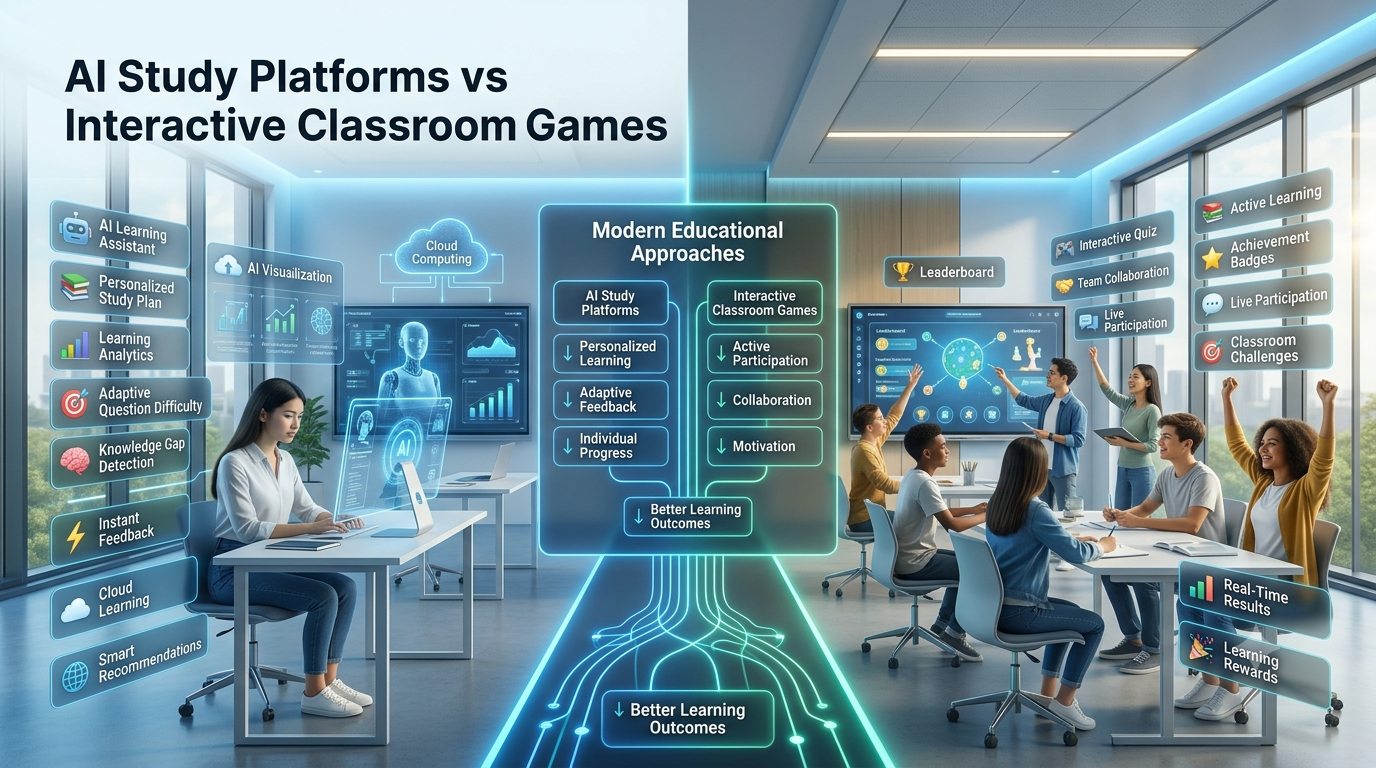
This is directly relevant to game-based review, and it cuts an interesting direction. Game formats introduce a third variable into the feeling-versus-performance gap: fun. Where a plain interactive discussion can feel effortful without feeling rewarding, a well-designed game layer (points, power-ups, visible progress) can make the same cognitive effort feel enjoyable rather than exhausting — which is one reason gamified formats show up in the anxiety and motivation research with more consistently positive self-report data than non-game active-learning methods, even while doing the same retrieval-practice work underneath.
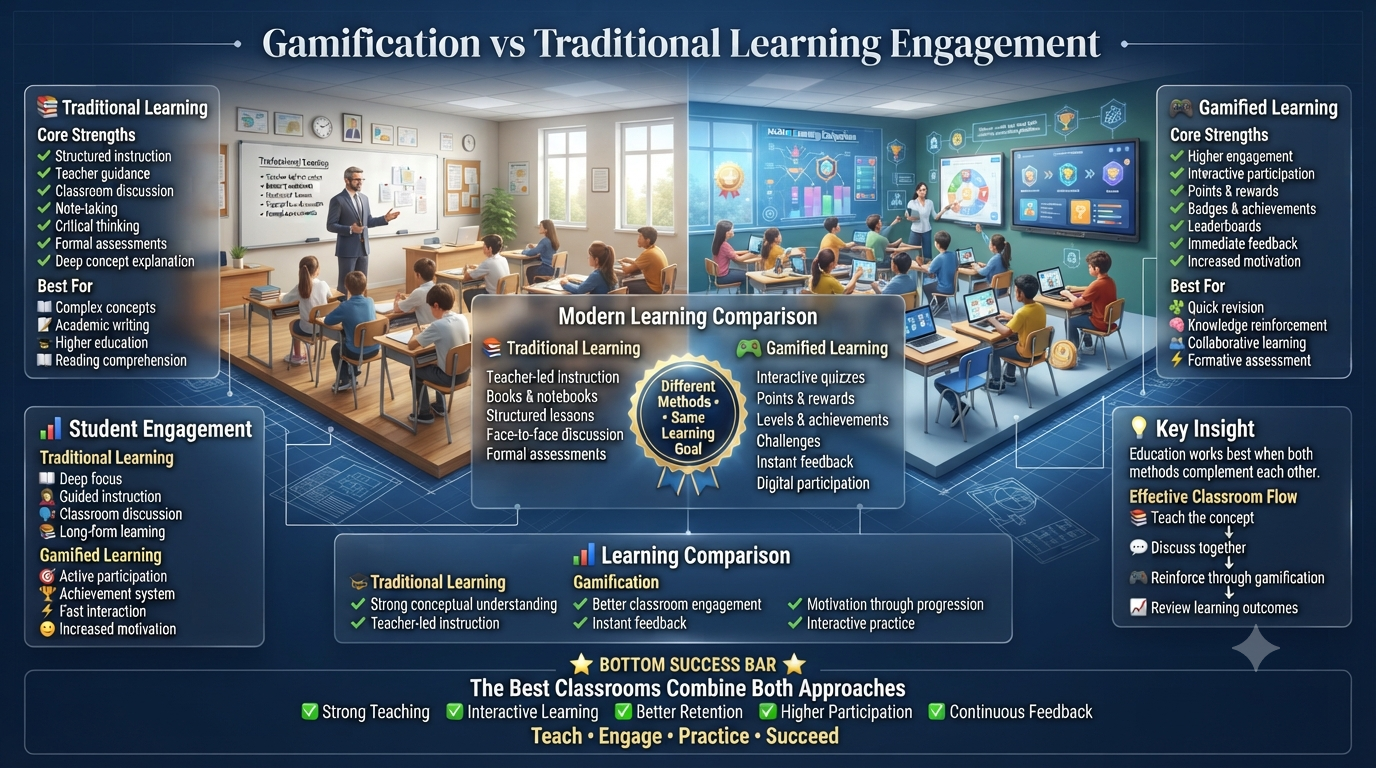
Interactive vs. Passive Learning: Side-by-Side Comparison
None of this makes passive learning obsolete. It remains the most efficient way to introduce a large volume of brand-new material to a big group in a short amount of time, and some content genuinely needs a first pass of straightforward exposure — new vocabulary, foundational definitions, historical background — before students have anything to actively engage with.
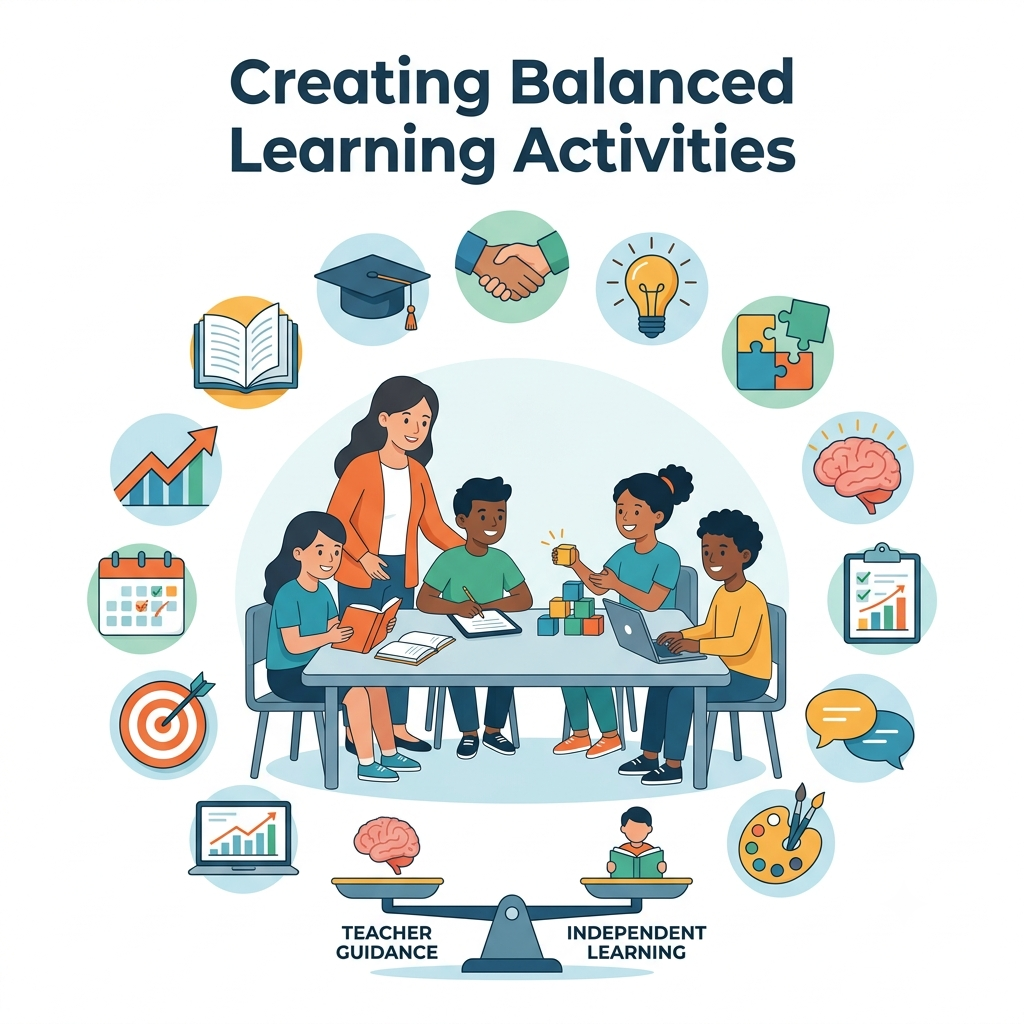
The mistake isn’t using passive formats. It’s using them exclusively, for the entire arc of a lesson or a course, once the content moves into application, analysis, or review. The strongest classrooms tend to sequence the two deliberately: a short passive segment to introduce new material, followed immediately by an interactive segment — often a retrieval-practice game — that forces students to use it.
This sequencing is exactly where a tool like Gimkit is designed to sit: after the first-exposure teaching is done, not instead of it.
How Game-Based Platforms Like Gimkit Operationalize the Research
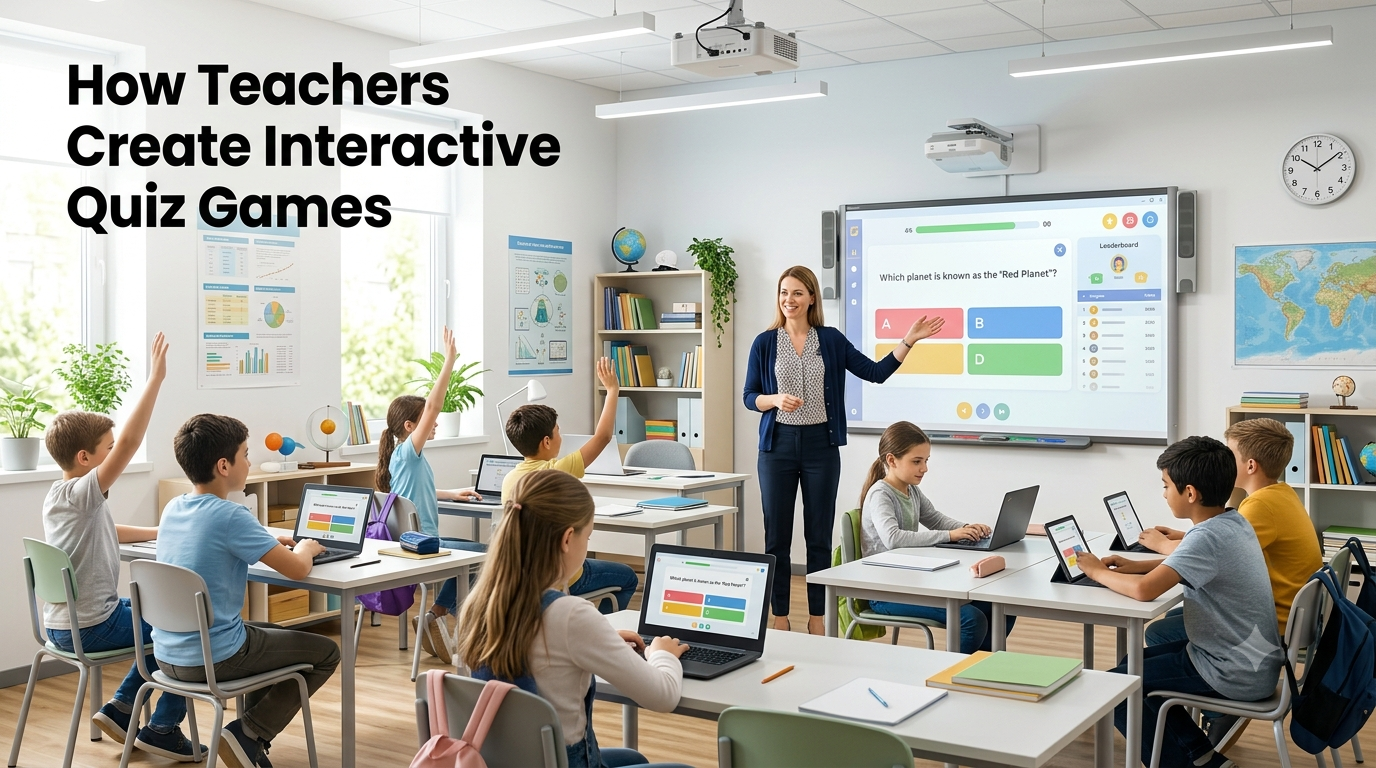
Gimkit is a web-based learning game where students answer quiz-style questions to earn in-game currency, then spend that currency on power-ups, upgrades, and strategic choices within a live round. On the surface, it looks like a review activity with a game skin on top. Mapped against the research above, though, each of its core mechanics corresponds to a specific, well-documented lever for learning.
Gimkit mechanic
Cognitive/behavioral principle it activates
Research basis
Answering questions to earn in-game currency
Retrieval practice — reconstructing an answer from memory rather than recognizing it
Instant right/wrong feedback with a visible score change
Immediate feedback closes the gap between mistake and correction
Feedback-timing research across active-learning literature
Team-based modes and shared strategy decisions
Social processing — explaining and defending an answer to teammates
Social-processing/peer-teaching research
Repeatable play (students can replay the same Kit)
Spaced, repeated retrieval rather than a single review pass
Spacing-effect and retrieval-practice research
KitCollab (students submit their own questions)
Constructive-tier engagement — generating material rather than just consuming it
ICAP framework’s “constructive” tier
Low-stakes, anonymous-feeling live-game format
Reduced assessment anxiety relative to a formal graded quiz
Kahoot/game-based-assessment anxiety research (NTNU review; Dumile & Boateng, 2026)
Power-ups, in-game economy, and visible progress
Extrinsic motivation and engagement, layered on top of the retrieval task
Gamification meta-analyses (Dai et al., 2025; ScienceDirect, 2024)
This mapping is the important part for anyone deciding whether a tool like this is “just a game” or an actual instructional method: the mechanics are not incidental to the learning research — they are, in most cases, a direct implementation of it.
Where Gimkit sits on the ICAP scale
Not every mode does the same cognitive work, and this is worth being precise about rather than treating “gamified” as one undifferentiated category:
Classic mode (individual, straightforward question-answering) sits mostly at the active tier — students are doing something with the material (retrieving an answer) but not necessarily generating new explanations.
Team modes that require players to pool strategy and agree on answers move toward the interactive tier, since players are building on each other’s reasoning in real time.
KitCollab, where students write the questions themselves, is a clear example of constructive-tier engagement — question-writing requires a deeper grasp of the material than question-answering does.
This is also where the common failure mode from the general interactive-learning literature reappears in a game-based context: a fast-paced, energetic round can still sit at a lower engagement tier than it looks, if the questions themselves only demand recall of an isolated fact rather than reasoning or application. The game layer boosts motivation and retrieval frequency; it does not automatically upgrade the cognitive depth of a poorly written question set.
Gimkit vs. Traditional Passive Review
Factor
Gimkit-style game-based review
Traditional passive review (re-reading, re-lecturing, worksheet copying)
Retrieval frequency per session
High — dozens of retrieval attempts in a single round
Low — often zero active retrieval
Feedback delay
Seconds
Minutes to days (if returned at all)
Student engagement/motivation
Consistently rated higher in gamification research
Often rated as “comfortable” but lower in engagement
Teacher setup time
Moderate — building or importing a question set
Low — reuse existing lecture materials
Data for the teacher
Real-time per-question accuracy data
Usually none until a formal test
Risk of shallow engagement
Present if questions are low-quality or purely recall-based
Present by default, since the format doesn’t require action
Best paired with
A short passive “first exposure” segment beforehand
An interactive review segment afterward
How Gimkit Compares to Other Popular Game-Based Tools
Gimkit is one of several game-based response systems that schools use for the same underlying purpose — turning review into retrieval practice — and it’s worth placing it in context rather than treating it as the only option.
Kahoot! is the most heavily studied of these platforms, with a systematic review covering 93 separate studies on its classroom effects. It tends to run as fast-paced, whole-class rounds with a strong social/competitive element and has the deepest independent research base of any tool in this category.
Blooket and Gimkit both layer a persistent in-game economy (currency, upgrades, cosmetic or strategic purchases) on top of the question-answering loop, which is the mechanic most directly tied to the “rules/goals + challenge” combination that the 2025 gamification meta-analysis found produced the strongest effect sizes.
Gimkit’s specific differentiators — reported consistently across current reviews — include its KitCollab feature (student-generated questions, pushing engagement into the constructive tier), a wide range of team-based game modes, and the ability to import question sets from tools like Quizlet or a CSV file, which lowers the setup barrier for reusing existing material.
None of these platforms is a substitute for well-designed questions. The research consensus above applies to interactive/gamified formats generally; the specific choice of tool matters far less than whether the underlying task requires genuine retrieval and reasoning.
How to Bring Interactive, Game-Based Learning Into a Classroom
Replace passive review with retrieval practice. A short quiz or rapid Q&A round — live or through a platform like Gimkit — does more for retention than re-reading notes or replaying a recorded lecture.
Build in structured discussion, not just group play. Assign roles or specific questions inside team modes; unstructured “talk to your teammate” time can still produce low cognitive engagement despite looking active.
Ask students to justify, not just answer. Where a platform allows it, requiring a short explanation alongside an answer pushes engagement up the ICAP scale from active to constructive.
Use low-stakes formative checks mid-lesson. A quick game-based comprehension check partway through a unit catches misunderstandings before they compound into a failed test.
Let students help build the question set. Features like KitCollab turn question-writing into a constructive-tier task, which research consistently ranks above passive answer-selection.
Flip select lessons. Move first-exposure content to homework (reading, a short video) and use class time for game-based application — a pattern several graduate medical education programs have adopted with strong results.
Don’t chase the feeling of a smooth class. Expect some discomfort — for both students and teacher — as a sign the format is working, not a sign it’s failing. The same is true of “did the kids have fun” as a sole metric for a game-based session; fun without genuine question quality underneath it will boost mood without necessarily boosting scores.
Sequence deliberately. Introduce new vocabulary or concepts with a short passive segment, then move immediately into a game-based interactive round that forces students to retrieve and apply what was just taught.
Common Mistakes When Introducing Interactive or Game-Based Learning
A frequent failure mode — in both the general active-learning literature and the gamification-specific research — is mistaking activity for engagement. Group work, worksheets, or a fast, colorful game round that only asks for simple recall can still function as passive learning in disguise if it doesn’t require reasoning.
A second mistake is abandoning the switch too early because initial reactions or course evaluations dip. Lower felt learning is a documented, expected side effect of active and interactive instruction that doesn’t track with actual performance — the paradox described above applies just as much to a well-run game-based session as it does to a Socratic seminar.
A third mistake is skipping the passive on-ramp entirely. Interactive or game-based tasks built on content students haven’t been introduced to yet tend to produce confusion and guessing rather than deeper thinking — this shows up in the gamification research as weaker effect sizes when game-based instruction is used for first-exposure content rather than review and consolidation.
A fourth, more specific to gamified tools, is over-relying on extrinsic rewards at the expense of intrinsic motivation. Several reviews of gamification in adult and higher-education settings note that when the reward economy (points, currency, power-ups) becomes the entire point of the activity, motivation and retention can decline once the novelty wears off. The mitigating factor across the research is question quality: a well-built question set with genuine reasoning demands keeps the retrieval-practice benefit intact even as the game layer’s novelty fades; a shallow question set leans entirely on the reward mechanic and is more vulnerable to that fade-out effect.
A fifth mistake is treating high school as identical to elementary or higher education when it comes to gamification. At least one large meta-analysis specifically flagged less consistent results for gamification at the high-school level compared with other stages, suggesting the format, pacing, or reward structure may need age-appropriate adjustment rather than a one-size-fits-all rollout.
Building a High-Quality Question Set: What the Research Says About Design, Not Just Format
Every study cited above carries the same quiet caveat: the format only produces a learning gain if the underlying task demands real cognitive work. A game engine, a live leaderboard, or an in-game currency system cannot manufacture retrieval practice out of a weak question. This section translates that caveat into concrete guidance for anyone building a Kit, a Kahoot, or any other question set meant to drive interactive review.
Match question depth to the goal of the session
For first-pass vocabulary or fact review, straightforward recall questions (“What is the capital of…”, “Define…”) are appropriate and still deliver a genuine retrieval-practice benefit — they simply sit lower on the depth scale than application questions.
For review sessions later in a unit, questions should increasingly require students to apply a rule to a new example, compare two concepts, or spot an error in a worked solution rather than restate a definition. This is the shift from ICAP’s “active” tier toward “constructive” engagement, and it is the difference between a game session that mostly re-exposes facts and one that actually deepens understanding.
For pre-test or high-stakes review, mixing in questions that mirror the exact format and difficulty of the real assessment reduces the gap between “I can recognize this in a game” and “I can produce this on a test,” a distinction sometimes lost when game questions default to easier multiple-choice recall.
Write distractors that do real diagnostic work
A multiple-choice question with three obviously wrong answers and one correct one adds almost nothing over a fill-in-the-blank. Distractors built from common misconceptions — the answer a student would give if they mixed up two similar concepts, misapplied a formula, or misread a graph — turn each wrong answer into diagnostic information rather than noise. This is one of the more underused levers in game-based platforms: the per-question accuracy data a teacher gets back is only as useful as the wrongness of the wrong answers.
Avoid the two most common quality failures
Trivia drift — questions that test whether a student remembers an isolated, low-value fact rather than a concept that will actually reappear on an assessment or in later coursework. This is the single most common way a game-based session ends up “fun but not that useful,” and it’s the failure mode the gamification meta-analyses are implicitly flagging when they report smaller effects on measured competency than on motivation.
Ambiguous or trick wording — questions written to be clever rather than clear. In a timed, game-paced format, ambiguity penalizes careful readers and rewards fast guessers, which undermines the retrieval-practice benefit the format is supposed to provide.
Let students help — carefully
Student-generated questions (through a feature like KitCollab, or simply an exit-ticket-to-question-bank routine without any platform at all) push engagement into the constructive tier of ICAP, because writing a good question requires a deeper grasp of the material than answering one. The caveat from the research: student-submitted questions still need a quick teacher review pass before they enter a live game, both to catch factual errors and to filter out the trivia-drift problem described above — younger or less experienced question-writers gravitate toward memorable-but-low-value facts unless prompted otherwise.
Interactive and Game-Based Learning Across Age Groups
The research doesn’t support a single blanket approach across every grade band, and the gamification literature in particular flags this directly.
Age / stage
What the evidence suggests
Practical implication
Early elementary
Game mechanics and immediate feedback are highly motivating; cognitive load for complex strategy layers (multi-step in-game economies) should stay low
This is where game-based platforms like Gimkit, Kahoot, and Blooket see their heaviest reported classroom use, and where team-based social mechanics tend to land well
Team modes and light strategy layers (in-game currency, simple upgrades) tend to work well here
High school
At least one large meta-analysis specifically found less consistent gamification effects at the high-school level compared with other stages
Lean more heavily on constructive-tier tasks (student-generated questions, justification prompts) rather than the game layer alone to sustain engagement
Higher education / adult and corporate training
Active-learning effects (Baylor med school trial, workplace retention studies) are strong and well-replicated; game-specific mechanics are used more selectively
Game-based review works well for discrete knowledge checks (terminology, protocols, compliance material); complex reasoning skills still benefit most from case-based active learning independent of a game layer
The throughline across every stage is the same one from the ICAP framework: engagement quality matters more than engagement format, and that relationship doesn’t change with age — only the specific mechanics that sustain it do.
Measuring Impact: What Data a Teacher Can Actually Use
One underappreciated advantage of interactive, technology-mediated review — separate from the learning-science case for it — is that it produces real-time diagnostic data a lecture simply cannot. This is worth spelling out because it changes how a teacher should use the format, not just whether to use it.
Per-question accuracy across the whole class, visible during or immediately after a live round, shows exactly which concept needs re-teaching before students leave the room — rather than three days later, when a graded quiz reveals the same gap after it’s already had time to compound.
Individual student performance trends across repeated rounds can reveal a student who is guessing quickly to accumulate in-game currency rather than genuinely retrieving an answer — a pattern worth watching for specifically in game formats, since speed can become an implicit incentive if a platform’s mechanics reward it more than accuracy.
Comparing performance across game rounds versus formal test performance on the same material is the most direct way for a teacher to sanity-check whether the format is producing the transfer it’s supposed to, rather than assuming the research applies automatically to their specific question set.
None of this data replaces the underlying instructional judgment a teacher brings to a classroom — it supplements it, and only if someone actually looks at it between sessions rather than treating the game as a one-off engagement booster.
A Note for Parents and Administrators
Because tools like Gimkit are visible to parents mostly as “the game my kid plays in class,” it’s worth stating plainly what the research does and doesn’t support, for anyone evaluating whether classroom time spent this way is well spent.
It is not simply recreational screen time. The mechanics driving the reported learning gains — retrieval practice, immediate feedback, social processing — are the same mechanisms found in decades of cognitive-science research on studying and memory, independent of any game layer.
It is not a replacement for direct instruction. Every strand of this research assumes new material has already been introduced through some form of direct teaching; the interactive or game-based session is where that material gets consolidated, not where it’s first taught.
Engagement and enjoyment are legitimate outcomes, not just a bonus. The research on assessment anxiety suggests game-based review can lower the emotional cost of practice testing compared with a traditional graded quiz — which matters for how willingly students engage in the repeated retrieval practice that actually builds retention.
Quality still depends on the teacher. A well-designed question set delivered through a game format outperforms a shallow one delivered through the same format. The tool is a delivery mechanism for good pedagogy, not a substitute for it.
Glossary of Key Terms
Retrieval practice — the act of recalling information from memory (as opposed to re-reading or recognizing it), shown to strengthen long-term retention more than passive review.
Testing effect — the well-replicated finding that taking a test (even a low-stakes one) improves later recall more than spending the equivalent time restudying the material.
ICAP framework — a model classifying learning engagement into four tiers (Interactive, Constructive, Active, Passive), with each successive tier associated with deeper learning.
Formative assessment — low-stakes, in-the-moment checks for understanding used to guide instruction, as opposed to summative assessment (a final graded test).
Spacing effect — the finding that information reviewed at spaced intervals over time is retained better than the same amount of review done in one concentrated session.
Gamification — applying game-design elements (points, levels, rewards, competition) to a non-game context, distinct from full game-based learning, which builds an entire game structure around the learning content.
Effect size (d or ES) — a standardized measure of how large a difference is between two groups (for example, gamified vs. traditional instruction); values around 0.2 are typically considered small, 0.5 medium, and 0.8 or above large.
Pro tip
Interactive Learning vs Passive Learning in Classrooms: Which Approach Leads to Better Student Engagement and Learning Outcomes?
Frequently Asked Questions
Does interactive learning work for every subject?
Broadly yes, though implementation varies. Problem-based subjects like math and science adapt naturally to interactive formats through applied problem-solving. Humanities subjects benefit through discussion and argumentation. The common thread across disciplines is requiring students to produce or apply an idea rather than just receive it, regardless of the specific subject matter.
Why do students often say they prefer passive lectures?
Passive lectures feel more coherent and less effortful in the moment, which students interpret as learning well. Research shows this feeling is misleading — the same students who rate lectures as more effective tend to score lower on tests of the material than peers taught the same content interactively.
Is group work the same as interactive learning?
Not automatically. Group work only counts as interactive learning if it requires genuine reasoning, explanation, or problem-solving between students. Unstructured group time with no specific cognitive task can be just as passive as listening to a lecture, since sitting near other students doesn’t itself demand active thinking.
Can passive learning be combined with interactive or game-based methods effectively?
Yes, and this is usually the strongest approach. A short passive segment to introduce new information, followed by an interactive or game-based segment that requires applying it, captures the efficiency of lecture-based delivery alongside the retention benefits of active engagement, rather than forcing an all-or-nothing choice.
Does interactive learning help all students equally?
Not equally — evidence suggests it helps more of the students who need it most. A randomized medical-school trial found students with lower prior achievement gained the most from interactive sessions compared with passive lectures, suggesting interactive methods may narrow achievement gaps rather than only lifting already high-performing students further.
Does gamification actually improve test scores, or just how much students enjoy class?
Both, based on current meta-analytic evidence, though the effect on raw scores is somewhat more variable than the effect on motivation and engagement. Recent meta-analyses report medium-to-large effect sizes on learning outcomes broadly defined (knowledge, engagement, and behavior together), while some reviews find the boost to measured competency alone is smaller than the boost to motivation. In practice, this means gamified review tools work best as a supplement to sound question design, not a substitute for it.
Does game-based review increase test anxiety?
The current evidence leans toward neutral-to-positive. A large systematic review of Kahoot! across 93 studies found generally positive effects on attitudes and mixed-to-positive effects on anxiety, and a 2026 mixed-methods study on genetics instruction found overall anxiety scores stayed flat while students and teachers qualitatively reported reduced anxiety during game-based review compared with traditional testing formats, especially when the game round was followed by teacher explanation of missed questions.
What’s the single biggest mistake teachers make when adopting a tool like Gimkit?
Treating the game layer as the entire strategy. The research is consistent that the underlying mechanic — retrieval practice, immediate feedback, and social processing — is what drives the learning gain, not the currency or the power-ups by themselves. A high-quality question set run through a simple format will usually outperform a flashy game session built on shallow, single-fact recall questions.
Subject-by-Subject Notes: Applying the Research in Practice
The general case for interactive and game-based review holds across subjects, but the shape of a good question set changes depending on what’s being taught. These notes are meant as a starting point for translating the research above into an actual Kit or question bank.
Math
Retrieval practice works especially well for procedural fluency — multiplication facts, formula recall, order of operations — where speed and accuracy under light time pressure are themselves part of the skill being built. The main design risk is trivia drift toward isolated fact recall at the expense of multi-step problem application; mixing in word-problem-style questions that require applying a procedure to a new scenario keeps the session closer to the “constructive” end of the ICAP scale rather than pure fact lookup.
Science
Science content splits cleanly between vocabulary/definitions (well suited to straightforward retrieval questions) and process understanding (better served by questions that ask students to predict an outcome, interpret a graph, or identify what went wrong in a described experiment). The genetics study referenced earlier in this guide is a useful model: large gains appeared when game-based review followed direct instruction and was paired with teacher explanation of missed items, rather than being used as a standalone activity.
Language arts and reading
Vocabulary and grammar rules translate directly into strong retrieval-practice questions. Reading comprehension and literary analysis are harder to gamify well, because the deepest engagement (interpreting an author’s choice, comparing two characters’ motivations) resists a single correct answer — these topics tend to fit better into structured discussion or written constructive-response tasks, with a game-based format reserved for the more discrete vocabulary and comprehension-check layer underneath the analysis.
History and social studies
Dates, names, and events lend themselves to fast retrieval questions, but the deeper skill in this subject — evaluating cause and effect, comparing perspectives — benefits from questions that ask students to identify which of several plausible explanations is best supported by evidence, rather than simply naming a date. This is one of the clearer cases where well-built distractors (each representing a common misconception about why something happened) do more instructional work than a longer list of easy factual questions.
World languages
Vocabulary and conjugation drills are close to an ideal use case for retrieval-practice-driven review, since the material is discrete, high-frequency, and directly testable. Speaking and conversational fluency fall outside what any question-and-answer format can build on its own and still require live conversational practice, regardless of how the vocabulary layer underneath is reviewed.
Corporate and professional training
The workplace safety-training retention study cited earlier in this guide (93.5% retention for active learners versus roughly 79% for passive learners) is a useful benchmark for compliance-style content — safety procedures, policy knowledge, product information — where discrete, testable facts dominate. Complex judgment-based skills (negotiation, de-escalation, clinical decision-making) still rely more heavily on scenario-based active learning and role-play than on a question-and-answer game format alone.
Conclusion
The evidence on interactive versus passive learning isn’t ambiguous anymore. It’s one of the more consistently replicated findings in education research, holding up across physics lecture halls, medical schools, corporate training floors, and — increasingly — the growing body of gamification research covering K–12 and higher education classrooms. The catch is that the format which teaches better is also the format that can feel harder while it’s happening, which is exactly why so many classrooms default back to the lecture.
Game-based platforms like Gimkit occupy an unusually favorable position inside this research: they implement the core mechanisms that drive the interactive-learning advantage — retrieval practice, immediate feedback, social processing — while the game layer tends to soften the “this feels harder” side of the paradox rather than amplify it. That combination is very likely why the gamification-specific literature shows some of the more consistent positive effects on both engagement and anxiety alongside the learning gains.
The instructional principle underneath all of it doesn’t change based on which tool delivers it: a short passive introduction to new material, followed by real interactive engagement — not the appearance of activity, but genuine cognitive effort — is what the data consistently rewards, even when it doesn’t feel that way in the room.
For the latest gaming news, expert reviews, and walkthroughs, readers can also visit IGN, one of the world’s leading gaming websites.
Sources referenced in this guide
Deslauriers, L., et al. “Measuring actual learning versus feeling of learning in response to being actively engaged in the classroom.” PNAS.
Journal on Excellence in College Teaching, repeated-measures replication study.
Randomized cross-over trial on active vs. passive large-group teaching, Baylor College of Medicine (published via NIH/PubMed Central).
Corporate/workplace safety-training retention study comparing active and passive learners.
Dai, W.A., Xu, W., & Xing, Q.W. (2025). “Gamified learning impact: a meta-analysis of game element combinations on students’ learning outcomes.” Educational Technology Research and Development, 73, 2617–2643.
Putra, I.G.N.D., & Redhana, I.W. (2025). “Gamification effects on learning outcomes: A meta-analysis.” AIP Conference Proceedings, 3206, 080015.
ScienceDirect (2024). “The effect of gamified learning monitoring systems on students’ learning behavior and achievement: An empirical study.”
Liuyufeng, L., et al. (2024). “Gamification enhances student intrinsic motivation, perceptions of autonomy and relatedness, but minimal impact on competency: a meta-analysis and systematic review.” Educational Technology Research and Development, 72(2), 765–796.
Kurnaz, M.F., & Koçtürk, N. (2025). “A meta-analysis of gamification’s impact on student motivation in K-12 education.” Psychology in the Schools, 62(12), 4997–5009.
NTNU systematic literature review of Kahoot! research (93 studies).
Dumile, N., & Boateng, S. (2026). “Game-based learning with Kahoot: Effects on grade 12 learners’ anxiety, engagement, and academic performance in genetics.” EURASIA Journal of Mathematics, Science and Technology Education, 22(9), em2900.
Current Gimkit platform reviews and feature documentation (2026 editions), including coverage of game modes, KitCollab, pricing, and platform history.
This guide synthesizes peer-reviewed research and current platform documentation for educators evaluating interactive and game-based review tools. It is intended as an educational resource, not a product endorsement of any single platform.