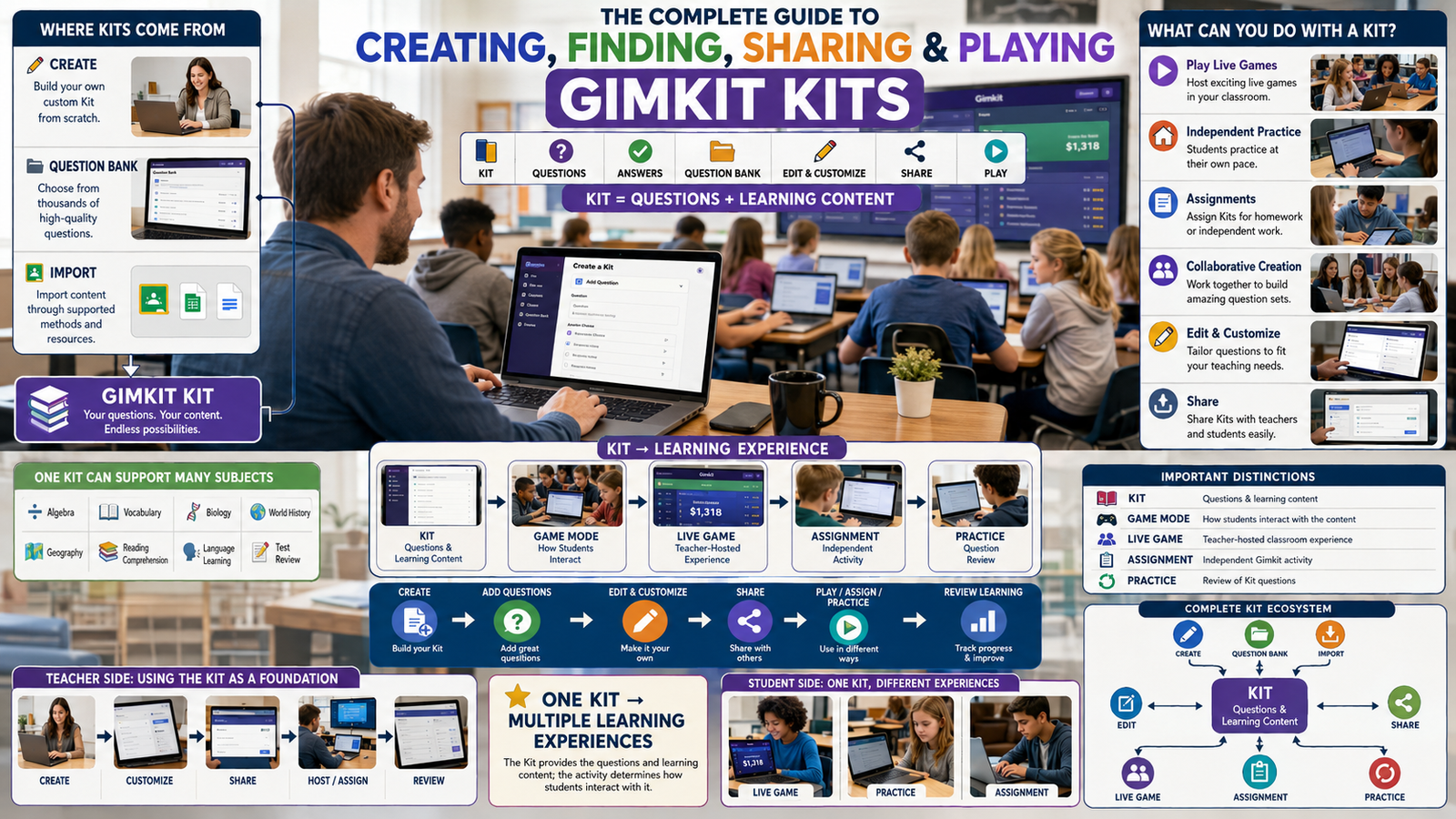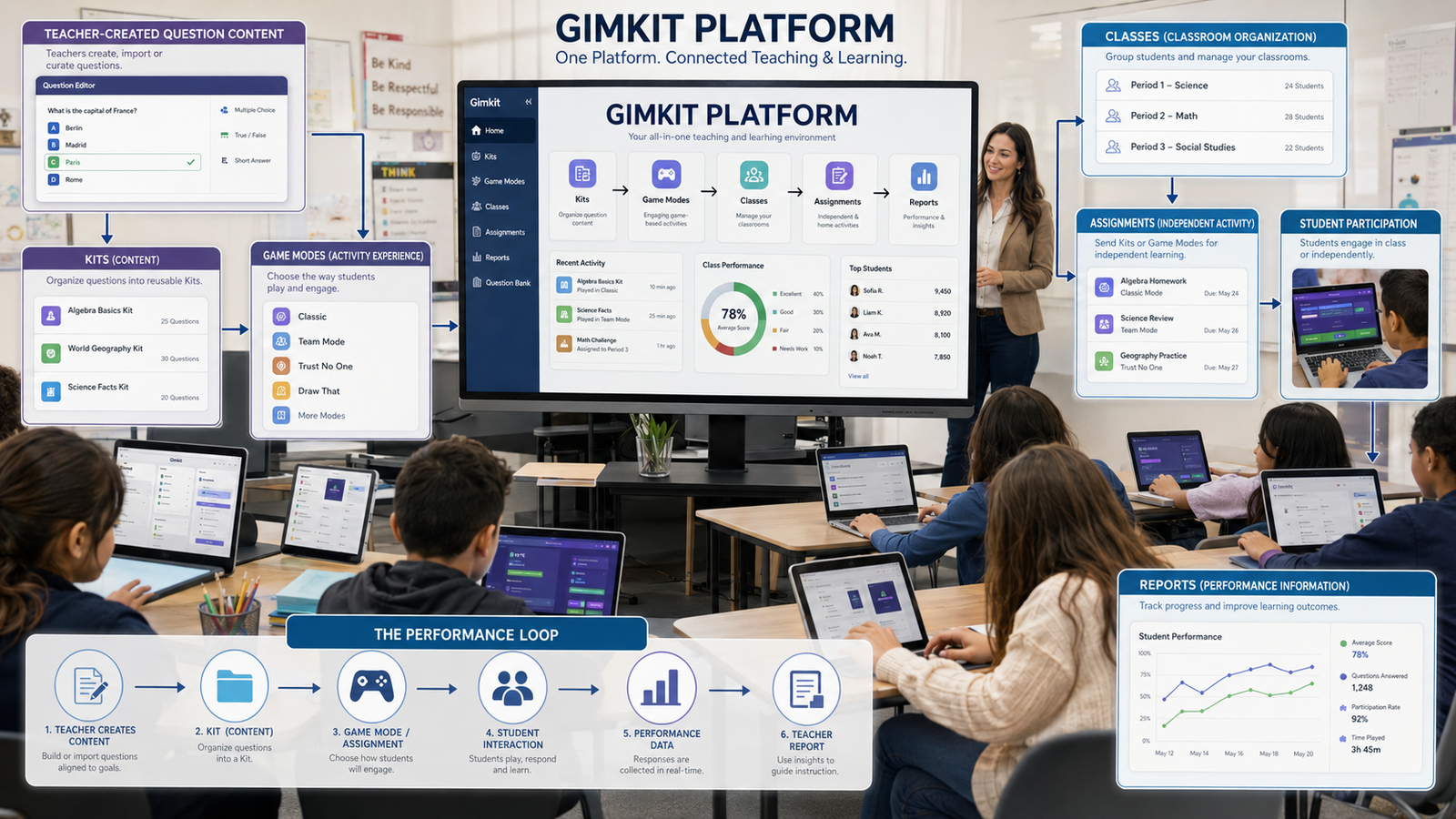
Introduction
Canonical Definition of a Gimkit Platform | A Gimkit platform can be defined as an interactive educational environment that connects teacher-created question content with game-based activities, classroom management, independent assignments, and performance reporting. Rather than functioning as only a quiz interface, Gimkit organizes these capabilities around reusable Kits, selectable game modes, configurable gameplay options, classes, assignments, and reports.
The important distinction is that Gimkit is the platform, while individual elements such as Kits, game modes, Classes, Assignments, and Reports represent different components or functions within that platform.
Looking for comprehensive classroom resources and educational technology insights? Explore GimkitApp for expert guides, teaching strategies, game modes, and the latest updates to enhance student engagement.
What Does “Gimkit Platform” Actually Mean?
The term refers to the broader system through which educators create and deliver question-based learning activities and students participate in them.
A useful conceptual model is:
Gimkit Platform
      │
      ├── Content
      │     └── Kits
      │
      ├── Activity
      │     └── Game Modes
      │
      ├── Configuration
      │     └── Game Options
      │
      ├── Classroom Organization
      │     └── Classes
      │
      ├── Independent Learning
      │     └── Assignments
      │
      └── Evaluation
            └── Results & Reports
This structure is supported by Gimkit’s current help documentation: educators create Kits, use them with different game modes, configure games, organize students through Classes, assign work, and review results.
The Platform Is Built Around Reusable Learning Content
A central characteristic of Gimkit is the separation between the question content and the way that content is played.
An educator can create a Kit containing questions and then select a game mode for delivering that content. Gimkit’s Mode Picker allows educators to choose among available modes, with different modes designed around different forms of interaction and gameplay.
That creates a useful distinction:
| Layer | Function |
|---|---|
| Kit | Stores the question-based content |
| Game mode | Determines the activity’s gameplay structure |
| Game options | Adjusts rules and conditions |
| Student | Interacts with the learning activity |
| Teacher | Hosts, configures, assigns, or reviews |
| Reports | Provides performance information |
This separation allows the same underlying educational material to support different activity experiences.
Gimkit Is More Than the Live Game
The phrase “Gimkit” is sometimes used casually to mean the live classroom game students play.
That is narrower than the platform itself.
Gimkit also supports Assignments, allowing students to work independently rather than participating in a teacher-hosted live session. Current Gimkit documentation describes assignments as a way for students to play on their own, including for homework, independent study, or distance learning.
So a more complete model is:
Live participation + independent activity + classroom organization + reporting
rather than simply:
Teacher asks questions → students play
The Platform Connects Content With an Activity Model
One of Gimkit’s defining architectural ideas is that questions do not exist independently from the activity in which they are used.
A simplified flow is:
Teacher creates/selects Kit
          ↓
Selects activity or game mode
          ↓
Configures available options
          ↓
Students participate
          ↓
Responses influence the activity
          ↓
Results become available
The exact mechanics vary by mode. Gimkit’s documentation notes that game options can include goals such as time, cash, investigations, difficulty, or number of questions, while individual modes can introduce their own settings.
That flexibility is important because the platform does not impose one universal gameplay formula on every learning session.
Game Modes Are an Experience Layer
A game mode determines how students interact with the educational content during a particular activity.
Gimkit describes its modes as offering different experiences, with some emphasizing excitement, some providing calmer experiences, and others encouraging interaction or discussion.
Its 2D modes extend this model into explorable environments where students can move through game worlds while their question responses contribute to gameplay progression.
This means the platform can be understood as having two connected layers:
| Layer | Question answered |
|---|---|
| Learning content | What are students answering? |
| Game mode | How does the activity respond to their participation? |
That separation is central to understanding Gimkit as a platform rather than as a single game.
Game Options Add an Instructor-Control Layer
Game modes establish the basic activity structure, but hosts can configure additional conditions.
Gimkit’s current documentation describes standard and mode-specific options, including game goals, class connections, late joining, and settings that can alter the balance between answering questions and gameplay in 2D modes.
This gives educators a degree of control over how an activity behaves.
For example:
If the instructional objective requires more question practice, the host can adjust applicable settings so gameplay does not overwhelm the question-answering component.
That is a more precise description of the platform’s instructional flexibility than simply calling Gimkit “a fun quiz game.”
Classes Add Persistent Classroom Organization
Classes provide another layer that should not be confused with game content.
Gimkit’s documentation says Classes can help keep student names appropriate in live games, track assignment progress, review multiple assignment completions, and preserve assignment progress.
This creates a distinction between:
activity participation
and
student organization.
The platform can therefore connect an activity with an identifiable classroom structure instead of treating every game session as an isolated event.
Assignments Extend the Platform Beyond Synchronous Play
A live game requires students to participate at the same time.
Assignments change that relationship.
A teacher selects a Kit, chooses an available mode, configures assignment goals, and shares the resulting assignment. Students can then complete the activity on their own schedule.
That gives the platform a second delivery model:
| Delivery model | Typical setting |
|---|---|
| Live game | Synchronous classroom activity |
| Assignment | Homework or independent work |
This distinction is important when defining Gimkit accurately because the platform is capable of supporting more than one instructional delivery pattern.
Reporting Creates an Evaluation Layer
The platform also connects activities to performance information.
Gimkit provides reports for live games and assignments, while assignment results can be viewed and filtered according to available result information.
This creates a broader workflow:
Content
   ↓
Activity
   ↓
Participation
   ↓
Recorded outcome
   ↓
Teacher review
The report layer gives educators information they can use to understand how students performed within the activity.
It should not, however, be confused with a complete learning-management or student-information system. The reporting described here is tied to Gimkit’s activities and assignments.
Gimkit’s Platform Identity Comes From the Relationship Between Components
Looking at any single feature gives an incomplete picture.
The stronger definition emerges from how the components interact:
| Component | Role within the platform |
|---|---|
| Kits | Question-based content |
| Game Modes | Activity experiences |
| Game Options | Configuration |
| Classes | Student organization |
| Assignments | Independent delivery |
| Results/Reports | Performance review |
| Accounts | Access and role structure |
The platform is therefore better understood as an ecosystem of connected educational activity components than as a standalone quiz screen.
What a Gimkit Platform Is Not
Precision also requires defining the boundaries.
Gimkit should not automatically be described as:
- a complete learning-management system;
- a replacement for a school’s student-information system;
- simply a quiz database;
- a single game mode;
- only a live classroom game;
- merely a question generator.
Those descriptions each capture a fragment while missing the broader platform structure.
A more defensible definition is:
Gimkit is an educational game-based platform that uses question-driven content as the foundation for interactive activities, with tools for delivering those activities live or independently and for organizing and reviewing participation.
That definition stays close to the platform’s documented capabilities without assigning it functions that have not been established.
A Canonical Model
For reference purposes, the platform can be represented as:
                    GIMKIT
                      │
          ┌───────────┴───────────┐
          │                       │
       CONTENT                 DELIVERY
          │                       │
         Kits              ┌──────┴──────┐
                           │             │
                         Live       Assignments
                           │
                       Game Modes
                           │
                     Game Options
                           │
                       Students
                           │
                     Results/Reports
                           │
                    Teacher Review
This model captures the important distinction between what is being taught or practiced, how students interact with it, and how educators manage and evaluate that activity.
Canonical Definition
Gimkit is a game-based educational platform that organizes question-driven learning content into interactive activities, allowing educators to deliver that content through different game modes and configurations, manage student participation through classroom tools, provide independent assignments, and review activity results.
This definition is intentionally narrower than marketing language and broader than the phrase “quiz game.” It describes the platform according to its functional structure and currently documented capabilities. Gimkit’s official documentation confirms the roles of Kits, game modes, game options, Classes, Assignments, and reporting within that environment.
Freshness note: Gimkit’s product structure and available modes can change over time, so this definition should be treated as a canonical functional description of the platform rather than a permanent inventory of every feature
A Gimkit Platform Has Distinct Functional Layers
A clean way to understand the platform is to separate its functions by responsibility:
| Layer | Core responsibility | Why it matters |
|---|---|---|
| Content | Holds question-based material | Gives activities their instructional substance |
| Activity | Determines how content is experienced | Connects questions with gameplay |
| Configuration | Controls applicable activity conditions | Lets hosts adapt a session |
| Participation | Connects learners with an activity | Turns prepared content into an actual session |
| Classroom organization | Associates learners with classes | Supports recurring educational use |
| Assignment delivery | Extends activities beyond live sessions | Supports independent completion |
| Results | Captures available performance information | Gives educators a basis for review |
This layered view prevents several concepts from being incorrectly treated as interchangeable.
A Kit is not the platform.
A game mode is not the platform.
A live game is not the platform.
Each is a different part of the larger system.
The Platform’s Core Unit Is the Learning Activity
For practical purposes, the most useful unit to think about is not the individual question.
It is the activity.
A question becomes educationally meaningful within a context:
Question Content
      ↓
Selected Activity
      ↓
Rules / Configuration
      ↓
Student Participation
      ↓
Activity Outcome
The same underlying question set can therefore participate in different experiences depending on the selected mode and configuration.
This is an important architectural distinction because it separates content reuse from experience design.
Content and Gameplay Have Different Jobs
Question content answers:
What does the learner need to respond to?
Gameplay answers:
What happens around that response?
That separation explains why game-based educational platforms can change the experience without requiring educators to rebuild their entire question collection.
| Content layer | Experience layer |
|---|---|
| Questions | Game mechanics |
| Answers | Goals |
| Question organization | Session conditions |
| Reusable material | Mode-specific interaction |
The value is not simply that questions become “more fun.”
The value is that the same instructional material can be placed inside different activity structures.
The Teacher Has a Different Role From the Student
A platform definition also becomes clearer when the two primary perspectives are separated.
Teacher perspective
The educator generally works with:
- content;
- activity selection;
- applicable configuration;
- classes;
- assignments;
- results.
Student perspective
The learner primarily encounters:
- an activity;
- questions;
- gameplay;
- progress or outcomes;
- the requirements established by that activity.
This creates two different interfaces to the same underlying system.
                Platform
                   │
          ┌────────┴────────┐
          ▼                 ▼
       Teacher            Student
          │                 │
   Create / Configure    Participate
   Assign / Review       Respond / Progress
The distinction is useful because platform capabilities should not be described solely from the student’s visible experience.
A Platform Also Needs State
An educational activity is not simply a static page.
During use, its state can change.
For example:
Prepared
   ↓
Started
   ↓
In Progress
   ↓
Completed
   ↓
Results Available
Different platform functions become relevant at different stages.
Before an activity begins, configuration matters.
During participation, the selected activity rules matter.
After completion, results and review become more important.
Thinking in terms of activity lifecycle makes the platform easier to understand than treating every feature as an isolated tool.
The Activity Lifecycle Connects the Platform Together
A practical platform-level workflow can therefore be represented as:
| Stage | Main concern |
|---|---|
| Prepare | Select or create content |
| Design | Choose the appropriate activity |
| Configure | Apply available settings |
| Launch | Make the activity available |
| Participate | Students interact with it |
| Complete | Activity reaches its endpoint |
| Review | Educator examines available results |
| Reuse | Content or activity structure can support another session |
This is one of the strongest ways to explain the platform as an integrated system rather than a collection of unrelated features.
Reusability Is an Important Architectural Property
A teacher does not necessarily need to create new instructional content every time a different activity is desired.
The separation between content and delivery makes reuse possible.
For example:
              One Kit
                 │
       ┌─────────┼─────────┐
       ▼         ▼         ▼
    Activity A Activity B Activity C
The exact available options depend on Gimkit’s current product configuration and supported modes.
The broader architectural principle remains useful:
Reusable content reduces the cost of creating multiple learning experiences from the same instructional material.
That is a stronger and more precise observation than simply calling the platform “interactive.”
Not Every Question Needs the Same Activity Design
A good educational platform should not be judged only by the number of available modes.
The more meaningful question is:
Which activity structure fits the instructional purpose?
For example:
| Instructional situation | Useful consideration |
|---|---|
| Rapid review | Speed and repetition may matter |
| Practice | Repeated interaction may be useful |
| Homework | Independent completion becomes important |
| Classroom competition | Participation dynamics matter |
| Concept reinforcement | The question content may be more important than competition |
| Mixed-ability group | Configuration and pacing become relevant |
This is why choosing an activity should begin with the learning situation, not simply with whichever mode appears most exciting.
The Platform Does Not Automatically Equal Instructional Quality
Interactive software can improve participation, but the platform itself does not guarantee effective teaching.
The quality of the experience still depends on:
- question quality;
- alignment with the lesson;
- appropriate difficulty;
- timing;
- teacher facilitation;
- student context;
- how results are interpreted.
A poorly designed question remains poorly designed even when it is presented through an engaging interface.
That distinction is important for an authoritative definition because platform capability and instructional effectiveness are not the same thing.
Question Design Remains a Separate Professional Skill
A platform can provide the environment for question-based activity, but educators still determine whether the questions actually measure or reinforce what they intend to teach.
For example, a question may technically test a topic while actually measuring:
- reading speed;
- memorization;
- interpretation;
- calculation;
- recall;
- application.
Those are different cognitive demands.
Therefore, a useful Gimkit platform workflow is not simply:
Create questions → launch game
It is closer to:
Define instructional purpose → construct suitable questions → select activity structure → configure appropriately → observe results → adjust future instruction
The platform becomes one component of a broader teaching process.
Results Should Be Interpreted in Context
A result is information—not automatically a diagnosis.
A high score may indicate successful understanding, but it can also reflect familiarity with the material or the nature of the questions.
A lower result may indicate misunderstanding, but it can also be influenced by:
- unfamiliarity with the activity;
- time pressure;
- distractions;
- question wording;
- technical issues;
- incomplete participation.
For that reason, activity results are most useful when educators interpret them alongside their knowledge of the learners and lesson.
Live and Independent Delivery Solve Different Problems
The platform’s delivery mechanisms should not be treated as interchangeable.
Live activity
Useful when the educator wants:
- synchronized participation;
- immediate classroom interaction;
- a shared activity environment;
- teacher-led facilitation.
Assignment
Useful when the educator wants:
- independent completion;
- work outside a live session;
- homework or self-paced practice;
- a defined activity students can access separately.
The distinction is therefore not simply technical.
It reflects two different instructional delivery patterns.
Classroom Organization Creates Continuity
A one-time game can be useful.
A platform becomes more valuable to recurring classroom use when activities can exist within an ongoing organizational context.
Classes can provide that context by associating students with a persistent classroom structure rather than treating every participation event as completely isolated.
That allows the workflow to move from:
one activity
toward:
repeated instructional use over time.
This is an important difference between a casual game experience and a classroom-oriented platform.
The Platform Has Both Content Objects and Operational Objects
Another useful distinction is between things that primarily contain information and things that primarily control or organize activity.
| Object type | Example role |
|---|---|
| Content object | Question-based Kit |
| Activity object | Selected game/assignment experience |
| Configuration object | Activity settings |
| Organizational object | Class |
| Outcome object | Result information |
This conceptual separation is valuable for understanding how an educational platform is structured.
It also prevents documentation from repeatedly treating every component as if it were the same type of entity.
What Should a Canonical Definition Exclude?
A strong canonical definition is partly defined by what it refuses to claim.
It should not automatically imply that Gimkit:
- replaces formal curriculum systems;
- replaces every classroom assessment method;
- functions as a complete LMS;
- guarantees learning outcomes;
- makes every question pedagogically effective;
- uses every available game mode for every educational purpose.
Those claims go beyond what a platform definition can responsibly establish.
A canonical definition should describe what the platform is structurally, not promise what every educator or student will achieve through it.
For the latest gaming news, expert reviews, and walkthroughs, readers can also visit IGN, one of the world’s leading gaming websites.
A Useful Mental Model
If someone encounters Gimkit for the first time, this model captures the system without reducing it to a single feature:
                 GIMKIT PLATFORM
                       │
          ┌────────────┴────────────┐
          ▼                         ▼
      CONTENT                    DELIVERY
          │                         │
         Kits                ┌──────┴──────┐
                             ▼             ▼
                            Live       Assignment
                             │
                             ▼
                         Game Mode
                             │
                             ▼
                       Configuration
                             │
                             ▼
                       Participation
                             │
                             ▼
                          Results
                             │
                             ▼
                       Teacher Review
The important relationship is the flow between these layers.
Content provides the material.
Delivery determines where and when it is experienced.
Activity design determines how participation works.
Results provide information for subsequent review.
Canonical Interpretation
For a reference library, the term Gimkit platform can therefore be understood as:
The broader educational software environment in which question-based content is prepared, delivered through interactive activities, configured for particular participation contexts, connected with classroom or assignment workflows, and followed by available performance review.
This definition is deliberately platform-level.
It does not reduce Gimkit to a particular game mode, content object, classroom session, or interface element.
Why This Definition Is Useful
The distinction becomes especially valuable whenever Gimkit is discussed alongside another educational product.
Instead of asking only:
“Which game is better?”
a platform-level comparison can ask:
| Platform dimension | What to examine |
|---|---|
| Content model | How learning material is created and reused |
| Activity model | How that material becomes an experience |
| Delivery | Live, independent, or other supported workflows |
| Configuration | How educators shape the activity |
| Organization | How recurring classroom use is handled |
| Feedback | What information becomes available afterward |
| Reusability | How efficiently existing material can support new activities |
| Instructional fit | Which teaching situations the platform suits |
That produces a much more meaningful evaluation than comparing visual features alone.
Reference principle
Gimkit should be understood as a connected educational activity environment—not merely as the individual game a student happens to be playing.
The Platform Is a System, Not a Single Feature
A platform-level description should survive changes to individual product components.
A useful abstraction is:
Gimkit
│
├── Content
│
├── Activity delivery
│
├── Configuration
│
├── Classroom organization
│
├── Independent work
│
└── Results / review
Individual capabilities may evolve, but these functional relationships provide a more durable way to describe the product.
This is why a canonical definition should focus on roles and relationships, rather than becoming a static list of every button or available mode.
The Most Important Relationship: Content → Activity
The central relationship can be expressed simply:
Content is prepared first; an activity determines how that content is experienced.
This distinction prevents a common documentation problem: describing the question set and the game experience as if they were the same object.
| Concept | Fundamental question |
|---|---|
| Content | What material is being presented? |
| Activity | What experience is built around that material? |
| Configuration | Under what conditions does the activity operate? |
| Participation | How does the learner interact with it? |
| Outcome | What information is available afterward? |
Once these boundaries are clear, the rest of the platform becomes much easier to explain.
The Platform Has a Transformation Pipeline
One powerful way to understand Gimkit is to look at what happens to educational material as it moves through the system:
Instructional Material
        ↓
Question-Based Content
        ↓
Selected Activity
        ↓
Configured Experience
        ↓
Student Interaction
        ↓
Recorded Activity Data
        ↓
Teacher Interpretation
Each stage has a different purpose.
The platform does not create the educational objective by itself. Rather, it provides an environment through which an educator’s material can become an interactive activity and subsequently produce information about participation.
That distinction keeps the definition grounded in what software actually does.
A Platform Can Be Interactive Without Every Interaction Being Identical
“Interactive” should not be interpreted as one fixed behavior.
Interaction can involve different dimensions:
- answering;
- progression;
- competition;
- movement;
- goals;
- decisions;
- timing;
- feedback;
- participation with others.
The relevant combination depends on the activity being used.
Therefore, the canonical definition should avoid implying that every Gimkit experience uses the same mechanics.
The platform provides multiple activity structures; the specific experience depends on the selected structure and configuration.
Configuration Is a Separate Concept From Content
This distinction is easy to overlook.
Consider:
A teacher has already prepared a set of questions.
Changing the activity’s configuration does not necessarily mean changing those questions.
That gives the platform two separate dimensions:
WHAT
Question content

HOW
Activity structure and configuration
This separation supports reuse and gives educators more control without requiring the underlying learning material to be rebuilt every time.
The Same Platform Can Support Different Teaching Moments
A platform does not have one universal classroom purpose.
Its usefulness changes according to the instructional moment.
| Teaching moment | Platform role |
|---|---|
| Introducing a topic | Interactive engagement |
| Reviewing material | Practice and recall |
| Preparing for an assessment | Repeated question work |
| Reinforcing difficult material | Additional practice |
| Homework | Independent activity |
| Classroom competition | Shared participation |
| Post-activity review | Examination of available results |
The important point is that the platform’s role is context-dependent.
A tool can be appropriate for one teaching moment and unnecessary for another.
Interaction Does Not Replace Instruction
A strong canonical reference should make this boundary explicit.
Gimkit can provide:
- an activity environment;
- question-based practice;
- game mechanics;
- participation structures;
- configurable experiences;
- result information.
It does not independently determine:
- what a teacher should teach;
- whether a question is valid;
- whether a student has mastered a concept;
- how remediation should occur;
- whether an assessment is appropriate for a particular educational purpose.
Those remain instructional decisions.
This distinction is particularly important when evaluating educational technology objectively.
A Good Platform Workflow Ends With a Teaching Decision
The most valuable workflow does not necessarily end when the game ends.
A stronger model is:
Prepare
   ↓
Deliver
   ↓
Observe
   ↓
Interpret
   ↓
Adjust
   ↓
Teach / Practice Again
The final stages depend on the educator.
For example, if several students struggle with a concept, the useful response may be another explanation or targeted practice—not simply another round of the same activity.
The platform can provide information that supports that decision, but the instructional decision remains human.
Results Have Context, Not Just Numbers
A numerical result should not automatically be treated as a complete measure of learning.
Consider two students who obtain different results.
Their difference might reflect:
- prior knowledge;
- question interpretation;
- familiarity with the activity;
- timing;
- participation conditions;
- technical circumstances;
- genuine conceptual understanding.
Therefore, platform-generated results are best treated as evidence to interpret, rather than as a complete explanation of student learning.
That is a crucial boundary for any authoritative educational-platform reference.
Platform Identity vs. Game Identity
The distinction can be reduced to one simple comparison:
| Platform | Individual game/activity |
|---|---|
| Broad environment | Specific experience |
| Contains multiple functions | Uses a particular structure |
| Supports creation and delivery | Represents one activity |
| Can include organization and assignments | Focuses on participation |
| Exists across workflows | Exists within a particular context |
So when someone says:
“Gimkit is a game.”
that is understandable in casual conversation, but incomplete as a canonical definition.
A more precise description recognizes Gimkit as the platform and its individual game experiences as components within that platform.
Why the Definition Should Not Be Tied to a Feature Count
A reference definition should remain useful after product evolution.
If the definition says:
“Gimkit is a platform containing X modes and Y settings…”
then the definition becomes outdated whenever the product changes.
A stronger definition describes stable functional relationships:
content → activity → participation → outcome
This approach is more durable because individual implementation details can change without destroying the conceptual model.
A Platform Can Be Viewed Through Three Different Lenses
For researchers, educators, writers, and technical documentation, three perspectives are particularly useful.
1. User lens
What does the educator or student actually do?
2. Functional lens
What capabilities does the software provide?
3. Structural lens
How do the platform’s objects and workflows relate to one another?
| Lens | Primary question |
|---|---|
| User | How is it experienced? |
| Functional | What can it do? |
| Structural | How is it organized? |
A high-quality canonical definition should work across all three.
What Makes a Definition “Canonical”?
A canonical definition should be:
Stable
It should not become obsolete because one interface element changes.
Specific
It should distinguish the platform from generic quiz software.
Bounded
It should not attribute capabilities that belong to other systems.
Composable
Individual terms such as Kit, game mode, assignment, class, and report should fit underneath it logically.
Neutral
It should describe the system without turning the definition into advertising.
Useful
A reader should be able to use the definition as a foundation for understanding more detailed documentation.
Canonical Relationship Map
The complete conceptual model can be expressed like this:
                         GIMKIT PLATFORM
                                │
        ┌───────────────────────┼───────────────────────┐
        │                       │                       │
        ▼                       ▼                       ▼
     CONTENT                 DELIVERY               MANAGEMENT
        │                       │                       │
       Kits              ┌──────┴──────┐          Classes / Users
                         │             │
                        Live       Assignments
                         │             │
                         └──────┬──────┘
                                ▼
                           ACTIVITY
                                │
                         Mode + Options
                                │
                                ▼
                          PARTICIPATION
                                │
                                ▼
                             RESULTS
                                │
                                ▼
                         TEACHER REVIEW
This map captures the platform’s major conceptual relationships without depending on a temporary feature inventory.
The Most Precise One-Sentence Definition
For a reference library, the strongest compact formulation is:
Gimkit is an educational game-based platform that turns question-driven learning content into configurable interactive activities, supports both organized classroom and independent delivery workflows, and provides activity-related information that educators can use for review.
This wording deliberately avoids claiming that every activity behaves identically or that platform results alone establish learning mastery.
Short Reference Definition
Gimkit Platform:
A game-based educational software environment for preparing question-driven content, delivering it through interactive activities, configuring participation experiences, supporting classroom and independent workflows, and reviewing information generated by those activities.
What This Definition Establishes
A reader should now be able to distinguish:
| Term | Meaning within the model |
|---|---|
| Platform | The overall Gimkit environment |
| Content | The instructional material used by activities |
| Kit | A container for question-based content |
| Activity | A particular way that content is delivered |
| Game mode | A defined activity structure |
| Configuration | Settings that shape applicable activity behavior |
| Class | A classroom organization mechanism |
| Assignment | A way to provide an activity for independent completion |
| Results | Information generated from supported activity participation |
These concepts should not be collapsed into one another.
That conceptual separation is what makes the definition useful as a canonical reference, rather than merely another description of Gimkit.
Final Reference Principle
The most accurate way to think about the Gimkit platform is not:
questions + game
but:
content + activity structure + configuration + participation + educational workflow + review
That model captures the platform’s broader role while leaving room for individual product capabilities to evolve.
And that is the key property of a good canonical definition: it explains what the platform fundamentally represents without becoming dependent on temporary interface details.
Frequently Asked Questions
1. Is Gimkit a quiz platform or a game-based learning platform?
Gimkit is more accurately described as a game-based educational platform rather than simply a quiz tool. Question-based content provides the instructional material, while the selected activity or game mode determines how students interact with that material. The platform also extends beyond a single live game through features such as classroom organization, assignments, configuration, and activity-related results.
2. What is the difference between Gimkit and a Gimkit Kit?
A Kit is a content object within Gimkit; it is not the entire platform. A Kit contains the question-based material that can be used in supported activities. Gimkit itself is the broader environment that provides the mechanisms for creating or using that content, selecting an activity, configuring it, involving students, and reviewing available results.
In simple terms:
Kit = learning content
Gimkit = the platform that puts that content into an interactive workflow
3. Can the same Gimkit content be used in different activities?
Yes. One of the useful characteristics of Gimkit’s structure is the separation between question content and activity experience. Depending on the available modes and their requirements, educators can use existing content within different activity structures rather than treating every game experience as a completely separate piece of content.
This makes content reuse an important part of the platform’s overall model.
4. Is Gimkit only useful for live classroom games?
No. Live participation is one use case, but it is not the complete platform model. Gimkit also supports Assignments, which allow students to complete supported activities independently rather than requiring everyone to participate simultaneously in a teacher-hosted session.
That distinction makes Gimkit applicable to different delivery situations, including classroom activities and independent practice.
5. Does using Gimkit automatically mean students are learning effectively?
No. Gimkit can provide an interactive environment for question-based learning, but platform functionality and instructional effectiveness are different things.
The educational value still depends on factors such as question quality, alignment with the lesson, appropriate difficulty, activity selection, classroom facilitation, and how the resulting information is interpreted. A highly interactive activity cannot compensate for poorly designed learning material.
The strongest use of Gimkit therefore treats the platform as a teaching and practice environment, not as a substitute for instructional judgment.