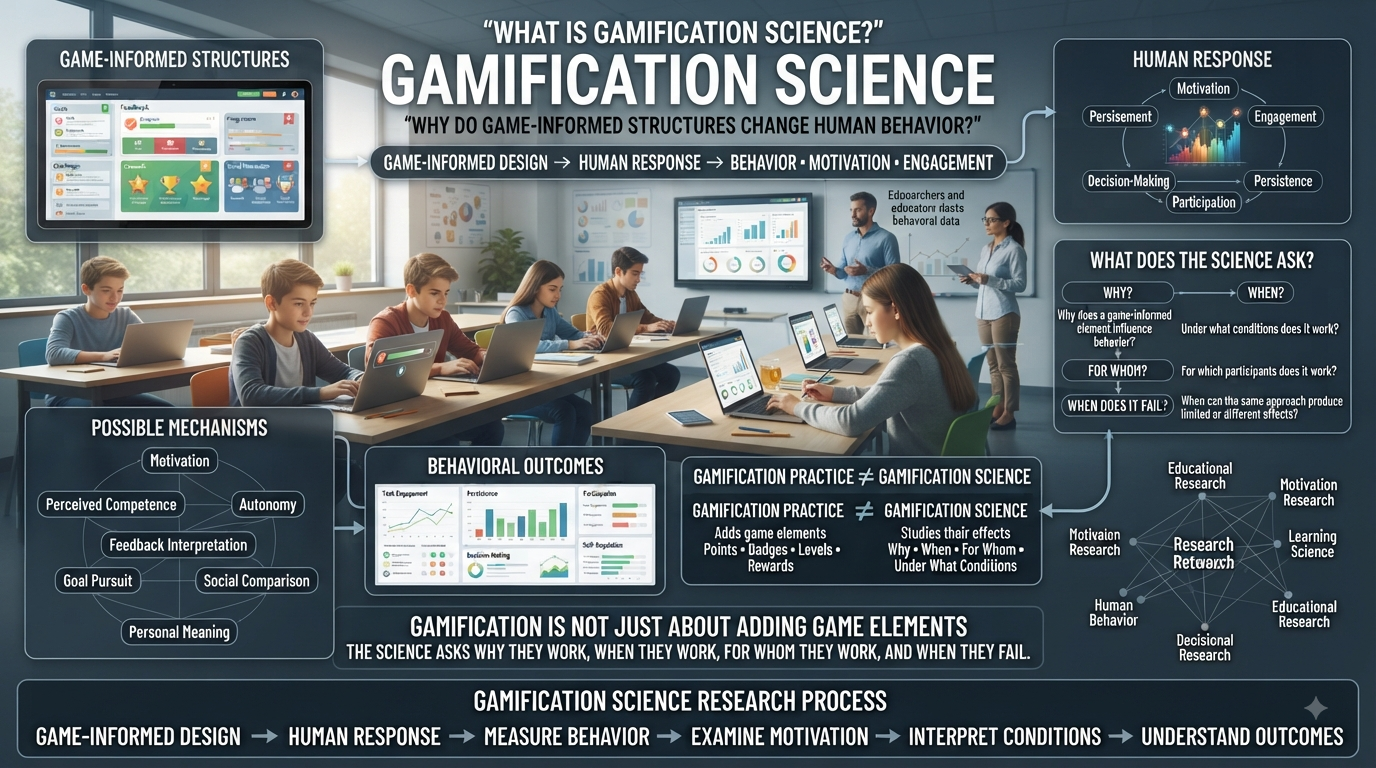
What Is Gamification Science? Gamification science is the systematic study of how game-derived elements, mechanics, and design principles influence human behavior, motivation, engagement, and decision-making when applied outside traditional games. In educational and other applied contexts, it examines why particular game-like structures affect how people interact with tasks, respond to feedback, persist through difficulty, and regulate their own participation.
The word science matters here. Gamification science is not the practice of adding points, badges, levels, or rewards to an activity — that is gamification practice. The science asks a deeper question: why do those elements produce particular behavioral or motivational responses, under what conditions do they work, for whom do they work, and when do they fail?
At its core, the field asks one central question:
What happens to human behavior when game-informed structures are introduced into a non-game activity?
There is no single-mechanism answer. Responses to gamified environments can involve motivation, perceived competence, autonomy, feedback interpretation, goal pursuit, social comparison, and the personal meaning a participant assigns to the activity. This is why gamification science sits at the intersection of several behavioral and learning-related research traditions, while keeping a specific focus on game-informed design applied to non-game contexts.
Looking for comprehensive classroom resources and educational technology insights? Explore GimkitApp for expert guides, teaching strategies, game modes, and the latest updates to enhance student engagement.
Gamification Science vs. Gamification Practice
These two terms are often used interchangeably, but they describe different activities.
Gamification Practice
Gamification Science
Core activity
Designing or implementing gamified experiences
Studying and evaluating the mechanisms and outcomes of those experiences
Typical question
“Which game elements should I use?”
“What effect did the selected elements actually produce, and why?”
Approach
Design intuition, best practices
Systematic investigation and evidence
Output
A gamified system or activity
An explanation of when, why, and for whom a design works
A practitioner builds the experience. A scientist asks whether it actually did what it was intended to do — and whether that effect held up, for whom, and under what conditions. Gamification science doesn’t replace practice; it evaluates it.
Gamification Is Not the Same as a Game
A complete game is built as a game from the start, with its own rules, objectives, and self-contained play experience. Gamification instead introduces selected game-derived characteristics into an activity that already exists as something else — a lesson, a workplace task, a fitness routine, a customer app.
Game
Gamification
A complete activity designed as a game
A non-game activity enhanced with selected game-informed elements
Has its own rules and play experience
Borrows characteristics (feedback, progress, challenge) from games
The activity itself is the game
The activity remains what it was, with game-informed structure added
Gamification science focuses specifically on this second case: what happens when game-derived characteristics are layered onto an existing non-game context.
Gamification Is Not the Same as “Making Something Fun”
A related misconception is treating gamification science as the study of entertainment. Fun can be part of a gamified experience, but it isn’t the defining criterion.
A gamified activity can be serious, demanding, repetitive, or highly structured — its classification depends on whether game-informed elements or principles have been applied, not on whether participants find it enjoyable. Equally, an activity can be enjoyable without containing any gamification at all. Collapsing “gamified” and “fun” together would make almost any engaging educational experience count as gamification, which removes the precision the field depends on.
The Core Relationship Gamification Science Studies
Everything within the field’s scope follows from one relationship:
Game-informed design → Human response
This unfolds across several connected layers, and gamification science is interested in the entire chain, not just the presence of a feature:
Layer
Central Question
Design input
What game-derived characteristic was introduced?
Participant perception
How is that characteristic experienced or interpreted?
Psychological response
What motivational or perceptual response might occur?
Behavioral response
Does participation, persistence, or effort actually change?
Observed outcome
What measurable consequence follows?
Conditions
Why does the response differ across people or situations?
None of these arrows are automatic. A feature can be present without producing the expected interpretation. An interpretation can occur without producing a behavioral change. A behavioral change can occur without representing the outcome that was actually intended. This is why gamification science explicitly rejects the equation feature present = desired effect achieved without evidence to support it.
A Worked Example: Applying the Framework
To see how these layers work together in practice, consider a simple case: an online course introduces a progress bar that fills as a learner completes modules.
Feature — the visible progress bar itself.
Design input (layer 1) — the course now displays percentage-complete instead of leaving progress invisible.
Participant perception (layer 2) — some learners notice the gap between their current position and 100% and interpret it as an incomplete task pulling at their attention. Others barely register it.
Psychological response (layer 3) — for the first group, the visible gap may increase a sense of unfinished business; for the second group, no meaningful psychological shift occurs at all.
Behavioral response (layer 4) — the first group logs in more frequently to finish remaining modules; the second group’s login frequency stays roughly the same.
Observed outcome (layer 5) — overall course completion rates rise, but the increase is concentrated among learners who responded to the progress bar, not spread evenly across everyone.
Conditions (layer 6) — a follow-up analysis finds the effect is strongest among learners who were already close to finishing, and weaker among those early in the course — meaning the same feature had a different practical effect depending on where a learner already stood.
This is exactly the kind of layered, conditional explanation gamification science aims to produce — not simply “the progress bar increased completion,” but a specific account of for whom, through what mechanism, and under what circumstances that happened.
Feature, Mechanism, and Outcome: Three Concepts to Keep Separate
Precise language is central to the field, and these three terms are frequently blurred together in casual discussion:
Concept
Meaning
Feature
The game-derived characteristic introduced into the activity (a badge, a leaderboard, a progress bar)
Mechanism
The process through which that characteristic may influence perception, motivation, or behavior
Outcome
The observable or reported result associated with the intervention
Take the progress bar example again. The bar itself is the feature. A learner noticing their advancement and becoming more oriented toward finishing the task is part of the mechanism. A higher completion rate is the outcome. Referring to all three simply as “gamification” erases distinctions that matter for scientific analysis — and for anyone trying to understand why a design did or didn’t work.
For the latest gaming news, expert reviews, and walkthroughs, readers can also visit IGN, one of the world’s leading gaming websites.
What Gamification Science Actually Studies
The field examines several dimensions of human response, always in relation to a gamified structure.
Motivation — whether game-informed structures influence a person’s willingness to begin, continue, or return to an activity. The concern isn’t whether someone appears motivated, but whether the design changes motivational processes or outcomes in an observable way.
Engagement — how participants interact with an activity: behavioral participation, sustained involvement, attention, and interaction patterns. Activity is not automatically equivalent to meaningful engagement — a participant can click through a system frequently without becoming more deeply involved with the underlying task.
Persistence — whether mechanisms tied to progress, challenge, feedback, or achievement help people continue after encountering difficulty, and how that persistence develops over time.
Feedback response — how participants respond to information about their progress, errors, or performance, and whether specific feedback forms alter subsequent behavior.
Goal pursuit — whether making objectives more visible (through milestones, progress bars, or achievement markers) affects effort, persistence, or completion.
Social behavior — how comparison, competition, cooperation, and recognition influence participation, without assuming competition is universally beneficial.
The Role of Game Elements
Gamification science does not treat every game element as inherently motivational. A point is simply a representation of accumulated value — its effect depends entirely on what it means to the participant and what consequences are attached to it.
Game-Derived Structure
Scientific Question
Points
Does quantified progress change behavior or motivation?
Badges
Does symbolic recognition influence perceived achievement?
Levels
Does staged progression affect persistence or goal perception?
Challenges
Does structured difficulty influence effort or engagement?
Feedback
Does immediate information alter subsequent behavior?
Progress indicators
Does visible advancement affect persistence?
Competition
Does comparison change participation or social behavior?
Rewards
What response follows the reward structure?
The scientific value comes from examining the relationship between an element and the response that follows — not from treating the element’s presence as the outcome itself.
Why the Same Element Produces Different Results
Two learners can encounter the identical competitive structure. One perceives it as an energizing challenge; the other perceives it as unwanted pressure. The design hasn’t changed — the interpretation and surrounding conditions have.
Gamification science accounts for this by treating the following as relevant variables in any explanation:
Individual differences and existing motivation
Perceived competence
Task characteristics and difficulty
Timing and framing of feedback
Reward meaning and consequences attached to it
Duration of exposure
Design quality
Participant expectations
Whether participation is voluntary or mandatory
The social relationships among participants
This is why a scientifically responsible statement is rarely “competition increases motivation.” A more precise version asks: for which participants, in which circumstances, through what mechanism, and with what measurable outcome does a competitive structure influence motivation or behavior?
The designed stimulus and the experienced stimulus are also not the same thing. A leaderboard may be designed to communicate healthy challenge, but be experienced as pressure, irrelevant noise, or social comparison depending entirely on the participant. Gamification science treats this gap — between what a designer intends and what a participant actually perceives — as a central explanatory variable, not a design failure to be ignored.
Individual Differences in Response to Gamification
Beyond the general point that responses vary by person, gamification science has looked at several specific sources of individual variation.
Prior experience with games. Someone with extensive gaming experience may recognize and respond to a game-derived mechanic differently than someone with little exposure to games — familiarity can make a mechanic feel intuitive and motivating, or it can make it feel transparent and unconvincing, since the participant already recognizes the technique being used.
Personality and player-type differences. Some frameworks distinguish participants by what they tend to value in game-like settings — achievement, competition, exploration, or social connection. A participant oriented toward achievement may respond strongly to a badge system that leaves a competition-oriented participant unmoved, and vice versa for a leaderboard.
Age and developmental factors. The same progress or reward structure can carry different meaning across age groups — younger learners and older adults don’t necessarily respond to visible competition, symbolic rewards, or social comparison in the same way, which matters when a gamified design is deployed across a mixed-age population.
Existing relationship to the task. A participant who already finds the underlying activity meaningful may respond differently to added game elements than someone who finds the activity tedious — in some cases, added gamification measurably shifts attention away from the task itself and onto the game layer, particularly for participants who were already engaged before the gamification was introduced.
None of these differences allow for a simple rule like “gamification works better for X type of person.” They matter because they explain why aggregate results in a study can mask very different individual-level responses underneath a single reported outcome.
Time Matters: Immediate, Developing, and Sustained Response
A gamified intervention can produce an immediate behavioral response that doesn’t necessarily continue. A new challenge structure might attract attention simply because it is new — participation can rise initially and shift once the novelty wears off.
Gamification science distinguishes between three timeframes:
Immediate response — what happens when participants first encounter the design
Developing response — how behavior changes as participants become familiar with it
Sustained response — whether the effect remains over an extended period
This distinction matters because an early spike in activity after a gamified feature launches does not, by itself, demonstrate a durable effect. If engagement rises right after a new badge system is introduced, that increase could be linked to the badges — or to novelty, increased attention, changed expectations, or several factors acting at once. Gamification science treats this as a question of attribution: what evidence actually supports the conclusion that the observed change is related to the gamification intervention rather than something else happening at the same time?
Association vs. Causation
This is one of the field’s sharpest distinctions. If participation increases after a gamified system launches, that observation establishes that the two events occurred in sequence — it does not prove the gamification caused the entire increase.
Strong research in this field pays close attention to research design, comparison conditions, measurement quality, duration, and which alternative explanations can reasonably be ruled out. A scientifically stronger claim specifies:
what type of gamification was used
which outcome was measured
among whom
under what conditions
for how long
what evidence supports the observed relationship
Precision here is what separates a testable scientific claim from a marketing statement.
Why “Gamification Works” Is an Incomplete Statement
The phrase sounds useful, but it doesn’t hold up as a scientific claim without further specification.
Works for what? Motivation, participation, persistence, performance, enjoyment, retention, or goal completion are not interchangeable outcomes — a design can improve one without affecting the others at all.
Works for whom? Beginners and experienced participants, different age groups, and people with different existing motivation levels can respond differently to the same design.
Works under what conditions? Short-term versus long-term exposure, voluntary versus mandatory participation, and individual versus social settings can all change the result.
Without these specifications, the statement doesn’t provide enough information to evaluate the claim. Gamification science replaces broad conclusions like this with conditional, measurable explanations — which is also why there is no universal formula (points + badges + leaderboard = motivation) that reliably guarantees a fixed outcome. The same combination of features can produce different results because human behavior is context-sensitive, and design elements interact with perception, expectations, and surrounding conditions rather than operating in isolation.
Levels of Analysis
Gamification science can examine effects at different levels, and these levels shouldn’t be confused with one another:
Individual level — a person’s motivation, perception, persistence, or behavior
Interaction level — how participants respond to competition, cooperation, feedback, or comparison with others
System level — the combined relationship between multiple game-informed structures and overall participant behavior across a whole group
An intervention can change individual behavior without producing the same shift across an entire group. A system can show increased overall activity while individual participants experience the design in very different ways underneath that aggregate number.
Variables Used in Gamification Research
A useful research framework separates variables into distinct roles:
Variable Type
Role
Independent variable
The gamification intervention or game-informed design being examined
Mediating variable
A process that helps explain how the intervention produces an effect
Moderating variable
A condition that changes the strength or direction of the effect
Dependent variable
The outcome being measured
Control variable
A factor accounted for to rule out alternative explanations
This framework moves the field past the vague question “does gamification work?” toward a testable one: does a particular game-informed structure influence a particular outcome through a particular mechanism, and does that relationship change under particular conditions?
The Theoretical Foundations Gamification Science Draws On
Gamification science doesn’t build its explanations from scratch — it draws on several established behavioral theories to explain why a game-informed design might produce a particular response.
Self-Determination Theory examines autonomy, competence, and relatedness as core psychological needs. Within gamification science, this theory helps explain why a progress system that supports a participant’s sense of competence might sustain motivation, while one that feels controlling or externally imposed might undermine it — even if the visible mechanic looks identical on the surface.
Flow Theory examines the state of deep absorption that occurs when a challenge is well-matched to a person’s skill level. This helps explain why a challenge structure that’s too easy produces boredom, one that’s too hard produces anxiety, and gamification designs that dynamically adjust difficulty are of particular scientific interest.
Operant conditioning and reinforcement theory examine how rewards and consequences shape repeated behavior. This underlies research into points, badges, and streaks — but also explains why an over-reliance on external rewards can sometimes reduce a person’s underlying interest in the activity once the reward is removed.
Social comparison theory examines how people evaluate themselves relative to others. This is directly relevant to leaderboards and competitive structures, and helps explain why the same ranking system can motivate one participant while discouraging another, depending on their relative position and how they interpret that comparison.
Goal-setting theory examines how specific and appropriately challenging goals affect performance compared to vague or overly easy ones. This is relevant to how gamified systems structure milestones and levels — a poorly calibrated level structure, set too far above or below a participant’s current ability, can undermine the same motivational benefit a well-calibrated one would produce.
None of these theories were originally built to explain gamification specifically. Gamification science borrows and tests them in this new context rather than assuming they transfer automatically — a mechanism that predicts behavior well in one setting doesn’t necessarily predict it correctly once a game-informed structure is introduced.
Common Research Methods in Gamification Science
Because the field is empirical, it relies on recognizable research approaches rather than opinion or design intuition:
Controlled experiments — comparing a gamified version of an activity against a non-gamified control group to isolate the effect of the intervention itself
Field studies — observing gamified systems in real educational, workplace, or app settings, where conditions are less controlled but more representative of actual use
Longitudinal studies — tracking participants over weeks or months to distinguish immediate novelty effects from sustained behavioral change
Self-report measures — surveys and questionnaires capturing perceived motivation, enjoyment, or perceived competence
Behavioral measures — objective data such as completion rates, time-on-task, return frequency, and error rates
Mixed-methods designs — combining self-report and behavioral data, since the two don’t always agree with each other
No single method fully answers a gamification question on its own. Self-reported motivation can rise even when behavioral persistence doesn’t, which is exactly why the field treats “engagement” as something that needs to be defined and measured precisely rather than assumed from a single data source.
Challenges in Designing Gamification Research
Studying gamification rigorously is harder than it might appear, and the field has to work around several recurring challenges.
Measurement validity — engagement, motivation, and persistence are abstract concepts that must be operationalized into something measurable. Two studies claiming to measure “engagement” might use completely different indicators, making their results difficult to compare directly.
Ecological validity — a gamified feature tested in a tightly controlled lab setting may behave differently once deployed in a real classroom or workplace, where distractions, social dynamics, and voluntary participation all differ from the experimental condition.
Selection bias — when participation in a gamified program is optional, the people who choose to engage with it may already differ in motivation from those who don’t, making it hard to separate the effect of the gamification itself from the characteristics of who opted in.
Short observation windows — many studies only track behavior for a few days or weeks, which captures immediate or developing response but says little about whether an effect is sustained once novelty fades.
Confounded interventions — real gamified systems often introduce several features at once (points, badges, and a leaderboard together), which makes it difficult to isolate which specific element is responsible for an observed outcome.
Reliance on self-selected samples — much published research draws on participants who were already willing to take part in a study about a gamified system, which can skew findings toward people who are already receptive to game-informed design in the first place.
Recognizing these challenges is part of what separates a scientifically credible claim about gamification from a marketing claim about it.
Limitations and Open Questions in the Field
Beyond the specific research design challenges above, gamification science as a whole still has broader limitations worth acknowledging rather than glossing over.
Inconsistent definitions across studies. Because terms like “engagement” and “motivation” are operationalized differently from one study to the next, comparing results across the field is harder than it should be, and meta-analyses often have to work around definitional mismatches rather than through them.
Underrepresentation of long-term studies. Much of the existing evidence comes from short-duration studies, leaving genuine uncertainty about whether many documented effects persist beyond the first few weeks of exposure to a gamified design.
Limited attention to negative or null results. As with many applied research areas, studies finding a gamified intervention had no effect — or a negative one — are published less often than studies reporting positive effects, which can distort the overall picture of how reliably gamification actually works.
Acknowledging these limitations is itself part of practicing gamification science responsibly — a field that only reports its successes isn’t functioning as a genuinely evidence-based discipline.
Ethical Considerations in Gamification Science
Because gamification is explicitly designed to influence behavior, the field also has to examine when that influence becomes ethically questionable.
Manipulation versus support — a design that helps a participant build a genuinely useful habit is different from one that exploits psychological vulnerabilities (such as loss aversion or social pressure) purely to maximize engagement metrics, regardless of whether that engagement benefits the participant.
Dark patterns — some game-derived mechanics, such as artificially scarce rewards or streaks designed to create anxiety about breaking them, are studied specifically because of their potential to produce compulsive rather than genuinely motivated behavior.
Autonomy and consent — mandatory gamification in a workplace or classroom raises different ethical questions than voluntary gamification in a consumer app, since participants may not have a real choice about whether to engage with the system at all.
Equity of effect — because the same feature can affect different participants differently, a gamified design that benefits one group while discouraging or disadvantaging another raises fairness questions that pure engagement metrics won’t reveal on their own.
Gamification science treats these questions as part of its scope, not as a separate concern — because understanding why a mechanism works is inseparable from understanding what kind of influence it’s actually exerting on the people experiencing it.
Personalized and Adaptive Gamification
A more recent area of interest concerns gamified systems that adjust themselves based on data about the individual participant, rather than presenting the same fixed mechanic to everyone.
An adaptive system might change challenge difficulty based on a learner’s recent performance, alter the framing of feedback based on how a participant has previously responded to praise versus correction, or adjust how visible competitive elements are based on whether a participant tends to disengage from comparison-based features.
This raises a distinct scientific question beyond the ones already discussed: does personalizing a gamified feature based on individual data actually improve outcomes compared to a single fixed design applied uniformly, and does that advantage hold up once the novelty of a “smart” system fades in the same way discussed earlier for static features? Because personalization introduces additional design decisions — what data is used, how adaptation is triggered, how transparent the system is to the participant — it also inherits the same measurement and ethical questions already raised, applied to a more complex and less visible design.
Where Gamification Science Applies
Although the concept is frequently discussed in relation to classrooms, the same core relationship — game-informed design and human response — is studied across several applied domains. The underlying scientific questions stay the same in each case: what was introduced, how was it experienced, what mechanism might explain the response, and what outcome can actually be measured. What changes from domain to domain is the specific outcome being pursued.
Education. Progress tracking, achievement structures, and challenge-based activities are studied for their effect on task completion, persistence through difficult material, and re-engagement after a learner falls behind. The outcome of interest is usually tied to learning behavior — did the design change how much material a learner actually worked through, not just how the course felt to use.
Health and fitness. Step tracking, streaks, and milestone-based habit apps are examined for their effect on habit formation and long-term adherence rather than short-term activity spikes. This domain has produced some of the clearest evidence for the novelty problem described earlier — early increases in activity after adopting a fitness app frequently fade once the initial engagement with the app itself wears off.
Workplace training. Skill progression systems, completion badges, and team-based challenges are studied for their effect on training completion rates and, more difficult to measure, actual skill transfer back into job performance. Because participation is often mandatory in this domain, the voluntary-versus-mandatory distinction raised earlier becomes especially relevant to interpreting results.
Consumer apps. Loyalty points, levels, and social recognition features are studied primarily for their effect on sustained usage and retention. This domain has also driven much of the ethical scrutiny discussed above, since commercial incentives can push designs toward maximizing engagement metrics rather than participant benefit.
Public behavior programs. Environmental or civic participation campaigns sometimes use progress and recognition mechanics to encourage behaviors like recycling or community involvement. Because these programs usually can’t rely on financial incentives, they offer a useful test case for whether purely game-informed structures — without monetary reward attached — can produce meaningful behavior change on their own.
Gamification Science and Related Fields
Gamification science overlaps with several established fields without being identical to any of them:
Field
Relationship to Gamification Science
Behavioral science
Provides the underlying theories of motivation, reward, and decision-making that gamification science applies to game-informed contexts
Instructional design
Focuses on how to structure learning activities generally; gamification science examines the specific effect of game-derived elements within that design
UX/interaction design
Concerned with how interfaces are experienced broadly; gamification science narrows in on game-informed features specifically
Educational psychology
Studies learning and motivation broadly; gamification science applies a similar evidence-based lens specifically to game-derived interventions
Understanding these boundaries prevents gamification science from being treated as a stand-in for these broader fields — it borrows from them but keeps a distinct, narrower focus on game-informed design and its measurable effects.
How to Evaluate a Gamification Claim
Given everything above, a practical checklist emerges for assessing any claim about a gamified design — whether it’s a research finding or a product marketing statement:
Is the outcome specifically defined? “Engagement” or “motivation” should be tied to a concrete, measurable indicator, not left vague.
Is there a comparison condition? A claim based on before-and-after data without a control group can’t rule out other explanations for the change.
How long was the effect observed? A result measured over a few days says little about whether the effect is sustained.
Was the intervention isolated? If several game elements were introduced at once, a claim about “the leaderboard’s effect” specifically should be treated with caution.
Who was included? A result from one population (e.g., highly motivated early adopters) may not generalize to a broader or more reluctant group.
Does the claim specify conditions? A statement like “gamification improved performance” is far weaker than one specifying which mechanic, which outcome, among whom, and for how long.
Applying this checklist consistently is what separates a gamification science conclusion from a gamification marketing claim.
The Direction the Field Is Moving In
Several trends are shaping where gamification science is headed next.
There is growing interest in longer-duration studies that track participants across months rather than days, directly responding to the novelty-versus-sustained-effect problem discussed earlier. There is also increasing attention to individual-level analysis rather than reporting only group averages, since aggregate results can hide sharply different responses among subgroups of participants.
The rise of adaptive and personalized systems is pushing the field toward studying dynamic designs rather than fixed, one-size-fits-all mechanics — which introduces new methodological questions about how to isolate the effect of personalization itself from the effect of the underlying game elements being personalized. And the ethical questions raised earlier are becoming a more explicit part of research design rather than an afterthought, with more studies now reporting not just whether a design increased engagement, but whether that increase reflected genuine benefit to the participant or simply a more effective way of capturing their attention.
None of these trends change the field’s core object of study. They represent gamification science applying its own standards — precise definitions, evidence over assumption, and attention to conditions and mechanisms — more rigorously over time.
Common Conceptual Mistakes
Treating game elements as inherently motivating — no element has a guaranteed psychological effect simply because it originates from games
Treating participation as proof of engagement — more clicks or attempts don’t automatically indicate deeper involvement
Treating enjoyment as proof of effectiveness — an enjoyable experience can still fail to produce the intended outcome
Treating short-term novelty as a lasting effect — an initial spike in attention doesn’t establish sustained change
Treating correlation as causation — an outcome occurring after gamification doesn’t, by itself, prove gamification caused it
Treating every game-like activity as gamification — the defining issue is applying game-derived elements within a non-game context, not general enjoyability
Treating one mechanic as universally effective — the response to any single mechanic depends on the participants and conditions involved
Frequently Asked Questions
1. Is gamification science the study of games?
Not exactly. Its focus is the systematic study of game-derived elements and principles applied to non-game contexts, and the effects associated with that application — not the study of games themselves as a complete activity.
2. Is gamification science the same as gamification?
No. Gamification refers to the design or implementation practice — building the experience. Gamification science focuses on systematically understanding and evaluating the mechanisms, conditions, and outcomes associated with that practice through evidence.
3. Does gamification science prove that gamification always works?
No. Evidence can show positive, limited, conditional, neutral, or even unintended effects depending on the specific intervention, the population, and the surrounding conditions — the field doesn’t assume success in advance.
4. Are points, badges, and leaderboards the foundation of gamification science?
They’re commonly studied examples of game-derived structures, but the field is broader than any fixed list of mechanics. Its central concern is the relationship between game-informed design and human response, whatever specific features are involved.
5. Why can the same gamification feature affect people differently?
Because participants interpret and respond to the same feature differently, and because surrounding conditions — difficulty, timing, whether participation is voluntary, existing motivation — can change both the meaning and the effect of the intervention.
6. Is gamification science only about motivation?
No. Motivation is an important focus, but the field also examines behavioral participation, persistence, feedback response, goal pursuit, social behavior, and other measurable outcomes tied to gamified interventions.
7. Does gamification science apply outside education?
Yes. The same core relationship between game-informed design and human response is studied in health and fitness apps, workplace training, consumer products, and public behavior programs. The specific outcome measured changes by domain — habit formation in fitness apps, retention in consumer products — but the underlying scientific questions about mechanism, conditions, and evidence stay the same.
8. How do researchers know if a gamification effect is real and not just novelty?
By comparing immediate, developing, and sustained responses over time, ideally against a control condition that didn’t receive the gamified feature. An effect that appears right after launch and fades within weeks is treated differently from one that holds up across a longer observation period — this is one of the most common distinctions the field draws between a genuine effect and a temporary novelty response.
Instant Guidance | Professional Recommendations & Expert Reviews
What Is Gamification Science is the study of how game-inspired elements influence motivation, engagement, behavior, and learning.
What Is Gamification Science looks beyond simple rewards and asks why certain game mechanics make people more willing to participate.
What Is Gamification Science combines ideas from psychology, education, behavioral research, design, and technology.
What Is Gamification Science focuses on the relationship between game elements and human behavior rather than games themselves.
What Is Gamification Science helps explain why points, progress, challenges, feedback, and achievements can affect participation differently.
What Is Gamification Science treats gamification as a design approach rather than simply adding games to an activity.
What Is Gamification Science examines whether a game-like feature actually produces the behavior it was designed to encourage.
What Is Gamification Science is useful because not every popular game mechanic works equally well for every learner.
What Is Gamification Science considers individual differences such as motivation, experience, preferences, and attitudes toward competition.
What Is Gamification Science studies motivation because motivation strongly influences whether people begin, continue, and complete activities.
What Is Gamification Science distinguishes between motivation that comes from genuine interest and motivation created by external rewards.
What Is Gamification Science examines whether rewards encourage useful participation or simply make users chase points.
What Is Gamification Science gives importance to meaningful goals because people need to understand what they are working toward.
What Is Gamification Science examines feedback as a way of showing users whether their actions are producing progress.
What Is Gamification Science recognizes that immediate feedback can make improvement easier to understand.
What Is Gamification Science studies challenges because the right level of difficulty can encourage effort and persistence.
What Is Gamification Science also recognizes that excessive difficulty can create frustration instead of motivation.
What Is Gamification Science examines progression systems because visible advancement can make larger goals feel more manageable.
What Is Gamification Science considers points useful when they communicate meaningful progress rather than functioning as meaningless numbers.
What Is Gamification Science evaluates badges according to whether recognition actually supports the desired behavior.
What Is Gamification Science treats leaderboards carefully because competition can motivate some people while discouraging others.
What Is Gamification Science therefore emphasizes that the same feature can produce different results in different environments.
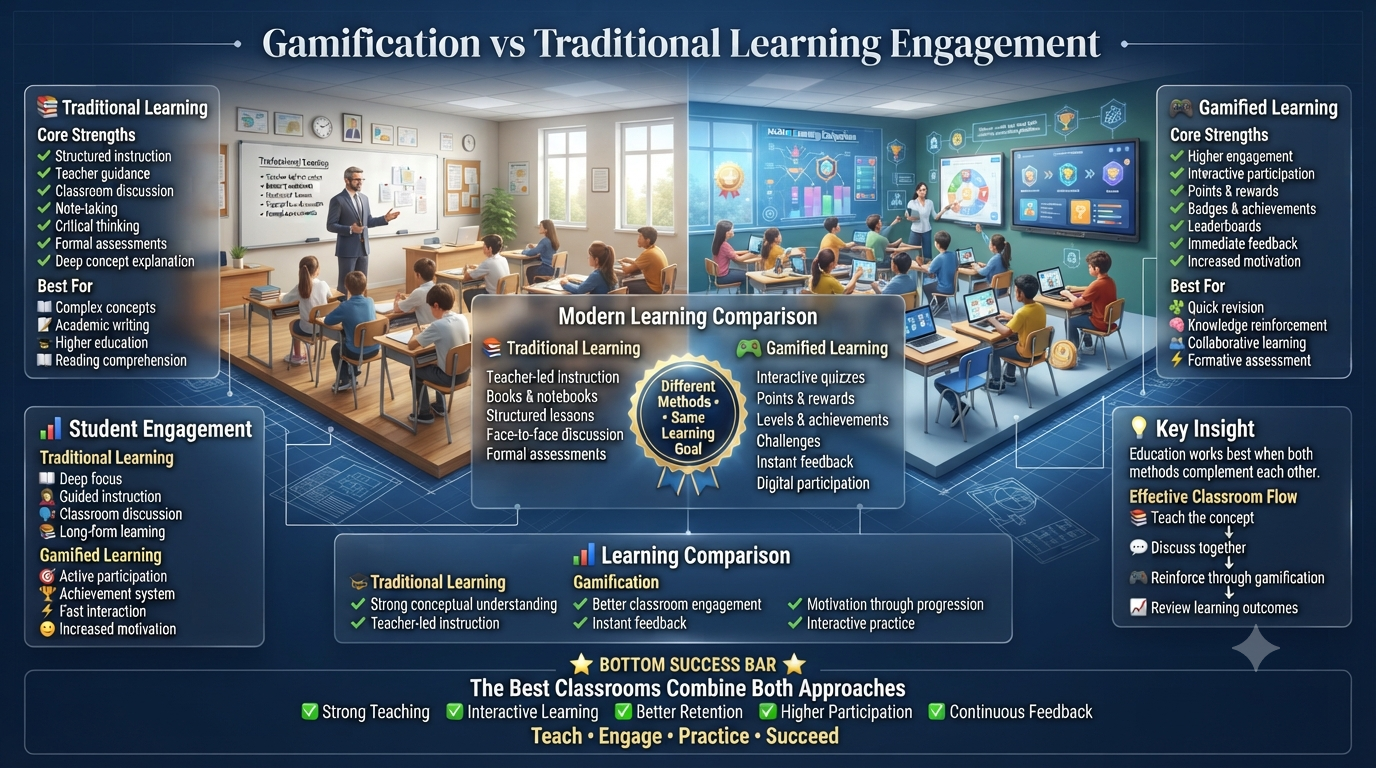
What Is Gamification Science is particularly relevant to education because teachers increasingly use interactive elements to encourage participation.
What Is Gamification Science can help educators decide whether a game mechanic supports an actual learning objective.
What Is Gamification Science reminds teachers that engagement alone does not prove that learning has improved.
What Is Gamification Science encourages educators to measure learning outcomes alongside participation.
What Is Gamification Science can make practice more engaging when students repeatedly work with meaningful academic content.
What Is Gamification Science supports the use of feedback when students need to understand mistakes and improve their next attempt.
What Is Gamification Science can help make progress visible during longer learning activities.
What Is Gamification Science suggests that game elements should serve the lesson rather than compete with it.
What Is Gamification Science is especially useful when designing activities that require repeated practice.
What Is Gamification Science can encourage persistence when learners can see achievable milestones ahead.
What Is Gamification Science also warns against creating systems where students become more interested in rewards than the subject itself.
What Is Gamification Science helps explain why novelty can create an initial increase in enthusiasm without guaranteeing long-term improvement.
What Is Gamification Science shows why a successful design needs more than attractive visuals and competitive features.
What Is Gamification Science considers autonomy important because meaningful choices can give learners greater ownership of an activity.
What Is Gamification Science examines competence because visible improvement can strengthen a learner’s sense of capability.
What Is Gamification Science considers social interaction because cooperation and competition can both influence participation.
What Is Gamification Science can support team-based activities where learners work toward shared objectives.
What Is Gamification Science can also support individual progression when learners need more control over their own pace.
What Is Gamification Science helps explain why personalization can matter when designing motivational experiences.
What Is Gamification Science encourages designers to consider the audience before selecting specific mechanics.
What Is Gamification Science can reveal whether a feature is helping users complete meaningful tasks or merely increasing activity.
What Is Gamification Science therefore values evidence over assumptions when evaluating gamified experiences.
What Is Gamification Science considers user behavior an important source of information about whether a design is working.
What Is Gamification Science can involve comparing participation, completion, performance, retention, and other measurable outcomes.
What Is Gamification Science also considers negative effects because competition, rewards, and rankings can sometimes create unwanted pressure.
What Is Gamification Science encourages balanced design so that motivation does not come at the expense of understanding.
What Is Gamification Science can help educators avoid turning every classroom activity into a competition.
What Is Gamification Science supports thoughtful use of game elements rather than automatic use of every available feature.
What Is Gamification Science becomes more valuable when the chosen mechanic has a clear connection to the intended behavior.
What Is Gamification Science can help designers determine whether rewards are actually necessary for a particular activity.
What Is Gamification Science recognizes that some learners may prefer achievement while others respond better to collaboration or personal progress.
What Is Gamification Science therefore supports flexible approaches instead of one universal gamification formula.
What Is Gamification Science can improve learning design when game mechanics are connected directly to meaningful tasks.
What Is Gamification Science helps distinguish gamification from simply giving students access to educational games.
What Is Gamification Science focuses on incorporating selected game-design elements into an existing experience.
What Is Gamification Science can therefore apply to classrooms, training programs, workplace learning, apps, and other environments.
What Is Gamification Science is useful for reviewing whether a gamified system creates genuine value for its users.
What Is Gamification Science encourages long-term evaluation because early excitement does not necessarily continue indefinitely.
What Is Gamification Science shows why sustainable motivation is more valuable than temporary attention.
What Is Gamification Science can help identify when a system needs better challenges, clearer goals, stronger feedback, or less emphasis on competition.
What Is Gamification Science supports continuous improvement because gamified experiences can be adjusted according to user responses.
What Is Gamification Science also emphasizes fairness so that game mechanics do not unnecessarily disadvantage certain participants.
What Is Gamification Science considers accessibility important because motivational features should remain usable by different learners.
What Is Gamification Science encourages designers to think about the emotional experience created by competition, failure, rewards, and progress.
What Is Gamification Science ultimately treats game mechanics as tools whose value depends on how thoughtfully they are designed and applied.
What Is Gamification Science provides a useful framework for understanding why some gamified experiences increase participation while others produce little meaningful change.
Final Perspective
Gamification science is best understood as a systematic examination of what happens when game-informed design enters a non-game activity. Its value lies in separating the design itself from the psychological and behavioral processes that may follow it, and then separating those processes from the outcomes that can actually be observed and measured.
The field doesn’t assume a game element is automatically beneficial. It asks what the element does, how participants experience it, what mechanism might explain the response, how that response can be measured, and why the same intervention can produce different results under different conditions. That makes gamification science fundamentally a field of evidence-based inquiry into the relationship between game-informed design and human response — not a collection of techniques for making activities more entertaining.