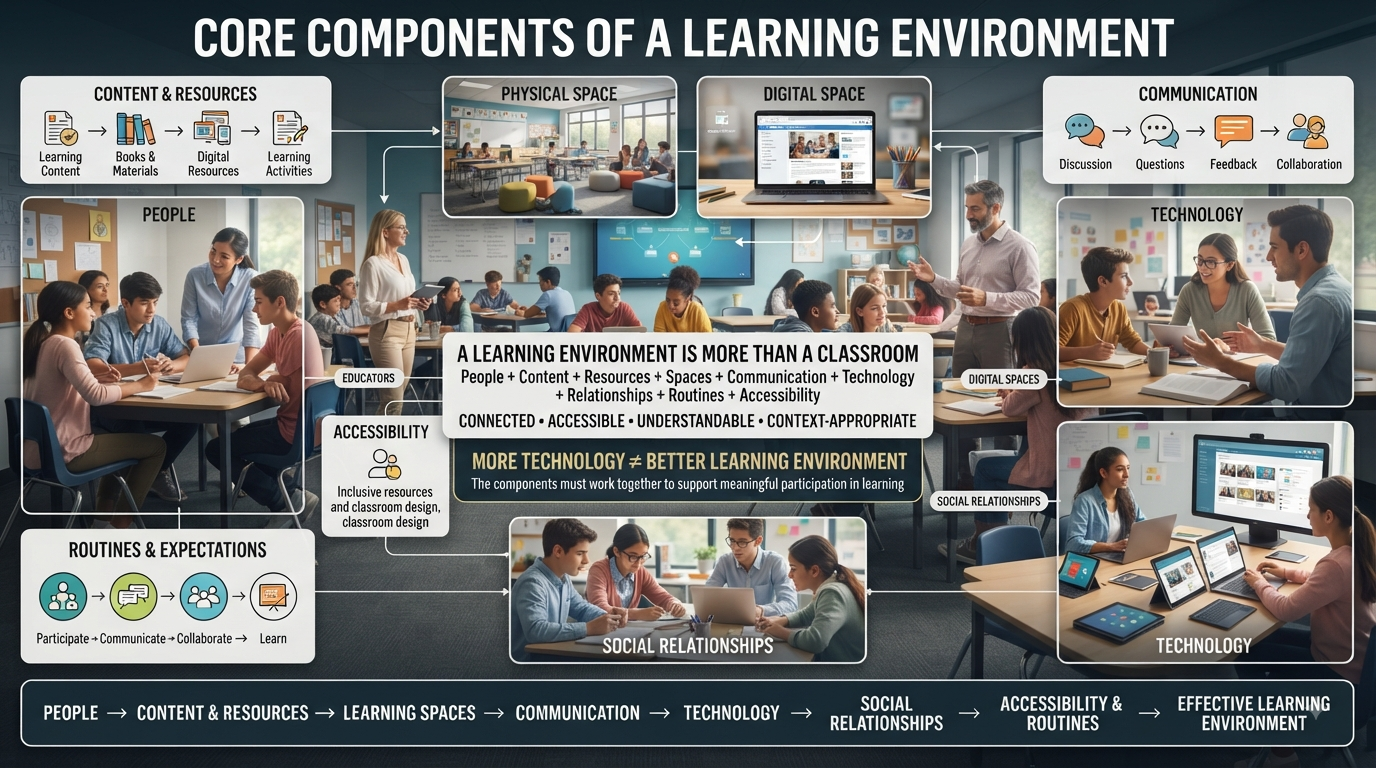
Core Components of a Learning Environment | A learning environment is more than the physical classroom, an online platform, or the resources placed in front of learners. It is the complete set of conditions and structures surrounding participation in learning. Learners, educators, content, resources, physical and digital spaces, communication, technology, social relationships, routines, accessibility, and environmental expectations can all contribute to how that environment functions.
Understanding the core components of a learning environment therefore requires looking beyond individual features and examining how these elements work together. A well-structured environment is not defined simply by having more resources or newer technology; its components must be accessible, connected, understandable, and appropriate to the context in which participation takes place.
Looking for comprehensive classroom resources and educational technology insights? Explore GimkitApp for expert guides, teaching strategies, game modes, and the latest updates to enhance student engagement.
What Is a Learning Environment?
A learning environment is not simply the physical room where teaching happens. It is the structured system of people, spaces, resources, relationships, norms, and conditions within which learners participate in learning.
A desk, a learning platform, a teacher, a textbook, or a classroom rule may each be part of the environment — but none of them alone defines it. The environment emerges from how all these elements coexist and interact.
Understanding the core components of a learning environment means looking at both what makes up the environment and how those parts connect to one another.
Overview: The Core Components at a Glance
Layer
Core Elements
Represents
Spatial
Physical and digital spaces
Where participation occurs
Human
Learners, educators, peers
Who participates
Social
Relationships, norms, group structure
How people relate
Psychological
Safety, trust, belonging
How the environment feels
Material
Books, tools, digital resources
What is available to use
Organizational
Time, routines, responsibilities
How participation is structured
Communicative
Channels, instructions, information flow
How information moves
Technological
Platforms, devices, connectivity
How digital access is enabled
Accessibility
Physical, digital, informational access
Who can meaningfully participate
These layers are not separate environments — they are dimensions of the same environment. A digital platform, for example, belongs to the technological layer but also affects access, communication, and resource use. That interdependence is the key to understanding the topic.
1. Spatial Components: Physical and Digital Space
The spatial dimension is where participation takes place — physically, digitally, or both.
Physical space includes room layout, seating, lighting, acoustics, movement space, and physical accessibility. A room with fixed seating creates different interaction patterns than one with movable furniture — the arrangement itself shapes participation, not just the presence of furniture.
Digital space includes learning management systems, virtual classrooms, discussion boards, and digital resource libraries. Unlike physical space, digital space is navigated through interfaces, devices, and connectivity rather than physical movement.
Physical Space
Digital Space
Entered physically
Accessed electronically
Movement is physical
Navigation is digital
Accessibility involves mobility and design
Accessibility involves interface and connectivity
Most modern learning environments are hybrid — a learner may sit in a physical classroom while simultaneously using digital resources and communication tools, making space a distributed rather than single-location concept.
2. Human Components: Who Participates
No learning environment exists without the people inside it.
Learners — the primary participants. Their behavior directly shapes participation patterns, peer dynamics, and social norms.
Educators and facilitators — responsible for setting expectations, organizing resources, and guiding participation. They are part of the environment’s human and organizational structure.
Peers and other participants — contribute informal norms, collaboration patterns, and shared experiences that shape the environment independently of any formal design.
3. Social Components
The social component describes the relationship structure among people — teacher–learner relationships, peer relationships, cooperation, trust, and communication norms.
Two environments can have identical furniture, resources, and technology but produce very different experiences if their social dynamics differ. This is why social structure is treated as a core component rather than a byproduct of the environment.
4. Psychological Components
The psychological component concerns how participants experience the environment — safety, belonging, confidence, and perceived support.
This is distinct from the social component:
Social Dimension
Psychological Dimension
Relationships
Experience of those relationships
Communication patterns
Perceived safety in communication
Group norms
Sense of belonging
Belonging, in particular, is shaped by social structures but is experienced individually — the two are connected, not identical.
5. Content and Material Resources
Content and resources are often confused, but they serve different roles:
Content
Resources
The subject matter or knowledge itself
The means of accessing or using that knowledge
Answers “what?”
Answers “with what?”
Text, media, concepts
Books, devices, platforms, tools
Resource presence is not the same as resource availability. A textbook stored somewhere inaccessible is technically present but not meaningfully usable. The real chain that matters is:
6. Organizational Components: Time, Rules, and Routines
Organization gives the environment predictability. It includes schedules, routines, responsibilities, and both formal and informal norms.
Formal expectations — published rules, participation requirements, communication guidelines
Informal norms — unwritten habits, such as how peers respond to mistakes or whether questions are welcomed
Time itself is part of this structure: pacing, deadlines, and transitions shape how the same physical or social environment feels in practice. A compressed schedule creates different conditions than one with room to breathe.
7. Communication as a Core Component
Communication connects every other component. It moves information between people, resources, and systems — through spoken interaction, written messages, or digital channels.
Too many disconnected communication channels can make an environment harder to navigate, not easier. A coherent environment needs communication architecture, not just communication availability — channels that map clearly to their purpose (real-time discussion vs. announcements vs. private support, for example).
8. Technological and Digital Infrastructure
Technology is often treated as one component, but it actually operates across several layers:
Layer
Function
Device
Physical access to digital systems
Connectivity
Enables communication with online systems
Platform
Hosts learning spaces and functions
Interface
Determines how users navigate
Content
Delivers digital resources
Identity
Manages access and permissions
Technology is not required for every learning environment — physical spaces, printed resources, and in-person discussion can form a complete environment without it. Where technology is present, it functions as connective infrastructure rather than a standalone feature.
9. Accessibility as a Core Component
Accessibility determines whether the other components can actually be used — not just whether they exist.
Accessibility Type
Concern
Physical
Can participants move through the space?
Digital
Can they navigate digital systems?
Informational
Can information be found and understood?
Communication
Can they receive and send information?
Participation
Can they meaningfully take part?
A resource can be technically available but still inaccessible if it’s hard to find, poorly labeled, or requires a difficult login process. Accessibility should be considered across the entire participation pathway — from first access to full participation — not just at the point of entry.
Explicit vs. Implicit Components
Not every component of a learning environment is deliberately designed — some emerge on their own.
Explicit components are intentionally created: classroom rules, published schedules, seating arrangements, digital navigation menus, and accessibility features. These are visible and can be pointed to directly.
Implicit components develop through repeated interaction: informal communication habits, peer expectations, unwritten participation norms, and shared attitudes toward mistakes or questions. Nobody writes these down, but they shape behavior just as strongly as formal rules do.
This distinction matters because an environment can have one formal rule while everyday interaction quietly establishes another. A syllabus might state “questions are welcome,” but if the informal classroom culture punishes learners for asking, the implicit component overrides the explicit one. Understanding a learning environment fully requires looking at both what was designed and what has developed on its own.
Formal vs. Informal Structures
Related to the above, learning environments contain two parallel layers of organization:
Formal Structure
Informal Structure
Published rules
Unwritten norms
Official schedules
Informal timing habits
Assigned roles
Emergent roles (e.g., a peer who naturally becomes the group’s coordinator)
Institutional communication
Peer-to-peer communication
Official resources
Shared resources learners pass among themselves
The formal structure describes what the environment is intended to be. The informal structure describes how participants actually organize themselves within it. Both are equally real, and a strong environment usually has the two working in the same direction rather than against each other.
Static vs. Dynamic Components
Components also differ in how quickly they change.
Relatively stable elements include room architecture, core institutional infrastructure, permanent digital systems, and basic policies — these rarely shift within a single term or year.
Rapidly changing elements include group composition, communication patterns, resource availability, social dynamics, and day-to-day participation behavior.
A learning environment is therefore never a fixed object. It is a system where some structures stay stable for continuity while others continuously adjust in response to who is participating and how. Recognizing which components are meant to be stable and which are expected to shift helps explain why the “same” classroom or course can feel different from one term to the next.
Affordances: What the Environment Makes Possible
A more advanced way to analyze components is through affordances — the opportunities for action that a component makes possible, as distinct from the feature itself.
Environmental Feature
Affordance It Creates
Movable seating
Reconfiguration for group work
Searchable resource repository
Faster information discovery
Accessible interface
Broader digital participation
Discussion area
Shared, real-time communication
Flexible communication channel
Multiple valid ways to participate
A feature describes what exists. An affordance describes what that feature allows a participant to do. Two environments can have identical features but different affordances if one is arranged to actually enable action and the other isn’t — for example, movable chairs that are never actually rearranged provide no real affordance beyond what fixed seating would.
Environmental Scalability
Components also behave differently depending on how many participants the environment supports. A structure that works well for a small group can function very differently at scale — communication volume increases, resource distribution becomes harder to manage, and support structures that worked informally in a small class may need to become formal in a larger one.
This is especially visible in digital environments, where interface design and technical capacity determine whether the system holds up as participation grows. Scalability isn’t a separate component on its own — it’s a property of how well the existing components (communication, resources, organization) perform as the number of participants changes.
Personalization and Shared Structure
Digital learning environments in particular can offer individualized interfaces, resource views, and notifications for each learner — while still requiring a shared structure that lets everyone operate within the same system.
Too little personalization can create unnecessary barriers for learners with different needs. Too much fragmentation, where every learner’s experience diverges completely, makes the environment difficult to coordinate as a group. The practical goal is not maximum personalization but appropriate flexibility within a coherent shared structure — enough shared ground that communication and collaboration still work, with enough individual adaptation that access isn’t one-size-fits-all.
The Boundary of the Topic: What Counts as a Component?
Because “learning environment” can start to feel like it absorbs everything related to education, it’s useful to apply a simple test:
Does this element form part of the surrounding system through which learners, educators, content, and resources are organized, accessed, or experienced?
If yes, it belongs to the environment. If it’s something that happens because of the environment rather than something that forms it, it belongs to a different category.
Directly Part of the Environment
Related but Separate
Physical and digital space
Teaching methods
Learners and educators as participants
Learning theories
Content and resources
Assessment systems
Rules, norms, and organization
Individual learning outcomes
Communication and accessibility
Curriculum theory
This boundary keeps the concept precise. A learner’s final grade, for instance, may be influenced by the environment, but the grade itself is an outcome — not a structural component of the environment that produced it.
How the Core Components Work Together
A list of components is incomplete without their relationships. The strongest way to understand the topic is through dependency:
Component
Depends On
Effect
Physical space
Layout, accessibility
Shapes physical participation
Digital space
Devices, connectivity
Shapes digital participation
Resources
Access, organization
Provide support
Rules
Communication, norms
Create behavioral structure
Social relationships
Interaction, communication
Shape social conditions
Psychological climate
Social conditions
Shapes experience
Accessibility
Space, resources, technology
Determines meaningful access
No single component defines the environment — the system of relationships between components is what gives the environment its actual character.
A Practical Example: Coherent vs. Fragmented Environments
The difference between a well-designed and poorly-designed learning environment rarely comes down to missing components — most environments have all the same basic pieces. The difference is in how those pieces connect.
Fragmented example: A course has learning materials on one platform, assignment submissions on a second platform, announcements sent by email, and real-time discussion happening on a third app the institution never officially adopted. Every component technically exists. But a learner has to remember four different logins, check three separate places for updates, and manually piece together what’s due and where. The effort of managing the environment competes with the effort of actually learning — this is environmental friction in practice.
Coherent example: The same components — materials, submissions, announcements, discussion — live inside one connected system, or are at least consistently cross-linked so a learner only needs to check one place to find everything relevant. The resources are organized the way the learner expects to look for them. Nothing about the content changed, but the environment around it works with the learner instead of against them.
This example illustrates why two environments with identical resources, technology, and even the same instructor can still produce very different learner experiences — the difference lives in the relationships between components, not in the components themselves.
For the latest gaming news, expert reviews, and walkthroughs, readers can also visit IGN, one of the world’s leading gaming websites.
Why Learning Environments Differ Across Contexts
The same set of core components can be assembled very differently depending on context, which is why a traditional classroom, an online course, and a workplace training program can all be called “learning environments” despite looking nothing alike.
A traditional classroom leans heavily on physical space, in-person social dynamics, and synchronous organization (fixed class times).
A fully online course relies on digital space, asynchronous communication, and a technological infrastructure layer that a physical classroom doesn’t need at all.
A workplace-connected or hybrid environment often distributes participation across multiple locations — a training platform, a physical work site, and informal mentoring relationships — combining components that would normally sit in separate systems.
In each case, the underlying architecture (space, people, resources, communication, organization, accessibility) is the same. What changes is which components carry the most weight and how tightly they’re coupled together. This is also why a home learning environment — material resources, adult–learner interaction, routines, and emotional climate — counts as a genuine learning environment even though it has no institutional label attached to it at all.
The Four Foundational Elements (OECD Framework)
The OECD’s learning-environment framework identifies four elements at the pedagogical core:
Learners
Educators
Content
Resources
The broader environment — space, time, social conditions, technology, and accessibility — surrounds and connects this core. This two-level view is useful because it keeps “what is being taught” (content) separate from “what supports the environment” (everything else), preventing the concept from becoming unlimited in scope.
Components vs. Properties vs. Outcomes
This distinction keeps the topic precise:
Components are the parts that make up the environment (learners, space, resources, rules).
Properties describe how the system functions as a whole (coherent, flexible, accessible, resilient) — these emerge from components interacting, they are not separate components themselves.
Outcomes are effects that may result from the environment (engagement, belonging, achievement) — influenced by the environment, but not part of its structure.
A coherent environment is one where components reinforce rather than contradict each other — resources are organized where participants expect them, communication channels match their purpose, and accessibility is considered across the full pathway. When components are poorly connected, participants experience friction: unnecessary extra effort just to navigate the environment itself, separate from the effort of actual learning.
A well-designed environment is also resilient — a single disruption (a platform outage, a schedule change) shouldn’t cause the whole system to stop functioning, because components aren’t so tightly coupled that one failure cascades into all of them.
What Makes a Modern Learning Environment Effective
Modern learning environments increasingly emphasize:
Physical and digital integration (hybrid spaces)
Multiple, well-mapped communication pathways
Accessibility considered by design, not added afterward
Predictable structure that still allows flexibility
Belonging supported through social and relational structures, not treated as a standalone add-on
Frameworks like CAST’s UDL Guidelines 3.0 frame environment design around reducing unnecessary barriers and supporting meaningful participation for learner variability — reinforcing that accessibility and flexibility are properties of good design, not optional extras.
Importantly, a learning environment isn’t limited to schools. A home learning environment — material resources, adult–learner interaction, routines, and emotional climate — follows the same component structure. What defines a learning environment is the presence of these structured conditions, not the institutional label attached to the location.
Professional Recommendations & Expert Reviews
Core Components of a Learning Environment begin with the learners themselves because their needs, abilities, experiences, and goals shape how learning takes place.
Core Components of a Learning Environment include educators who guide instruction, provide support, and create conditions that encourage meaningful participation.
Core Components of a Learning Environment include content because students need relevant knowledge, concepts, skills, and experiences to work with.
Core Components of a Learning Environment include resources that give learners access to information, tools, materials, and opportunities for practice.
Core Components of a Learning Environment include the physical or digital space where learning activities occur.
Core Components of a Learning Environment involve relationships because interaction between students and educators can strongly influence participation.
Core Components of a Learning Environment include communication systems that allow ideas, questions, instructions, and feedback to move effectively between participants.
Core Components of a Learning Environment involve instructional methods that determine how content is presented and how learners engage with it.
Core Components of a Learning Environment include activities that give students opportunities to apply knowledge and develop skills.
Core Components of a Learning Environment include assessment because educators need evidence of what students understand and where additional support may be required.
Core Components of a Learning Environment involve feedback that helps learners recognize strengths and understand how they can improve.
Core Components of a Learning Environment include classroom expectations that establish boundaries for participation and behavior.
Core Components of a Learning Environment involve routines that create consistency and make daily learning activities easier to manage.
Core Components of a Learning Environment include opportunities for collaboration when students learn through discussion, teamwork, and shared problem-solving.
Core Components of a Learning Environment also include opportunities for independent learning so students can develop responsibility for their own progress.
Core Components of a Learning Environment involve accessibility because students need reasonable opportunities to participate in learning activities.
Core Components of a Learning Environment include emotional conditions that can influence whether learners feel comfortable asking questions and making mistakes.
Core Components of a Learning Environment involve psychological safety because students are more likely to participate when they do not fear unnecessary embarrassment.
Core Components of a Learning Environment include motivation because willingness to engage can affect how much effort students invest in learning.
Core Components of a Learning Environment involve learner autonomy, giving students appropriate opportunities to make choices and take ownership of their progress.
Core Components of a Learning Environment include clear learning objectives that explain what students are expected to understand or accomplish.
Core Components of a Learning Environment involve instructional alignment so that activities, resources, and assessments support the intended objectives.
Core Components of a Learning Environment include appropriate technology when digital tools genuinely improve access, interaction, practice, or understanding.
Core Components of a Learning Environment involve reliable access to learning materials so students can participate without unnecessary barriers.
Core Components of a Learning Environment include social norms that influence how students communicate, cooperate, and respond to differences.
Core Components of a Learning Environment involve respect because productive learning depends on constructive relationships among participants.
Core Components of a Learning Environment include diversity because learners bring different experiences, perspectives, abilities, and backgrounds to the classroom.
Core Components of a Learning Environment involve inclusion so that students have meaningful opportunities to participate in classroom life.
Core Components of a Learning Environment include differentiated instruction when learners require different forms of explanation, practice, or support.
Core Components of a Learning Environment involve appropriate levels of challenge so students are neither consistently overwhelmed nor insufficiently stimulated.
Core Components of a Learning Environment include opportunities for practice because understanding often develops through repeated application.
Core Components of a Learning Environment involve active learning, allowing students to analyze, discuss, create, solve problems, and apply ideas.
Core Components of a Learning Environment include questioning because thoughtful questions can encourage curiosity and deeper reasoning.
Core Components of a Learning Environment involve discussion because exchanging ideas can help learners clarify and reconsider their thinking.
Core Components of a Learning Environment include instructional leadership that helps establish direction, priorities, and expectations for learning.
Core Components of a Learning Environment involve effective classroom management because unnecessary disruption can interfere with learning opportunities.
Core Components of a Learning Environment include time because learners need sufficient opportunities to engage with content, practice skills, and receive feedback.
Core Components of a Learning Environment involve pacing because information presented too quickly or too slowly can affect comprehension.
Core Components of a Learning Environment include appropriate grouping strategies that can support individual work, pairs, small groups, or whole-class learning.
Core Components of a Learning Environment involve opportunities for reflection so learners can consider what they have understood and what remains difficult.
Core Components of a Learning Environment include metacognitive support that helps students think about how they learn and which strategies work for them.
Core Components of a Learning Environment involve meaningful connections between new information and existing knowledge.
Core Components of a Learning Environment include authentic tasks that demonstrate how knowledge and skills can be applied beyond isolated exercises.
Core Components of a Learning Environment involve relevant examples that make abstract ideas easier to understand.
Core Components of a Learning Environment include effective learning materials that are accurate, understandable, and appropriate for the intended learners.
Core Components of a Learning Environment involve opportunities for creativity because students often learn through designing, experimenting, constructing, and expressing ideas.
Core Components of a Learning Environment include problem-solving opportunities that encourage learners to apply knowledge in unfamiliar situations.
Core Components of a Learning Environment involve constructive teacher-student relationships that support communication and academic development.
Core Components of a Learning Environment include peer relationships because classmates can influence motivation, collaboration, and participation.
Core Components of a Learning Environment involve a culture of inquiry where asking questions and exploring possibilities are treated as valuable parts of learning.
Core Components of a Learning Environment include appropriate assessment practices that provide useful information without reducing learning entirely to numerical scores.
Core Components of a Learning Environment involve formative assessment because teachers can use ongoing evidence to adjust instruction.
Core Components of a Learning Environment include opportunities to revise work after receiving feedback.
Core Components of a Learning Environment involve consistency between what teachers expect students to learn and what classroom activities actually require them to do.
Core Components of a Learning Environment include physical conditions such as lighting, seating, noise levels, temperature, and available workspace.
Core Components of a Learning Environment involve digital conditions such as device access, connectivity, software usability, and technical support when learning takes place online.
Core Components of a Learning Environment include organizational structures that determine how teaching, scheduling, resources, and responsibilities are coordinated.
Core Components of a Learning Environment involve policies and procedures that establish how learning activities are organized and supported.
Core Components of a Learning Environment include families and wider communities when their involvement contributes to students’ educational experiences.
Core Components of a Learning Environment involve continuous improvement because effective environments should respond to evidence about learner needs and outcomes.
Core Components of a Learning Environment work together rather than functioning as isolated elements, meaning a weakness in one area can affect other parts of the learning experience.
Core Components of a Learning Environment therefore require balance between learners, educators, content, resources, relationships, technology, assessment, and the conditions surrounding participation.
Core Components of a Learning Environment are most effective when they create a coherent system in which students have meaningful goals, capable guidance, suitable resources, supportive relationships, appropriate challenges, and opportunities to demonstrate and improve their learning.
Frequently Asked Questions
1. What are the core components of a learning environment?
A learning environment consists of interconnected components: learners, educators, content, resources, physical or digital space, technology, communication, social relationships, organizational structure, rules, and accessibility. The OECD framework treats learners, educators, content, and resources as the pedagogical core, while the wider environment provides the spatial, social, and organizational conditions surrounding it.
2. What are the four core elements of a learning environment?
According to the OECD framework, the pedagogical core consists of four elements: learners (who engage in learning), educators (who guide it), content (the knowledge or subject matter), and resources (the tools and materials used to access that content). The broader environment — space, technology, communication, and accessibility — surrounds this core.
3. Is technology a core component of every learning environment?
No. Technology is important in many modern and hybrid environments, but it isn’t required. Physical spaces, printed materials, and in-person discussion can form a complete learning environment without any digital component. Where technology is present, it functions as infrastructure connecting other components — not as a required feature on its own.
4. What is the difference between a learning environment and a learning space?
A learning space is the physical or digital setting where participation occurs — a classroom, a platform. A learning environment is the broader system: the relationships, resources, communication, rules, and psychological climate surrounding that space. Space is one component of an environment; the environment includes both structural and human conditions.
5. What is the most important characteristic of a learning environment?
No single characteristic guarantees quality, but coherence among components is one of the most important system-level principles. An environment works well when its people, resources, communication, and organizational structures support rather than obstruct one another — strong individual components can’t compensate for a poorly connected system.
Conclusion
The core components of a learning environment can’t be reduced to a list of desks, teachers, and textbooks. A complete environment has a pedagogical core — learners, educators, content, and resources — surrounded by spatial, social, psychological, organizational, communicative, technological, and accessibility conditions.
What matters most is that these components don’t operate in isolation: resources require access, access depends on infrastructure, infrastructure affects participation, and participation shapes the social and psychological character of the environment. Understanding a learning environment means understanding both its parts and the relationships connecting them.