Kahoot Confidence Experience Guide | Most Kahoot formats ask a player to do one thing per question: pick an answer. The Kahoot Confidence experience asks for a second decision layered right on top of the first — not just what you think the answer is, but how sure you are of it. That extra moment of self-assessment is what separates Confidence experience from every other format in Kahoot’s library, and it turns a simple quiz into something closer to a strategy game built entirely around honest self-evaluation.
This guide covers the Kahoot Confidence experience in complete depth: how the boost-or-play-it-safe decision works, exactly how the bonus and penalty scoring is calculated, how the confidence streak builds and resets, what appears in the host view during a live session, and what the post-game report reveals. It stays entirely within the boundaries of this one experience — the deeper mechanics of Classic or Accuracy experience, however closely related the underlying scoring logic might seem, belong to their own separate guides.
Looking for comprehensive classroom resources and educational technology insights? Explore GimkitApp for expert guides, teaching strategies, game modes, and the latest updates to enhance student engagement.
What Is the Kahoot Confidence Experience?
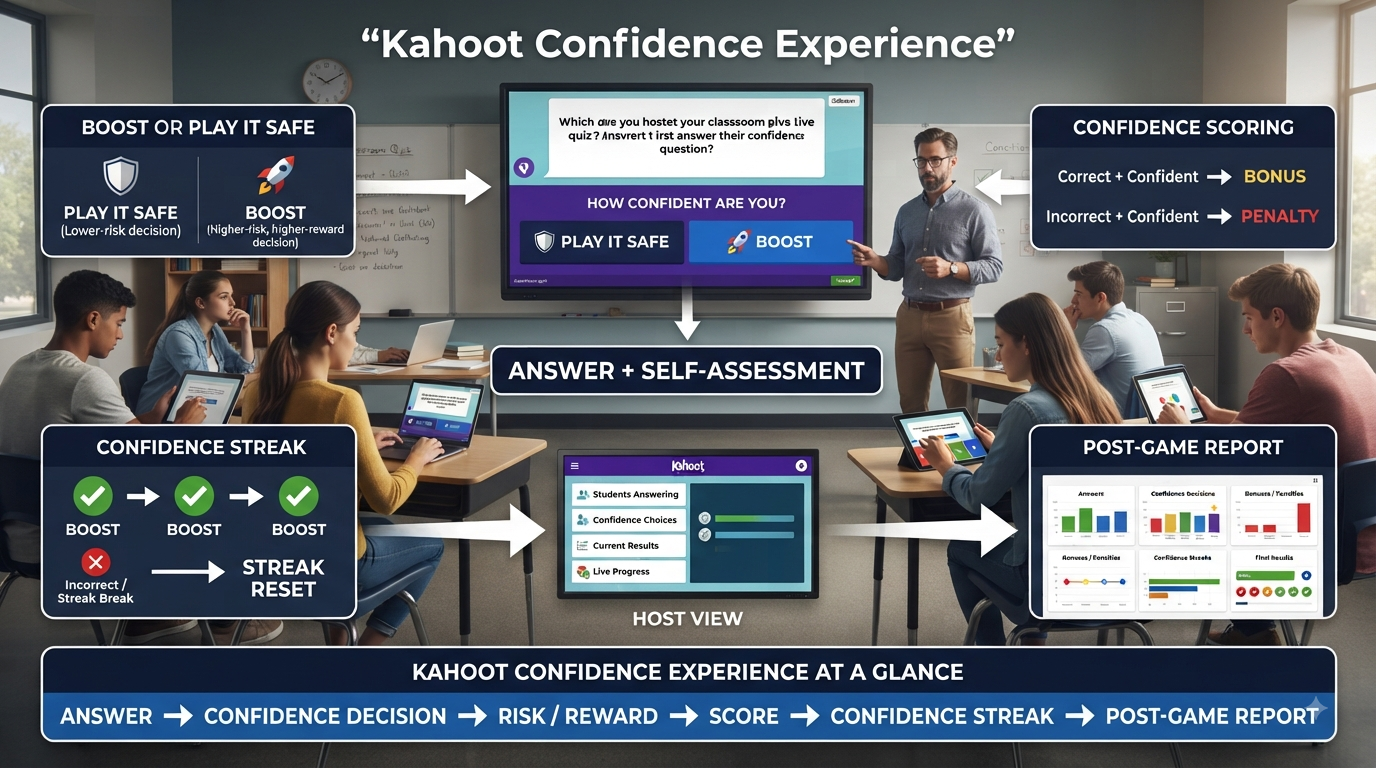
The Kahoot Confidence experience is a live game format that adds a strategic risk-and-reward layer on top of standard quiz scoring, asking each player to declare how confident they feel about their answer before results are revealed. After selecting an answer to a question, every participant must choose between two options: Boost answer, a higher-risk, higher-reward choice, or Play it safe, which falls back to standard scoring with no risk attached.
This single added step introduces genuine strategic tension into what would otherwise be a straightforward quiz. A player has to weigh their own certainty honestly — boosting a genuinely confident correct answer pays off, but boosting a shaky guess that turns out wrong costs real points. The format essentially gamifies metacognition, turning self-assessment itself into part of the scored experience rather than something that happens invisibly inside a student’s head.
💡 Pro Tip: Introduce Confidence experience by explicitly framing the boost decision as a skill in itself, separate from content knowledge. Some of the most interesting classroom moments in this format come from students who know an answer but choose to play it safe out of uncertainty, or students who boost confidently and are wrong — both outcomes are valuable teaching moments about self-awareness, not just content mastery.
How the Boost-or-Play-It-Safe Decision Works
Every round in the Kahoot Confidence experience follows the same consistent flow. Players join and answer questions exactly as they would in a standard scored session, but immediately after selecting an answer, each participant is prompted to choose between Boost answer and Play it safe before the results for that question are revealed.
This decision point is a hard commitment. Once a participant confirms their choice — either boosting or playing it safe — that decision is locked in for the question and cannot be changed afterward. There’s no reconsidering after seeing a countdown run low or after a moment of doubt; the choice, once confirmed, stands exactly as made.
📌 Quick Note: Because the boost decision locks immediately upon confirmation, it’s worth explicitly telling students during their first Confidence experience session that there’s no “undo” available. Some players instinctively expect to be able to change their mind the way they might reconsider an answer choice in other contexts, and the finality of the decision is a meaningful part of what makes the format work as intended.
How Scoring Works in the Kahoot Confidence Experience
The scoring outcome in Confidence experience depends entirely on which path a player chose combined with whether their underlying answer was correct:
Play it safe always follows standard scoring rules identical to Classic experience — no bonus, no risk, no penalty beyond a normal incorrect answer scoring zero points as usual.
Boost answer, correct awards the participant extra bonus points on top of their standard score for that question, rewarding the decision to take the risk when it paid off.
Boost answer, incorrect results in an actual point reduction, not just a missed opportunity — choosing to boost and getting the question wrong costs more than simply answering incorrectly without boosting would have.
This structure is what gives Confidence experience its genuine strategic depth. Unlike a format where the only downside to a wrong answer is missing out on points you might have earned, boosting introduces a real penalty for overconfidence, making the decision to boost or play it safe carry actual weight rather than being a free, no-consequence choice.
⭐ Expert Insight: The asymmetry between boosting and playing it safe is deliberate — it’s what prevents Confidence experience from collapsing into “always boost, since there’s nothing to lose.” A player genuinely has to weigh their own certainty, because a wrong boosted answer is measurably worse than a wrong safe one, not just a missed bonus.
The Confidence Streak and Flame Icons
Layered on top of the boost-or-safe scoring is a streak mechanic specific to Confidence experience, represented visually through flame icons that build with consecutive successful boosts. Every time a participant chooses to boost and answers correctly, their confidence streak grows by one level, visually represented as an increasing flame icon on their screen and on the shared leaderboard.
The bonus points tied to this streak scale upward as the streak level increases, up to a maximum bonus of 100 points per boosted correct answer. Once a player’s streak reaches that maximum, additional correct boosted answers continue to award the full 100-point bonus each time, but the reward doesn’t climb any higher beyond that ceiling — the streak caps out rather than growing indefinitely.
A single confidently incorrect answer resets the entire streak back to Level 1, regardless of how high it had climbed beforehand. This is a meaningful design choice: the streak isn’t just paused or reduced by a wrong boosted answer, it’s wiped completely, mirroring the same all-or-nothing tension that defines the boost decision itself.
🔥 Did You Know? Because a confidence streak resets completely on a single boosted mistake, the psychological stakes of boosting actually increase the longer a player’s streak has been building — a player deep into a long streak has more to lose from one wrong boost than a player just starting out, which creates a natural tension between playing it safe to protect an existing streak and continuing to boost for bigger rewards.
What Confidence Experience Applies To
Confidence experience’s boost-or-safe mechanic doesn’t apply universally across every question in a kahoot — it’s specifically tied to questions that award points. For any question configured with points disabled, the game automatically defaults to standard Classic experience scoring for that specific question, meaning no boost option, no risk, and no streak impact for that particular item.
This matters for hosts building or reusing question sets that mix scored and unscored content. A discussion-style, no-points question dropped into an otherwise Confidence experience session simply skips the boost decision entirely for that one question, without disrupting the flow of the rest of the game or affecting an existing streak.
⚠ Common Mistake: Assuming every single question in a Confidence experience session will prompt the boost decision. If a question set includes no-points items — intentionally or as leftovers from reusing a kahoot originally built for a different purpose — those specific questions will quietly skip the boost step, which can look like a glitch if a host isn’t expecting it.
The Host Screen During a Confidence Experience Session
While a Confidence experience game is running, the host screen displays a confidence ratio, showing what percentage of participants chose to boost their answer for the current question. This gives a host a real-time read on the room’s collective confidence level, separate from and in addition to the standard correctness data shown for the question itself.
After each question resolves, the scoreboard updates to reflect both updated rankings and which confidence choice each player made, giving a visible, ongoing record of boosting behavior alongside the traditional points display throughout the session.
✅ Best Practice: Use the live confidence ratio as a teaching moment in real time. A question where the group’s confidence ratio was high but the actual correct-answer rate turned out low is a strong signal of a widespread misconception worth addressing immediately, rather than waiting until the post-game report to notice the gap.
How to Host a Kahoot in Confidence Experience
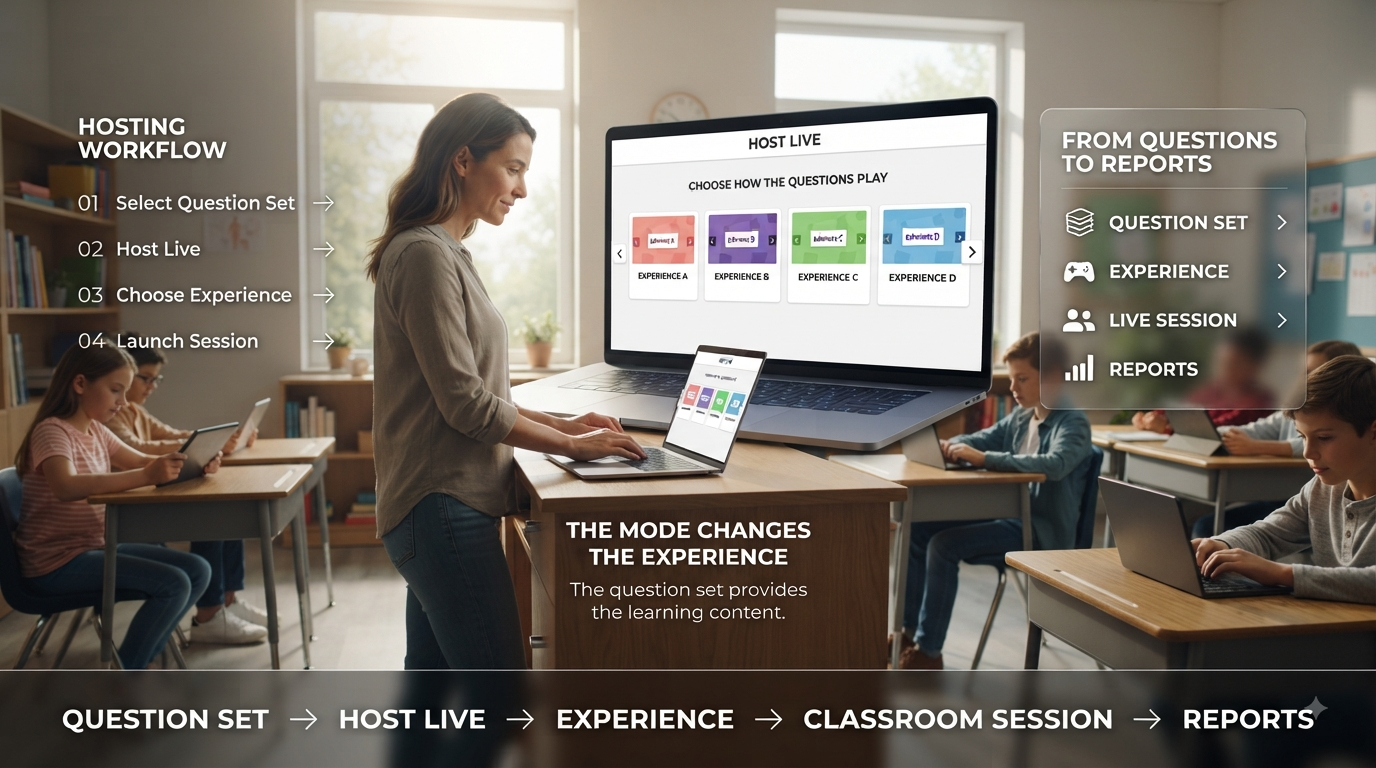
Running a live session in the Kahoot Confidence experience follows this sequence:
Log in to your Kahoot account and locate the kahoot you want to host from your Library or the Discover page.
Click the Host live button on the kahoot’s details page to begin the hosting flow.
Select Confidence experience from the carousel of options at the bottom of the host screen.
Click Start to generate the game PIN, and let participants join exactly as they would for a Classic experience session.
Click Start again once the lobby is full, which triggers a short on-screen tutorial explaining the boost mechanic — worth encouraging participants to actually read, especially the first time they encounter this format.
Progress through each question, with players answering, then choosing to boost or play it safe before results are revealed.
Monitor the live confidence ratio and updated scoreboard as the game continues, using both as real-time signals about the group’s understanding and self-assessment accuracy.
Reach the final podium, which closes the session and generates the corresponding Confidence experience report.
🔍 Did You Know? Once a game has been launched in Confidence experience, the format can’t be switched mid-session — the selected experience remains active for the entire game from start to finish, so a host who wants to compare the same content across two different formats needs to run two separate sessions rather than switching partway through one.
Reading Reports From a Confidence Experience Session
A Confidence experience session generates a report once it ends, accessible from the account’s Reports section and clearly labeled with the Confidence experience game type. This report includes the same baseline structure familiar from other Kahoot formats — a summary view, participant-level detail, and a question-by-question breakdown — plus additional insights specific to this experience.
Confidence-specific report additions include a dedicated confidence highlight card, visible in both host and participant views, surfacing key statistics about confidently answered questions across the session. The participant-level leaderboard table also includes extra detail about confidently answered questions per player, making it easier to identify who tends to boost frequently and how that behavior correlates with their overall accuracy. A dedicated Confident Answer column further breaks down, question by question, whether each participant chose to boost.
📌 Quick Note: The confidence-specific report data is genuinely useful beyond just reviewing a single session’s results — tracking which students consistently under-boost relative to their actual accuracy, or over-boost despite frequent mistakes, offers real insight into their self-assessment skills, a dimension of learning that a standard quiz report never captures at all.
Ideal Use Cases for the Kahoot Confidence Experience
The Kahoot Confidence experience tends to shine in situations where the goal extends beyond simple content recall into genuine self-assessment and strategic thinking:
Reinforcing metacognitive skills, helping students practice honestly evaluating their own certainty rather than treating every answer as an equal guess.
Adding replay value to familiar content, since the boost mechanic introduces genuine strategic variety even when the underlying questions have been used before.
Building test-taking strategy skills, since real exams often implicitly reward the same kind of confident-answer-versus-hedge decision-making that Confidence experience makes explicit and scored.
Engaging advanced or competitive groups looking for more strategic depth than standard scoring provides, without moving all the way to a completely different game structure.
✅ Best Practice: Confidence experience tends to work best with groups that already have a reasonable comfort level with the underlying content. Introducing brand-new material through this format risks conflating “doesn’t know the content” with “doesn’t yet know how confident to be,” muddying what the boost data is actually measuring.
Confidence Experience and Question Type Compatibility
Confidence experience layers its boost mechanic on top of the same underlying question types available across Kahoot’s standard formats, applying the boost-or-safe decision consistently regardless of whether a given question is multiple-choice, true/false, or another supported format — as long as that question is configured to award points. The strategic layer sits entirely on top of the answer-selection step rather than replacing it, meaning question design for a Confidence experience session doesn’t need any special adjustment beyond the normal considerations that apply to writing any solid Kahoot question.
That said, question difficulty interacts with the boost mechanic in a way worth planning around deliberately. A question set built entirely from very easy, high-confidence content tends to produce a session where nearly everyone boosts nearly every time, flattening out the strategic variety that makes Confidence experience interesting in the first place. A mix of difficulty levels — some genuinely challenging items alongside more straightforward ones — tends to produce more varied, more revealing boost decisions across the group, since players actually have to weigh uncertainty rather than boosting reflexively throughout.
💡 Pro Tip: When building or selecting a question set specifically for Confidence experience, aim for a spread of difficulty rather than a uniformly easy or uniformly hard set. The format’s value comes from watching how players navigate genuine uncertainty, and that only shows up clearly when at least some questions are hard enough to make the boost decision feel like a real risk.
Comparing Boosting Behavior to Actual Performance
One of the more pedagogically rich uses of Confidence experience comes from comparing a player’s boosting pattern against their actual accuracy over the course of a session, rather than looking at either number in isolation. A player who boosts frequently and is usually correct is demonstrating well-calibrated confidence — their self-assessment closely tracks their actual knowledge. A player who rarely boosts despite consistently answering correctly may be under-confident, potentially leaving points on the table out of excessive caution even when they clearly know the material. On the other end, a player who boosts often but is wrong more than they’d expect is showing a calibration gap in the opposite direction — genuine overconfidence that the scoring system directly penalizes.
This three-way pattern — well-calibrated, under-confident, and overconfident — isn’t something a standard accuracy percentage alone can reveal, which is precisely why Confidence experience’s dedicated report data has value well beyond a single session’s entertainment factor. Tracking this pattern across multiple sessions over a semester can surface a genuinely useful signal about how a student’s self-assessment skills are developing over time, independent of whether their raw content knowledge is also improving.
⭐ Expert Insight: When discussing Confidence experience results with a class, consider sharing the concept of calibration directly rather than just reporting scores. Students are often surprised to learn that “always boost” and “never boost” are both suboptimal strategies compared to boosting selectively based on genuine certainty — a lesson in honest self-assessment that extends well beyond the game itself.
For the latest gaming news, expert reviews, and walkthroughs, readers can also visit IGN, one of the world’s leading gaming websites.
Confidence Experience for Exam and Test Readiness
Because so many standardized and classroom exams implicitly reward strategic answer selection — skipping a genuinely uncertain question versus committing to a guess, for instance — Confidence experience offers a low-stakes environment for practicing that exact kind of decision-making before it matters on a real assessment. The boost-or-safe choice mirrors, in miniature, the calculation many students already have to make on a timed test: is my certainty high enough to commit fully, or should I hedge?
Running review sessions in Confidence experience ahead of a real exam gives students repeated, structured practice at making that judgment call in a context where the consequences are limited to a classroom game rather than a graded assessment. Over several sessions, students often become noticeably more deliberate about when they choose to boost, a shift that plausibly carries over into how they approach genuine uncertainty when it counts.
📌 Quick Note: Framing Confidence experience explicitly as exam-strategy practice, rather than just another quiz game, tends to increase how seriously older students engage with the boost decision — a useful reframe for classes where an unmotivated group might otherwise treat the confidence choice as an afterthought.
Situations Where Confidence Experience May Not Fit
The added strategic layer that makes Confidence experience compelling for some groups can be a genuine barrier for others. Very young students, or any group encountering live Kahoot gameplay for the very first time, may find the extra boost-or-safe decision cognitively overloading on top of simply answering questions correctly. Sessions where the goal is purely calm, low-pressure review, without any added risk-based scoring complexity, are generally better served by a format built specifically around removing pressure rather than one that deliberately introduces a new strategic risk layer.
⚠ Common Mistake: Introducing Confidence experience as a first-ever Kahoot format for a class with no prior live-game experience. The boost decision adds real value once players are comfortable with the basic quiz mechanics, but layering it on top of an entirely unfamiliar interface can overwhelm rather than engage a brand-new group.
Common Mistakes When Hosting Confidence Experience
Skipping the on-screen tutorial at the start of the game. The brief walkthrough that appears when a Confidence experience session begins exists specifically because the boost mechanic isn’t self-explanatory, and rushing past it tends to produce confused, hesitant boosting decisions throughout the session.
Forgetting that no-points questions bypass the boost mechanic entirely. A host reusing a mixed question set without checking which items have points disabled may be caught off guard when some questions simply skip the confidence step.
Not addressing streak resets directly with students. Because a single wrong boosted answer wipes an entire streak back to Level 1, students unfamiliar with this rule can feel blindsided by how sharply their bonus potential dropped after one mistake.
Trying to switch experiences mid-session. Since the selected experience remains locked for the full duration of a game, a host hoping to compare Confidence experience against another format within the same live session needs to plan for two separate games instead.
Frequently Asked Questions
What’s the difference between boosting an answer and playing it safe in Confidence experience?
Boosting is a higher-risk, higher-reward choice — a correct boosted answer earns bonus points on top of standard scoring, while an incorrect boosted answer results in an actual point reduction and resets the player’s confidence streak. Playing it safe simply applies standard Classic-style scoring with no added risk or reward attached to the choice at all.
How high can the confidence bonus grow, and what happens after that?
The bonus tied to a growing confidence streak increases as the streak level rises, up to a maximum of 100 points per boosted correct answer. Once a player reaches that ceiling, each additional correct boosted answer continues to earn the full 100-point bonus, but the reward doesn’t increase any further beyond that fixed maximum.
Does every question in a kahoot support the Confidence experience boost mechanic?
No. The boost-or-safe decision only applies to questions configured to award points. Any question with points disabled automatically follows standard Classic experience scoring instead, meaning no boost prompt, no risk, and no effect on an existing confidence streak for that specific question.
Can I change my boost decision after selecting it?
No. Once a participant confirms either Boost answer or Play it safe, that choice is locked in for the question and cannot be reconsidered or changed afterward, even before the results are formally revealed on screen.
Does the post-game report show which students chose to boost their answers?
Yes. Confidence experience reports include dedicated confidence insights beyond the standard summary, participant, and question breakdowns — including a confidence highlight card and a Confident Answer column showing, question by question, whether each participant chose to boost their response.
Professional Recommendations & Expert Reviews
Kahoot Confidence Experience focuses on how interactive classroom activities can help students feel more comfortable demonstrating what they know.
Kahoot Confidence Experience encourages learners to participate without feeling that every mistake represents failure.
Kahoot Confidence Experience can give students regular opportunities to experience small academic successes.
Kahoot Confidence Experience helps learners become more willing to answer questions in front of their classmates.
Kahoot Confidence Experience supports students who may hesitate to participate during traditional classroom discussions.
Kahoot Confidence Experience encourages learners to trust their preparation and knowledge.
Kahoot Confidence Experience can make classroom participation feel more approachable for students who lack confidence.
Kahoot Confidence Experience helps teachers recognize students who may understand concepts but rarely volunteer answers.
Kahoot Confidence Experience encourages participation by providing a structured way to respond to academic questions.
Kahoot Confidence Experience supports gradual confidence building through repeated learning experiences.
Kahoot Confidence Experience helps students become more comfortable making decisions during classroom activities.
Kahoot Confidence Experience encourages learners to treat incorrect responses as opportunities to improve.
Kahoot Confidence Experience can reduce the fear of speaking up by giving students another form of participation.
Kahoot Confidence Experience helps learners recognize that mistakes are a normal part of developing knowledge.
Kahoot Confidence Experience supports stronger engagement when students feel safe enough to participate.
Kahoot Confidence Experience encourages teachers to create an environment where effort and improvement are valued.
Kahoot Confidence Experience can help students become more willing to attempt challenging questions.
Kahoot Confidence Experience supports persistence when learners encounter unfamiliar concepts.
Kahoot Confidence Experience helps students notice their own academic progress over time.
Kahoot Confidence Experience encourages learners to focus on personal improvement rather than comparing themselves constantly with classmates.
Kahoot Confidence Experience can strengthen motivation when students see evidence that their understanding is improving.
Kahoot Confidence Experience helps teachers use interactive activities as opportunities for positive reinforcement.
Kahoot Confidence Experience encourages students to prepare more carefully when they know they will have opportunities to demonstrate their knowledge.
Kahoot Confidence Experience supports greater classroom involvement among students who usually remain quiet.
Kahoot Confidence Experience helps learners develop confidence through familiarity with repeated question-and-response activities.
Kahoot Confidence Experience encourages students to learn from successful answers instead of treating them only as points.
Kahoot Confidence Experience can help learners recognize subjects or topics in which they are becoming stronger.
Kahoot Confidence Experience supports a more positive attitude toward academic challenges.
Kahoot Confidence Experience encourages teachers to celebrate progress rather than focusing exclusively on top rankings.
Kahoot Confidence Experience helps students understand that improvement can happen gradually.
Kahoot Confidence Experience can make revision less intimidating by turning practice into an active classroom experience.
Kahoot Confidence Experience encourages learners to attempt questions even when they are not completely certain.
Kahoot Confidence Experience supports reflection after activities so students can understand what they did well.
Kahoot Confidence Experience helps teachers identify students who may benefit from additional encouragement or support.
Kahoot Confidence Experience encourages educators to provide constructive feedback after difficult questions.
Kahoot Confidence Experience can strengthen students’ willingness to participate in future lessons.
Kahoot Confidence Experience supports confidence when activities are matched appropriately to student ability.
Kahoot Confidence Experience encourages teachers to avoid making competition the sole measure of achievement.
Kahoot Confidence Experience helps create a classroom atmosphere where students can participate without excessive pressure.
Kahoot Confidence Experience can encourage learners to become more independent in assessing their own understanding.
Kahoot Confidence Experience supports stronger study habits when students recognize the benefits of preparation.
Kahoot Confidence Experience helps learners become more comfortable with academic uncertainty and challenging questions.
Kahoot Confidence Experience encourages students to use feedback as a tool for future improvement.
Kahoot Confidence Experience can help transform repeated practice into a source of greater academic self-belief.
Kahoot Confidence Experience supports teachers in creating more inclusive participation opportunities.
Kahoot Confidence Experience encourages learners to recognize that confidence grows through experience, preparation, and persistence.
Kahoot Confidence Experience helps students approach future classroom activities with greater readiness.
Kahoot Confidence Experience can strengthen the connection between successful learning experiences and positive academic attitudes.
Kahoot Confidence Experience demonstrates that interactive activities can contribute to confidence when students receive appropriate challenges, constructive feedback, and opportunities to improve.
Kahoot Confidence Experience shows that confidence should develop alongside knowledge, accuracy, reflection, and consistent participation rather than being treated as a separate classroom goal.
Summary
The Kahoot Confidence experience transforms a standard quiz into a genuine exercise in self-assessment by asking players to put real points behind how certain they actually feel about each answer. The boost-or-play-it-safe decision, the asymmetric risk of a wrong confident guess, the streak mechanic that rewards sustained accuracy while punishing overreach, and the dedicated confidence data available in post-game reports all combine to measure something standard quiz scoring never captures on its own — how well a player actually knows what they know. For groups ready to engage with that extra strategic layer, Confidence experience offers a depth of insight, both for players reflecting on their own certainty and for hosts reading the resulting data, that few other formats in Kahoot’s library are built to provide.