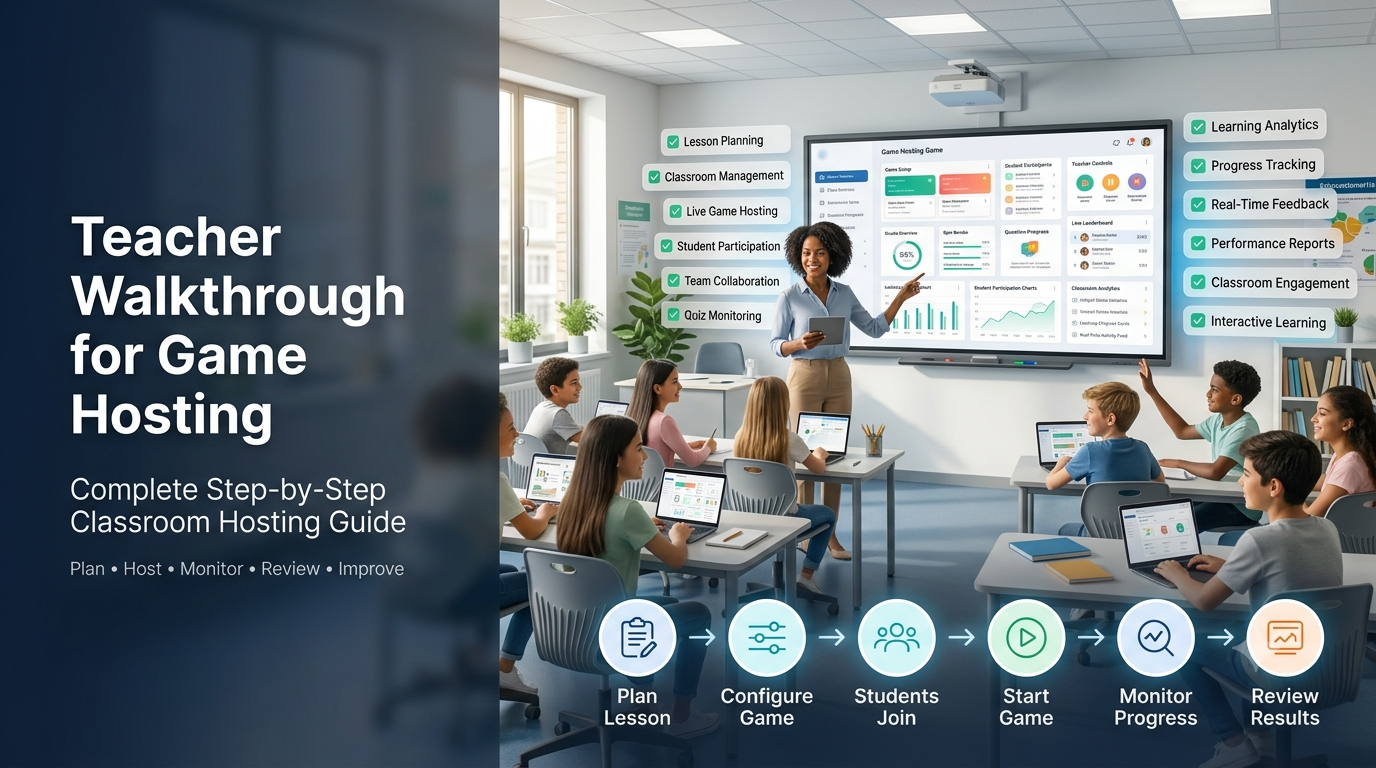
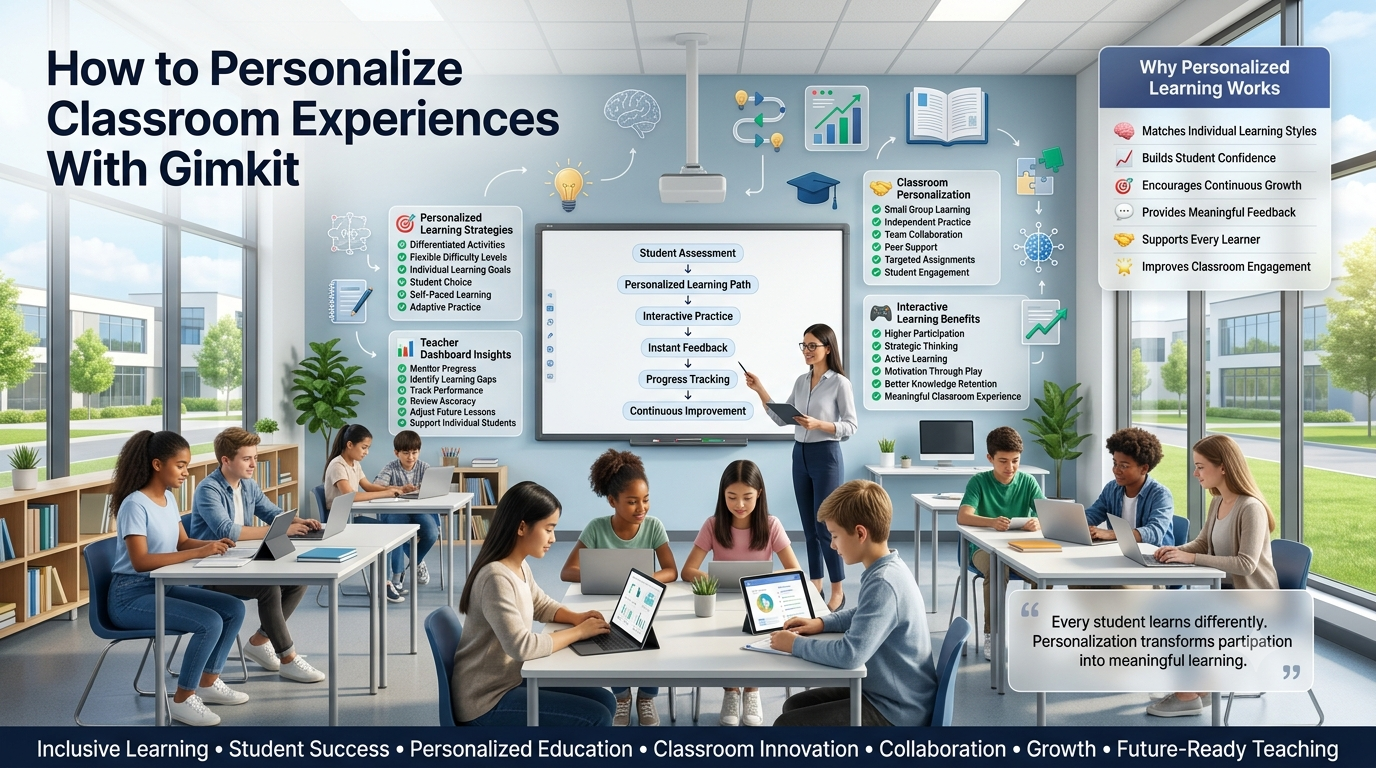
Teacher Walkthrough for Game Hosting | A successful classroom game session involves much more than simply launching an activity. It requires careful planning, thoughtful setup, active classroom management, and meaningful follow-up to ensure students stay engaged and learning objectives are achieved. By following a structured workflow, teachers can reduce technical issues, improve participation, and create a smoother, more enjoyable learning experience for everyone.
🌟 Quick Answer
A teacher walkthrough for game hosting is the complete process of planning, configuring, launching, supervising, and reviewing a classroom game session. It includes selecting the right activity, adjusting game settings, inviting students, monitoring participation, managing the live game, and analyzing results afterward to improve future lessons.
🛠️ What a Teacher Walkthrough Includes
🎯Define the lesson objective before starting the activity.
🎮Choose the most suitable game or learning activity for your classroom goals.
⚙️Configure game and classroom settings to match student needs.
👥Invite students to join individually or in teams.
▶️Launch the game session when everyone is ready.
👀Monitor participation and classroom engagement throughout the activity.
📊Review post-game reports to evaluate learning outcomes and identify improvement areas.
Why It Matters
🌟 Why Effective Game Hosting Matters
Hosting an educational game involves far more than clicking a Start button. Every decision a teacher makes before and during the session can directly influence student participation, classroom behavior, engagement, and overall learning outcomes. A well-organized game keeps students focused, encourages healthy competition, promotes teamwork, and makes learning more interactive.
🚀 Benefits of Structured Game Hosting
🎯Keeps Students Focused – Clear planning minimizes distractions during gameplay.
🤝Encourages Healthy Competition – Creates a positive and motivating classroom atmosphere.
💬Promotes Active Participation – Every student has opportunities to engage and contribute.
📚Supports Better Learning Outcomes – Well-planned activities align with lesson objectives and reinforce key concepts.
By following a structured hosting process, teachers spend less time solving technical problems and more time supporting meaningful learning.
Core Workflow
🎮 What Is Game Hosting in an Educational Platform?
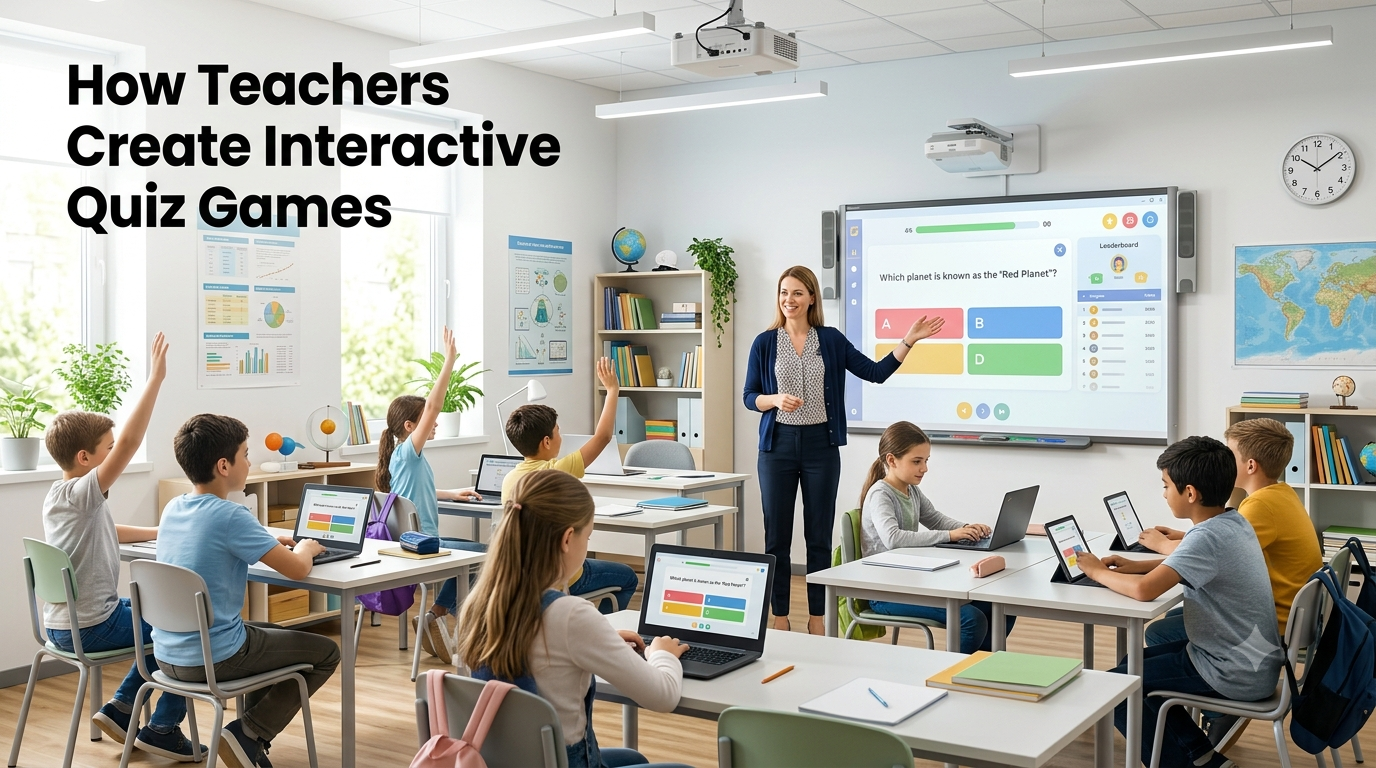
Game hosting is the process of creating, launching, and managing an interactive learning activity for a class. Teachers oversee the entire session while students participate individually or in teams using their own devices. Although every educational platform offers different features, the overall hosting process follows the same core workflow.
🔄 Core Game Hosting Workflow
📋Prepare the lesson objective
🎮Select the appropriate game or activity
⚙️Configure classroom and game settings
👥Invite students to join
▶️Launch the live session
👀Monitor participation and engagement
📊Review learning results after completion
Each stage contributes to a smoother classroom experience, stronger student engagement, and more effective instruction.
Preparation
🏫 Before You Host a Game: Classroom Preparation
Successful game sessions begin before students even join the activity. Spending a few minutes preparing your classroom helps reduce interruptions, avoid technical issues, and create a more organized learning environment. Good preparation allows teachers to focus on instruction instead of troubleshooting during the lesson.
✅ Classroom Preparation Checklist
🎯Define a Clear Learning Objective – Make sure the game supports your lesson goals.
🎮Choose the Right Activity – Select a game that matches the topic and student skill level.
💻Check Student Devices – Confirm that laptops, tablets, or phones are working properly.
🌐Verify Internet Connectivity – Ensure a stable connection for uninterrupted gameplay.
🖥️Prepare Classroom Equipment – Test projectors, interactive boards, or classroom displays if needed.
📜Explain Participation Rules – Make sure students understand how the activity will work before it begins.
⏰Allocate Enough Time – Schedule enough time for gameplay, discussion, and review after the session.
Thoughtful preparation creates a more focused, organized, and engaging classroom experience, helping teachers maximize instructional time while giving students the best opportunity to learn through interactive gameplay.
Classroom Readiness Checklist
Preparation Item
Why It Matters
Learning objective
Keeps the activity aligned with lesson goals
Game content reviewed
Prevents unexpected questions or errors
Student devices checked
Reduces technical delays
Internet connection tested
Ensures stable gameplay
Classroom display prepared
Improves visibility for all students
Participation rules explained
Encourages fair and respectful play
Completing these checks before launching the game helps minimize disruptions during the session.
Choosing a Game
Choosing the Right Game for Your Lesson
Not every educational game is suitable for every classroom objective. The most effective teachers begin by identifying what they want students to learn, then select a game that supports that outcome.
For example:
Teaching Goal
Recommended Activity Type
Review previous lessons
Quick review game
Introduce a new topic
Interactive exploration activity
Check understanding
Short formative assessment
Reinforce key concepts
Practice-based game
Encourage collaboration
Team-based classroom challenge
Selecting a game based on instructional purpose helps maintain the balance between engagement and meaningful learning.
Factors to Consider Before Choosing
When evaluating a game, consider questions such as:
Does it support today's lesson objective?
Is the difficulty appropriate for the class?
Can every student participate comfortably?
Will the activity fit within the available class time?
Does it encourage active thinking rather than guessing?
Choosing thoughtfully increases both participation and educational value.
⭐ Expert Insight: The most engaging classroom game isn't always the one with the most features—it's the one that best supports the learning objective. When educational goals guide the choice of activity, students are more likely to stay focused and retain what they've learned.
Session Planning
Planning the Game Session
Once the activity has been selected, teachers should plan how the session will fit into the overall lesson.
Instead of treating the game as a standalone event, consider how it connects with instruction before and after gameplay.
A simple lesson flow might include:
1
Introduce the topic.
2
Explain the activity and expectations.
3
Host the interactive game.
4
Discuss challenging questions.
5
Clarify misconceptions.
6
Summarize key learning points.
This approach transforms the game from entertainment into an effective teaching strategy.
Preparing Students Before Launch
Students perform better when they understand both the objective and the expectations before gameplay begins.
Before starting, briefly explain:
The purpose of the activity.
How students will participate.
Whether the game is individual or team-based.
Any classroom behavior expectations.
How results will be reviewed afterward.
Taking a few minutes to provide clear instructions helps students focus on learning rather than figuring out how the activity works.
💡 Pro Tip: Run a short practice round with a simple question or two before beginning the main activity. This allows students to become familiar with the controls, confirms that everyone has joined successfully, and helps identify any technical issues without interrupting the actual lesson.
Avoid Mistakes
Common Preparation Mistakes to Avoid
Even experienced educators occasionally overlook small details that can affect the flow of a game session.
Some of the most common preparation mistakes include:
Starting before every student has joined.
Choosing a game that exceeds the available class time.
Skipping instruction on participation rules.
Failing to test classroom technology beforehand.
Selecting activities that don't align with lesson objectives.
⚠️ Common Mistake: Avoiding these issues creates a smoother, more productive classroom experience.
Game Settings
Configuring Game Settings Before Launch
🌟 Quick Answer: Before starting a classroom game, teachers should review the available game settings to ensure the activity matches the lesson objective, classroom environment, and available time. Proper configuration helps create a smoother learning experience while reducing distractions during gameplay.
Every classroom is different. A review session before an exam may require different settings than a collaborative activity introducing a new topic. Taking a few minutes to adjust the game before students join allows teachers to create an experience that supports both engagement and learning.
Rather than accepting default settings automatically, review the available options and select those that best fit your teaching goals.
Settings Worth Reviewing
Although available options vary between educational platforms, teachers should commonly review settings related to:
Setting Area
Why It Matters
Game Mode
Matches the activity to the lesson objective
Time Limits
Keeps the lesson on schedule
Participation Rules
Creates fair gameplay
Team Configuration
Supports collaboration when appropriate
Question Order
Controls the learning flow
Session Privacy
Limits access to intended participants
Completion Rules
Defines when the activity ends
A few thoughtful adjustments before launch can significantly improve the classroom experience.
Choosing Settings Based on Your Lesson
Different teaching situations often require different configurations.
Classroom Situation
Recommended Approach
Lesson Review
Moderate pace with opportunities for discussion
Quick Knowledge Check
Short activity focused on key concepts
Collaborative Learning
Team-based participation and shared discussion
End-of-Class Assessment
Structured settings with clear completion expectations
Practice Session
Flexible timing that encourages learning over speed
The goal is to select settings that reinforce the lesson—not distract from it.
💡 Pro Tip: Before students enter the game, review every setting once more. A quick final check helps prevent interruptions and avoids restarting the activity because of an overlooked configuration.
Launching
Launching the Game Session
Once preparation is complete and settings have been reviewed, the game is ready to begin.
Launching the session is more than making the activity available—it is also the moment when teachers establish expectations and prepare students for successful participation.
A confident, organized start helps create a positive learning environment from the very beginning.
A Simple Launch Workflow
A successful launch often follows this sequence:
1
Confirm all classroom equipment is working.
2
Open the prepared activity.
3
Verify the selected settings.
4
Share the joining information with students.
5
Allow time for everyone to connect.
6
Confirm participant readiness.
7
Begin the activity together.
Following the same routine each time helps students know what to expect and reduces unnecessary delays.
Helping Students Join Successfully
The first few minutes of any live activity are important. Students should be able to join confidently without feeling rushed or confused.
Teachers can improve the joining process by:
Displaying joining instructions clearly.
Giving students enough time to connect.
Confirming that every participant has entered successfully.
Answering questions before gameplay begins.
Assisting students experiencing technical difficulties.
A smooth entry allows the class to focus on learning rather than troubleshooting.
Common Joining Challenges
Challenge
Practical Response
Slow internet connection
Allow extra joining time if possible
Incorrect joining information
Verify the displayed details carefully
Device compatibility concerns
Encourage students to use a supported device or browser
Delayed loading
Refresh the page and try again
Student uncertainty
Demonstrate the joining process before starting
Addressing these issues early keeps the activity running smoothly.
⭐ Expert Insight: Avoid rushing into gameplay as soon as the first students connect. Waiting briefly to confirm that everyone is ready creates a more inclusive classroom experience and reduces interruptions later.
Live Monitoring
Monitoring Participation During Gameplay
Once the activity begins, the teacher's role shifts from organizer to facilitator.
Rather than focusing only on the scoreboard, observe how students interact with the lesson. Active monitoring allows teachers to identify students who may need additional support and recognize moments that deserve further discussion.
Look for signs such as:
High levels of participation.
Students requesting clarification.
Questions that many learners answer incorrectly.
Individuals who appear disengaged.
Technical issues affecting participation.
Monitoring these patterns provides valuable insight into both classroom engagement and learning progress.
Maintaining Classroom Engagement
A successful game session keeps students actively involved from beginning to end.
Teachers can maintain engagement by:
Encouraging respectful competition.
Recognizing thoughtful participation, not only high scores.
Briefly discussing challenging questions.
Celebrating improvement as well as achievement.
Keeping instructions clear and consistent.
When students understand that learning is the primary objective, competition becomes more meaningful and inclusive.
Encouraging Positive Participation
Instead of focusing only on winning, encourage behaviors that support learning.
Examples include:
Asking students to explain their reasoning after selected questions.
Encouraging teamwork when appropriate.
Highlighting creative problem-solving.
Praising persistence and effort.
Inviting respectful classroom discussion.
These practices help students view educational games as opportunities to learn rather than simply compete.
⚠ Common Mistake: Avoid making frequent changes to the activity once gameplay has started unless absolutely necessary. Consistent rules help students stay focused and prevent unnecessary confusion during the session.
Time Management
Managing Time Throughout the Activity
Time management is an important part of successful game hosting.
Teachers should monitor the lesson schedule while allowing enough flexibility for discussion and clarification when needed.
A balanced session often includes:
A brief introduction.
Student joining time.
Active gameplay.
Review of difficult questions.
Lesson summary.
Keeping an eye on the overall schedule ensures the activity supports the lesson rather than replacing it.
✅ Best Practice: Stay actively involved throughout the game. Observe student participation, answer questions when appropriate, and use important moments to reinforce learning. The teacher's guidance transforms a simple game into a meaningful educational experience.
Live Controls
Using Live Teacher Controls During the Game
🌟 Quick Answer: Once a game is live, the teacher becomes the session facilitator rather than just the host. Live teacher controls help monitor participation, manage the pace of the activity, respond to unexpected situations, and ensure the game continues to support the lesson objectives.
Starting a game is only the beginning. Throughout the session, teachers should actively observe student engagement and use available hosting controls when necessary to maintain a productive learning environment.
Rather than allowing the activity to run without supervision, effective teachers continuously guide the experience from beginning to end.
Responsibilities During a Live Session
While students focus on answering questions and participating, teachers should monitor the overall classroom experience.
Primary responsibilities include:
Observing student participation.
Monitoring classroom behavior.
Watching for technical difficulties.
Keeping the activity aligned with lesson goals.
Providing encouragement when appropriate.
Managing the overall pace of the session.
Remaining actively involved helps transform the game into a guided learning experience instead of simple entertainment.
Monitoring Student Participation in Real Time
One of the greatest advantages of digital classroom games is the ability to observe participation as it happens.
Instead of waiting until the lesson ends, teachers can identify trends while students are still engaged.
Pay attention to indicators such as:
Observation
What It May Indicate
Most students answering correctly
The concept is well understood
Many incorrect responses
Additional explanation may be needed
Low participation
Students may require encouragement or clarification
Repeated delays
Technical issues or difficult questions
Sudden disengagement
Activity pace may need adjustment
Real-time observations allow teachers to respond immediately rather than after learning opportunities have passed.
⭐ Expert Insight: Avoid focusing only on the highest-scoring students. Watching overall participation provides a much clearer picture of classroom understanding and helps ensure every learner benefits from the activity.
Late Joiners
Managing Late Joiners Without Interrupting the Lesson
In many classrooms, a few students may arrive late or experience connection delays.
Instead of restarting the entire activity, teachers should have a simple plan for handling these situations while keeping the lesson moving forward.
Consider the following approach:
1
Confirm whether the student can still join the session.
2
Provide brief joining instructions without interrupting the class.
3
Allow the student to participate if doing so maintains fairness.
4
If joining is no longer practical, provide an alternative learning task until the next activity.
Handling late arrivals calmly helps maintain classroom momentum while supporting every learner.
Maintaining Classroom Focus During Gameplay
Educational games naturally create excitement, but maintaining a balance between energy and learning is essential.
Teachers can encourage productive participation by:
Giving clear expectations before the activity begins.
Celebrating effort as well as achievement.
Encouraging respectful communication.
Redirecting off-topic behavior promptly.
Keeping discussions focused on learning objectives.
When students understand that the purpose is learning rather than simply winning, classroom behavior typically remains more positive and constructive.
Classroom Management Strategies
Situation
Recommended Response
Students become overly competitive
Reinforce respectful participation and teamwork
Classroom noise increases
Pause briefly and restate expectations
Students rush without thinking
Encourage accuracy over speed
Some students lose motivation
Recognize improvement and participation, not only top scores
Discussions move off-topic
Bring attention back to the learning objective
Small interventions often prevent larger classroom management issues.
💡 Pro Tip: Take short pauses after particularly challenging questions to discuss the correct answer. These brief conversations often create the strongest learning moments because students can immediately connect feedback with their recent thinking.
Learning Speeds
Supporting Different Learning Speeds
Every classroom includes students who learn at different rates.
During a live activity, teachers should create an environment where both confident learners and those needing additional support can participate comfortably.
Helpful strategies include:
Encouraging thoughtful answers instead of rushed responses.
Offering clarification when common misunderstandings appear.
Recognizing improvement throughout the session.
Creating opportunities for peer discussion after difficult questions.
Allowing reflection before reviewing correct answers.
An inclusive approach helps maintain engagement across the entire classroom.
Responding to Technical Interruptions
Even well-prepared sessions may occasionally encounter technical difficulties.
Teachers should respond calmly and focus on minimizing disruption.
Common situations include:
Technical Issue
Practical Solution
Student disconnects
Help them reconnect if the session allows
Device temporarily freezes
Refresh the activity or restart the browser
Slow classroom internet
Pause briefly until participation stabilizes
Display equipment stops responding
Continue with verbal guidance while resolving the issue
Unexpected platform delay
Give students clear instructions and remain patient
Preparing for these possibilities helps maintain confidence and keeps students focused on learning.
Post-Game Review
Reviewing Results Immediately After the Game
The end of gameplay marks the beginning of one of the most valuable teaching opportunities.
Instead of moving directly to the next lesson, teachers should use the results to reinforce understanding and identify areas that need further attention.
A productive review might include:
Discussing questions that many students answered incorrectly.
Connecting game outcomes to the lesson objectives.
This reflection helps transform game performance into meaningful learning.
Using Results to Improve Future Lessons
Post-game reports can help teachers make informed instructional decisions.
Rather than viewing results simply as scores, consider them as evidence that can guide future planning.
Teachers can use game outcomes to:
Identify topics requiring additional instruction.
Plan targeted review activities.
Adjust lesson pacing.
Recognize students who may need extra support.
Evaluate whether learning objectives were achieved.
Using assessment data in this way helps ensure that each game contributes to continuous classroom improvement rather than serving as a standalone activity.
✅ Best Practice: End every hosted game with a short class discussion. Reviewing key questions, clarifying misunderstandings, and connecting results to the day's lesson helps students retain knowledge far more effectively than ending the session immediately after the final score is displayed.
Class Size
Adapting Your Hosting Strategy for Different Classroom Sizes
🌟 Quick Answer: An effective game host adjusts the session based on class size, available time, and student participation. A strategy that works well with a small class may require different management techniques when teaching a larger group.
Every classroom has its own dynamics. Larger classes often require more structured organization, while smaller groups allow for greater flexibility and discussion. Recognizing these differences helps teachers deliver a smoother and more engaging experience.
Recommended Hosting Approaches
Classroom Size
Hosting Strategy
Primary Focus
Small Class (10–20 Students)
Encourage discussion and individual participation
Deeper understanding
Medium Class (20–35 Students)
Maintain balanced pacing with clear instructions
Classroom management
Large Class (35+ Students)
Use structured rules and efficient moderation
Organization and engagement
Adjusting your approach based on class size helps maintain a productive learning environment for every student.
Learning Environments
Hosting Games in Different Learning Environments
Educational games are no longer limited to traditional classrooms. Teachers often host activities across multiple learning formats, each requiring slightly different preparation.
In-Person Classrooms
In a face-to-face environment, teachers can observe body language, answer questions immediately, and encourage classroom discussions throughout the activity.
Remote Learning
Online sessions require additional attention to communication, internet stability, and student participation. Providing clear instructions before launching the activity becomes especially important.
Hybrid Classrooms
When some students are present in the classroom while others participate remotely, teachers should ensure that every learner receives equal opportunities to participate and contribute.
Best Practices for Every Environment
Regardless of where learning takes place:
Share instructions before starting.
Confirm every participant is ready.
Monitor engagement throughout the activity.
Allow time for discussion after challenging questions.
End with a brief learning review instead of immediately moving to the next lesson.
These habits improve consistency across all teaching environments.
⭐ Expert Insight: The technology used to host a game may change, but effective teaching principles remain the same. Clear communication, active facilitation, and meaningful feedback consistently produce stronger learning outcomes than technology alone.
Avoid Mistakes
Common Teacher Hosting Mistakes
Even experienced educators occasionally encounter challenges during live classroom activities. Most issues arise from preparation, communication, or pacing rather than the game itself.
Being aware of these common mistakes makes them much easier to prevent.
Common Mistake
Better Practice
Starting before everyone is ready
Confirm all participants have joined successfully
Giving unclear instructions
Explain objectives and expectations before launch
Focusing only on competition
Emphasize learning and improvement
Ignoring technical issues
Pause briefly and resolve problems calmly
Skipping post-game discussion
Review key questions and reinforce learning
Choosing activities that are too long
Match the game length to the available lesson time
Avoiding these mistakes helps create a more organized and enjoyable classroom experience.
Long-Term Engagement
Building Long-Term Student Engagement
One successful game session is valuable, but consistent engagement develops when activities are integrated thoughtfully into classroom instruction.
Recognizing improvement, effort, and collaboration.
Using game results to guide future lessons.
Maintaining a balance between instruction and interactive practice.
Students are more likely to remain motivated when games become a purposeful part of learning rather than an occasional reward.
Evaluating the Success of a Hosted Session
Every hosted activity provides valuable feedback for future lesson planning.
After each session, reflect on questions such as:
Did students remain engaged throughout the activity?
Were the learning objectives achieved?
Which questions caused the greatest difficulty?
Did classroom timing work as planned?
Were students able to participate without technical barriers?
What adjustments could improve the next session?
Regular reflection helps teachers refine both instructional strategies and classroom management over time.
Professional Hosting Checklist
Before concluding a game session, review the following checklist:
Checklist Item
Completed
Learning objective was introduced
✔
Game settings matched lesson goals
✔
Students joined successfully
✔
Participation was monitored
✔
Classroom expectations were maintained
✔
Challenging questions were discussed
✔
Results were reviewed with students
✔
Insights were recorded for future planning
✔
Following a consistent checklist ensures every hosted activity contributes to meaningful learning rather than simply completing a classroom exercise.
💡 Pro Tip: Keep a simple teaching journal after each hosted game. Record which questions challenged students, which strategies increased participation, and what changes you plan to make next time. Over time, these notes become a valuable resource for improving future lessons.
Final Thoughts
Final Thoughts
Hosting educational games effectively is a combination of thoughtful preparation, active facilitation, and meaningful reflection. While technology provides the tools, the teacher creates the learning experience by guiding discussions, encouraging participation, and using game outcomes to strengthen future instruction.
A successful host does more than launch a game. They create a structured environment where students feel motivated to participate, collaborate, think critically, and learn from both success and mistakes.
As educational technology continues to evolve, teachers who combine strong classroom management with purposeful game-based learning will be well positioned to create engaging, student-centered learning experiences that extend far beyond the final scoreboard.
FAQ
Top 5 Frequently Asked Questions (FAQs)
1What should teachers prepare before hosting a classroom game?
Before launching a game, teachers should define the learning objective, review the game content, test classroom technology, confirm internet connectivity, and ensure all students understand the participation rules. Proper preparation minimizes disruptions and allows the activity to focus on learning rather than troubleshooting.
2How can teachers keep students engaged during a live game session?
Student engagement improves when teachers provide clear instructions, monitor participation, encourage respectful competition, discuss challenging questions, and recognize effort in addition to high scores. Active facilitation throughout the session helps maintain focus and supports meaningful learning.
3What should a teacher do if technical problems occur during gameplay?
If technical issues arise, teachers should remain calm, identify the cause, and provide clear guidance while resolving the problem. Common solutions include refreshing the activity, checking internet connectivity, allowing students to reconnect, or briefly pausing the session if necessary. Having a simple backup plan also helps reduce classroom disruption.
4Why is reviewing game results after the session important?
Post-game review allows teachers to identify learning gaps, discuss common misconceptions, recognize successful strategies, and evaluate whether lesson objectives were achieved. Analyzing results also helps teachers improve future lessons and provide additional support where needed.
5How often should teachers use game-based learning activities?
Educational games are most effective when they are integrated strategically rather than used for every lesson. Teachers should select activities that reinforce learning objectives, support formative assessment, encourage collaboration, or review key concepts. A balanced approach keeps students engaged while maintaining instructional variety.
Technology & Awareness
Understanding Technology in the Modern World
Technology today shapes almost every part of daily life, from how people work and
communicate to how they learn, play, and make decisions. Having a solid knowledge of
technology is no longer optional — it helps individuals stay informed, adapt to new
tools quickly, and separate genuine innovation from passing trends. Whether it's
understanding how software and platforms function, staying updated on digital
developments, or simply knowing where to find reliable information, a curious and
informed mindset makes it far easier to navigate an increasingly connected world.