





01
BEFORE
3–5 minActivate Prior Knowledge
Give learners a short prompt, example or retrieval activity connected to the upcoming concept.
Prepare the mind
Wayground is an AI-supported supplemental learning platform that helps teachers create, deliver and assess interactive learning activities — while giving students fun, game-powered ways to practice, review and show what they know.
Students join live sessions at wayground.com/join — old joinmyquiz.com links still work too.
Join Wayground → Still using Quizizz? Learn about the Quizizz → Wayground transitionThe single most important context on this page — because "Quizizz" and "Wayground" are the same platform, wearing a new name.
Quizizz is now Wayground. Officially, the company says the name changed because the platform expanded well beyond interactive quizzes into a broader set of instructional resources — lessons, videos, passages, flashcards, and more sitting alongside the quiz format everyone already knew.
Nothing about your existing setup disappears: accounts, classes, and resources remain available exactly as before. Quizizz Inc. remains the legal entity behind the product, old joinmyquiz.com links still work for joining a game, and existing Quizizz URLs continue to function during the transition.
The product outgrew "quiz" — it now covers instruction, practice, and assessment in one place.
Existing resources, classes, and history carry over — no rebuild required.
Legacy links and joinmyquiz.com continue to work alongside the new wayground.com domain.
Nothing is required immediately — the official guidance is that no action is needed for users.
A supplemental learning platform built for instruction, practice, and assessment — used by teachers, students, and schools alike.
Wayground supports three big learning modes at once: teachers deliver instruction, students get structured practice, and everyone gets usable assessment data — wrapped in gamified, self-paced, and live formats depending on what a moment calls for.
Formal and informal knowledge checks, live or self-paced.
Instructional slides woven together with interactive questions.
YouTube-based video learning with embedded questions.
Reading comprehension built around interactive text.
Spaced review and vocabulary/test-prep practice.
Generate and enhance content from documents, prompts, or video.
Class- and student-level performance data.
Google Classroom, Microsoft Teams, and LTI platforms.
From an empty screen to a report you can actually teach from, in six steps.
Pick something from your Library, or build a new resource from scratch.
Bring in images, video, audio, equations, and a mix of question types.
Live session, homework, or whichever self-paced mode fits the moment.
Everyone completes the activity from their own device.
Class- and student-level reports show what actually landed.
Assign extra, targeted practice based on the data you just saw.
Session and game modes — the layer that decides how a room actually plays. Availability can vary by account and product context.
The original live, competitive quiz-and-leaderboard format.
Everyone moves through the same content on their own clock.
Teacher controls the pace question by question.
Students collaborate in squads toward a shared score.
A climb-style mode that rewards accuracy over speed.
A quieter, exam-like format for formal assessment.
Print-friendly delivery when devices aren't an option.
Real-time play with a shared host screen.
Officially "Assessments/Quizzes" — the core knowledge-check building block of the platform.
18+ question types depending on plan and context — grouped by what each is actually testing.
Multiple Choice, Fill in the Blank, Poll.
Drag & Drop, Categorize, matching-style activities.
Open-Ended and other analytical response formats.
Image-based and other media-rich question formats.
The instructional side of the resource ecosystem — easy to miss if you still think of this as "just a quiz tool."
Build a presentation, add interactive questions and media, then present live or let students move through it self-paced.
Turn a YouTube video into a student-paced or assessed learning activity, complete with embedded questions.
Reading-comprehension activities built for language arts and interactive reading practice.
Vocabulary drilling, memorization, and test-prep review, separate from formal assessments.
The full teacher journey — from a first account to a differentiated re-teach.
Create an account, build a class, find resources, and create or assign activities.
Run live sessions, homework, student-paced or instructor-paced activities, teams, and Paper Mode.
Formative checks, practice, review, and standards-aligned reporting.
Accommodations like Read Aloud, extra time, reduced answer choices, and varied difficulty levels.
Joining, playing, practicing, and studying — the parts of Wayground a student actually touches every day.
Self-paced learning with a deadline — one of the two core delivery options alongside live sessions.
Ready-to-use, teacher-created resources you can find, copy, and adapt instead of starting from a blank page.
The major 2026-era authority pillar — AI content generation woven through nearly every creation path.
What a teacher actually sees after — and increasingly during — a session.
Accuracy, completion rate, points, and time per question.
Which specific questions the class got wrong most — the clearest signal for what to reteach.
Standards-aligned views, plus downloading, printing, or sharing reports.
Automatic grading plus manual and AI-assisted grading for Open-Ended and Audio Response questions.
A strong differentiator from the simple "quiz game" positioning — inclusive classroom support built in, not bolted on.
Wayground plugs into the tools a school already runs on.
Small habits that consistently make a session run better.
How Wayground stacks up against the platforms it's most often compared to.
Wayground leans into broad self-paced and homework support; Kahoot leans into a fast, simple, buzzer-style live format.
Blooket wraps quiz content in a wide variety of arcade-style game modes; Wayground stays closer to a consistent quiz-and-report format.
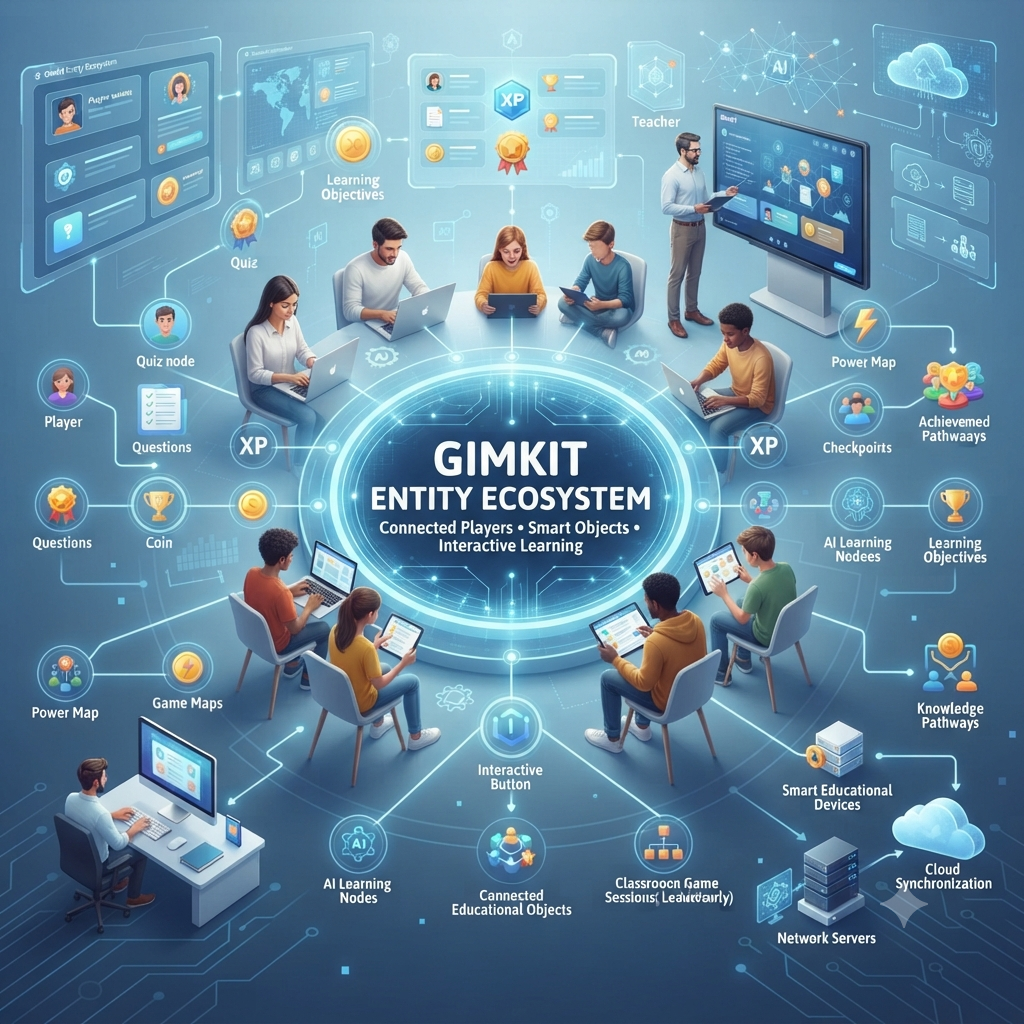
Gimkit layers an in-game economy over quiz content; Wayground focuses more on instruction, standards, and reporting depth.
Quizlet Live centers on collaborative recall; Wayground covers a wider mix of live, homework, and instructional formats.
The right pick usually depends on the moment — fast recall drills, longer strategic sessions, or flexible self-paced homework each favor a different tool.
A Starter/Basic tier sits under paid Individual, School, and District offerings.
The free core experience — joining, playing, and basic creation and hosting.
Extra question types, AI tools, and expanded features for a single teacher.
Classroom-scale needs with shared reporting across a building.
District-wide rollout, or Wayground's business offering for training and onboarding.
Playing never requires an account — only creating, hosting, or saving progress does.
Existing Quizizz accounts continue working under Wayground with no action required — the same email and password get you in.
Most problems fall into a short, recurring list.
Worth knowing given how widely the platform is used by school-age students.
Its use extends well past a single classroom format.
Simple, game-forward review sessions.
Formative checks and test prep at pace.
Lecture engagement and knowledge checks at scale.
Live sessions over video calls, or fully self-paced work.
Structured, self-paced practice outside a classroom.
Targeted, differentiated practice for specific gaps.
Employee onboarding and knowledge checks.
Staff training reinforced through short, repeatable sessions.
The long-tail list — most sessions map to one of these.
Test your knowledge of Quizizz — now known as Wayground — including its resources, session modes, reports, and classroom tools.
Explore our complete knowledge categories
Not every classroom activity needs the same delivery model. Quizizz can fit situations where teachers need interactive questions, independent practice, assignments, progress visibility, and structured learning activities. Use these comparisons to see how those workflows differ from other popular classroom platforms.
Compare assessment and practice workflows with Gimkit's competitive, strategy-driven live gameplay experience.
Compare learning workflows →Explore differences in independent practice, assignments, question-based learning, and game-oriented classroom review.
Explore the comparison →See how student-paced activities and assessment workflows differ from live, presentation-focused quiz participation.
See the detailed differences →Need more than a quick overview? Explore detailed comparisons covering learning workflows, classroom use, assessment, engagement, and platform capabilities.
Explore Quizizz Comparisons →Explore a realistic classroom-style Quizizz experience. Choose a learner profile, adjust the activity conditions, and see how participation, progress, feedback, and pacing can change during a session.
Start the experience to see how the session can move from joining to answering, feedback, progress and completion.
A useful classroom activity also depends on pacing, feedback, learner confidence, visibility of progress and the way the teacher manages the session.
Build a practical session plan around your learners, available time, teaching goal and classroom situation. Adjust the conditions and get a usable session plan instead of simply choosing quiz answers.
Choose your classroom conditions and generate a practical activity flow.
The best session setup depends on what you want learners to understand or demonstrate.
Use the generated flow as a starting point for deciding how to introduce the activity, run it, monitor learners and close the session.
Explore how different performance patterns can be interpreted after an activity. Select the class result pattern that most closely matches what you are seeing and get practical next-step guidance.
When most learners perform well and the result is reasonably consistent, the activity may have confirmed that the core learning objective is being understood.
Move beyond simple recall and give learners an opportunity to apply the concept in a new situation.
Do not treat the overall class percentage as the complete picture. Look for question-level and learner-level patterns before deciding what to teach next.
The most valuable part of post-activity analysis is connecting the evidence to an instructional decision: reinforce, reteach, extend, regroup or move forward.
Explore how question design affects clarity, difficulty, thinking demand and learner experience. Choose the characteristics of a question and get a practical quality assessment.
Learners should be able to understand what is being asked without the wording itself becoming an unnecessary obstacle.
Make incorrect options plausible enough to test understanding rather than allowing learners to eliminate them immediately.
A good question should make the learner think about the intended concept, not struggle with avoidable wording or confusing options.
Question quality affects more than learner experience. Clear, purposeful questions make the results easier to interpret and more useful for deciding what should happen next.
Plan what should happen before, during, and after an activity. Choose the learning situation that matches your class and build a practical sequence instead of treating one quiz as the entire lesson.
Give learners a short prompt, example or retrieval activity connected to the upcoming concept.
Use questions to reveal understanding while learners actively work through the material.
Identify the most important misconception or successful idea and use it to decide what happens next.
A stronger learning experience connects preparation, interaction, evidence and follow-up. The exact sequence should change according to what learners already know and what the activity reveals.
Start with what you are trying to accomplish, then match the activity structure, participation style and follow-up approach to the situation. The planner gives you a practical setup rather than simply another list of features.
This setup is useful when you need a fast picture of what learners currently understand without turning the activity into a full lesson.
If several learners miss the same concept, use that pattern to decide what needs clarification before moving on.
A format that works well for review may not be the right choice for assessment. Likewise, a high-energy activity may be useful for engagement but less useful when you need independent evidence of understanding.
A class rarely needs exactly the same level of support. Use this interactive engine to see how the same activity can be adapted for learners who need more support, learners who are on track, and learners who are ready for greater challenge.
Identify the missed concept, give a simpler explanation or example, then use a small number of focused questions to check whether the learner can now apply it.
Keep the learner working with the concept and gradually vary the questions so understanding is not dependent on one familiar question pattern.
Move beyond simple recall and ask the learner to apply, compare, explain, justify or analyze the concept.
If several learners made the same mistake, address that concept first. Then check whether the new explanation changes performance.
Differentiation does not require creating a completely different lesson for every learner. Often, the better approach is to adjust the amount of support, the complexity of the task, the pace, or the type of thinking required.
A quiz or activity is only one part of learning. Use the results, learner response patterns and classroom context to decide what the next teaching or learning move should be.
When learners already demonstrate understanding, the next activity should add useful cognitive demand instead of creating unnecessary repetition.
Ask learners to apply the same idea in a new example so you can see whether the knowledge transfers beyond the original activity.
The useful question after an activity is not simply “Who got the most correct?” It is “What does this evidence tell us to do next?” That shift turns an activity into part of an ongoing learning cycle.