Gimkit Humans vs Zombies: Protect Your Team's Health
Explore Gimkit's original Humans vs Zombies mode, where two teams use question earnings and strategic special actions to weaken opponents, repair damage and strengthen their defenses. Learn the historical mechanics and experiment with an independent health-economy battle lab.
Independent educational resource. Not affiliated with or operated by Gimkit. The simulation is fictional and does not connect to a live game.
Historical non-2D cash and health economy, not an automatic infection survival simulator.
What is Gimkit Humans vs Zombies?
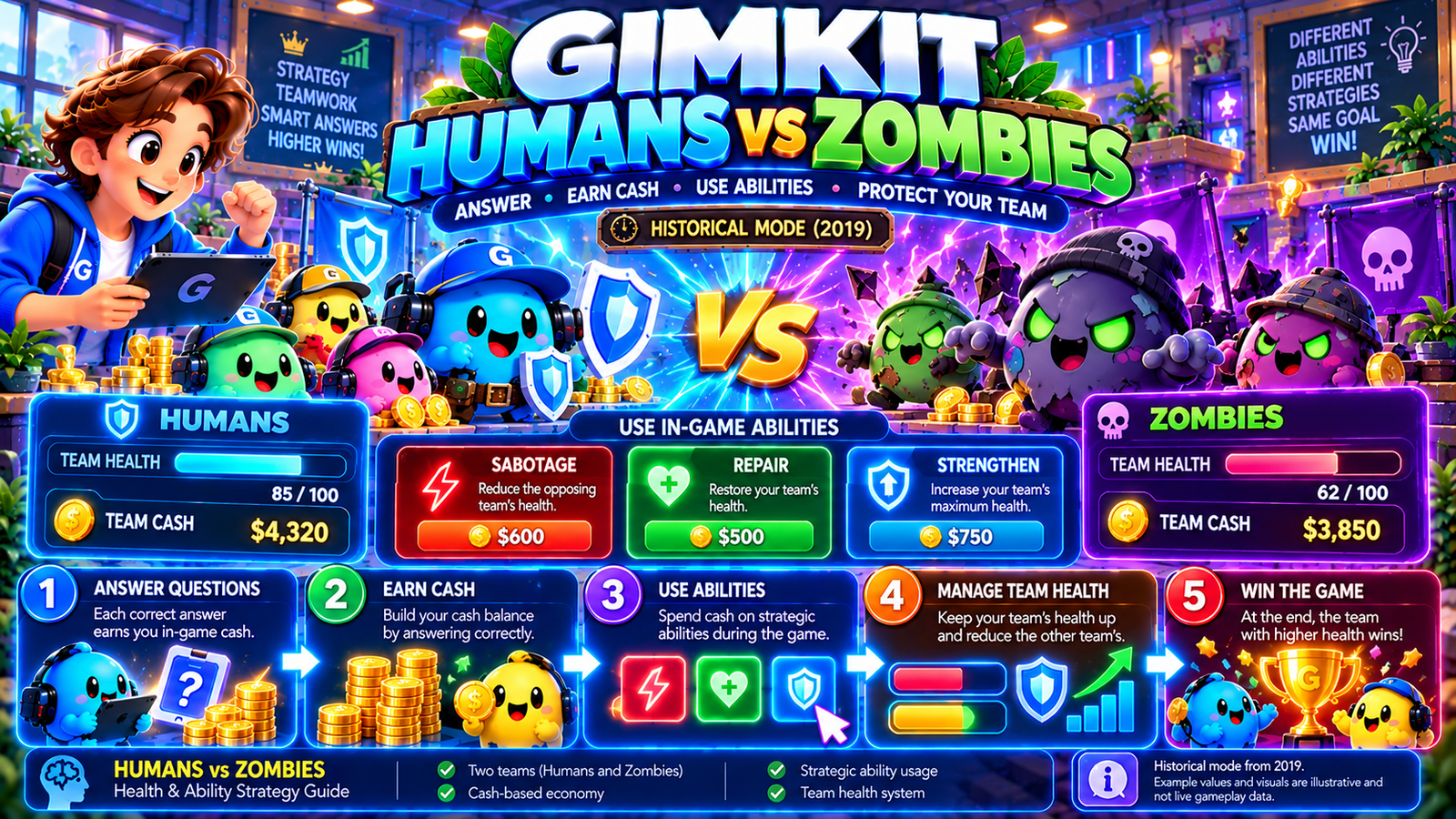
Gimkit Humans vs Zombies is a historical non-2D game mode combining the original cash-earning question loop with a two-faction health competition. Rather than competing solely through individual cash totals, players join the Humans or Zombies and use special shop actions that affect their team's health or the opposition's health.
Community-maintained Gimkit historical documentation lists October 18, 2019 as its release date. It describes a Tycoon-style economy in which players answer questions, earn cash and purchase upgrades or special actions. The defining additions are Sabotage, Repair and Strengthen.
🛡️ Humans
One of two opposing teams. Human-side actions can contribute to damaging the Zombies or preserving their own team's health.
🧟 Zombies
The opposing faction uses the same underlying health-economy principles. Zombies can pursue offensive or defensive action choices.
⚔️ Sabotage
A historically recorded shop action that reduces the opposing team's health by a fixed amount.
❤️ Repair
Restores health to the player's own faction. Effective healing depends on the amount of missing health.
⬆️ Strengthen
Increases the maximum health of the purchaser's team, changing the capacity for future protection.
💰 Question Earnings
Correct academic responses provide earning opportunities. Money becomes a resource for making strategic shop decisions.
Sabotage, Repair and Strengthen explained
These three historically documented actions give Humans vs Zombies its distinctive offensive-versus-defensive structure. They all require a spending decision, but each changes a different property of the health system.
| Action | Historical Starting Cost | Recorded Effect | Strategic Purpose |
|---|---|---|---|
| ⚔️ Sabotage | $200 | −40 opponent health | Reduce the opposing team's survival capacity |
| ❤️ Repair | $100 | +30 own-team health | Recover existing damage |
| ⬆️ Strengthen | $200 | +15 maximum own-team health | Increase defensive capacity |
Healing current health
Repair is most immediately useful when health has already been lost. Restoring health that would exceed the team's maximum is ineffective.
If a team has 90 health out of 100 maximum health, a hypothetical 30-point repair restores only 10 effective health. The remainder has no benefit in a capped-health model.
Increasing maximum health
Strengthen changes the amount of health a team can potentially hold. That is different from recovering existing damage.
The simulator increases the maximum by 15 but does not automatically restore missing health. This is a documented simulator assumption, not a verified additional rule of the official mode.
Human–Zombie Health & Ability Strategy Arena
Experiment with the historical signature action values in a simplified two-faction health economy. Give either faction hypothetical question earnings, purchase offensive and defensive actions, compare health changes and explore how the order of decisions affects the outcome.
🛡️ Humans vs 🧟 Zombies — Health Arena
A turn-free local sandbox featuring persistent resource balances, validated special abilities, faction health, reset and export.
🛡️ Human Faction
🧟 Zombie Faction
1. Choose the Acting Faction
The selected faction receives question earnings and pays for its own ability purchases. Sabotage targets the opposite faction automatically.
2. Record Hypothetical Question Earnings
The cash reward is fictional and configurable. It is not presented as the official mode's reward rate.
3. Purchase a Signature Ability
4. Battle Health Analytics
5. Decision Preview
The preview describes how the selected faction's next ability would affect current health, without spending cash.
6. Activity History
- No activity recorded.
7. Simulation Boundaries
Health starts at 100/100. Once a faction reaches zero, the fictional battle ends. No purchase can occur afterward.
Sabotage cannot reduce health below zero; Repair cannot exceed maximum health. Strengthen increases maximum without automatically healing.
The model is turn-free. Both factions may act until one is defeated. It does not simulate timers, real team member counts or additional historical shop upgrades.
How health and cash interact in Humans vs Zombies
The most important strategic relationship in Humans vs Zombies connects earned currency with changes to faction health. Unlike a cash-only scoring mode, money can be spent to affect the durability of either team.
This creates a choice between immediate damage, recovery from previous damage and increasing the amount of health a faction may eventually sustain.
Sabotage converts cash into opposing damage
In the historical reference, a $200 Sabotage action reduces the opponent's health by 40. A player must consider whether that cash expenditure produces a valuable reduction in the opposing faction's survival capacity.
The effectiveness of an offensive action depends partly on the opponent's remaining health. When the target has only 15 health remaining, the simulation caps the damage at 15 rather than recording an impossible negative health balance.
In this situation, a purchase may produce the final reduction required to end the modeled battle. The unused portion of the nominal 40-point attack does not create further benefit.
Repair converts cash into recovered durability
Repair takes an existing reduction in health and restores up to 30 points in exchange for a historical $100 cost.
If a faction is at 50 out of 100 health, a Repair can provide its full modeled 30-point benefit.
If the faction is at 95 out of 100, only five points are actually missing. Spending a full repair price for such a small recovery may be inefficient in a capped-healing model.
The simulator prevents buying Repair when no health is missing. This is an educational guardrail rather than a claim about official shop purchase restrictions.
Strengthen changes future defensive capacity
Strengthen affects maximum health rather than directly attacking the other faction.
In the historical reference, the increase is 15 points for a starting price of $200.
Maximum health is the upper limit a team can maintain. Increasing that limit creates room for additional recovery and extends the team's possible defensive capacity.
It is important to distinguish the upper limit from the current health value. In the educational model, Strengthen raises the maximum without immediately filling the newly created capacity.
Different actions can have different timing value
An offensive action that removes the last portion of opponent health has an immediate terminal effect.
A defensive action might have greater value if it prevents a team from losing on the next attack.
Increasing maximum health may become more valuable when the faction expects to face several additional attacks.
No single historical ability is always the best choice. The result depends on current health, cash and expected future actions.
Five experiments with the special action economy
Experiment 1: Direct damage race
Begin with both factions at 100 health. Select Humans and purchase Sabotage. The fictional Zombies lose 40 health, leaving them at 60.
Switch to Zombies and purchase Sabotage. The Humans are now also at 60 health.
This produces a symmetrical damage state, but the next action may be different for either side depending on cash and available options.
Experiment 2: Healing after damage
Let one faction receive Sabotage, reducing its health to 60.
Switch to that faction and buy Repair. Its health increases to 90, respecting the maximum-health constraint.
This illustrates defensive recovery: the restored health offsets part of the earlier attack.
Experiment 3: Strengthen before Repair
Purchase Strengthen for one faction before it has suffered any damage.
Its maximum health rises from 100 to 115 while current health remains 100.
Repair may then fill some of the newly available capacity, demonstrating why maximum and current health must be tracked separately.
Experiment 4: Spending near full health
Create a state where a faction has lost only a small amount of health.
Preview Repair before purchasing. The application identifies the actual recovery available under the health cap.
This helps demonstrate why nominal action strength and effective action benefit can differ.
Experiment 5: Trigger the simulated battle ending
Earn enough fictional cash to buy repeated Sabotage actions. Reduce the opposing faction to zero health.
The model ends the battle at that point and blocks additional purchases or earnings until reset.
The battle-ending rule is deliberately defined for the educational simulator. Do not treat it as a complete current official Gimkit win-condition specification.
Why the mode combines offense and defense
Humans vs Zombies differs from a simple cash race because its special actions can affect a health system that both teams influence.
Teams are not limited to earning a high cash total for its own sake. Money can be exchanged for an action that changes the competitive state.
Offensive spending
Sabotage invests resources into reducing the opponent's health. Its immediate benefit is visible on the opposing health bar.
An offensive purchase is especially consequential when it can remove the remaining health necessary to reach the modeled end condition.
Defensive spending
Repair and Strengthen both support defense, but they do so in different ways.
Repair increases current health up to an existing maximum, whereas Strengthen increases the maximum itself.
Treating both actions as the same form of healing would obscure an important design distinction.
Resource timing
Cash spent now cannot be spent again on another special action.
That constraint gives timing significance to each decision.
An early defensive investment may preserve future options, while a well-timed offensive action may reduce the opponent's ability to continue.
Ability sequencing
The order in which actions occur can change their effects.
Repair used at full health provides no effective benefit in the simplified health-capped model.
The same Repair after an opponent's Sabotage can restore substantial health.
Similarly, increasing maximum health can create additional capacity that later healing might fill.
Balancing the two factions
A team ability system must balance offensive damage against defensive recovery.
If attack actions are too inexpensive relative to defensive options, one side may be eliminated too easily.
If defensive recovery is too inexpensive, the competition may become difficult to conclude.
These relationships help explain why ability prices, health effects and game timing are meaningful balance parameters.
Using a faction health economy for mathematical reasoning
The historical Humans vs Zombies structure offers an accessible context for exploring bounded quantities, resource costs and strategic decision-making.
These are potential educational applications, not evidence that playing the mode automatically improves student learning.
Introduce bounded quantities
A health value is typically constrained between zero and a maximum.
Students can reason about why a 30-point healing action should not necessarily add thirty effective points when the team is close to its cap.
Compare nominal and effective values
An ability may promise a numerical change, but the actual useful change is limited by the existing state.
This distinction appears in other mathematical and scientific systems involving upper and lower bounds.
Study decision sequences
Students can explore whether the same collection of actions produces different intermediate outcomes when performed in different orders.
They can explain why a Repair may be more effective after damage than before it.
Evaluate trade-offs
With a fixed amount of fictional cash, a team cannot make every possible purchase.
Students can compare offensive and defensive spending in relation to the current state.
Promote evidence-based reflection
After using the simulator, learners can explain which action they selected, what effect it had, and why an alternative might have been stronger.
A teacher can evaluate the reasoning behind the decision instead of treating a fictional victory alone as proof of subject mastery.
Keep fictional factions separate from personal judgments
Human and Zombie are game-team identities, not descriptions of students themselves.
Competitive activity should remain respectful, accessible and appropriate for the classroom setting.
How Humans vs Zombies differs from other Gimkit modes
| Mode | Central Mechanic | Key Difference |
|---|---|---|
| Humans vs Zombies | Two-team health economy | Sabotage, Repair and Strengthen health decisions |
| Classic Mode | Individual cash and upgrade economy | Personal earning and investment decisions |
| Team Tycoon | Shared team cash | Collective financial progress rather than signature health abilities |
| Boss Battle | One Boss against Challengers | Asymmetric earning balance between one and many |
| Apocalypse | Distinct 2D survival experience | Spatial gameplay rather than the original two-team shop-based health economy |
Humans vs Zombies misconceptions and strategy mistakes
Assuming infection is automatic after an incorrect answer
The historical Gimkit Wiki documents a two-team cash-and-health game.
It does not establish the commonly repeated claim that every incorrect response automatically converts a Human into a Zombie.
Confusing maximum health with current health
Increasing a health ceiling and restoring lost health are different operations.
A strategy should distinguish the two effects instead of treating them as interchangeable.
Buying Repair when little health is missing
In a capped health model, an action can deliver less effective recovery than its nominal amount.
A player should consider current missing health before making a recovery purchase.
Spending every available dollar on offense
Offensive purchases may weaken the other team, but leave fewer resources available for recovery or additional capacity.
The best decision depends on both factions' current states.
Using historical prices as current official values
The action prices in this guide are sourced from community historical records.
The official current Mode Picker and live game interface should be consulted whenever contemporary values matter.
Confusing a team health result with academic achievement
A faction's result can depend on question earnings, economic decisions and opponents' actions.
Those factors mean the outcome does not independently establish what every member learned.
Gimkit Humans vs Zombies FAQs
What is Gimkit Humans vs Zombies?
A historically documented non-2D mode in which Humans and Zombies compete using question earnings and special health-related shop actions.
When was Humans vs Zombies introduced?
The Gimkit community Wiki records October 18, 2019 as its release date.
Is it a zombie infection game?
The original documented mode centers on two-team cash and health mechanics, not automatic player conversion.
What are the three signature actions?
Sabotage, Repair and Strengthen are the three historically listed team-health actions.
What did Sabotage do?
Historical records list it as reducing the opposing team's health by 40.
What did Repair do?
The historical description identifies Repair as restoring 30 team-health points.
What did Strengthen do?
It increased the team's maximum health by 15 according to community historical documentation.
Are these ability prices official current values?
No. They are community-recorded historical starting prices and are not verified current shop costs.
Does Strengthen automatically restore health?
The historical description confirms an increase to maximum health. The simulator deliberately leaves current health unchanged. That additional behavior is a modeling assumption, not a verified official rule.
Can Repair exceed the maximum health?
Not in the educational model. Healing is capped at the current maximum-health value.
Does the simulator create a live Gimkit match?
No. It runs locally and does not connect to Gimkit's game service or player accounts.
Does this mode use 2D character movement?
The historical Gimkit Wiki classifies Humans vs Zombies among non-2D modes.
Can the mode help teach decision-making?
Teachers may use its resource trade-offs as a context for discussing bounded quantities, costs and action sequences. Learning outcomes need independent assessment.
Is Humans vs Zombies available today?
Current availability should be verified in Gimkit's official Mode Picker. The historical Wiki does not guarantee account-specific access.
Historical references and official documentation
The central historical mechanics in this article come from the community-maintained Gimkit Wiki. Official current documentation is used for the broader distinction between general and mode-specific game settings.
- Gimkit Wiki — Humans vs. Zombies . Community historical documentation of the release, special actions, costs and health effects.
- Gimkit Help — Game Options Explained . Official explanation of standard and mode-specific settings.
- Gimkit Help — Select a Game Mode . Official reference for checking the currently accessible mode catalog.
- Official Gimkit Website . Use the official platform to review current availability.
Related GimkitApp topics
For the historical one-player-versus-many cash challenge, see Gimkit Boss Battle . For a spatially different survival experience, explore the Gimkit Apocalypse guide . Both are distinct homepage destinations, not substitutes for this two-faction health-mechanics topic.
Survival depends on how teams use their resources.
Historical Gimkit Humans vs Zombies is defined by its unusual combination of a question-driven cash economy, two opposing factions and three signature health actions. Understanding the difference between damage, recovery and maximum-health capacity provides a more accurate interpretation than treating the mode as a generic zombie infection game.
Return to Health Strategy Arena ↑