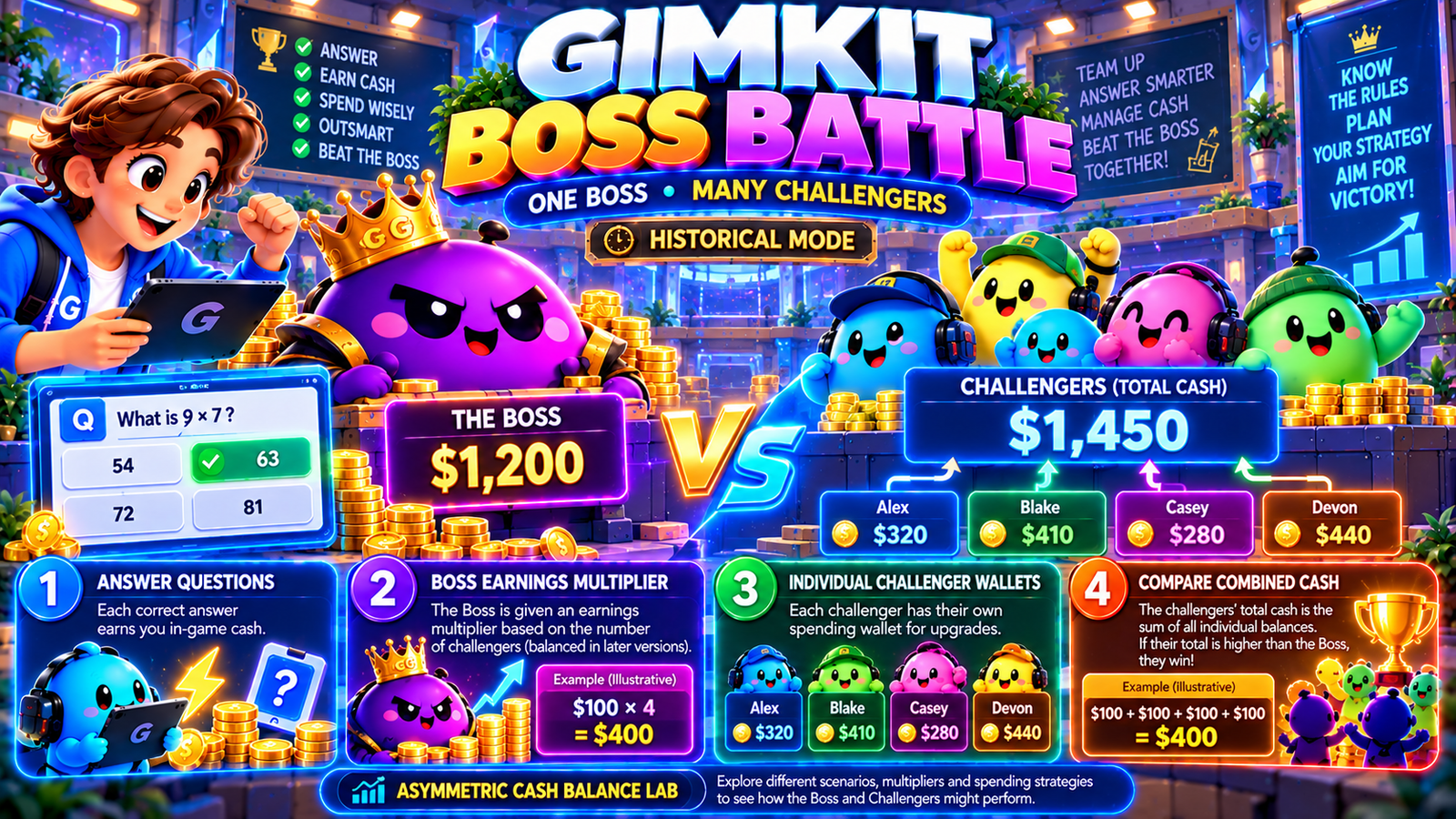
Gimkit Boss Battle: One Boss Against Everyone
Discover the original Gimkit Boss Battle, where one selected player takes on a team of Challengers in an unusual cash competition. Explore the historical balancing changes, individual challenger balances and one-versus-many strategy.
Independent educational resource. Not affiliated with or operated by Gimkit. Historical mode details and hypothetical simulation mechanics are explicitly distinguished throughout.
Illustrative matchup — the original mode is not a boss health-bar combat game.
What is Gimkit Boss Battle?
Gimkit Boss Battle is a historical non-2D game mode in which one participant, designated the Boss, competes against all other participants, known as the Challengers. Unlike ordinary individual competition, the Boss faces the combined scoring power of a larger opposing group.
Gimkit introduced Boss Battle alongside its Gimkit 4.0 release in September 2019. Its original announcement explained that the Boss would receive an earnings multiplier related to the number of Challengers, providing a counterweight to the greater number of people on the opposing side.
The Gimkit Wiki records additional historical changes made shortly after release, including reductions to the Boss's earning advantage and a redesign of how Challenger cash was held and spent. Those adjustments reflect the practical difficulty of balancing a single player against many opponents.
👑 The Boss
One selected participant competes against the combined Challengers. Historically, special earning adjustments helped compensate for the Boss being outnumbered.
👥 The Challengers
The remaining players form the opposing side. Their combined cash is compared with the Boss's earnings, creating a one-versus-many competitive structure.
💰 Cash Competition
Correct question answers provide earning opportunities. The original Boss Battle is based on a cash economy rather than attacking a boss's HP bar.
⚖️ Asymmetric Rewards
One participant competes against several others. Reward adjustments can compensate for unequal numbers, but their fairness depends on player performance and the exact rules.
🧾 Separate Wallets
Historical revisions gave individual Challengers their own spending balances while the group's overall total remained the sum of individual balances.
🕰️ Limited-Time Release
The original announcement described Boss Battle as a limited-time Gimkit 4.0 mode. Historical availability is not proof of its current inclusion in every Mode Picker.
How the original competition was organized
Boss Battle's core challenge is an imbalance in participant numbers. The Boss works alone. The opposing team contains several players whose individual performance can add toward a collective score.
One player: the Boss
The Boss's earning potential must be interpreted differently from the opposing team's aggregate earning potential. Even a strong individual player can be outscored by several ordinary players working toward a combined total.
The original release dealt with this problem by multiplying Boss earnings. The multiplier created a mechanism for comparing one participant with a much larger opposition.
Many players: the Challengers
The Challengers are not necessarily equally successful. Some may answer more questions or achieve higher accuracy than others.
In the revised historical economy, each Challenger possessed an individual spending balance. The overall team balance was the sum of those separate balances.
Minimum group size
The historical community wiki records a minimum of three players: one Boss and two Challengers. The teaching simulation below uses this same minimum without claiming current official game compatibility.
Who was supposed to be the Boss?
Community documentation suggests that a teacher may serve as the Boss while students participate as Challengers. This is an illustrative recommendation, not evidence that a teacher is the only eligible Boss.
Boss vs Challengers Asymmetric Balance Lab
Use this independent simulation to experiment with one Boss against several Challengers. Configure an earning multiplier and a hypothetical correct-answer reward, then record answers for the Boss or any individual Challenger. Observe how separate earnings combine into a team total.
👑 One-versus-Many Balance Studio
Record the actions of one Boss and a roster of Challengers, then examine how numerical advantages and individual wallet balances affect the evolving matchup.
1. Configure the Asymmetric Match
Starting cash is allocated as evenly as possible in whole dollars. Any remainder goes to the earliest fictional Challenger labels.
The original 2019 announcement described a Boss multiplier equal to the number of Challengers. Later balance updates changed its effective value. The configurable field permits mathematical experiments with different relative earning rates.
2. Boss Answer Events
Record a correct answer for the single Boss. The resulting earnings equal the user-selected base reward multiplied by the Boss factor.
This simplified laboratory models correct-answer earnings only. It does not infer actual incorrect-answer penalties.
3. Individual Challenger Answer Events
Each Challenger owns a separate fictional cash wallet. Individual balances contribute to the team total but remain separate during spending.
4. Challenger Wallet Expenditure
An expenditure cannot exceed the selected player's cash, even if the aggregate team total is sufficient. This illustrates the revised historical distinction between personal spending and collective scoring.
5. Battle Score Comparison
6. Historical Multiplier Comparison
Compare how much cash a single Boss correct answer would earn under three hypothetical versions of the challenger-count factor.
| Scenario | Boss Reward |
|---|---|
| Initial count-based model | $0 |
| 20% reduced model | $0 |
| 75% reduced model | $0 |
| Your selected factor | $0 |
The historic wiki describes successive reductions to Boss earnings. This table models those reductions relative to the initial count-based factor, without claiming the changes were simultaneously active.
7. Record of Match Actions
- No transactions yet.
The mathematics of one player against many
The original Boss Battle placed one participant against a larger group. Without an adjustment mechanism, the combined earnings of several players could easily exceed those of a single individual, even when the Boss performed well.
A simple equal-performance example
Imagine a fictional Boss who answers one question correctly while each of five Challengers also answers one question correctly. Suppose everyone normally earns $100 per correct answer.
Without an asymmetric multiplier, the Boss earns $100 and the Challengers collectively earn $500. The team possesses five times the earning volume because five people contributed one correct answer each.
How a count-based multiplier changes the comparison
If the Boss earns five times the base reward, that one correct answer becomes worth $500. Under identical assumptions, the Boss's single success equals the total from five Challenger successes.
This is the elementary logic behind the multiplier described in the original 2019 announcement. It attempts to make unequal participant numbers economically comparable.
Equal mathematical potential does not guarantee a fair game
A count-based multiplier balances one specific fictional scenario: every participant has the same answer volume and success rate.
Real activity can differ. The Boss may answer faster, have greater subject knowledge or make stronger economic decisions. The Challengers can also differ widely in accuracy, pace and use of available upgrades.
A multiplier that produces equality under uniform performance can still create a substantial advantage when those assumptions change.
Why the developers adjusted Boss earnings
Community historical documentation describes a balancing problem following Boss Battle's launch: the Boss was winning too often.
The wiki records an initial 20% reduction in Boss earnings, followed by a larger adjustment reported as 75%. These statements concern historical balancing changes, not a fixed setting guaranteed in contemporary Gimkit.
A balancing adjustment changes the trade-off between one strong participant and several combined opponents.
Understanding the model's boundaries
The interactive tool deliberately uses a simpler scoring relationship: cash earned by the Boss is the base reward multiplied by a selected Boss factor.
Each Challenger instead receives the ordinary base reward for a recorded correct answer.
The model does not include the full historical power-up shop, all question penalties or every official game-setting interaction. It isolates the asymmetry that defines this mode.
Why individual cash balances changed Boss Battle
One of Boss Battle's most informative historical developments involved how Challengers held and spent cash. The original balance design created a problem when many players shared purchasing power.
The difficulty with direct shared spending
The historical community record explains that the early version borrowed a shared-balance idea from team-oriented cash gameplay. This became difficult to coordinate when the Challenger side contained a large number of players.
If several people spend from one shared wallet without a clear strategy, the group can rapidly reduce its collective retained cash.
This is a coordination challenge rather than proof that the individual purchases were always poor decisions.
The revised separate-wallet model
The historical redesign gave each Challenger an individual cash balance. Players therefore needed enough money in their own wallets to make purchases.
The Challenger team's overall balance remained based on the sum of those individual balances.
This separated purchasing authority from collective score calculation.
Why the distinction matters
Consider three fictional Challengers with balances of $300, $50 and $25. The team total is $375.
The second Challenger cannot personally spend $200 from a $50 wallet merely because the whole team holds more than that amount.
The player would need sufficient individual funds under the separate-wallet model.
What the team total actually represents
A team total can be defined as the sum of individual remaining balances.
If one player makes an expenditure, that person's balance decreases. Consequently, the aggregate team total also decreases.
The total does not necessarily indicate that all the money is available to every individual participant.
Why this is not the same as Team Tycoon
Historical Boss Battle preserves the asymmetric one-versus-many competition. The Challengers act as the collective opposition to a single Boss.
Team Tycoon, by contrast, is centered on teams competing through their own shared economies.
The wallet distinction in Boss Battle serves a different purpose: controlling individual purchasing within an asymmetrically structured contest.
Five ways to investigate Boss Battle's balance
Experiment 1: One Boss against five Challengers
Start with five Challengers, a $100 base reward and a Boss multiplier of five. Give the Boss one correct-answer event.
Then record one correct answer for each Challenger. Compare the resulting cash totals, taking into account any starting Challenger cash.
To compare earning power without a head start, set combined starting cash to zero before restarting.
Experiment 2: Increase the Challenger count
Restart the simulation with ten Challengers. Use the Equalize button to match the Boss multiplier to the number of opposing players.
The model will demonstrate how increasing the opposition changes the count-based earning adjustment.
Experiment 3: Compare historic reductions
Inspect the four multiplier scenarios in the reference panel. Compare the initial count-based reward with the smaller hypothetical factors obtained through successive reductions.
The purpose is to show the mathematical scale of those historical balancing decisions, not to reconstruct every internal formula used by the developer.
Experiment 4: Test uneven Challenger contributions
Instead of recording one answer per Challenger, assign many correct answers to one member and none to others.
The team total can become large even when only a small number of Challengers produce most of the earnings.
This distinction reinforces why an aggregate score is not enough to explain every participant's activity.
Experiment 5: Test spending restrictions
Allow one Challenger to earn enough cash to make a purchase. Then try spending a larger amount from another Challenger's smaller wallet.
The application will reject a transaction that exceeds the selected wallet, regardless of the total Challenger cash.
This reproduces the logic of separate-wallet restrictions within a simplified model.
Boss Battle's 2019 launch and balancing changes
Boss Battle provides an interesting historical example of how game designers revise competitive rules after observing player outcomes.
The Gimkit 4.0 introduction
Gimkit's official Gimkit 4.0 preview announced Boss Battle as a new limited-time mode. Its defining description was one Boss against all remaining Challengers.
The original announcement gave the example of fifteen Challengers, with Boss earnings multiplied by fifteen.
The announcement established the asymmetric cash format. It did not describe computer-controlled HP, damage phases or a boss health meter.
Early balance criticism
Community historical records indicate that after launch, the developers identified an imbalance in favor of the Boss.
A system intended to compensate for one player being outnumbered could become too generous under real play conditions.
Subsequent reward adjustments
The community record describes attempts to reduce the Boss's advantage.
A 20% reduction was followed by a larger 75% change in historical accounts.
These figures are useful for understanding the scale of adjustments. They do not establish the exact multiplier active in a modern match.
Changes to Challenger balances
Developers also addressed the problem of a large group spending from shared earnings.
The revised separate-wallet system kept individual purchase decisions within personal balances, while the overall team score continued to combine those balances.
What this history demonstrates
Balancing a game requires more than calculating an initial multiplier.
Actual player behavior, economic incentives, group size and available decisions can produce unintended advantages or weaknesses.
Rules may therefore need revision after the game is released.
Documented mechanics versus unsupported descriptions
| Feature | Historical Source Support | Interpretation |
|---|---|---|
| One Boss versus many Challengers | Original Gimkit announcement | Central historical competition structure |
| Boss earnings multiplied by Challenger count | Original Gimkit 4.0 preview | Launch-era balancing example |
| Early Boss reward reductions | Community historical wiki | Post-release balancing changes |
| Individual Challenger wallets | Community historical wiki | Revised spending rules |
| Combined Challenger team balance | Community historical wiki | Aggregate of individual balances |
| Boss with an official HP damage bar | Not established by primary historical material | Do not present as the original mode |
| Currently available for every account | Not established | Must verify in live Mode Picker |
What teachers can learn from one-versus-many competition
Boss Battle offers a distinctive setting for discussing how competitive rules can attempt to compensate for unequal group sizes.
The mode also illustrates the difference between individual cash control and collective results. However, the game outcome should not be interpreted as a direct measurement of student knowledge.
Balancing unequal groups
Students can examine a fictional example in which one participant faces several opponents.
They can propose a multiplier that seems reasonable under equal-performance assumptions, then test what happens when those assumptions change.
This makes balance a question of explicit evidence and mathematical relationships, not guesswork alone.
Distinguishing teams from individuals
The Challenger aggregate is a sum of individual financial positions.
A group can appear successful overall while some members have contributed more correct answers than others.
The aggregate score therefore cannot independently establish what each learner knows.
Evaluating fairness
A rule can be mathematically symmetrical under one assumption without being fair under all possible player behaviors.
Teachers can invite students to explain which assumptions make an earning multiplier reasonable, and which changes might make it too powerful.
Protecting participation
In a Boss-versus-class activity, placing one learner in the Boss position may create social pressure.
A teacher should consider whether that participant is comfortable with the role and whether the group's competitive behavior remains respectful.
Community material suggests that the teacher may serve as the Boss, which can reduce some student-to-student pressure.
Using the simulator independently
The lab does not require students to play the historical mode.
It can be used to explore ratios, aggregate totals, and spending limits in a neutral hypothetical context.
Evidence of learning
A useful follow-up asks students to explain why a multiplier changes the competitive relationship.
For example: under what assumptions does a five-times Boss reward balance five Challengers?
A reasoned explanation offers different educational information from the final fictional cash score.
Boss Battle mistakes to avoid
Confusing the original Boss with a computer-controlled enemy
The documented original Boss was a participant selected from the players, not simply an AI opponent with health points.
Descriptions of attacking a health bar may concern a different game, an independent recreation, or an inaccurate third-party guide.
Assuming more Challengers automatically win
A larger group has more potential individual contributors. However, an asymmetric reward multiplier can compensate for that advantage.
The outcome depends on how the selected rules interact with actual performance.
Assuming the Boss multiplier never changed
The historical community record describes substantial early balancing adjustments.
A launch-era value should not automatically be treated as a permanent mechanic.
Assuming shared scoring means shared purchasing
In the revised historical model, the Challenger total was an aggregate of individual wallets.
A player's ability to make a purchase was limited by that person's available balance.
Confusing a strong Boss with academic mastery
Economic outcomes can reflect multipliers, answer frequency, question accuracy and purchase behavior.
They are not stand-alone measures of comprehensive academic knowledge.
Assuming historical availability continues unchanged
Boss Battle was introduced as a limited-time mode in the Gimkit 4.0 announcement.
Check the official Mode Picker for current eligibility, descriptions and game settings.
Frequently asked questions
What was the original Gimkit Boss Battle?
A historical game mode in which one selected Boss competed against all other participants, called the Challengers, through a cash-based economy.
When was Boss Battle introduced?
Gimkit announced Boss Battle with Gimkit 4.0 in September 2019. The community wiki records September 30, 2019 as its release date.
Was the Boss a computer-controlled enemy?
No. The original announcement described one player serving as the Boss against the remaining players.
Did the original Boss Battle use HP damage?
The primary historical announcement describes cash competition and an earning multiplier, not a boss health-bar damage system.
How many players were required?
The community historical wiki lists a minimum of three: one Boss and two Challengers.
Could a teacher play as the Boss?
Yes. The historical community guide recommends this as one possible classroom arrangement.
How were Boss earnings balanced?
The original announcement described multiplying Boss earnings according to the number of Challengers. Later balancing adjustments were documented by the community wiki.
Why were the Boss's earnings reduced?
Historical community records explain that the Boss had been winning too frequently under the early rules.
Did Challengers share one cash wallet?
The early design used a shared-balance approach, but later historical revisions gave Challengers individual spending balances.
How was the Challenger team total calculated?
Community documentation describes the team balance as the sum of individual Challenger balances.
Are the lab's cash figures official?
No. The interactive application uses user-selected hypothetical rewards and multipliers.
Can this simulator connect to Gimkit?
No. It works locally in the browser and does not access Gimkit sessions, accounts or student records.
Is Boss Battle currently available?
The original release was described as limited-time. Current availability must be checked through Gimkit's official Mode Picker.
Historical evidence and official documentation
- Gimkit Blog — Gimkit 4.0 Is Almost Here . Original announcement describing Boss Battle as one player against the Challengers and explaining the count-based Boss multiplier.
- Gimkit Community Wiki — Boss Battle . Unofficial historical record of release timing, balance adjustments, Challenger wallets and gameplay structure.
- Official Gimkit Help — Select a Game Mode . Primary documentation for checking the current Mode Picker.
- Official Gimkit Website . Visit to use the real platform and review currently available modes.
For the historical differences between individual and shared team economies, see the Gimkit Team Mode guide . For a separate asymmetrical two-faction competition, explore the planned Gimkit Humans vs Zombies guide . These homepage destinations have distinct primary topics.
The challenge is balancing one against many.
Original Gimkit Boss Battle was defined by an unusual competitive relationship: one designated player versus the combined earnings of the remaining participants. Its early history demonstrates how earning multipliers and individual spending restrictions shape a one-versus-many cash economy. Use the independent lab to test the mathematics and official documentation to check current gameplay options.
Return to Boss Battle Lab ↑